Ohio Rules for a Rider Aged 12
A 12-year-old may be able to ride an ATV on certain Ohio trails, but turning 12 does not make every road, trail or riding area open to them. The key is to separate the state forest age rule from supervision, registration, equipment and location requirements. Here’s what families should check before loading a machine.
Where a 12-year-old may ride in Ohio
For designated Ohio state forest trails, age 12 is generally the minimum for a young person to operate an all-purpose vehicle. Riders aged 12 through 15 must ride with the required adult supervision; they cannot treat reaching 12 as permission to head out alone. Check the rules for the specific riding area before leaving, since access depends on using an authorized route and meeting the site’s current conditions.
This age rule is about operating on eligible state forest trails. It does not mean a 12-year-old can ride anywhere in Ohio, and it does not automatically authorize riding on a county road, township road, public park or private property. Those places have separate rules or permission requirements. For the broader location rules, see Ohio Rules for Riding State Forest Land and Ohio Minimum Age for State Forest Trails.
Do not assume that the state forest rule applies to every land manager. A federal riding area, private park or local trail system may set different age, supervision, permit or equipment requirements. Wayne National Forest, for example, has a separate OHV permit system, so check its rules rather than relying only on state forest guidance. How the Wayne National Forest OHV Permit Works
| Where the 12-year-old rides | What to check before the trip |
|---|---|
| Designated Ohio state forest trail | Minimum age, adult supervision, machine eligibility, registration plate and current trail access |
| Wayne National Forest trail | Federal area rules and the required Wayne OHV permit |
| Township or county road | Whether that specific road is open to APVs and whether the rider meets road-use requirements |
| Private land | The landowner’s permission and any conditions they set |
| Private riding park | The park’s age, supervision, machine and admission rules |
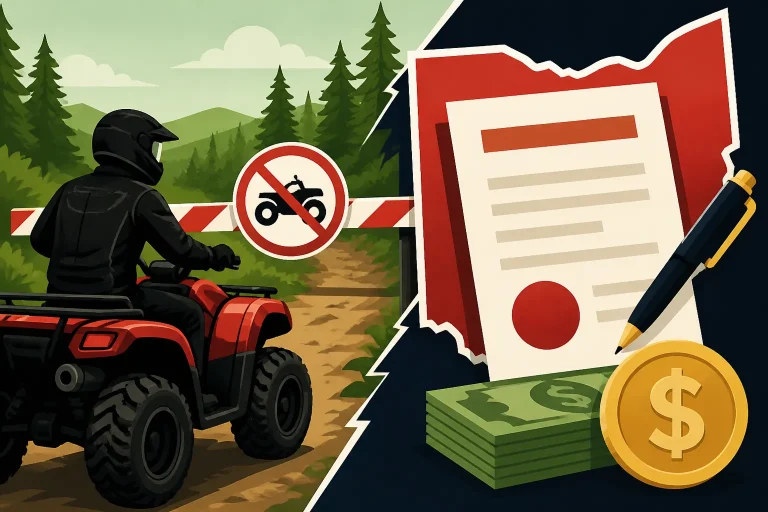
A route that appears on a map is not necessarily open to an ATV or UTV. Trails can close, and public land may allow some activities while prohibiting motorized riding. Check the official trail information before you go, and obey posted signs and closures.
What adult supervision means
A 12-year-old should not ride on the assumption that an adult waiting in the parking lot counts as supervision. Plan for the adult to accompany the young rider on the ride and remain close enough to supervise. Check the specific land manager’s current wording for any requirements about who may supervise and what qualifications that person must have.
For Ohio’s under-16 rules, the supervising adult’s relationship to the rider matters. A parent or guardian is the clearest choice when planning a state forest ride. If another adult will supervise, do not assume that any adult can take that role; confirm the applicable rule in advance. More detail is available in A Licensed Parent With an Under-16 Rider in Ohio and Ohio Rules for Riders Under 16.
Supervision is not a substitute for a suitable machine or a capable rider. An adult should be able to see how the child is handling the terrain, recognize when the rider is tired or overwhelmed, and stop the ride when conditions change. Keep the group together, agree on signals and stopping points, and avoid letting a young rider follow faster machines out of sight.
Before setting out, talk through a few practical rules:
- Stay on the marked route and stop at closures or hazards.
- Keep a safe following distance, especially on hills, loose ground and muddy sections.
- Stop if the rider cannot comfortably control the machine or is becoming tired.
- Do not carry a passenger unless the machine is designed for one and the rules for that location allow it.
- Make sure the child knows how to stop, signal for help and respond if the group becomes separated.
A child who can operate a machine in a yard may still be unprepared for a narrow trail, steep slope or changing surface. Choose a route that matches the rider’s ability, not just the adult’s preferred ride.
Registration, permits and equipment to check
Age is only one part of the checklist. A 12-year-old’s machine must also be eligible for the place where you plan to ride, and the rider needs the required safety equipment. For Ohio state forest trails, confirm that the machine has the registration and plate required for that use. Ohio does not sell a separate state forest sticker in place of the APV plate. Start with Do You Need a Permit for Ohio State Forest Trails? and Why the Ohio Plate Is the Trail Permit.
If the machine is registered outside Ohio, confirm that its registration qualifies for the intended ride. Reciprocity rules can depend on the home state and the riding location, so do not assume that a plate accepted on one trail system is accepted everywhere. See Ohio Reciprocity for Out-of-State Machines before travelling.
Protective equipment matters even when a child is experienced. Check the trail area’s helmet and eye-protection requirements, and make sure the helmet fits properly and is appropriate for off-road riding. A loose helmet or ordinary fashion eyewear is not a dependable substitute for properly fitted protective gear. Review Ohio Helmet Rules on State Forest Trails for the relevant state forest requirements.
A pre-ride check helps catch problems before they become trail emergencies. Confirm that the controls work, the tires are in good condition and the machine is the right size for the rider. The child should be able to reach and operate the controls without stretching, and should be able to stop the machine reliably. If they cannot do that, the machine is not a safe fit, regardless of the stated age range on a product label.
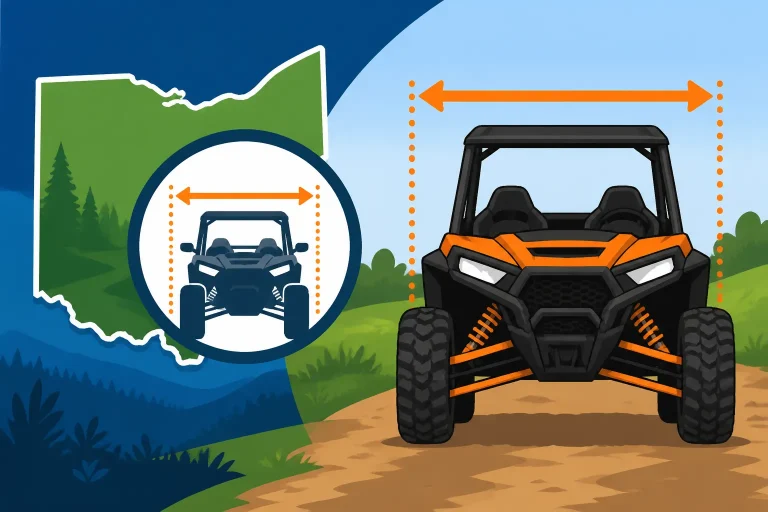
Also check the route’s width limits and trail conditions. A side-by-side that is too wide for a designated area cannot use that trail simply because an adult is driving it. Wet clay, steep grades and deep ruts can make a route much harder than it looks on a map. If conditions exceed the child’s ability, choose another trail or postpone the ride.
Roads, private land and common mistakes
A state forest trail rule does not grant permission to ride on public roads. Ohio road access depends on the particular road and its governing authority, and road use can bring separate requirements for the machine and operator. Do not ride a 12-year-old onto a road based only on the fact that the child may operate on a state forest trail. Check the road’s status and the applicable age, supervision, equipment and licensing requirements first.
Private property is not automatically open to riders either. Get permission from the landowner before riding, and follow any limits they set. A farm lane, field or wooded parcel may look like a convenient place to practice, but access belongs to the owner. Public parks and wildlife areas can also have restrictions different from state forest trail rules.
Several assumptions often lead families into trouble:
- “They turned 12, so they can ride alone.” The minimum age does not remove the supervision requirement for a rider under 16.
- “The adult is nearby, so that counts.” Plan for the adult to accompany the ride and verify who qualifies to supervise.
- “A valid plate means every trail is open.” Registration does not override trail closures, width limits or land-manager rules.
- “The rules are the same at every public riding area.” State forests, national forests and private parks may have different requirements.
- “A trail map proves the route is open.” Check current notices and signs; routes can close or have limited access.
- “The child can ride a machine sized for an adult.” A young rider needs a machine they can control, not just one they can sit on.
A safer plan is to decide where to ride first, check that location’s rules, and then match the rider and machine to the route. If any part of the age or supervision rule is unclear, contact the land manager before the trip rather than trying to resolve it at the trailhead.
Disclaimer
This article is for general informational purposes only and does not constitute professional advice. Laws, prices and regulations vary by location and change over time. Consult a qualified professional for guidance on your specific situation.