A Licensed Parent With an Under-16 Rider in Ohio
A Licensed Parent With an Under-16 Rider in Ohio
Taking a child on an Ohio ATV or UTV ride raises two separate questions: who may supervise, and where the child may operate the machine. A licensed parent can be an important part of the answer, but supervision does not override age limits, trail rules, or road restrictions. Here’s how to think through the rules, prepare for a ride, and avoid assuming that permission in one place applies everywhere.
What a Licensed Parent’s Role Means
Ohio’s rules for a young rider depend on the setting. The rules for riding on a state forest trail aren’t necessarily the same as the rules for private land or a public road. In general, a parent’s job is more than being somewhere nearby: the adult needs to be able to supervise the child as the ride happens and respond if something goes wrong.
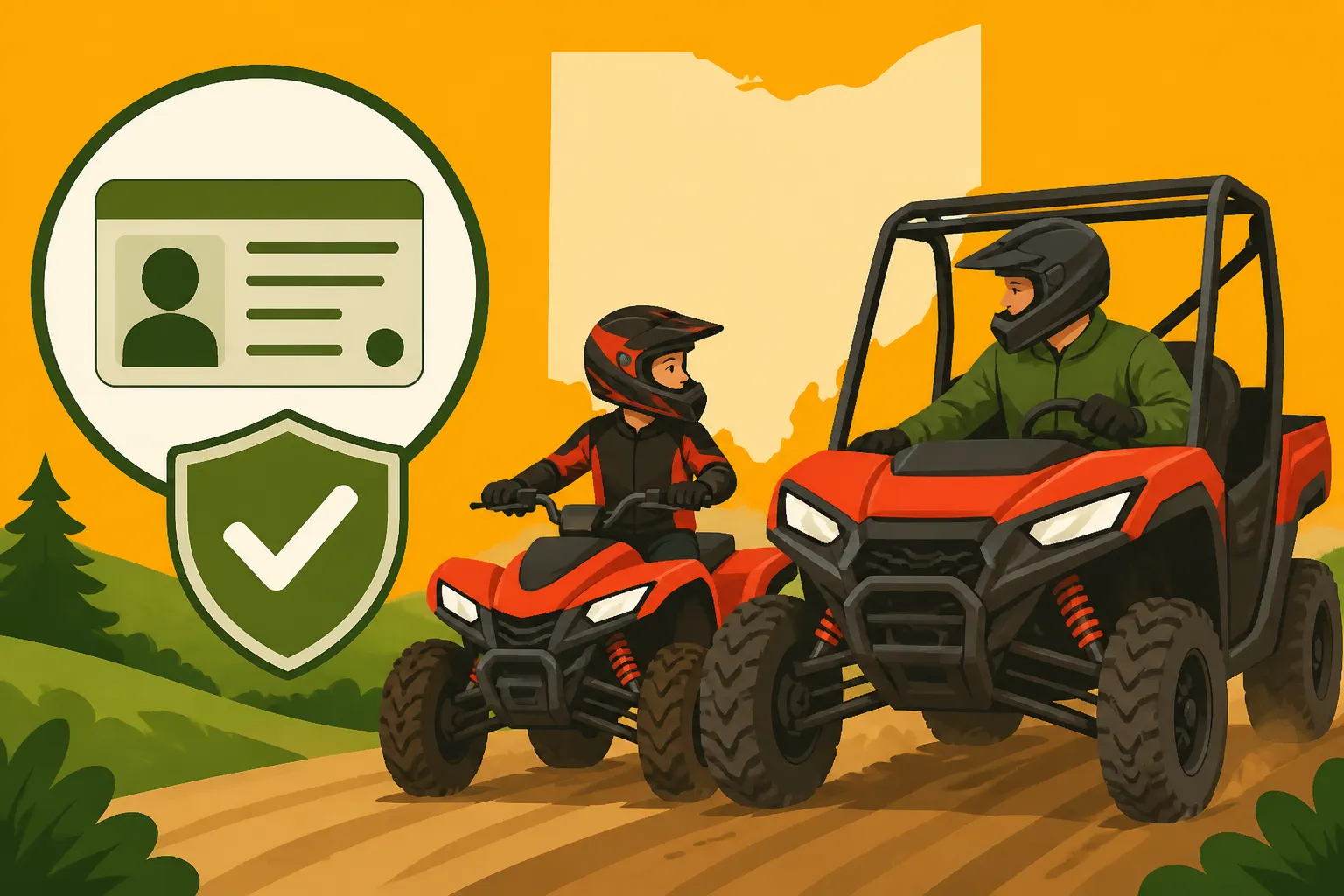
For designated state forest riding areas, riders under 16 must be accompanied by a parent, guardian, or another adult who meets the applicable supervision requirements. A valid driver’s license may be part of those requirements for the accompanying adult. Before heading out, confirm the current rule for the specific trail system with the Ohio Department of Natural Resources, or ODNR. The details of Which Adult Can Supervise an Under-16 Forest Rider can help clarify the distinction between a parent and another authorized adult.
A licensed parent’s presence does not make every activity lawful. It does not automatically let a child ride a machine that is too large for them, operate on a closed trail, or drive on a road where APVs are prohibited. Nor should a parent assume that being licensed to drive a car means they can supervise from a distant parking area while a child rides out of sight.
A practical way to understand the adult’s role is to separate three questions:
- Is the young person old enough to ride in this location?
- Does the location require the young person to be accompanied, and does the adult meet that requirement?
- Is the specific machine and route allowed?
All three need a yes before the ride begins. Ohio Supervision Rules for Minors offers related context on why supervision rules and age limits should be checked separately.
| Riding location | What to check before the ride | What a licensed parent does not automatically authorize |
|---|---|---|
| Designated state forest trail | Minimum age, accompanying-adult requirement, permitted machine width, open trails, and protective gear | Riding below the minimum age or leaving the marked route |
| Private property | The property owner’s permission, applicable Ohio law, age and supervision rules, and safe boundaries | Riding on adjoining land or roads without permission |
| Public road | Whether the specific road is open to APVs and the road-use requirements for the machine and operator | A child operating on a road simply because an adult is present |
| National forest or other managed land | The land manager’s rules, access permit requirements, and any age or supervision limits | Assuming state forest rules or a state registration settle every access requirement |
The table is a starting point, not a substitute for checking the rules of the specific property or trail. Some areas have additional conditions, and access rules can differ even between nearby places.
Supervision is not the same as permission to ride
A parent may agree to a ride and still need to check whether the landowner or agency allows it. On private land, get permission from the person who controls the property and establish where the child may travel. On public land, use the designated routes and follow posted closures. A child’s relationship to the accompanying adult does not replace landowner permission or a required permit.
If the ride is on an Ohio state forest trail, check Ohio Rules for Riding State Forest Land and Ohio Forest Access for Riders Under 16. Those topics are especially useful when planning around an age threshold, permitted route, or machine-width restriction.
A license matters differently by location
It’s easy to hear “licensed parent” and assume that the same license rule applies everywhere. Instead, check what the specific land manager requires of the accompanying adult. The young person’s ability to operate off-road is also a different question from whether they can legally operate on a public road. See Ohio Driver’s License Rules for APVs for the road-use distinction.
Age Limits and Where a Child May Ride
Ohio’s age rules are not one universal permission to ride anywhere with an adult. A trail system may have a minimum age, and a road may have operator requirements that a parent cannot waive. Check the rules for the exact setting, not just the general state rule.
State forest trails
Ohio state forest riding areas have their own age and access conditions. Riders under 16 need the required adult accompaniment, and the minimum age for operating on a state forest trail is an important separate check. Do not treat adult supervision as an exception to a minimum-age rule. For more detail, see Ohio Minimum Age for State Forest Trails and Ohio Rules for Riders Under 16.
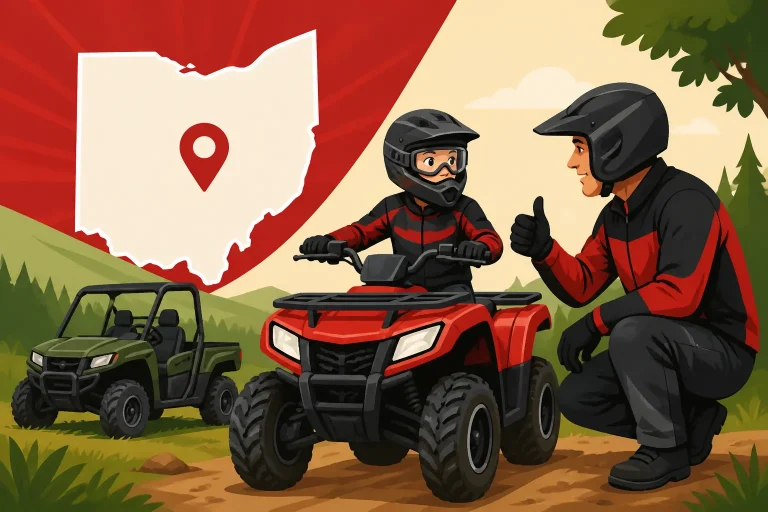
The child’s age should be considered alongside the machine. A young rider who meets the minimum age may still be unable to control a large or powerful ATV safely. A parent should assess whether the rider can reach the controls, operate the brakes, steer through uneven terrain, and stop the machine without help. If the child cannot manage those tasks on level ground, a narrow trail with hills, ruts, or other riders is not an appropriate place to learn.
Before setting out, also confirm that the trail is open and that the machine fits any width limits. Some Ohio state forest trails restrict the width of machines allowed. A parent’s presence does not make a machine that exceeds a trail limit eligible to ride there. Check current trail information and machine dimensions rather than relying on a model name or an estimate.
Private property
Private land is not automatically free from safety or legal requirements. Get permission from the property owner, identify the permitted area, and make sure the child knows where the boundaries are. A verbal “you can ride here” should not be read as permission to cross a neighboring field, enter a public trail, or ride along a nearby road.
A responsible plan for private property includes a route the young person can handle, a clear turnaround point, and an adult close enough to supervise. Set ground rules before the machine starts: no riding out of sight, no carrying passengers unless the machine is designed for them and the rules allow it, and no entering areas the owner has marked off.
For more on property access, see Ohio Landowner Permission Requirements and [Ohio Rules for Riding Private Property]. These are useful reminders that permission and supervision are related but separate responsibilities.
Public roads
A licensed parent cannot simply accompany an under-16 rider onto a public road and make the trip lawful. Road use depends on whether that road is open to APVs and whether the operator and machine meet the applicable requirements. A road may be closed to APVs even when another nearby road is open. A machine’s registration or plate does not, by itself, create permission to use every road.
When a route involves a public road, check the local rules and make sure the intended operator meets the requirements. If the child is not legally eligible to operate the machine on that road, the adult’s presence does not fix that problem. The safer choice is to keep the child on an authorized off-road route and have a qualified adult handle any road segment when permitted.
National forest, wildlife areas, and other public land
Rules can change when a ride moves from a state forest to national forest land or another public property. A state registration, an adult’s driver’s license, or permission to ride one trail system may not satisfy every requirement elsewhere. Check the land manager’s rules for age, supervision, access permits, open routes, and equipment before crossing between properties.
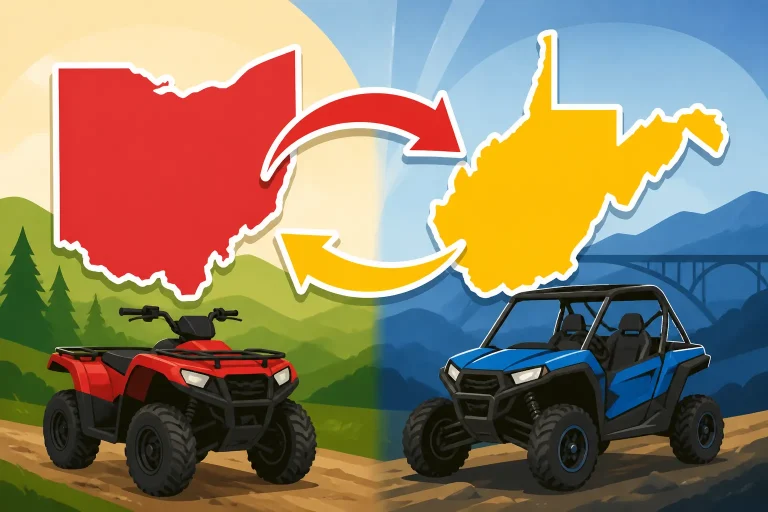
This matters on trips where a family is visiting from another state. Ohio has reciprocity rules for some out-of-state registrations, but visitors should confirm what documents and permits apply to their machine and destination. Start with Ohio APV Reciprocity With Other States and What a Visitor From a Registering State Must Show. Reciprocity is about whether a registration may be recognized; it does not erase age or supervision requirements.
Choosing a Safe Ride for a Young Operator
Meeting a legal age threshold is only the first step. The machine, trail conditions, child’s ability, and adult’s supervision all affect whether the ride is a sensible one. A good plan gives the child a manageable route and leaves enough room to stop, regroup, and change plans.
Match the machine to the rider
Choose a machine the child can control without stretching to reach the handlebars, brakes, or throttle. Check the owner’s manual for the intended rider size and operating guidance. The child should be able to sit securely, understand the controls, and stop the machine reliably in a safe practice area before attempting a trail.
An adult should not assume a child can safely operate a larger machine because they have ridden a smaller one. A heavier ATV or UTV can respond differently, carry more momentum, and be harder to control on a slope or in soft ground. Extra power can make a mistake more consequential, especially if the rider is inexperienced.
Before the ride, practice basic skills in a legal, level area away from traffic and obstacles:
- Starting and stopping smoothly.
- Braking without losing control.
- Turning at low speed in both directions.
- Holding a steady speed and stopping on a signal.
- Getting off safely if the machine stalls or tips.
- Recognizing when the machine is beyond the rider’s comfort level.
Keep the practice session short and calm. If the child is tired, frustrated, or unable to follow instructions, postpone the trail ride.
Keep the adult close enough to supervise
“Accompanied” should be treated as active supervision, not a box to check. The parent should be able to see or promptly reach the young rider and communicate clearly. A group ride with adults spread far apart may leave a child without meaningful help when a problem occurs.
For a first ride, a parent can travel at a pace that allows the child to focus on the route rather than keep up with faster riders. Avoid splitting the group at intersections or letting the child ride ahead around blind corners. Agree on a stop signal and a meeting point if the group becomes separated.
Set boundaries before starting:
- Stay on the marked route.
- Stop when the adult signals.
- Do not pass another rider without permission.
- Leave space between machines.
- Do not cross a road unless the route and crossing are allowed.
- Tell the adult immediately about a mechanical problem or discomfort.
The parent should also be prepared to end the ride early. Fatigue, poor visibility, changing weather, or deteriorating trail conditions can make a planned route unsuitable.
Use the required protective equipment
Protective equipment is not a substitute for supervision, but it can reduce the chance of serious injury. Check the current rules for the riding area and make sure the child has properly fitted equipment before arrival. Ohio state forest guidance includes helmet and eye-protection requirements; see Ohio Helmet Rules on State Forest Trails for the location-specific details.
At a minimum, check that the helmet is appropriate for the activity and fits securely, and that the rider has suitable eye protection, gloves, sturdy footwear, and clothing that covers exposed skin. A loose helmet or goggles that keep slipping can distract a young rider and reduce protection. Have the child try the equipment on before the trip rather than discovering fit problems at the trailhead.
A parent should wear protective equipment too. Adults set the example, and a properly equipped adult is better prepared to help if a child falls or has a breakdown.
Check the route and conditions
Trail conditions can change after rain, during maintenance, or when an area closes for management work. Review official trail information before loading the machines and again before riding. At the trailhead, read posted notices, confirm the route, and check for closures or restrictions.
Choose a route that suits the least experienced rider in the group. A trail with steep climbs, deep ruts, loose surfaces, or narrow turns may be a poor first ride even if the child meets the age requirement. If conditions have changed, turn around rather than pressure a young rider to continue.
For families using Ohio state forest areas, Ohio Trail Conditions Before You Ride and Ohio Trail Closures to Check First can help with trip planning. Conditions and closures are location-specific, so a report for one forest does not necessarily describe another.
A Parent’s Pre-Ride Checklist
A little preparation can prevent a day at the trailhead from turning into a frustrating or unsafe trip. Use this checklist before leaving home, then confirm the local rules once you arrive.
- Confirm the location. Identify whether the ride is on a state forest trail, national forest land, private property, or a road. Do not rely on the rules for a different location.
- Check the young rider’s age eligibility. Confirm the minimum age and whether the child must be accompanied. If a rule is unclear, ask the land manager before the trip.
- Check the adult requirement. Find out whether the accompanying adult must be a parent, guardian, authorized adult, or licensed adult. Carry the adult’s driver’s license if the rules require it.
- Check the machine. Confirm that it is allowed in the area, within any width limit, and suitable for the rider. Inspect brakes, throttle, tires, lights where relevant, and basic controls.
- Confirm registration and permits. Make sure the machine’s plate or registration meets the location’s requirements. Check separately for any land-specific pass or permit.
- Plan a suitable route. Pick a manageable distance, agree on stopping points, and identify where the group can turn around.
- Fit protective gear. Check the helmet and eye protection, plus clothing and footwear, before the rider gets on the machine.
- Set ground rules. Explain the route, signals, spacing, passing rules, and what the child should do if separated or if the machine stops.
- Check current conditions. Review closures and weather, then read the trailhead notices. Be willing to change plans.
- Keep the required documents accessible. Bring any registration, permit, or proof of ownership the location requires. Keep them protected from rain and easy to produce if requested.
If the ride crosses jurisdiction boundaries, repeat the checks for each place. A family might begin on a state forest trail and then approach a road, private parcel, or different public-land area. The rules that applied at the starting point may not cover the next section.
If the adult is not the parent
A parent may authorize another adult to accompany the child where the applicable rules allow it. Do not assume any adult in the group qualifies. Check whether the person must be a guardian, have the parent’s authorization, meet a minimum age, or hold a valid driver’s license. The child should also know who is responsible for them throughout the ride.
If a friend or relative is taking the child, make sure the parent and accompanying adult agree on the route, emergency plan, and limits. The supervising adult should know the child’s experience level and any relevant medical needs. Written contact information can be useful, but it does not replace any authorization or qualification required by the riding area.
Common Mistakes to Avoid
A few assumptions can cause trouble even when a parent is trying to do everything right.
Assuming the adult’s license makes the child road-legal
A parent’s driver’s license does not transfer road-driving privileges to a child. Check the rule for the specific road and the child’s ability to operate there. If the child cannot legally operate on that road, do not include it in their route.
Treating the plate as permission to ride anywhere
Registration and trail access are not always the same thing. A plate may satisfy a registration requirement without granting access to a particular property or trail. A land manager may require a separate permit, and a posted closure still applies.
Confusing minimum age with readiness
A child may be old enough under a location’s rules and still lack the skills or size to control a machine safely. A parent should consider more than age: experience, strength, coordination, attention, and the terrain all matter.
Letting a group set the pace
A young rider should not be pushed to keep up with adults or older teens. If the group is moving too fast, split the ride or choose a slower route. The parent should be ready to turn back if the child is uncomfortable.
Assuming rules are identical across Ohio
Ohio state forests, local roads, private property, and federal lands may have different requirements. Verify the rules for the exact destination. When the answer is uncertain, ask the agency or property manager rather than relying on a friend’s account of a different ride.
Frequently Asked Questions
Does a parent have to be licensed to supervise an under-16 rider in Ohio?
The requirement depends on the riding location. State forest rules may require the accompanying adult to hold a valid driver’s license. Check the current rule for the specific area; do not assume a parent’s relationship alone satisfies every supervision condition.
Can a licensed parent let a child under 16 ride on a public road?
A parent’s presence does not automatically make a child’s road operation legal. The road must be open to APVs, and the operator and machine must meet the road-use requirements. Check local rules before including any road in a ride.
Does a state forest trail allow every rider under 16 if a parent is present?
No. Adult accompaniment does not necessarily override the trail system’s minimum age or other restrictions. Confirm both the child’s age eligibility and the adult-supervision rule before traveling.
Is Ohio registration enough for an out-of-state family to ride?
Not necessarily. Reciprocity may affect whether another state’s registration is accepted, but it does not settle every permit, age, supervision, or trail-access requirement. Check the rules for the destination and bring the required documents.
Disclaimer
This article is for general informational purposes only and does not constitute professional advice. Laws, prices and regulations vary by location and change over time. Consult a qualified professional for guidance on your specific situation.