Teaching a Young Rider in Ohio
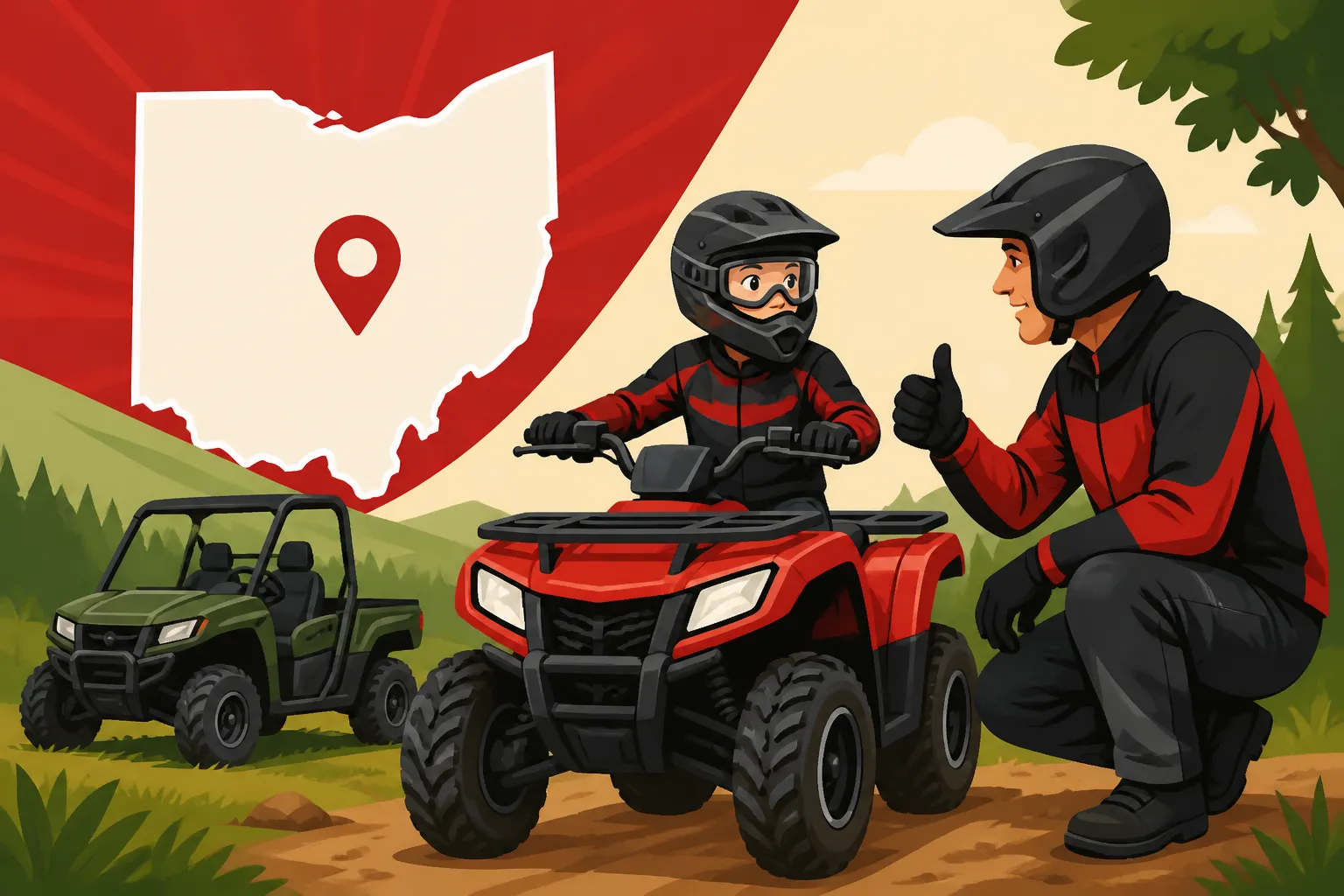
Teaching a young rider in Ohio takes more than finding a flat field and handing over the keys. You need a machine that fits, clear adult supervision, protective gear and a progression that lets a child build skills without being rushed. Ohio rules also change with the land, so start by separating private-property practice from riding on public trails or roads.
Start with Ohio’s rules and the place you plan to ride
Before a young rider practices, identify who owns or manages the riding area. A family field, a state forest trail, a private riding park and a public road do not share one set of rules. Permission from a landowner matters, and permission alone does not override age, equipment or operating rules that apply to a particular public area.
Ohio does not have one statewide age rule that makes every child eligible to operate every ATV or UTV in every setting. State forest trails have their own minimum-age and supervision requirements. In general, riders under 16 should expect to need a responsible adult riding with them, and some Ohio Department of Natural Resources riding areas set 12 as the minimum age for operating on their trails. Confirm the current rule for the specific area before loading up. Ohio Minimum Age for State Forest Trails and [Ohio Supervision Rules on Forest Trails] explain those distinctions.
A rule for a state forest should not be treated as permission to ride on a county road, township road or another kind of public land. Road riding has separate eligibility, equipment and insurance requirements. An adult riding alongside a child does not automatically make an otherwise prohibited road ride lawful. For a young rider, it is usually simpler and safer to keep initial practice on private ground where the owner has given permission. See [Ohio Rules for Riding Private Property] for the basics of access and permission.
The machine’s registration or plate is another separate question. Ohio’s plate can serve as the permit for state forest riding, while a machine registered in another state may be subject to reciprocity rules. A visitor may need to show proof of home-state registration, and the answer can depend on the state and the riding location. Check Ohio Reciprocity for Out-of-State Machines before treating a plate from home as sufficient.
A rider’s age, supervision, helmet and eye protection rules can also depend on where the ride takes place. Before every trip, verify the rules with the land manager rather than relying on what another family did last season. Useful starting points include [Ohio Rules for a Rider Aged 12] and Ohio Helmet Rules on State Forest Trails.
| Riding location | What to check before a young rider starts | A sensible first step |
|---|---|---|
| Private property | Landowner permission, hazards, machine suitability and any applicable state rules | Choose a flat, open area away from roads, water and other riders |
| Ohio state forest trail | Minimum age, adult supervision, registration or permit, helmet and eye protection, trail width and current closures | Check the forest’s rules before traveling |
| Private riding park | The park’s age limits, waiver, supervision policy, equipment rules and trail difficulty | Call ahead and ask whether a novice youth rider can use a designated practice area |
| Public road | Whether the specific road is open, whether the rider can legally operate there, and required equipment and insurance | Do not use a public road as a practice area |
These are planning categories, not substitutes for checking the specific site’s rules. Conditions and local requirements can change, and a road or trail that looks open may be closed to ATVs and UTVs.
Choose a machine the child can control
A machine that is too large or powerful can overwhelm a careful rider. A child should be able to reach the controls comfortably, turn the handlebars without stretching, and operate the throttle and brakes without shifting position. They should also be able to get on and off without help, unless the machine’s design makes that impossible.
Do not choose by age label alone. Children of the same age can differ substantially in height, strength, coordination and judgment. A machine marketed for a particular age range may still be a poor fit for an individual child. Before buying or borrowing one, check the manufacturer’s sizing guidance, the child’s reach and the machine’s controls.
Look for control, not just a small frame
A useful fit check is to have the child sit on the stationary machine with the engine off. Their feet should be placed as the manufacturer intends, their hands should reach the bars naturally, and they should be able to turn the bars through the normal range without losing balance. Have them demonstrate how they would use the brakes and throttle while you steady the machine. If they cannot operate the controls smoothly, the machine is not ready for them.
Consider these factors together:
- Weight: The young rider should be able to handle the machine’s steering and basic movement. A heavy machine can be difficult to manage if it starts to tip or needs to be repositioned.
- Throttle response: A smooth, predictable response is easier for a beginner to learn than an abrupt surge.
- Brakes: The child must understand which control does what and be able to use the brakes reliably.
- Seat and foot position: A rider who is perched, stretched or unable to keep a stable position has less control.
- Speed settings: If the machine has a manufacturer-approved speed limiter, set it conservatively and make sure the child understands that it does not replace supervision.
- Passenger capacity: A single-rider machine should not be turned into a two-person ride. Adding a passenger changes balance and handling and can place both people at risk.
An ATV is designed for one rider unless the manufacturer specifically identifies it as a two-up model. A UTV may have passenger seats, but a passenger should ride only in a designated seat with the required restraint, and the young operator must still be legally allowed to drive in that location. See [Ohio Rules for Riding With a Passenger] before planning a ride with a child as a passenger or operator.
A youth machine is not automatically safe just because it is smaller. It still needs functioning brakes, tires, throttle return, lights where required, and any other equipment required for its use. Inspect it before each session, and follow the owner’s manual for maintenance and operating limits.
Match the terrain to the rider’s level
A beginner does not need mud holes, steep climbs or a long trail loop to learn. The first practice area should be large enough for controlled turns and stops, but not so large that the child can disappear from view. Use a level, firm surface with good visibility. Remove or avoid hazards such as rocks, branches, ditches, fences, water, parked vehicles and hidden drop-offs.
A flat field can still contain risks. Walk the area first, especially if grass could hide holes, wire or debris. Keep the practice boundary well away from a road, driveway, slope or water. Decide in advance where the child will stop if they feel unsure, and where the adult will stand to remain visible without being in the machine’s path.
If the child will ride an Ohio forest trail later, do not use the first session to test trail ability. Start on a safe, controlled area, then build toward gentle, wide routes only after the rider can reliably steer, stop and follow instructions. Trail rules may limit machine width as well as rider age, so check the exact requirements before choosing a machine for state forest use. Measuring Against the 62 Inch Limit can help with that separate question.
Set a safety standard before the engine starts
Protective equipment should be part of every ride, not something reserved for trails or longer outings. Fit the equipment before starting the engine, and check that it still fits as the child grows. A loose helmet or boots that slide off easily can undermine otherwise careful preparation.
A properly fitted helmet is essential. Check that it is intended for motorized riding, sits level, stays secure when fastened and does not shift excessively when the child moves their head. A helmet that is too large can be uncomfortable and may not protect as intended. Eye protection helps guard against dust, grit, insects and branches; ordinary sunglasses may not provide the coverage or impact protection needed for riding.
A practical gear checklist includes:
- A correctly fitted helmet suitable for the type of riding.
- Goggles or other appropriate eye protection.
- Gloves that allow a secure grip and easy control operation.
- Long sleeves and durable long pants.
- Sturdy over-the-ankle footwear with good grip.
- Any required protective equipment for the particular land or riding area.
Do not assume a helmet that looks substantial meets the relevant standard. Check its certification markings and the rules for the place where the child will ride. If ordering gear through Amazon or another marketplace, verify the model, size, fit guidance and seller information, and inspect the item on arrival. For a child’s first helmet, an in-person fitting at a knowledgeable shop can make it easier to spot a poor fit.
Before starting the engine, teach the child how to use the kill switch and how to stop safely. They should know not to put hands or feet near moving parts, not to approach a running machine from an unsafe position and not to start moving until the adult gives a clear signal. Keep bystanders, pets and other riders outside the practice area. An adult should be close enough to intervene, but not positioned where a machine could strike them.
Ohio does not generally require every recreational ATV rider to complete a statewide safety course before riding, but that is not a reason to skip training. A structured course can give a novice a useful foundation in controls, riding position, risk awareness and basic operating skills. Requirements can be different for particular programs, land managers or organized activities, so check those conditions too. See Does Ohio Require an ATV Safety Course? and Ohio Safety Training for Riders.
Teach skills in short, manageable stages
Young riders learn more from a calm, repeatable routine than from a long session full of new challenges. Keep each practice period short enough for the child to stay attentive. Stop if they become tired, frustrated, cold, overheated or distracted. Fatigue can make a child less responsive just when concentration matters most.
Before each session, agree on a small number of clear instructions. Avoid giving several directions at once while the machine is moving. Use plain words and consistent signals. For example, establish a stop signal and a start signal, then make sure the child can repeat what each means before turning the engine on.
A gradual practice sequence
- Walk through the machine. With the engine off, identify the throttle, brakes, kill switch and any other controls. Show the child how to mount and dismount safely and where to place hands and feet.
- Practice the stop routine. Have the child demonstrate how to stop and switch off the machine while stationary. Repeat until they can do it without hunting for the control.
- Start and stop in a straight line. Use a very short distance at low speed. Focus on smooth throttle use and a controlled stop rather than acceleration.
- Practice broad turns. Start with large, gentle turns in both directions. Do not move to tight turns until the rider can remain balanced and control speed.
- Build steering and braking consistency. Ask the child to stop at a chosen point, then repeat from a similar speed and distance. Keep enough space between attempts.
- Add a mild surface change. Only after the basics are reliable, practice on a slight, predictable change in terrain. Avoid loose slopes, ruts, water and obstacles at first.
- Review before moving on. Ask the child to explain what they learned and what they would do if they felt uncertain. If they cannot remember the stop procedure or follow instructions consistently, return to an easier step.
This is a teaching sequence, not a guarantee that every child is ready after completing it. Some riders need many sessions at the stationary-control stage or on a straight path. A child who can go fast is not necessarily able to stop, turn or make a sound decision under pressure.
Teach a child to slow down before turns rather than entering them at a speed they cannot manage. Explain that an ATV can tip, especially during a turn, on a slope or when a rider makes an abrupt change in direction. Keep practice at walking pace or another very low speed until the child can control the machine predictably. Do not encourage wheelies, jumps, racing or riding close to another machine.
Make supervision active
“An adult is nearby” is not the same as active supervision. The supervising adult should be attentive, sober, able to see the rider and ready to stop the session. Avoid supervising while distracted by a phone, another activity or a separate ride. If the adult is riding another vehicle, they need to remain close enough to respond and must comply with the applicable supervision rules.
Choose one adult to give instructions. Too many voices can confuse a young rider, especially when the machine is moving. Agree on simple signals before starting, and keep other children and spectators well outside the riding area. If a child does not follow a direction, stop the machine and talk through it while stationary. Do not try to correct a mistake by shouting from a distance.
The adult should also know the machine. Read its manual, understand the controls and know how to shut it off. If the child is on a borrowed or rental machine, ask the owner or rental provider about the operating controls, speed settings, passenger limits and maintenance condition. Do not assume that a child can safely operate a machine just because it is available.
Move to trails only when the rider is ready
A child who can ride around a field may still be unprepared for a trail. Trails add changing surfaces, blind corners, ruts, hills, other riders, noise and limited room to stop. The adult should select a route that matches the child’s demonstrated ability, not the child’s enthusiasm or the group’s pace.
Before leaving, check the site’s operating rules, opening status, trail difficulty and any restrictions on age, supervision, width or equipment. Carry the registration documents and permits that apply, and confirm whether out-of-state registration is accepted. A forest permit or registration does not make every trail suitable for a novice. See [Ohio Rules for a Rider Aged 12] for age-related context and Ohio Reciprocity for Out-of-State Machines if the machine is registered elsewhere.
For a first trail ride:
- Choose an easy, short route with room to stop and regroup.
- Ride at the child’s pace, even if the rest of the group is faster.
- Keep the child within sight and close enough to communicate.
- Leave generous space between machines and avoid following another rider’s rear tire closely.
- Stop before difficult terrain instead of expecting the child to attempt it.
- Turn back if the rider is tired, nervous or struggling to control the machine.
- Avoid riding in poor visibility, heavy dust or conditions that make traction unpredictable.
Do not pressure a child to continue because the group has already traveled partway through a loop. A planned turnaround point gives everyone an easy way to shorten the ride. Explain that stopping is a good decision, not a failure.
A novice also needs to know the basic trail etiquette: stay on marked routes, give other users space, avoid disturbing wildlife and do not ride around closed gates or barriers. When encountering another rider, slow down and follow the posted or customary right-of-way instructions for that area. On a shared trail, an adult should be prepared to stop and explain what to do before the child reaches a confusing encounter.
If the child is not ready for a public trail, continue practicing on authorized private ground or consider a supervised training environment. A private riding park may offer a more controlled place to learn, but each park sets its own requirements. Ask about youth access, required gear, supervision and beginner routes before you go.
Signs a rider needs more practice
A child may be eager and still need more time before a trail ride. Keep practice at the current level if the rider:
- Has trouble finding or using the brakes or kill switch.
- Applies too much throttle or cannot hold a steady low speed.
- Looks down at the controls instead of watching the path.
- Makes abrupt turns or leans in a way that destabilizes the machine.
- Fails to stop when asked.
- Becomes distracted by other riders or tries to keep up with an adult.
- Cannot describe what to do if they feel unsure or lose control.
If any of these happen, stop and review the basics. Do not treat repeated errors as defiance or push through them to finish a planned route. A break, a simpler exercise or another day of practice may be the right answer.
Frequently Asked Questions
Does Ohio require an ATV safety course for a young rider?
Ohio does not generally require all recreational ATV riders to complete a statewide safety course. A specific land manager, event or program may have separate conditions, and a course can still be a valuable way to teach core skills. Check the requirements for the place and activity planned.
Can a child ride on Ohio state forest trails?
Possibly, but the child’s age, supervision and the forest’s current rules matter. Ohio state forest APV areas generally set an age floor for operating, and riders under 16 may need adult supervision. Confirm the current requirements with the land manager before the trip.
Is an adult riding nearby enough supervision?
Not necessarily. Supervision rules depend on the riding area, and an adult who is distracted or too far away may not be able to intervene. Stay attentive, keep the child in sight and follow the specific supervision requirements for the land.
Can a beginner learn on a UTV with a passenger?
A passenger does not replace adult supervision, and the child must be legally eligible to operate the UTV in that location. Use only designated seats and restraints, follow the manufacturer’s passenger limits and check the applicable age and road-use rules. For a first lesson, a controlled, single-rider practice setup is often easier to manage.
Disclaimer
This article is for general informational purposes only and does not constitute professional advice. Laws, prices and regulations vary by location and change over time. Consult a qualified professional for guidance on your specific situation.