Ohio Rules on Wildlife Area Land
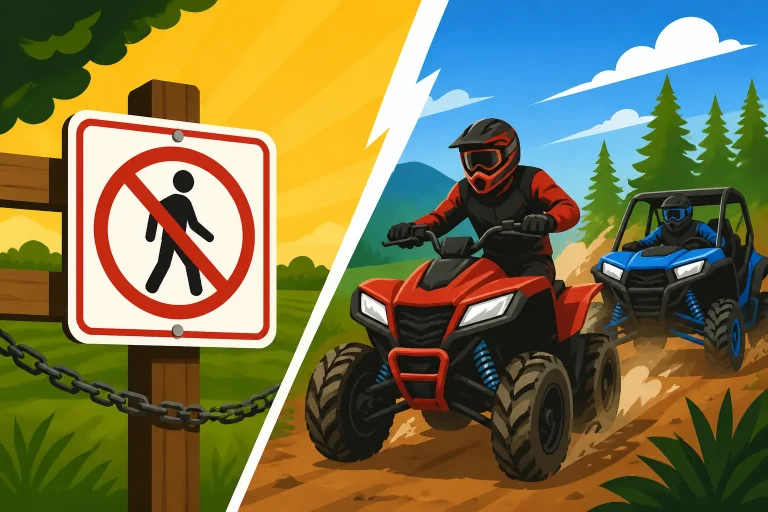
Ohio wildlife areas can look like open public land on a map, but that does not mean they are open ATV or UTV riding areas. The key is to distinguish legal public-road access from recreational off-road use, then verify the rules for the specific property before unloading or riding.
The short answer: a wildlife area is not automatically an ATV trail
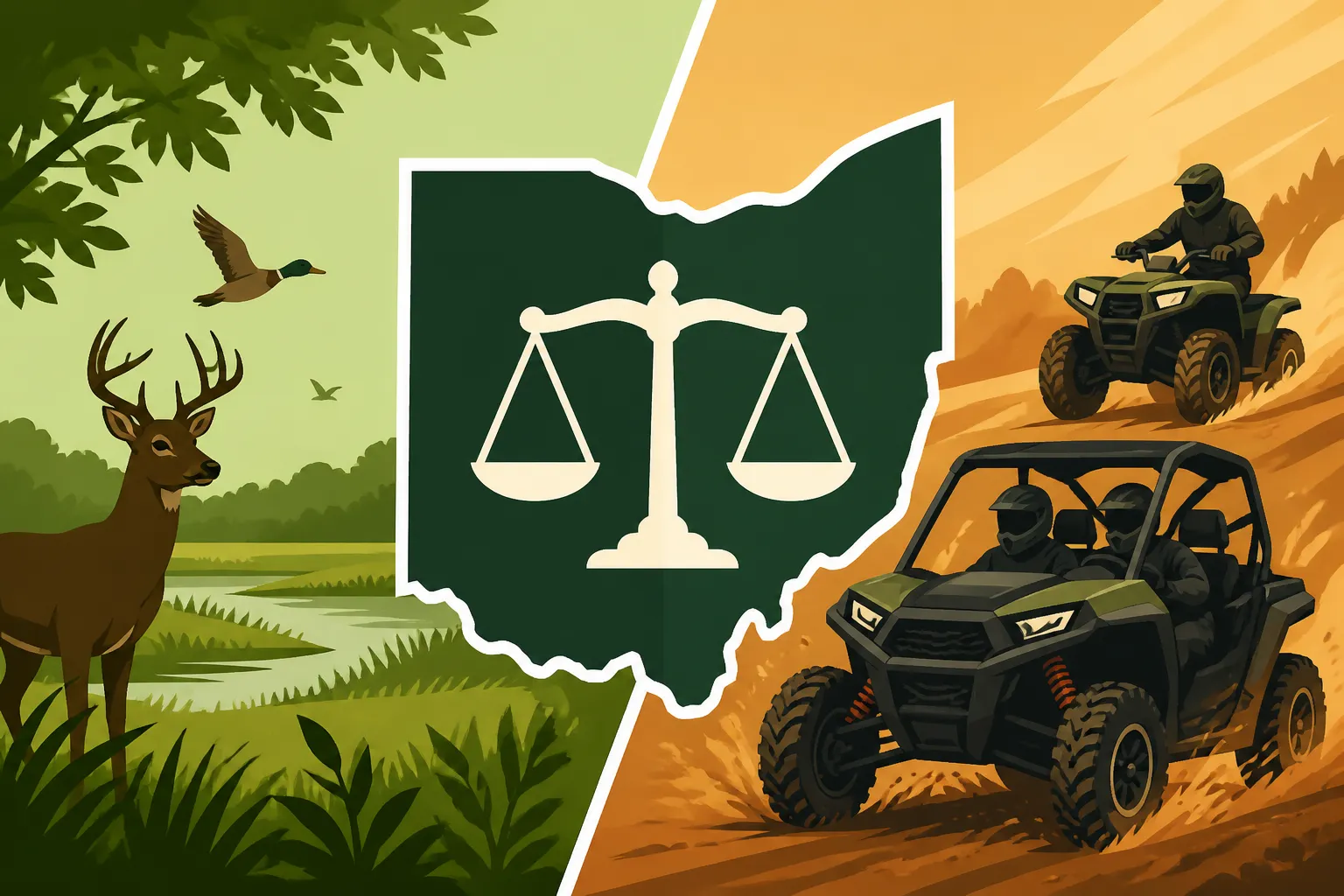
Ohio wildlife areas are managed for purposes such as wildlife habitat, hunting, fishing and related public access. They are not generally designated as recreational ATV trail systems. Having an Ohio registration plate, a valid out-of-state registration or a permit for another riding area does not, by itself, authorize riding across a wildlife area.
The practical rule is to operate a motor vehicle only where the property’s current rules allow it. A road that is open to public vehicle traffic is different from a trail, field edge, service track or route that merely looks passable. Do not assume a visible track is an approved route, even if another vehicle has used it.
| Situation | What to assume before checking | What to verify |
|---|---|---|
| Riding off-road across a wildlife area | Not allowed unless the property’s rules clearly authorize it | Whether a specific route is officially open to APVs |
| Using a road through the property | Access may be limited to roads open to public vehicle travel | Signs, closures, vehicle restrictions and the road’s public-access status |
| Driving to a hunting or fishing location | A recreational ride is not automatically part of permitted access | Whether vehicle access is allowed for that purpose and on that route |
| Riding on nearby state forest trails | Wildlife area rules do not apply in place of state forest rules | Whether the forest trail is open, and its equipment and rider requirements |
| Riding with a Wayne National Forest pass | The pass applies to the authorized national forest system, not every public parcel | The boundaries and routes covered by that pass |
For riders, the safest starting point is simple: treat a wildlife area as closed to recreational ATV or UTV riding unless the managing authority confirms that a particular route is open. If staff cannot confirm that access, choose a designated riding area instead.
This is different from Ohio state forests, where certain named trail systems are open to registered APVs under specific operating rules. The state forest rules are not a general permission to ride on other public land. See Ohio Rules for Riding State Forest Land for that separate set of requirements.
Roads, trails and service routes are not interchangeable
A wildlife area may contain paved roads, gravel roads, parking areas, access lanes and tracks used for management. Their presence does not tell you which vehicles may use them or for what purpose. The relevant question is not whether a route exists; it is whether that route is open to your vehicle and intended use.
Public vehicle roads
A road open to public vehicle travel may provide access through or into a wildlife area. That does not necessarily make it an ATV trail. Follow signs and any restrictions on the road, and do not leave it to continue onto an adjoining path, field or woods unless that additional route is specifically authorized.
A road can also be open to some traffic while limiting other uses. For example, a road may be intended for reaching a parking area or for ordinary travel rather than for recreational laps. Signs, gates and property rules matter more than the appearance of the route.
Footpaths and management routes
Walking paths, hunting access paths, fire lanes, maintenance tracks and field roads are not automatically open to ATVs or UTVs. A track created for staff, contractors or habitat work is not public riding access simply because it has tire marks. Likewise, a trail shown for hiking or another activity should not be treated as an OHV route.
Stay off closed paths and do not go around a gate or barrier. A gate may mark a legal closure, protect habitat, prevent vehicle damage or restrict access during a particular season. The fact that it is physically possible to get around a barrier does not make that route open.
Parking areas and staging
A designated parking area is not necessarily a staging area for riding. It may be intended for cars and trucks carrying visitors to a wildlife area, not for loading and unloading machines for off-road use. Before bringing a trailer, check whether the property allows the vehicle and trailer to park there and whether riding is allowed from that location.
If no official information identifies an ATV route or staging location, do not use a public parking lot as a substitute trailhead. Ask the property manager before unloading.
How to check a specific wildlife area before you go
Rules and access conditions can differ between properties and can change with closures, maintenance, weather, habitat work or public-safety needs. A broad description of Ohio wildlife areas cannot confirm whether a particular road is currently open. Check the exact location and route you plan to use.
A practical verification process
-
Identify the property and its managing office. Use the property’s official name, not just a nearby town, trailhead or road name. Make sure the land is actually a wildlife area and not an adjoining state forest, national forest, county park or private parcel.
-
Read the current property information. Look for rules about motor vehicles, public roads, parking, seasonal access and closures. Pay attention to the purpose of any access permission; authorization to reach a parking area is not necessarily authorization for recreational riding.
-
Check signs at entrances and along the route. Follow restrictions posted at gates, road junctions and parking areas. If online information and an on-site sign appear to conflict, do not ride the questionable route until the managing office clarifies it.
-
Ask a specific question. Instead of asking only, “Can I ride here?”, name the machine type, the road or trail, where you plan to enter, and whether you intend to ride recreationally or reach a permitted activity. Ask whether the route is open to that vehicle and use.
-
Confirm any special access conditions. Ask whether the route is open year-round or only during certain periods, whether a gate is normally closed, and whether access requires written authorization or another condition.
-
Keep the answer and follow it narrowly. If staff authorize a specific road or access purpose, do not treat that as approval for nearby tracks or off-road riding. Carry written confirmation when available, and obey posted restrictions on the day of the visit.
If the property does not provide a clear answer, do not infer permission from an old map, an online comment, another rider’s account or tire tracks. Use a designated riding location where the routes and access rules are clear. Ohio Trail Closures to Check First can help with the separate task of checking closures at established riding areas.
Why maps can mislead
Maps are useful for finding boundaries and access points, but a line on a map does not always identify a route open to motor vehicles. It may represent a walking path, an administrative road, a property boundary or an old route. Public mapping apps can also show tracks that were never approved for recreational use.
Use maps to locate the property and plan questions, not as proof that riding is allowed. If you cannot confirm that a route is open, stay off it.
What registration and reciprocity do—and do not—allow
Registration answers a different question from land access. It may be required for operating an APV in situations covered by Ohio law, but it does not grant permission to ride on every public parcel. A registered machine can still be prohibited from a particular wildlife area or route.
Ohio registration is not a property pass
An Ohio plate is not a universal public-land pass. The rules for Ohio state forest trails, national forest routes and wildlife areas are not interchangeable. The fact that an Ohio registration plate serves as a trail permit in a particular state forest context does not extend that permission to wildlife areas. For the distinction between registration and trail access, see Why the Ohio Plate Is the Trail Permit.
Likewise, an APV registration does not turn an ordinary road, maintenance track or walking path into an OHV route. Check both parts of the question:
- Is the machine properly registered for the kind of operation planned?
- Is the specific property and route open to that machine and activity?
A “yes” to the first question does not answer the second.
Out-of-state plates and permits
A visitor’s home-state registration may satisfy some requirements for riding in Ohio, depending on the state and the circumstances. Reciprocity concerns whether Ohio recognizes a visitor’s registration for covered operation; it does not create an exception to the access rules of a wildlife area.
If you are bringing a machine from another state, check both the registration issue and the property rules. Start with Ohio Reciprocity for Out-of-State Machines and The Ohio Temporary Permit for Visitors if you need to understand visitor requirements. Then confirm whether the particular wildlife area allows the planned use at all.
A Wayne National Forest permit is also limited to the routes and lands it covers. It is not a statewide permit for wildlife areas, county parks or private ground. A permit that is valid for one system should never be treated as permission to cross a different property.
Other permissions do not automatically cover riding
A hunting license, fishing access, event approval, landowner permission for an adjoining property or permission to park does not necessarily authorize motorized travel within a wildlife area. The terms of the permission matter. If access is granted for a specific task or route, stay within those limits.
For private parcels adjoining public land, permission must come from the landowner or other person with authority over that property. Public access to a wildlife area does not mean that neighboring private ground is open. Ohio Landowner Permission Rules explains why separate permission matters when a route crosses private property.
Common situations and safer alternatives
Many problems arise from assumptions that seem reasonable in the moment: a road looks public, a gate is open, or a machine is already registered. A few common cases show why it helps to verify the exact route before unloading.
“I only want to ride the access road”
First determine whether the road is open to public vehicle travel and whether APV use is allowed for your purpose. Do not assume an access road is open for recreational riding simply because visitors can drive cars on it. Stay on the confirmed route, and do not turn onto adjoining trails or field tracks.
If the road is not clearly identified or a sign limits access, contact the managing office. A short call before the trip is easier than explaining an uncertain route after a stop or complaint.
“I’m using the machine to get to a hunting or fishing spot”
Access for hunting or fishing does not automatically mean an ATV may be used to travel wherever it is convenient. Verify whether vehicle access is allowed on that property, whether it is limited to designated roads, and whether any special authorization applies.
Do not ride across habitat, fields or closed routes to reach a location. If the property offers a specific access arrangement, follow the stated conditions exactly. For questions involving mobility-related access or other special circumstances, ask the managing office directly rather than relying on a general rule or another visitor’s experience.
“There are tire tracks, so the route must be open”
Tracks may be from management vehicles, emergency access, illegal riding or a prior use that is no longer allowed. They do not establish public permission. If a route is not identified as open to APVs, do not use tracks as a guide.
The same caution applies to unofficial online routes and GPS tracks. A digital route can remain visible long after access changes or a closure is posted.
“The property is public, so I can ride there”
Public ownership does not mean every activity is allowed. Public land is managed for particular purposes, and access rules can restrict motorized use. A wildlife area can be open to visitors on foot while remaining closed to recreational ATV riding.
This distinction also applies to county parks. Their rules are set separately, and most public parks are not interchangeable with OHV riding areas. See [Ohio Rules for Riding a County Park] before assuming a park road or trail is open to machines.
“A nearby trail system is open, so I can connect to it”
Do not cross a wildlife area to connect two legal riding areas unless the connecting route is explicitly authorized. A trailhead, road or public parcel near an OHV system does not make the entire route legal. Check property boundaries and access rules for every segment of the trip.
If the planned ride depends on crossing land where vehicle permission is unclear, choose another route. [Ohio Rules for Riding a Reclaimed Mine] is also useful when a ride involves reclaimed land, since its access rules can differ from both wildlife area and forest rules.
Choose a designated riding area
When the goal is recreational riding rather than travel to a permitted activity, a designated trail system or private riding park is usually the clearer option. Confirm that the machine fits the area’s width and equipment limits, that the trail is open, and that all riders meet applicable requirements.
Do not assume a trail system’s rules carry over to adjacent land. Stay within marked routes and respect closures, gates and property boundaries.
Frequently Asked Questions
Can I ride an ATV on any road inside an Ohio wildlife area?
No. A road’s presence does not establish that it is open to APVs or recreational riding. Confirm that the specific road is open to your vehicle and intended use, and follow all signs and closures.
Does an Ohio registration plate let me ride on wildlife area land?
No. Registration may address vehicle requirements, but it does not grant access to a wildlife area or authorize off-road riding. Check the property’s rules separately.
Does an out-of-state registration change the wildlife area rules?
No. Reciprocity may affect whether Ohio recognizes a visitor’s registration, but it does not override the land manager’s access rules. Verify both registration and route access before riding.
Can I ride to a hunting or fishing spot?
Do not assume so. Vehicle access may be limited to designated roads or subject to specific conditions. Ask the managing office about the property, route and purpose before relying on ATV access.
What should I do if signs and online information disagree?
Follow the more restrictive instruction until the managing office clarifies the situation. Do not ride past a closure or onto an uncertain route based only on an online map.
Disclaimer
This article is for general informational purposes only and does not constitute professional advice. Laws, prices and regulations vary by location and change over time. Consult a qualified professional for guidance on your specific situation.