Wildlife Area Roads in Ohio
Ohio wildlife areas can look like a maze of gravel roads, gates and parking lots, but a road that appears rideable is not automatically open to an ATV or UTV. The key is to confirm both that motor vehicles may use the route and that your machine is allowed there. Here’s how to check before unloading or riding in.
The short answer: a wildlife area is not an ATV trail
Ohio wildlife areas are managed for wildlife and public activities such as hunting, fishing and wildlife viewing. They are not generally designated off-highway vehicle trail systems. A road through a wildlife area may serve staff, habitat work or public access without being open to recreational ATV or UTV riding.
The most important distinction is between a road you can see and a route your machine is authorized to use. An established gravel road, a two-track, a fire lane or a path leading to a pond does not automatically allow recreational riding. A gate being open does not necessarily grant permission either. The route’s official status, signs and rules for that specific area matter.
A state APV registration plate also does not create access rights on wildlife area land. Registration generally establishes that the machine is registered; it does not override land-use restrictions. Similarly, an out-of-state plate or permit does not make a closed route open. Reciprocity matters only where the machine is otherwise permitted. For the broader distinction, see Ohio APV Reciprocity With Other States and Ohio Rules for Riding a Wildlife Area.
| What you see | What it does and does not tell you |
|---|---|
| A gravel or dirt road | It may be an access or management road; appearance alone does not authorize recreational riding. |
| A road open to ordinary traffic | It may still have restrictions for APVs, including limits on which machines may use it. |
| An open gate | It is not proof that the route is open to recreational vehicles. |
| A posted closure or barrier | Treat it as a restriction and do not ride past it. |
| A parking area beside a road | Parking there does not necessarily mean you may ride from the lot onto the area’s roads. |
| An Ohio APV plate | It does not grant permission to ride on wildlife area roads or trails that are closed to APVs. |
When a posted sign, official map and general rule appear to conflict, do not assume the less restrictive interpretation is correct. Check with the wildlife area office or the responsible state agency before riding. If an area does not clearly identify a route as open to your type of machine, plan on keeping the machine off it.
Why a road’s status and your machine’s status both matter
Access questions often get muddled because riders ask only whether a road is public or open. For an ATV or UTV, there are two separate questions:
- May motor vehicles use this particular route?
- May this type of vehicle use it for this purpose?
A road may be used by agency staff or maintenance vehicles but not by visitors. Another route might be open for ordinary vehicles accessing a designated parking area while still not serving as an ATV route. Even a road that is legally open to some traffic does not necessarily exempt an APV from Ohio’s rules for operating on roads.
This is why “it’s a road” is not enough to establish permission. The route may be signed for a limited use, closed to public motor vehicles, or subject to seasonal or area-specific restrictions. Riding off the road to get around a gate or reach a nearby feature creates a separate problem: it is not a substitute route and may damage habitat or violate the closure.
Management roads are not recreational trails
Wildlife areas may contain routes used to manage habitat, reach water-control structures, maintain facilities or support other agency work. Those routes can resemble trails on the ground. Their presence does not mean they are open for recreational riding.
The same caution applies to narrow paths, field edges and old tracks. A worn line may have been made by work vehicles, farm equipment or unauthorized riders. Tire marks are not permission. Do not follow them unless official information confirms that the route is open to your machine.
A designated trail system is different: it has an identified purpose and an official access framework. Ohio’s state forest riding rules, for example, are not interchangeable with wildlife area rules. See Ohio Rules for Riding a State Forest for that separate land category. A plate or permit that is useful on an authorized trail system does not automatically cover wildlife area roads.
Public access does not mean motorized access
Wildlife areas are open to many kinds of public use, but that does not mean every activity is allowed everywhere. A place may be open for walking, hunting or fishing while restricting motorized travel to specific roads or parking areas. Public access and vehicle access are different permissions.
This distinction matters when approaching a hunting or fishing spot. You may be allowed to park at a designated lot and continue on foot, while riding farther along a service road is not allowed. If your plan depends on riding close to a particular location, verify the route before you go rather than relying on the fact that the destination is open to visitors.
How to check a wildlife area before you unload
The safest approach is to check the individual wildlife area, not just general information about Ohio APV registration. Rules can differ by property, road and season. A quick check before the trip can prevent a citation, a forced turnaround or damage to sensitive ground.
- Identify the exact wildlife area. Use its official name and location. Do not rely only on a nearby town or a trail-map label that may cover multiple properties.
- Review the official area map and posted rules. Look for roads expressly open to motor vehicles, parking locations, gates, seasonal restrictions and closures. A map marking a road for access does not necessarily mean it is an ATV route, so check the legend and accompanying rules.
- Confirm that the rules cover your machine. “Motor vehicle” or “vehicle access” language can be broader or narrower than an ATV or UTV authorization. If the wording is unclear, ask the area office or agency contact responsible for the property.
- Check conditions close to your visit. A road or lot can be affected by seasonal management, weather, construction, hunting activity or a temporary closure. A map may not show every current restriction.
- Read signs at the entrance and along the route. Signs and barriers can identify restrictions that are easy to miss during online planning. If signage indicates closure, do not ride through or around it.
- Plan a legal place to park or unload. Make sure the parking area permits the vehicle and trailer you bring. Do not use an access road as an improvised staging area unless parking there is allowed.
If you call, ask a direct question: “Can I ride this specific ATV or UTV on this named road for recreation, and where may I park or unload?” That is more useful than asking whether the wildlife area is “open.” The latter may refer to public access for other activities, not motorized use.
Keep the answer practical. Note the route name, the permitted access point and any conditions, but still follow current signs when you arrive. If the information is uncertain or you cannot confirm that the route is open to your machine, choose another place to ride.
For trail access elsewhere, make sure you understand the relevant registration or permit rules separately. Do You Need a Permit for Ohio State Forest Trails? covers state forest access, while The Ohio Temporary Permit for Visitors explains a different issue for visitors. Neither should be treated as permission to ride on a wildlife area route that is closed to APVs.
Common mistakes and better alternatives
Treating a trail map as proof of permission
A map can help locate roads, but it may not establish which vehicles can use them. A line marked as a road is not necessarily an ATV route. Look for the map’s legend and any rules linked to the specific property. If the map does not answer the machine-access question, contact the area office.
Riding around a gate or closure
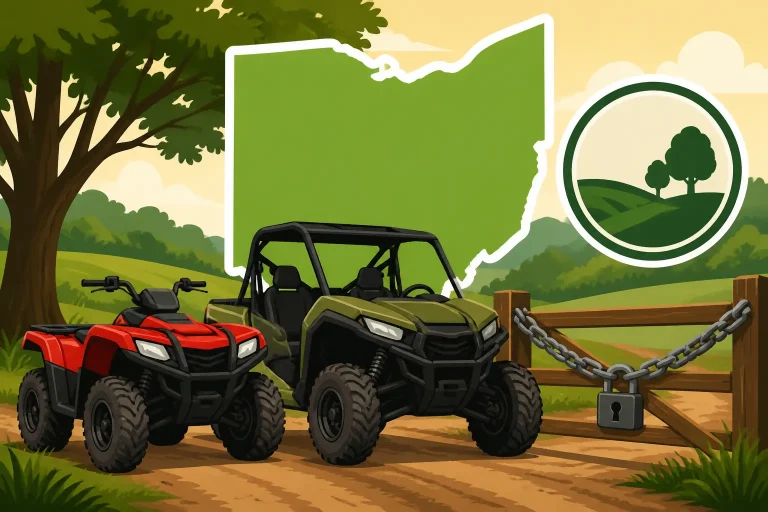
A closed gate is a clear reason to stop, not an obstacle to work around. A route may be closed to protect habitat, manage water, prevent unsafe travel or allow other work. Going around a barrier can take a rider onto land or ground that is even more restricted. Do not assume that a closure applies only to cars.
Assuming a road-legal setup makes every road available
Equipment, insurance and registration may be relevant to lawful road operation, but they do not create a right to use a restricted road on public land. Local road-opening rules and wildlife area access rules are separate questions. Read Where Ohio Law Allows APVs on Roads if your plan includes riding on public roads; it does not replace checking land-specific access.
Unloading at the edge and riding in
A legal place to park a truck and trailer is not automatically a legal starting point for an ATV ride. If the route from the lot is not authorized for APVs, unloading there and continuing into the wildlife area does not make the ride permissible. Confirm the route from the parking area to the intended destination, not just the parking location itself.
Confusing wildlife areas with nearby riding areas
A wildlife area may be near a state forest, private riding park or trail system, but their boundaries and rules are separate. Do not assume that a trail or road remains open after it crosses onto wildlife area property. Check the boundary and route before continuing. For privately owned ground, permission must come from the landowner; [Ohio Rules for Riding Private Property] explains that separate situation.
If wildlife area roads are not clearly open to your machine, use a riding area that expressly allows the vehicle and activity. Confirm its access rules, operating hours, permit requirements and any width or age restrictions before leaving home. This avoids turning a fishing or hunting access road into an unplanned—and potentially unlawful—ride.
Disclaimer
This article is for general informational purposes only and does not constitute professional advice. Laws, prices and regulations vary by location and change over time. Consult a qualified professional for guidance on your specific situation.