Which States’ Registrations Ohio Accepts on Its Trails
Which States’ Registrations Ohio Accepts on Its Trails
An out-of-state plate does not automatically settle whether your ATV or UTV can ride Ohio trails. Ohio’s reciprocity rules, your home state’s registration system, and the trail system you plan to use all matter. The practical answer is to confirm that your registration qualifies, carry proof, and check for any separate land-manager permit before unloading.
The short answer: Ohio relies on reciprocity, not just the state name
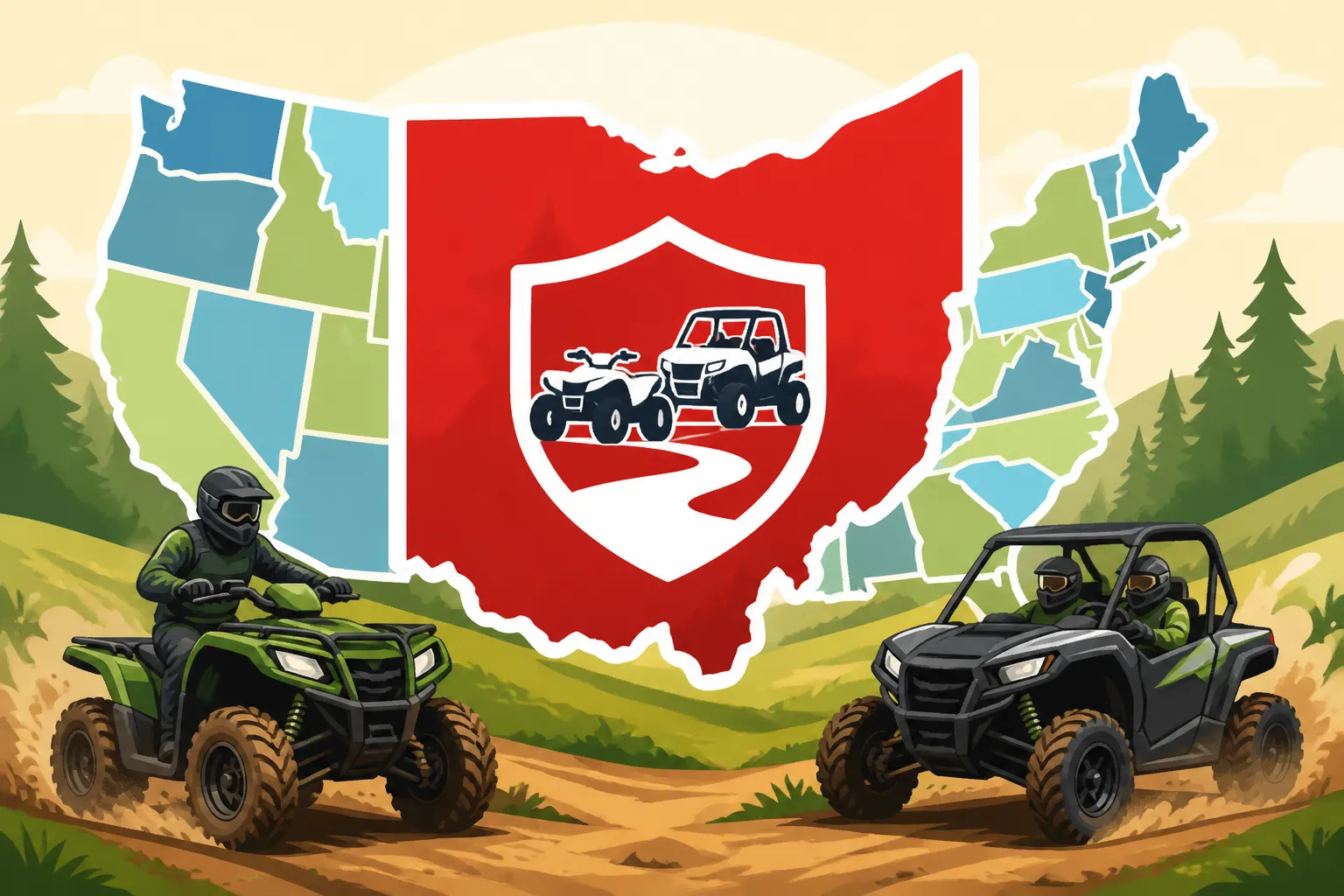
Ohio may recognize a nonresident’s current home-state registration when the registration and the other state’s laws qualify under Ohio’s reciprocity rules. That means there is not a simple rule that every out-of-state registration is accepted everywhere in Ohio. Nor does a machine’s title, purchase paperwork, or plate alone prove that it can ride a particular trail.
The relevant question is whether your machine is registered for the kind of off-road use involved and whether Ohio recognizes that registration for a visiting rider. A plate issued for road use, a registration for a different vehicle category, or an expired document may not meet the requirement. If your state does not register comparable machines, you may need an Ohio temporary permit instead.
That is why a state-by-state answer can be misleading. State rules can differ by machine type, the purpose of registration, and whether the state grants Ohio riders similar privileges. A registration that works for one kind of vehicle or place may not cover a side-by-side on an Ohio forest trail. Before travelling, check both your home state’s rules and Ohio’s current visitor requirements. For the broader framework, see Ohio APV Reciprocity With Other States.
| Your situation | What to confirm before riding |
|---|---|
| Your home state registers your ATV or UTV for off-road use | The registration is current, applies to that machine, and qualifies under Ohio reciprocity |
| Your state does not register comparable machines | Whether Ohio requires you to obtain a temporary permit |
| You have a title but no current registration | Whether that title is only proof of ownership and what operating document you still need |
| You plan to ride a state forest trail | Whether your home registration is accepted for that trail and any additional access rules |
| You plan to ride in Wayne National Forest | Whether a separate Wayne National Forest OHV permit is required |
| You intend to use a public road | Whether local road access is allowed and what equipment, insurance, and driver requirements apply |
The table is a starting point, not a substitute for checking the specific rule. Keep the answers for your route and machine together with your registration documents. If an official or trail manager gives you different instructions for a particular area, follow the requirements for that area.
How to check whether your state registration qualifies
Start with the document you actually carry, not the name of the state printed on your plate. Look for the vehicle description, registration status, expiration date, and any use restrictions. Then confirm that the registration covers off-road operation and that Ohio recognizes it for nonresident trail use.
A useful check has four parts:
- Confirm what your home state issued. Find out whether your document is an off-road registration, a title, a road-vehicle registration, or another kind of permit. These documents do different jobs. A title generally establishes ownership; it does not automatically grant permission to ride.
- Match the document to the machine. Check that the registration identifies the ATV or UTV you are bringing, rather than another vehicle or a different category. If a machine has been modified or reclassified, ask whether the registration still covers it.
- Check whether it is current. Make sure the registration has not expired and that any required plate, decal, or other proof is displayed as directed by your home state.
- Ask whether Ohio recognizes it for your planned use. Confirm that the home-state registration qualifies under Ohio’s reciprocity rule and covers the place you intend to ride. If the answer is unclear, ask the relevant Ohio office or land manager before travel.
Do not assume that a home-state title or bill of sale can stand in for registration. These papers may help prove ownership, but they do not necessarily authorize operation on Ohio trails. Similarly, a registration that is valid in your home state may not automatically satisfy every Ohio requirement. Keep the title or purchase papers as useful ownership records, but verify the operating document separately.
If you are travelling from a nearby state, use the same steps rather than relying on what another rider says. The details for Pennsylvania, West Virginia, Michigan, Indiana, and Kentucky can differ, and the fact that a state borders Ohio does not by itself establish that every registration it issues is accepted. Check the specific vehicle type and current rules for your state. Related state-by-state topics include Ohio Reciprocity With Pennsylvania, Ohio Reciprocity With West Virginia, Ohio Reciprocity With Michigan, and Ohio Reciprocity With Indiana.
A good confirmation should answer these questions plainly:
- Is my particular registration valid for this ATV or UTV?
- Does it authorize off-road operation, rather than only identifying ownership or allowing road use?
- Does Ohio recognize it for a nonresident on the trail system I plan to use?
- Must I carry anything besides the registration document?
- Is a separate Ohio permit needed if my registration does not qualify?
If you cannot get a clear answer, do not treat silence as approval. Contact the appropriate Ohio office or trail manager and describe the machine, the exact document you have, and where you plan to ride. That makes it easier to distinguish a paperwork issue from a trail-specific restriction.
What to bring and display when riding in Ohio
Bring the current registration proof for the machine, and make sure the information matches the vehicle. If the registration requires a plate or decal to be displayed, mount it where it can be seen and keep it legible. A document buried in a trailer or stored only at home is not a useful way to answer a question during a trail check.
A practical trip folder can include:
- The machine’s current registration document
- Any permit required for the trail system
- Proof of ownership, such as a title or bill of sale, if you have it
- Any other documents required for the type of riding you plan to do
Keep these records protected from mud and water, and know where they are before you start riding. A photo on a phone can be a helpful backup, but do not assume it replaces a required original or that every official will accept a digital copy. Check what form of proof is allowed.
A visitor with a qualifying home-state registration should confirm what that registration must show and what needs to be displayed. What a Visitor From a Registering State Must Show covers the document check in more detail. If your home state does not register comparable machines, or your paperwork does not qualify, check the Ohio visitor permit process before you arrive. See What a Visitor From a Non-Registering State Must Buy and Ohio Temporary Permit for a Visitor.
A temporary permit is not a universal fix for every registration problem. First establish whether the issue is that your state does not register the machine, that your document is expired, or that the machine is not covered by it. Those situations may have different requirements. A temporary permit also does not override a trail closure, an age rule, a width limit, or a local restriction.
Do not borrow another person’s plate or rely on a registration for a different machine. The point of carrying proof is to show that this machine has the appropriate authorization. If ownership has recently changed, or a registration still names a prior owner, sort out the paperwork before the trip rather than assuming a bill of sale will resolve every question at the trailhead.
State forest trails, Wayne National Forest, and roads are different
An accepted home-state registration does not give unlimited access to every place in Ohio. Registration and trail permission are related, but they are not the same thing. State forest rules, federal forest requirements, private park policies, and road-use laws can each add conditions.
Ohio state forest trails
For Ohio state forest riding, confirm the current trail rules as well as the registration requirement. A qualifying out-of-state registration may address one part of the process, but it does not remove requirements about where machines may go, who may ride, or what equipment is needed. Stay on marked routes and check current operating dates, closures, machine-width rules, and rider restrictions before setting out.
Start with Ohio Rules for Riding State Forest Land and Ohio’s 62 Inch State Forest Limit. If you are uncertain whether your registration is accepted at a specific forest, contact the appropriate Ohio authority or check the official trail information before loading your machine.
Wayne National Forest
Wayne National Forest is managed separately from Ohio’s state forests. A home-state registration should not be assumed to cover every federal forest requirement. Check whether the trail or route you plan to use requires a separate Wayne National Forest OHV permit, and confirm what each rider must carry or buy.
The permit requirement is separate from registration reciprocity. A visitor may need to satisfy both: have a registration Ohio recognizes and meet the forest’s access rules. Read How the Wayne National Forest OHV Permit Works and Which Trails a Wayne Forest Pass Opens before you go. Verify the current permit details with the forest, since access conditions and permit instructions can change.
Public roads and connections between trails
Trail registration does not automatically make an ATV or UTV legal on public roads. Road access depends on the road, local decisions, vehicle requirements, and other applicable rules. A machine with an out-of-state registration may still be prohibited from travelling along a road or may need to meet separate equipment, insurance, and operator requirements.
Do not use a trail registration as a reason to ride down a road to reach a trailhead. Check the exact route and local road rules first. Where Ohio Law Allows APVs on Roads explains why the answer can vary from one road to another.
| Where you plan to ride | Registration answers | Other checks |
|---|---|---|
| Ohio state forest trail | Does Ohio accept your home-state registration? | Forest operating rules, marked routes, width and rider requirements |
| Wayne National Forest route | Is your machine properly registered? | Separate forest permit and route access conditions |
| Private riding park | Does the park require registration or proof of ownership? | Park-specific admission, safety, and machine rules |
| Township or county road | Is the machine registered for the relevant use? | Whether that specific road is open and whether road equipment and insurance rules apply |
A route that crosses more than one kind of land deserves extra attention. Confirm each segment, not only the destination. A trailhead may lead onto a state forest route, a federal route, or a privately managed connection, and the rules can change at the boundary.
Common mistakes and a simple pre-trip check
Most registration problems come from treating one kind of paperwork as if it solves every requirement. A few careful checks before departure can prevent a long drive ending at the trailhead.
Mistake: assuming every state plate is accepted
A plate may show that a machine has some form of state registration, but it does not tell you by itself whether the registration qualifies for Ohio trail use. Confirm that it is current, applies to the machine, and is recognized under Ohio’s reciprocity rules.
Mistake: treating a title as a riding permit
A title is important proof of ownership. It is not necessarily permission to operate on an Ohio trail. If you have a title but no valid registration, ask what registration or visitor permit is required. Do not rely on a sales receipt to settle the issue.
Mistake: thinking reciprocity includes every permit
Reciprocity concerns how Ohio treats a qualifying home-state registration. It does not necessarily cover a separate permit required by a land manager, a private park, or a particular trail system. Check registration and site access as separate items.
Mistake: overlooking a machine-specific restriction
A document may be valid while the machine is still ineligible for a particular route. Width, vehicle type, rider age, required equipment, and seasonal closures can all matter. Confirm the trail rules for the exact machine you are bringing, especially if it is a wide side-by-side.
A practical pre-trip sequence
- Identify the exact trail system and any land boundaries on your route.
- Check your home-state registration document and expiration date.
- Confirm that it applies to your machine and off-road use.
- Verify that Ohio recognizes it for nonresident riding.
- If it does not qualify, find out whether an Ohio temporary permit is required.
- Check for separate forest or park permits.
- Review current trail access, width limits, operating rules, and closures.
- Pack the registration and required permits where you can produce them.
If you are travelling with more than one machine, check each registration separately. Do not assume that one vehicle’s paperwork covers a second ATV or UTV. The same applies to a borrowed or recently purchased machine: confirm whose name appears on the document, whether the registration remains valid, and whether the machine is authorized for the trip.
A short call or official check before leaving is especially worthwhile when the home-state registration is unusual, the machine has been reclassified, or the route includes multiple land managers. Keep a note of the answer and the office you contacted. It will not replace the required documents, but it can help you resolve an avoidable misunderstanding.
Frequently Asked Questions
Does Ohio accept registrations from every state?
Not automatically. Ohio’s reciprocity rules and the details of the registration matter. Confirm that your home-state document is current, applies to your machine, and qualifies for the Ohio use you have planned.
Do I need an Ohio permit if my state does not register ATVs?
You may need an Ohio temporary permit when your home state does not register comparable machines or your document does not qualify. Check the current visitor requirements before travelling. Ohio Temporary Permit for a Visitor explains what to verify.
Does an accepted registration cover Wayne National Forest?
Not necessarily. Registration reciprocity and Wayne National Forest access are separate matters. Check whether the forest requires an additional OHV permit and confirm the requirements for your route.
Can I ride Ohio roads with an out-of-state registration?
Registration alone does not establish that a road is open to ATVs or UTVs. Check the rules for the particular road and any separate vehicle, insurance, equipment, and operator requirements.
Disclaimer
This article is for general informational purposes only and does not constitute professional advice. Laws, prices and regulations vary by location and change over time. Consult a qualified professional for guidance on your specific situation.