What a Closed-Trail Citation Costs in Ohio
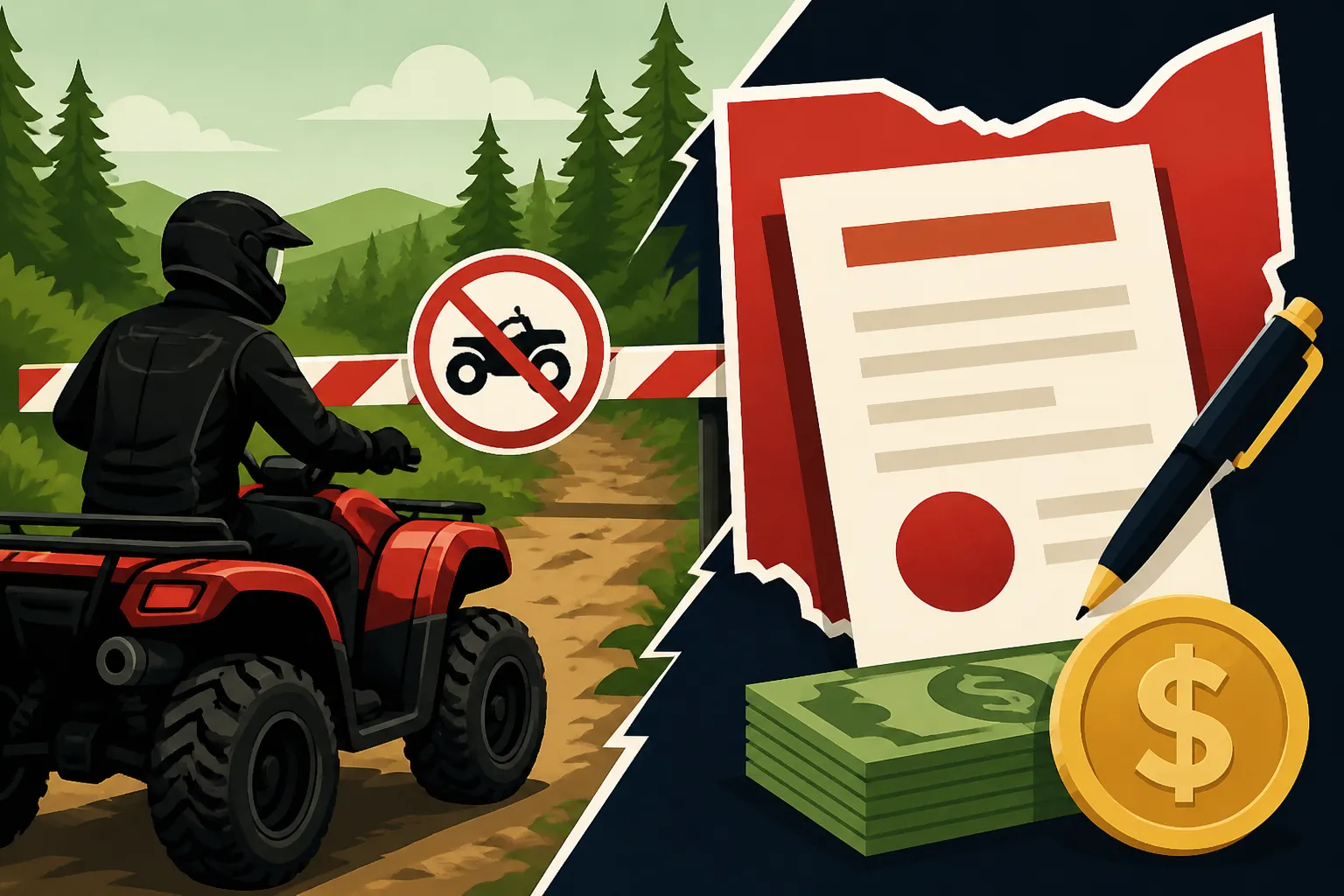
A closed-trail citation in Ohio does not have one fixed price. The amount can depend on where you were riding, which rule the officer says you broke, and the court handling the case. Understanding those variables—and responding to the citation on time—can help you avoid confusing a listed fine with the total cost of the case.
Why There Is No Single Ohio Closed-Trail Fine
A trail closure can come from different authorities. A state forest, national forest, wildlife area, local government, or private riding park may each control access under different rules. The place where the citation was issued matters because it can determine which law or regulation applies and where the case is handled.
For example, riding past a closure on Ohio state forest land is not necessarily treated the same way as riding onto a closed route in Wayne National Forest. A national forest citation may follow a federal process, while a state or local citation may go through an Ohio court. Private parks can also enforce their own access terms, in addition to any public-law restrictions that apply.
The phrase “closed trail” can cover several situations: a seasonal closure, a temporary closure after bad weather, a route shut for repairs or logging, or a rider leaving an open route and entering an area where riding is prohibited. The specific rule cited is more useful than the general description. That is why the citation itself should identify the alleged violation, location, and instructions for responding.
| What affects the total | Why it matters |
|---|---|
| Land manager and location | The case may be handled under state, federal, local, or park rules |
| Rule or offense listed | Different violations can have different penalties and procedures |
| Court and case process | Court costs or other charges may be added to a fine |
| Case outcome | The amount due depends on the result and any orders in the case |
| Response timing | Missing a required response can create additional problems |
A sign saying “closed” is not just a trail suggestion. Closure notices may be posted at a trailhead, gate, junction, or on an official map or notice. The basis and duration of a closure can vary, but riders should not assume that a route is open simply because it appears on an older map or a navigation app. Check Ohio Trail Closures to Check First and What the Trailhead Board Tells You Before a Ride before unloading.
The broader rules also matter. Ohio’s state forest requirements are not automatically the same as rules for a county park or private property. For context on state forest access, see Ohio Rules for Riding a State Forest. If a rider leaves a marked route rather than merely using a route that has been temporarily closed, [Ohio Rules for Riding Off the Trail] may also help clarify the issue.
What the Citation May Cost Beyond the Fine
A citation may show a fine, a possible amount due, or instructions for appearing or responding. That figure may not represent the entire cost. Court costs or other authorized charges can be added, and the total may depend on the court’s process and the outcome of the case. The citation, the court, and any official case information are the right places to confirm the amount; avoid relying on another rider’s estimate for a different location or offense.
The total can be thought of in parts:
- Fine or penalty: The amount associated with the offense if the case results in a penalty.
- Court costs: Charges connected with processing the case may apply.
- Other case-specific amounts: A court may impose additional requirements or amounts where authorized, depending on the facts and applicable rules.
- Indirect costs: Travel to court, time away from work, or legal help can add to the practical cost even if they are not listed as a fine.
Not every citation leads to the same result. The amount can depend on the offense alleged, the governing rule, prior history where relevant, and how the matter is resolved. A rider should not assume that a first citation will be dismissed, that a posted sign automatically makes a case more serious, or that paying a listed amount is always the only possible response. Those conclusions depend on the actual notice and the applicable process.
The land manager also affects where to get reliable information. If the citation names an Ohio state agency or court, follow the state or court instructions printed on it. If it concerns Wayne National Forest, use the federal contact or response details provided with the citation. A ranger or land manager can help explain the closure and identify the responsible office, but they may not be able to change a court deadline or decide the case.
For a state forest incident, What a State Forest Officer Can Cite You For offers useful context about the kinds of violations an officer may address. For a case on national forest land, What a Wayne National Forest Citation Costs a Rider is more directly relevant. Those topics can help you understand the setting, but the exact notice you received remains the controlling starting point for your own next steps.
What to Do After Receiving a Closed-Trail Citation
Take the citation seriously even if you believe the closure was unclear or the route was open. A ticket is not the right moment to rely on memory alone or to assume that a warning will replace the required response.
- Read the entire citation. Note the alleged violation, date, location, issuing authority, court or office, and every response instruction. Check whether it requires a court appearance or gives another way to respond.
- Record the deadline. Put the date somewhere you will see it. If the notice is difficult to understand, contact the court or agency named on it promptly and ask about procedure. Do not wait until the deadline is close.
- Keep the original documents. Save the citation, any envelope, and related notices. Make copies or clear photographs for your records, but do not treat a phone image as a substitute for a document the court asks you to bring.
- Write down what happened. While details are fresh, note where you entered, the route you followed, what signs or barriers you saw, and what the officer told you. Keep the account factual.
- Preserve relevant evidence. Save dated photos, trail maps, closure notices, messages, and ride records if they relate to the incident. Do not alter or delete material that could help explain what happened.
- Ask the right office about the process. The issuing agency can often clarify where the closure applied or which office manages the land. The court can explain filing, appearance, and payment procedures. Neither conversation should be treated as a substitute for legal advice where you need it.
- Consider qualified legal help when the stakes are significant. A lawyer familiar with the relevant court or land-management rules can help you understand options and consequences. This may be especially useful if the citation involves more than one allegation or you dispute important facts.
If you think the trail was open, focus on evidence that helps establish the location and conditions at the time. A general map showing a route does not necessarily prove it was open on the citation date; closures can be temporary. A photo of a sign may help, but its usefulness depends on when and where it was taken and whether it shows the relevant entrance or junction.
If you believe you were on an open trail and the officer identified the wrong location, record landmarks, intersections, trail markers, and the direction of travel. If a sign was missing or hard to see, document that fact safely and promptly. Avoid returning to a closed area to gather evidence, and do not move a closure sign or barrier.
If the notice offers a way to pay, read its terms carefully before using it. Payment can affect how the case is resolved, so do not assume it is merely a deposit or that it preserves every option. Ask the court what the payment means if the instructions are unclear. If you intend to dispute the citation, follow the response procedure rather than simply ignoring the payment notice.
A missed deadline can create new issues, such as a required appearance or further court action. The consequences depend on the notice and the court, so contact the court promptly if you have already missed a date. Do not rely on a general online answer to determine whether the court will accept a late response.
How to Avoid a Closed-Trail Citation
The most dependable way to avoid a closure citation is to verify access shortly before the ride, not just when you planned the trip. Trail status can change because of weather, maintenance, resource protection, or other land-management needs. A route that was open on a previous visit may not be open now.
Before leaving home, check the managing agency’s current closure information and map. On arrival, read the trailhead board and signs at junctions. If a gate, barricade, or closure notice conflicts with an older map or an app, do not ride around it. When the status is unclear, stop and ask the responsible office rather than testing the route.
A few habits can prevent common mistakes:
- Download or save current maps where service may be unreliable.
- Make sure everyone in the group understands the route and closure signs.
- Turn around at a closed section instead of taking an unmarked bypass.
- Do not assume a closed route becomes legal to use because other riders have gone through.
- Check the rules for the specific property; registration or a trail pass does not override a closure.
- If conditions change during the ride, follow posted instructions and avoid creating a new route around a closure.
For national forest rides, contact the appropriate ranger district if a closure is not clear before you load. Calling a Ranger District Before You Load can help you plan that check. If you are unsure whether a posted restriction applies to your intended route, the land manager is a better source than a social media post or an old ride report.
A registration plate, trail permit, or pass generally addresses access or identification requirements; it does not give permission to ride every route. Likewise, a trail being physically passable does not mean it is legally open. Keep the closure information with your route plan, and be prepared to change plans when a trail is shut.
The amount owed after a closed-trail citation depends on the location, rule, court process, and case outcome. Read the notice, verify the total with the office handling the case, and meet the stated response deadline. For future rides, check current closures and turn around when a route is marked closed.
Disclaimer
This article is for general informational purposes only and does not constitute professional advice. Laws, prices and regulations vary by location and change over time. Consult a qualified professional for guidance on your specific situation.