What the Trailhead Board Tells You Before a Ride
A trailhead board can prevent a wasted unload, an avoidable citation or a ride into a closed route. But the information is not always organized the same way, and a map alone may not show current restrictions. Here’s what Ohio ATV and UTV riders should look for at the board, especially when permits, out-of-state registration or changing trail conditions are involved.
Start With the Map, Route Markings and Closure Notices
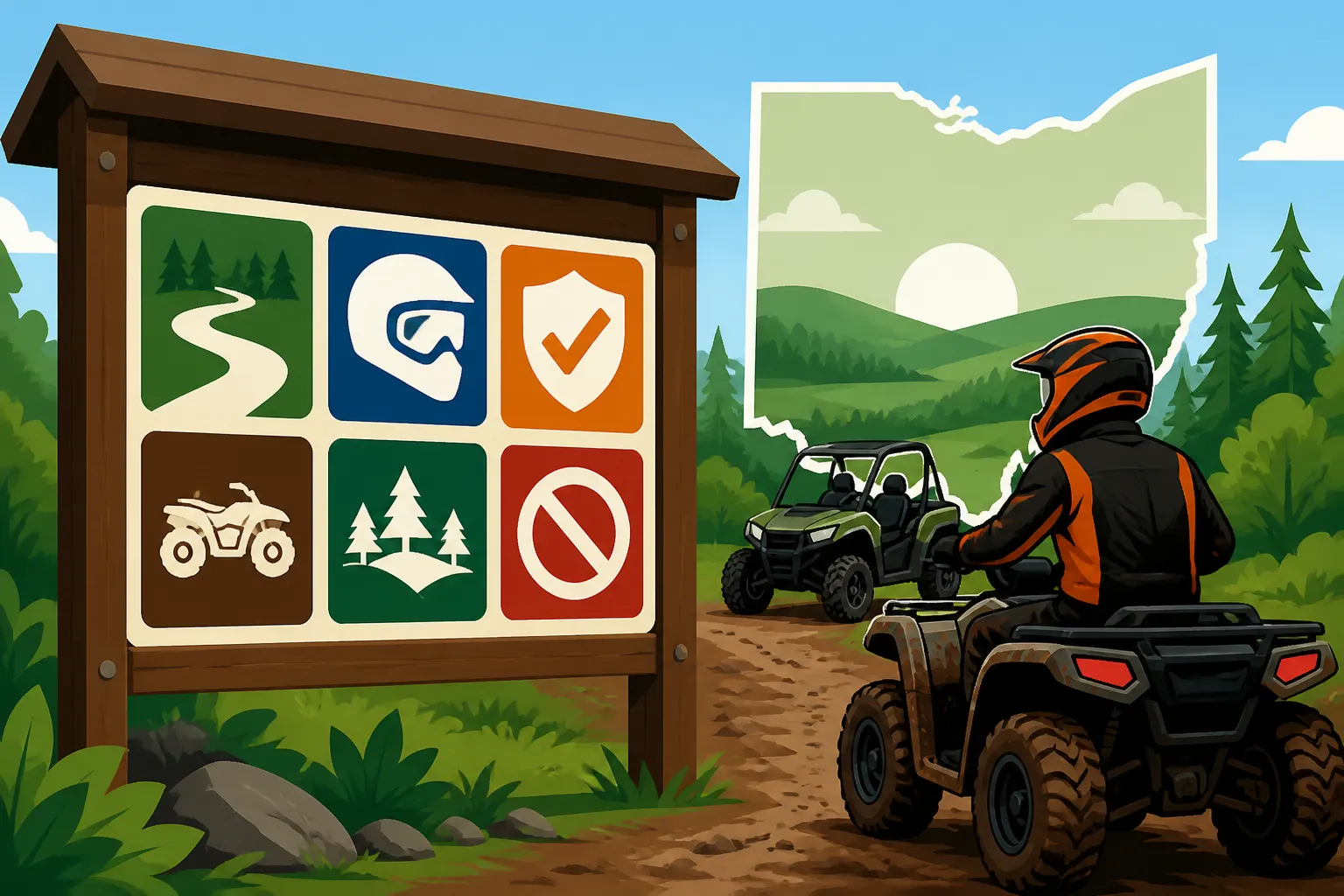
Before unloading, take a moment to read the whole board rather than looking only for a trail map. A board may include a map, posted rules, seasonal notices and contact information, but the details and layout vary by riding area. Treat each item as useful evidence of what applies there, not as a promise that every Ohio trailhead displays the same information.
Start with the map. Identify your starting point, the trails or roads open to machines, any marked intersections, and the route back to the parking area. Check whether the map distinguishes different users or trail types. A route that appears to connect on a general forest map may not be open to ATV or UTV riding.
Look for closure notices before choosing a route. A trail can be temporarily closed because of maintenance, weather damage, timber work or another local condition. Closures may affect only one segment, so trace your intended route carefully and note a legal alternative. If a notice is hard to interpret, do not assume the route is open simply because it appears on the map. Check the posted contact information or ask the managing office before riding.
A trailhead map is helpful for orientation, but it may not be the newest or most detailed source for every condition. Compare it with current information from the land manager when possible. Ohio Trail Maps From ODNR can help with planning, while Ohio Trail Closures to Check First covers why a route that looks open on a map may not be rideable that day.
Pay attention to symbols and legends. A dashed line, colored marker or boundary may identify a route, a closure or a trail intended for a different use. If the legend is missing, unclear or weathered, avoid guessing. Follow the on-the-ground signs and remain on routes clearly designated for your machine.
| What to check | Why it matters | What to do if it is unclear |
|---|---|---|
| Map and legend | Shows route layout, boundaries and sometimes user types | Ask the land manager or choose a clearly marked route |
| Closure notices | Identifies routes that may be temporarily unavailable | Do not ride past a closure; check for an alternate |
| Permit and registration signs | May explain what documents or passes are required | Confirm requirements before unloading |
| Trail rules | May cover speed, hours, machine limits or rider conduct | Follow the posted rule and verify unclear details |
| Emergency and contact information | Helps you report a problem or find assistance | Save the information before leaving the lot |
| Parking and staging directions | Helps prevent blocking access or parking in a restricted area | Use the designated spaces and keep access lanes clear |
The board can also help you judge whether the route suits your group. A short loop may be a better choice than a long route if you are unfamiliar with the area, riding with children or unsure how much time remains before the posted closing time. Do not rely on distance alone: terrain, intersections, stops and machine trouble can make a ride take longer than expected.
Check What the Board Says About Plates and Permits
A trailhead board may remind riders to display registration or carry a permit, but riders should understand the basic requirement before arriving. In Ohio, state forest access and Wayne National Forest access do not necessarily work the same way. A sign at one area should not be treated as a rule for every riding area.
For Ohio state forest riding, an Ohio APV registration plate is generally the required registration credential for an Ohio machine, and the plate serves as the trail access permit in that system. It is not a substitute for following trail rules or for having any required paperwork available. Review Do You Need a Permit for Ohio State Forest Trails? and Why the Ohio Plate Is the Trail Permit before heading out.
Visitors should check whether their home-state registration is accepted for the riding area and what proof they need to carry. Reciprocity depends on the relevant rules and the visitor’s situation; a board may give a short reminder without explaining every state’s requirements. If your home state does not register the type of machine you are bringing, do not assume that an out-of-state plate or bill of sale will be enough. Ohio APV Reciprocity With Other States explains the issue, and The Ohio Temporary Permit for Visitors is relevant when a visitor may need a temporary permit.
Wayne National Forest has a separate OHV permit system. Do not assume an Ohio APV plate alone covers that access requirement. Read the local instructions, confirm that your permit applies to the area you plan to ride, and check whether every rider in your group needs an individual pass. How the Wayne National Forest OHV Permit Works and Which Trails a Wayne Forest Pass Opens explain why checking the permit and the specific route matters.
The board is most useful as a final on-site check, not as your only permit research. A rider who reaches a trailhead without the needed registration or pass may have to leave, even if the machine is otherwise ready to ride. Before loading, confirm:
- Your machine has the registration required for the riding area.
- Your plate is attached and visible as required.
- You have the applicable pass or permit, if the area requires one.
- Your registration or permit is valid for the machine and rider using it.
- You can show the required documents if asked.
If the board and the documents you brought seem to conflict, stop and clarify the rule before entering the trail. A faded sign, an old map or a general statement about visitors may not answer a specific question about your state’s registration. Contact the managing office when possible rather than relying on another rider’s interpretation.
Read the Rules That Affect Your Machine and Group
Trailhead signs often focus on rules that are easy to miss when riders arrive ready to go: where machines are allowed, when riding is permitted, which equipment is required and what conduct can damage the trail. Read the posted rules even if you have ridden the area before. Conditions and notices can change, and another forest or riding area may use different rules.
Check for machine limits, including restrictions on width or type. Some Ohio state forest routes have limits that can exclude wider side-by-sides. If your machine is close to a posted limit, measure it before the trip rather than estimating from the model name. The board may also identify routes that are unsuitable for certain machines or direct riders to a particular route system. Ohio Rules for Riding State Forest Land is useful background, but the local signs still matter.
Look for operating hours and seasonal information. A gate or board may show when an area is open, when a season ends or whether a route is closed for a specific period. Do not assume that a trail is open just because the parking lot is accessible. If you are unsure whether the posted hours apply to riding, parking or both, check with the area manager.
Also look for requirements about helmets, eye protection, age or adult supervision. These can depend on where you are riding and who is in your group. A rider who meets one area’s requirements may still need to follow a different rule elsewhere. When riding with children, confirm the rules that apply to the land and route, then make sure the supervising adult understands them before the group departs.
A board may include practical etiquette reminders as well as legal requirements. Yielding, keeping to the marked route, avoiding unnecessary wheelspin and giving other users room all help keep trails usable. On narrow routes, slow down well before a blind turn and be ready for another machine, a hiker, a horse or a work vehicle. Ohio Trail Etiquette on Narrow Trails offers more detail for shared routes.
Do not treat a lack of a sign as permission to leave the route. Stay on clearly marked trails and respect gates, barriers and private-property boundaries. If a route appears blocked or the markings conflict, turn around rather than creating a new path around the obstruction. Riding around a closure can cause erosion, damage property and put the group onto a route that is not open to machines.
Make the Board Part of Your Pre-Ride Routine
A quick, consistent check is easier than trying to remember every sign once the ride has started. One person can read the map while another checks the machine and gear, but everyone in the group should understand the route and any important restrictions. A passenger or newer rider should also know where the group is headed and what to do if the machines become separated.
Use this sequence at the trailhead:
- Read every current notice. Look for closures, weather-related warnings, work activity and temporary restrictions.
- Match the map to the route markers. Confirm the trailhead location, intended loop and return route.
- Check access requirements. Make sure registration, plates and any separate pass are correct for that riding area.
- Review the rules for your group. Pay particular attention to machine limits, hours, protective equipment and supervision.
- Save useful information. Note the office or emergency contact details and take a photo of the map or posted notice if permitted.
- Choose a realistic route. Account for riders’ experience, machine range, daylight and the possibility of delays.
- Recheck before leaving the lot. Confirm that every rider knows the route and that the group has the required documents.
A photo can be useful if you need to check an intersection later, but it should not replace posted signs or current directions. Keep your phone charged and do not assume you will have cell service on the trail. If you use an electronic map, download the relevant information before leaving an area with reliable coverage. Bring a paper map or another backup when practical.
If you find a closed route after starting, turn around at the closure and use only a clearly open alternative. Do not ride around a barrier, even if the route appears passable or other tracks lead past it. If the board’s directions are unclear or a notice seems inconsistent with signs farther along the route, stop in a safe place and contact the managing office when possible.
A useful pre-ride habit is to check the board again when you return to the staging area, especially if you plan to ride another loop. New information may have been posted, or the first route may have revealed a closure or condition worth sharing with the group. Before heading home, report a damaged sign, blocked route or safety concern through the contact method provided by the land manager.
The trailhead board cannot answer every question about reciprocity, permits or route conditions. Its value is that it brings local information together at the point where it matters. Read it carefully, confirm permit questions before travel, and let current closure signs guide your decisions on the ground.
Disclaimer
This article is for general informational purposes only and does not constitute professional advice. Laws, prices and regulations vary by location and change over time. Consult a qualified professional for guidance on your specific situation.