Ohio State Forest Riding Hours
Ohio state forest riding hours are easy to misread: a trail can be open for the season and still be closed for the night, or temporarily shut because of conditions. The usual riding window runs from half an hour before sunrise to half an hour after sunset. Here’s how to plan around that window, seasonal dates and last-minute closures.
Ohio state forest riding hours
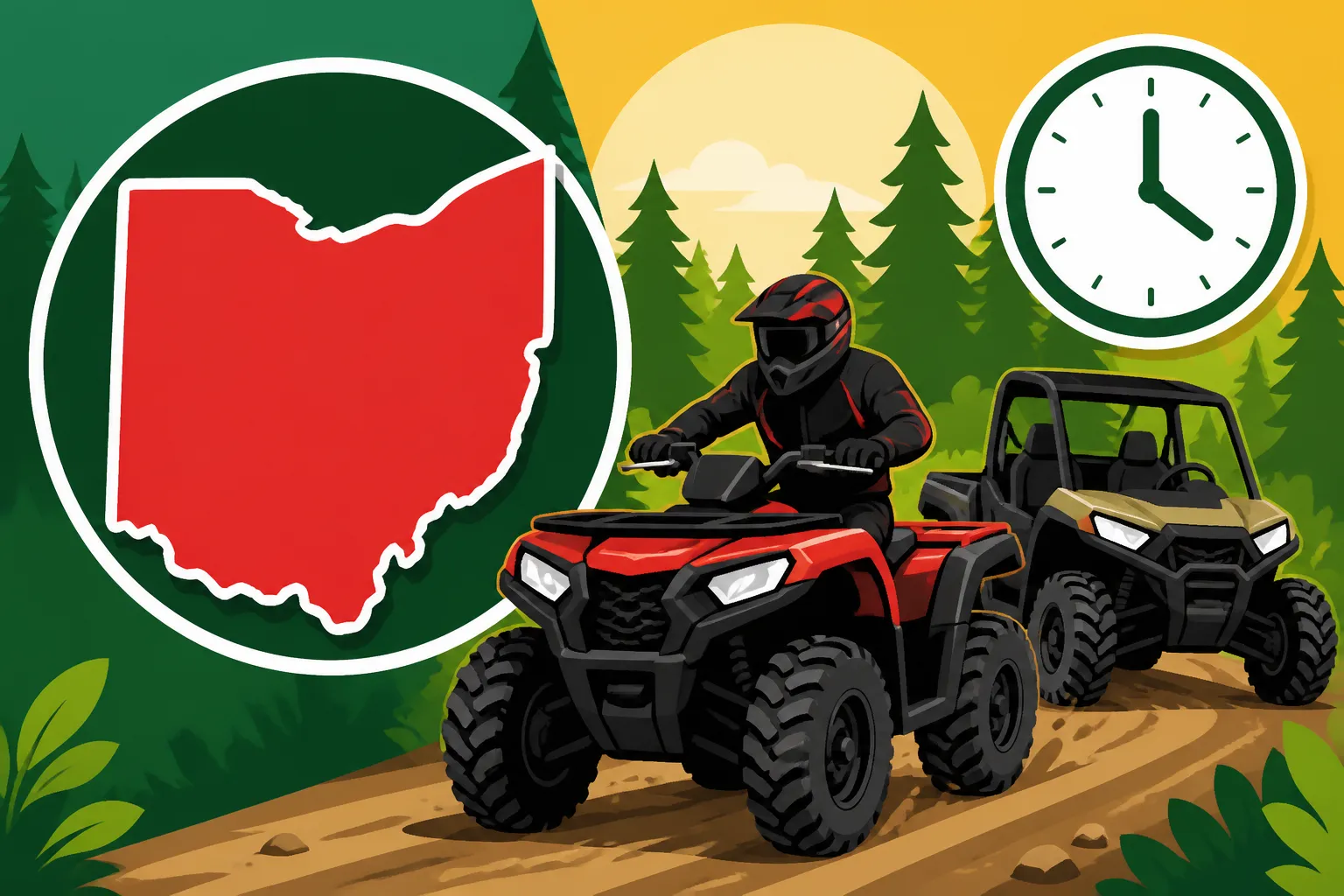
For Ohio state forest trails designated for all-purpose vehicles, the general riding window is from half an hour before sunrise until half an hour after sunset. It is not an all-night schedule, and being on a trail before the cutoff does not mean you can keep riding after it.
Use the sunrise and sunset times for the specific area and day you plan to ride. The window changes through the year, so a departure time that works in summer may be too late in autumn. Build your plan around when you must be off the trails, not just when you expect to arrive at the staging area.
A practical approach is to set a personal turnaround time earlier than the official closing time. That gives your group room to ride back at a safe pace, deal with a flat tire or a stuck machine, and reach the lot before riding hours end. On unfamiliar trails, leave more margin: navigating a new route often takes longer than the map suggests.
The cutoff applies to riding on the trail system. Do not assume that riding slowly, using lights, or heading only a short distance back to your vehicle makes after-hours riding acceptable. If your machine is disabled near closing time, contact the appropriate forest or ranger office for instructions rather than continuing to ride outside the permitted hours.
Start and finish with a time buffer
Before unloading, agree on a return time with everyone in the group. A few simple checks help keep the schedule realistic:
- Check local sunrise and sunset times for your ride date.
- Estimate the full loop, including stops and the ride back to the staging area.
- Allow extra time for muddy, steep or unfamiliar sections.
- Decide what to do if a rider has trouble or the group gets separated.
- Turn around early enough to reach the trailhead before the riding window closes.
A map distance alone is a poor way to estimate ride time. Trail conditions, traffic, machine capability and group size all matter. A route that seems short may take longer when riders need to wait at narrow sections or help someone through a difficult spot.
If daylight is limited, choose a shorter route and avoid adding a spur just because the group is making good time. It is safer to finish early than to count on a perfect trip back.
Seasonal openings are separate from daily hours
The daily sunrise-to-sunset window is only one part of the schedule. Ohio state forest riding areas can also have a riding season, and an area may be closed outside that season even during daylight.
Many Ohio state forest riding areas have a seasonal schedule that generally runs from the first Friday in April to the second Monday in December. Maumee State Forest is an exception that is generally open year-round. These patterns are useful for planning, but they are not a guarantee that a trail is open on a particular day. Check current information before traveling, especially near seasonal opening or closing dates.
A seasonal opening does not cancel the daily riding hours. If a trail is open for the season, riders still need to finish within the daily window. The reverse is also true: daylight does not make a trail legal to ride when it is seasonally closed.
| Schedule question | What to plan for |
|---|---|
| Daily riding window | Generally, half an hour before sunrise to half an hour after sunset |
| Seasonal access | Many areas generally open from the first Friday in April to the second Monday in December |
| Maumee State Forest | Generally open year-round, but check for current closures |
| Temporary closure | Can override the normal season and daily schedule |
| Trail access | Stay on routes designated for riding and follow posted signs |
For the broad seasonal pattern, see Ohio Trail Opening Day and Ohio Trail Closing Day. To understand why schedules differ by forest, Why Three Forests Close and One Does Not gives more context. Always confirm the current status with the relevant official information before loading your machine.
Do not confuse state forests with Wayne National Forest
Ohio state forest riding areas and Wayne National Forest are different places with different access rules. The state forest schedule does not automatically apply to Wayne National Forest routes, and a Wayne permit does not replace requirements for riding on state forest trails. Check the rules for the land you plan to ride, not just the general rules for Ohio.
Likewise, access rules for a road or trail outside a designated state forest riding area may be different. A route that looks passable on a map is not necessarily open to ATVs or UTVs. Stay on marked, authorized routes and obey signs and gates. For more detail about local trail schedules, see Ohio’s Trail Season by Forest and Ohio Trail Closures to Check First.
Closures, weather and trailhead checks
A trail may be unavailable even during its normal season and daily hours. Closures can be temporary or specific to one section. Weather, trail damage, maintenance, land access and other operational needs can affect access. A gate or closure notice takes priority over a general schedule.
Check for current conditions before driving to the trailhead. Look for official forest or trail updates, and read the information posted at the staging area when you arrive. If a sign, gate or current notice conflicts with an older map or a remembered schedule, follow the current restriction. Do not ride around a closure or use an unmarked route to get to an open section.
Heavy rain can make some trails difficult or damage vulnerable surfaces. A trail can also feel different after a dry spell, a freeze or a thaw. The schedule tells you when riding may be allowed; it does not mean every trail is in good condition. For planning around ground conditions, see Ohio Trails After Heavy Rain and Riding After a Week of Rain.
A useful pre-ride check takes only a few minutes:
- Confirm which forest or riding area you are visiting.
- Check whether its trails are in season and currently open.
- Confirm the daily riding window for the date.
- Review any route-specific closures or restrictions.
- Look at the trailhead board before unloading.
- Set a return time that leaves a buffer before closing.
If you cannot confirm a trail’s status, postpone that route or contact the appropriate office rather than assuming it is open. This matters most when traveling a long distance: a seasonal schedule or old trail map cannot tell you whether a specific section is closed today.
Permits, reciprocity and a safe return plan
The time window is only one part of legal access. Before riding, make sure your machine and riders meet the requirements for the area. Ohio’s APV plate serves as the state forest trail permit for machines that need Ohio registration. Visitors may be able to ride using qualifying home-state registration, while riders from states without an applicable registration system may need an Ohio temporary permit. The right answer depends on the machine and the rider’s home-state rules.
For the permit details, see Why the Ohio Plate Is the Trail Permit, Ohio APV Reciprocity With Other States and The Ohio Temporary Permit for Visitors. Do not assume that a plate or permit gives access to every public trail in the state; it applies only where the machine is otherwise allowed.
Rider rules matter too. Ohio state forest trails have requirements involving helmets, eye protection, age and adult supervision. Check the rules that apply to each rider in your group, particularly when children are riding. Helmets and Eye Protection on Ohio Forest Trails and Ohio Forest Access for Riders Under 16 cover those issues.
For the ride itself, match your route to the available daylight and the group’s ability. A compact plan is usually more reliable than trying to cover every trail:
- Pick a route that can be completed with time to spare.
- Carry a charged phone, but do not depend on cell coverage.
- Bring basic tools and supplies for a minor repair.
- Keep the group together and agree on a meeting point if separated.
- Leave the trail before the riding window ends, even if the route is unfinished.
Night-riding equipment does not extend the permitted hours. Headlights help riders see and be seen while riding within the allowed window, but they are not permission to remain on a closed trail after sunset. If a delay makes the return uncertain, turn back early rather than taking an unfamiliar route or riding faster to make up time.
Ohio state forest riding hours are easiest to follow when you treat them as a firm finish time, not a target to reach at the last minute. Check the season, confirm current closures, and give your group enough daylight to return without rushing.
Disclaimer
This article is for general informational purposes only and does not constitute professional advice. Laws, prices and regulations vary by location and change over time. Consult a qualified professional for guidance on your specific situation.