Ohio Rules for a Rented Machine
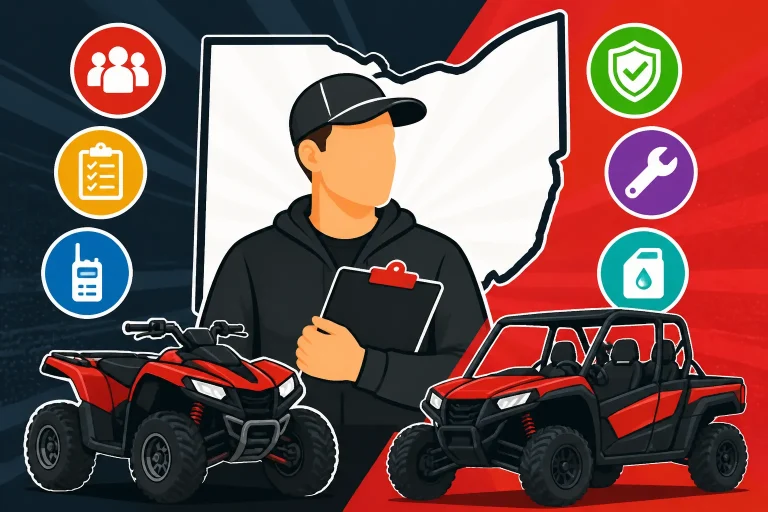
Renting an ATV or UTV can make an Ohio trail day easy, but the rental agreement does not answer every legal question. You still need to know whether the machine is properly registered, whether your visit requires a separate permit, and what rules apply to the place you plan to ride. This guide explains what to confirm before you book and before you unload.
Start With Where You Plan to Ride
Ohio does not have one permit that automatically covers every off-road riding area. Requirements depend on the land, the machine, and sometimes the rider’s home state. A rental company may supply a plated machine but not a separate land-use permit, or it may include a permit for one destination but not another.
Before booking, identify the riding area by name. Ohio state forest trails, Wayne National Forest routes, private riding parks, and private land do not all use the same access rules. A machine that is acceptable at one location may be too wide, improperly equipped, or missing a required permit at another.
| Riding location | What to confirm before the ride |
|---|---|
| Ohio state forest trails | Whether the rental machine has the required Ohio registration or accepted out-of-state registration, fits the trail width limit, and meets rider safety rules |
| Wayne National Forest routes | Whether the required Wayne OHV permit is included or must be purchased separately, and which routes the permit covers |
| Private riding park | The park’s admission, registration, age, equipment, and passenger rules |
| Private property | The landowner’s permission and any conditions they set |
| Public roads | Whether the particular road is open to APVs and whether the machine and rider meet road-use requirements |
If you have not chosen a destination yet, start with Where to Ride an ATV in Ohio and Ohio’s Four State Forest APV Areas. Then check the rules for the specific forest, park, or route. A map that shows a trail does not necessarily mean every rented machine can use it.
The distinction between a state forest and a national forest matters. Ohio’s state forest trail requirements are not interchangeable with Wayne National Forest’s permit system. The rental company may explain what it usually provides, but you should still verify that its answer matches your actual destination and travel dates.
A useful approach is to treat the rental as two separate arrangements:
- The machine: Is it legally registered for the riding area, and is it the right type and size?
- The ride: Do you and any passengers have the required permits, meet the eligibility rules, and understand the route restrictions?
A rental receipt proves that you rented the machine. It does not, by itself, prove that the machine is registered, that you have permission to ride on public land, or that a separate trail permit has been paid.
Questions to Ask Before You Reserve
Rental operators vary in what they include. Ask specific questions rather than relying on a general statement such as “everything is covered.” Ideally, get the answers in writing or keep a copy of the rental information that spells out what is included.
Confirm the machine’s registration
Ask whether the particular machine is registered for the riding location you plan to visit. If the rental company says it is registered, ask what registration or plate it carries and whether that registration is accepted at the destination.
Do not assume a vehicle is ready for every public trail simply because a rental business offers it for off-road use. A business may rent machines for private property or a private park, where the access rules differ from Ohio state forest or Wayne National Forest requirements.
For state forest use, ask whether the machine has a valid plate or other accepted registration documentation. The Ohio plate is not the same thing as a rental agreement. The state’s APV registration system is explained in Ohio APV Permits Explained and Why the Ohio Plate Is the Trail Permit.
If the vehicle is from outside Ohio, ask what state issued its registration and whether that registration is accepted for the planned ride. A machine’s state registration and the renter’s home address are separate issues. A visitor’s residence does not automatically determine whether the machine’s registration is accepted.
Ask whether separate permits are included
Be precise about the destination. Ask, “Does this rental include the permit required for the specific Wayne National Forest route we plan to ride?” That is more useful than asking whether permits are included in general.
If the answer is yes, ask what the permit applies to. It may be tied to a particular machine, rider, passenger, or time period. Do not assume that one permit covers a whole group or every person in a UTV. Confirm whether passengers need a permit of their own and whether the rental company provides evidence you can carry.
If the answer is no, ask where and how you can obtain the required permit before riding. Check current instructions with the official land manager, because the authorized sales locations and permit details can change. How the Wayne National Forest OHV Permit Works explains why that permit is separate from Ohio registration.
Clarify what “included” means
A rental package might include the machine and basic safety equipment but exclude trail access, fuel, damage protection, or transport. Ask the operator to name each included item instead of relying on a package label.
Useful questions include:
- Is the registration current for the entire rental period?
- Will the plate or registration information stay with the machine?
- Is the required land-use permit included?
- Does the permit cover the driver, passengers, or both?
- Are helmets and eye protection supplied, and are they suitable for each rider?
- Is the machine allowed on the specific trail system and within its width limit?
- Are there restrictions on passengers, age, or who may drive?
- Does the rental agreement limit where the machine can be taken?
- What should I do if the plate, permit, or registration paperwork is missing?
- Is the machine insured, and what does that insurance cover?
The rental company may have contractual restrictions beyond public rules. For instance, it may prohibit riding on roads, certain trails, or wet ground even where access might otherwise be allowed. The contract is not permission to ignore public land rules; it is an additional set of conditions you must follow.
Confirm who is responsible for a violation
Ask what happens if the machine is missing a required document or is not permitted on the route. Do not rely on a verbal assurance that “the rental place handles it” if you are the person who will be stopped on the trail.
The rider should be able to show the required documents or explain where they are kept. If the company retains paperwork in a storage box, learn how to access it before leaving the staging area. If the machine has a plate but no visible registration information, ask the operator to resolve that before you depart.
Registration, Reciprocity, and Visitor Permits
A rented machine can be registered in Ohio or another state. The important question is whether that registration is valid and accepted for the place you plan to ride. Reciprocity is about whether Ohio recognizes another state’s registration for a particular use; it is not a general waiver of local trail rules.
Ohio-registered rental machines
If the rental machine carries an Ohio APV plate, verify that the registration is current and that the plate belongs to that machine. Do not remove, cover, or swap the plate. Keep any registration card or other required proof with the vehicle as directed by the rental company.
Ohio’s APV registration rules are separate from title ownership. A rental company may own the machine and hold its title, while you operate it under the rental agreement. You do not need to become the titled owner simply to rent and ride a machine. But ownership being in the company’s name does not remove the need for proper registration.
For more on the difference between a state registration and a land-use permit, see Do You Need a Permit for Ohio State Forest Trails?. Also remember that a plate does not automatically make a machine legal on public roads. Road access depends on the specific road and the machine’s equipment.
Out-of-state rental machines
Some rental fleets operate machines registered outside Ohio. Ask the operator which state issued the registration and whether the company has confirmed acceptance for the intended Ohio riding area.
Do not treat the rental company’s home state, your home state, and the machine’s registration state as interchangeable. A rider may live in one state, rent a machine registered in another, and ride in Ohio. Each fact can matter, so ask about the machine’s registration rather than asking only whether “out-of-state riders are allowed.”
Ohio’s rules for visitors and reciprocity are covered in Ohio APV Reciprocity With Other States and Riding Ohio With an Out-of-State Plate. These can help you understand what to verify, but the rental company should still identify the registration actually on the vehicle.
Machines from states without comparable registration
If the rental machine is registered in a state that does not have an equivalent off-road registration system, a visitor permit may be required for some Ohio riding. The relevant rules can depend on the machine’s status and the destination. Ask the operator whether the machine needs an Ohio temporary permit and who is responsible for obtaining it.
A visitor permit is not necessarily a substitute for every other requirement. It may address registration for a qualifying visitor and machine, but it does not automatically provide a Wayne National Forest permit, private park admission, or permission to ride a closed route.
Use The Ohio Temporary Permit for Visitors and Do Nonresidents Need Ohio Registration? as starting points, then confirm current requirements with the appropriate official source. If the rental company cannot tell you what registration or permit applies, do not assume that the machine is ready for a public trail.
Keep the paperwork accessible
Before leaving the rental counter, find out what documents must accompany the machine and where they are stored. Carrying a photograph on a phone can be a useful backup, but do not assume a photo replaces paperwork that the rules require you to carry. The rental operator should tell you what to present during a roadside or trail inspection.
Check that the registration details match the machine. If the paperwork identifies a different vehicle, the plate is unreadable, or the documents are missing, ask the rental company to correct the problem before you ride. A rider should not have to guess whether the paperwork is valid after arriving at a trail gate.
Wayne National Forest Permits Are a Separate Check
One of the most common rental misunderstandings is assuming that an Ohio plate covers every fee or permit needed to ride. It does not. Wayne National Forest has its own OHV permit requirement, separate from Ohio APV registration. The permit system also has its own conditions, so ask the rental company exactly what is included.
If you are headed to Wayne, confirm all of the following:
- The machine is eligible for the routes you plan to use.
- The required Wayne permit is included or you know where to obtain it.
- You know whether each rider or passenger needs a separate permit.
- You know the permit’s valid period and the routes it authorizes.
- You can show the permit or required proof while riding.
- The machine meets any applicable width and equipment restrictions.
Do not assume a permit is transferable from one rental machine to another or from one rider to another. Ask who the permit is issued to and what it covers. If you are renting multiple vehicles, confirm the arrangement for each one. If a passenger is riding in a UTV, ask whether that passenger has a separate permit obligation.
The rental operator may sell or provide Wayne permits as part of a package, but that does not mean the permit is included automatically. Get a direct answer before you pay. If the company says you can purchase one at the trailhead or from a local vendor, verify that this is practical for your arrival time and destination. An office or sales location may not be open when you arrive.
Wayne routes can also have route-specific closures or restrictions. A permit does not authorize riding off a marked route, through a closed gate, or on a trail that does not allow your machine. Check the current trail information before loading up, and look at the trailhead board when you arrive. What the Trailhead Board Tells You Before a Ride is a useful reminder to check local notices even when your permit is in order.
Ohio state forest trails use a different arrangement. The Ohio plate generally serves as the trail permit on those trails, subject to the applicable registration and riding rules. That does not mean the same plate replaces Wayne’s separate permit. If your trip combines state forest and Wayne routes, check each area independently rather than assuming one authorization carries across the entire weekend.
Also confirm the current permit process directly with the Forest Service or an authorized seller. Permit terms, locations, and required proof can change. A rental company may have accurate information for its usual route, but it may not know that a particular route is closed or that you are planning to ride somewhere outside its standard package.
Rider Eligibility, Equipment, and Machine Fit
A properly registered rental is only one part of a legal ride. The driver and passengers must follow the rules for the land and the machine. The rental company may have stricter age or driver requirements than the public rules, and the stricter rental condition still applies to your reservation.
Age and supervision
Before booking for a young rider, tell the operator the rider’s age and ask whether that person may operate the specific machine. A youth ATV, adult ATV, and UTV are not automatically interchangeable. The rental business may set minimum ages, require a licensed adult, or prohibit a minor from driving altogether.
Public-land rules can also require adult supervision for younger riders. Confirm who qualifies as a supervising adult and whether the adult must ride alongside or remain with the young rider. Do not interpret a rental company’s permission as proof that the rider meets the rules for a state forest or national forest.
If the group includes a minor, make sure the adult responsible for supervision understands the route, trail closures, and emergency plan. A large UTV may feel easier to manage than a quad, but it can still be too wide for a trail system and may have passenger restrictions.
Helmets and eye protection
Ask what protective gear is supplied and whether the fit can be adjusted for each rider. If you use your own helmet, check that it meets the applicable requirements and is the right size. A helmet that is too loose can shift during a ride, while a helmet that is too tight can become uncomfortable enough that a rider removes it.
If you buy gear through Amazon, use the listing to check sizing and product details, but verify the helmet’s required certification and physical label rather than relying only on a product title. Amazon listings can include different versions or sellers of a product, so check that the item delivered matches the one you intended to buy.
Eye protection matters on dusty trails even when a rider wears a helmet. Ask whether the rental company provides goggles or other suitable protection. When comparing goggles on Amazon, check that they fit the helmet and seal comfortably; a pair that leaves a large gap can let dust and debris reach the eyes. Bring a backup if your ride depends on a personal fit you cannot replace locally.
Width, passengers, and route suitability
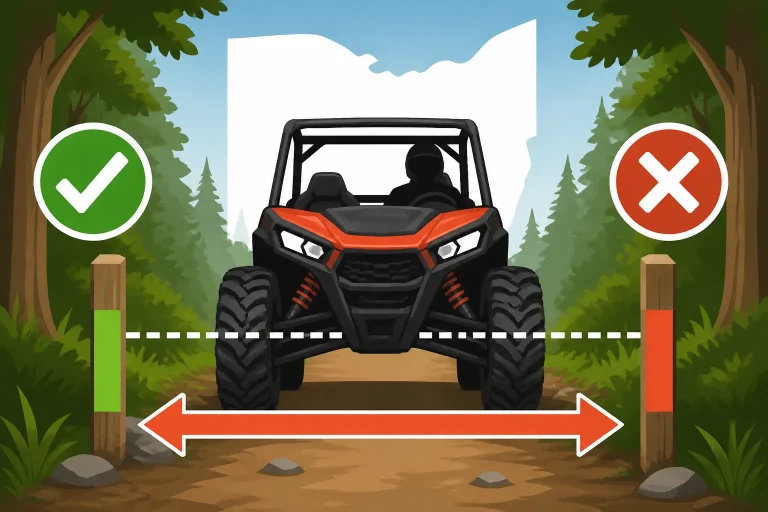
Ask for the machine’s width, not just its model name. Ohio state forest trails have a width limit, and a UTV that is too wide may not be allowed on those trails. A rental company that serves a private park may offer wider machines that are unsuitable for a state forest route.
Do not estimate width by eye. Confirm the actual specification for the rented vehicle, including any accessories that affect its width. If the machine is near the limit, ask the land manager how width is measured and whether installed accessories count. A general statement such as “it fits most trails” is not a reliable answer.
Confirm passenger capacity and do not carry more people than the machine is designed or permitted to carry. A passenger should have a proper seat and restraint where applicable. Never allow someone to ride on a rack, fender, or other improvised position.
Equipment and condition
Before taking the keys, inspect the machine with the rental staff. Check tires, brakes, steering, lights, seat belts on a UTV, and any visible damage. Ask how the machine is started, shifted, and stopped. Find out where the emergency shutoff is and how to contact the operator if the vehicle becomes disabled.
Ask whether the rental includes a basic safety briefing. If you are new to riding, request one even if the company does not require it. A few minutes spent learning the controls can prevent a minor mistake from becoming a rollover or collision.
When buying small personal items through Amazon, such as gloves or a compact first-aid kit, verify that they are suitable for the conditions and do not interfere with controls or restraints. Do not assume a phone, tool, or accessory can be attached to the vehicle without permission; rental agreements may restrict modifications.
Road Use, Private Parks, and the Rental Contract
A machine rented for off-road riding is not automatically street legal. An Ohio APV plate or a Wayne permit does not authorize you to ride on any public road you choose. Road access depends on the route, local decisions, the machine’s equipment, and the rider’s legal eligibility.
If the rental company suggests riding between trail areas on a road, ask which road and confirm that it is open to APVs. Ohio road access can vary by county, township, and municipality. A road that is open in one jurisdiction may be closed in the next. Ohio Counties That Allow APVs on Roads and How to Find an Ohio Township Resolution explain why checking the exact route matters.
Even where a road is open, a machine may need specific road equipment, insurance, and a qualified driver. Do not infer road legality from headlights, turn signals, mirrors, or a plate alone. Ask the rental operator whether the machine is approved for the specific road route and what documents or insurance proof must be carried. If the company cannot confirm road use, transport the machine to an authorized riding area instead.
Private riding parks have their own entry conditions. A park may require a valid plate, proof of registration, a waiver, protective equipment, or a particular kind of admission. A rental agreement does not replace a park’s entrance requirements. Call the park and tell them that you are bringing a rental machine; verify whether the rental company’s documentation is acceptable.
On private property, the owner’s permission controls access. Do not use a farm lane, field, reclaimed mine, or informal path just because it looks rideable or appears on a phone map. Permission should cover the machine, the dates, the people in your group, and any conditions the owner sets.
Read the rental contract before signing. Pay attention to restrictions on:
- Where the machine may be ridden
- Who may operate it
- Whether passengers are allowed
- Whether the vehicle may be transported to another site
- What happens after a breakdown or collision
- Whether damage, recovery, or cleaning charges may apply
- Whether the company requires its own safety equipment or procedures
The rental contract cannot make an otherwise prohibited ride legal. Likewise, a public permit does not override a contract that limits where you may take the machine. You need to satisfy both sets of rules.
A Practical Checklist for Rental Day
A short check before departure can catch the problems that are hardest to fix at a trailhead. Do not rush through it just because the rental counter is busy.
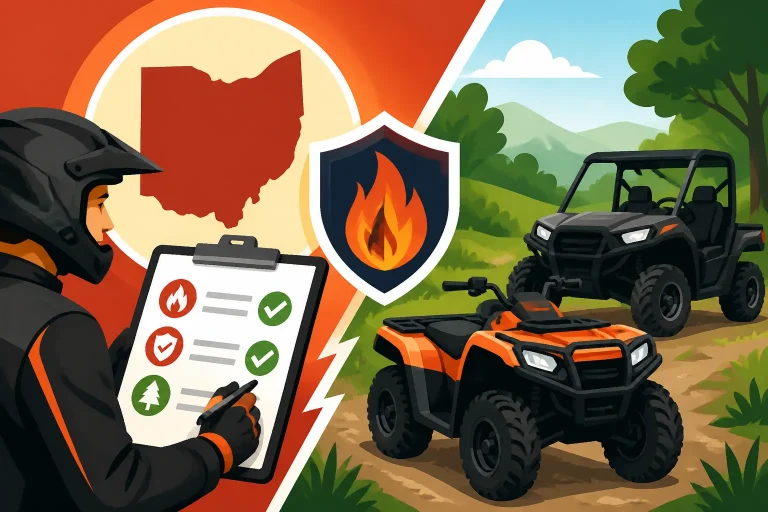
- Name your destination. Confirm the exact trail system, park, or property where you intend to ride.
- Identify the machine. Record its make, model, plate, and stated width. Confirm it is the machine on the paperwork.
- Check registration. Make sure the machine has current registration accepted for that location and that required documents are available.
- Check separate permits. For Wayne National Forest, verify the required OHV permit and what people or machines it covers.
- Confirm rider eligibility. Review age, supervision, driver, passenger, and helmet rules for everyone in the group.
- Inspect safety equipment. Fit helmets and eye protection. Check restraints, brakes, tires, steering, and lights.
- Review the route. Check current closures and restrictions. Do not assume every mapped road or trail is open.
- Read the contract. Confirm where the machine may go and what to do if it breaks down.
- Carry what you need. Keep the rental paperwork, registration proof, permits, and emergency contact information accessible.
- Ask before improvising. If the machine or paperwork does not match what you were told, pause and have the rental company resolve it.
A quick photo of the plate and paperwork can help you keep track of the machine you rented, but it is not a substitute for required documents. Keep personal documents secure and follow the rental company’s instructions for carrying the vehicle’s paperwork.
If a trail officer, ranger, or deputy stops you, stay calm and follow instructions. Show the plate, registration, permits, and identification requested. If you do not know where a document is, say so and contact the rental company rather than guessing or arguing about what the permit covers.
If you discover a problem before riding, do not try to solve it by taking a different trail or removing a plate. Contact the rental operator and ask for a compliant machine, the missing document, or a clear explanation of the rules. If the operator cannot resolve it, contact the appropriate land manager before entering the route.
The safest rental is not necessarily the newest or largest machine. It is one that fits the terrain, fits the riders, meets the rules for the destination, and comes with paperwork you can understand. Confirming those details before booking is easier than discovering a missing permit or an oversized machine at the trail gate.
Disclaimer
This article is for general informational purposes only and does not constitute professional advice. Laws, prices and regulations vary by location and change over time. Consult a qualified professional for guidance on your specific situation.