Ohio Rules for a Machine Wider Than the Trail
A wide side-by-side can be legal to own and still be too wide for an Ohio trail. The key is to separate a land manager’s machine-width limit from the trail’s actual clearance, then check both before unloading. Here’s how to assess the fit, what not to do when a route narrows, and where to look for alternatives.
Two different limits can affect a wide machine
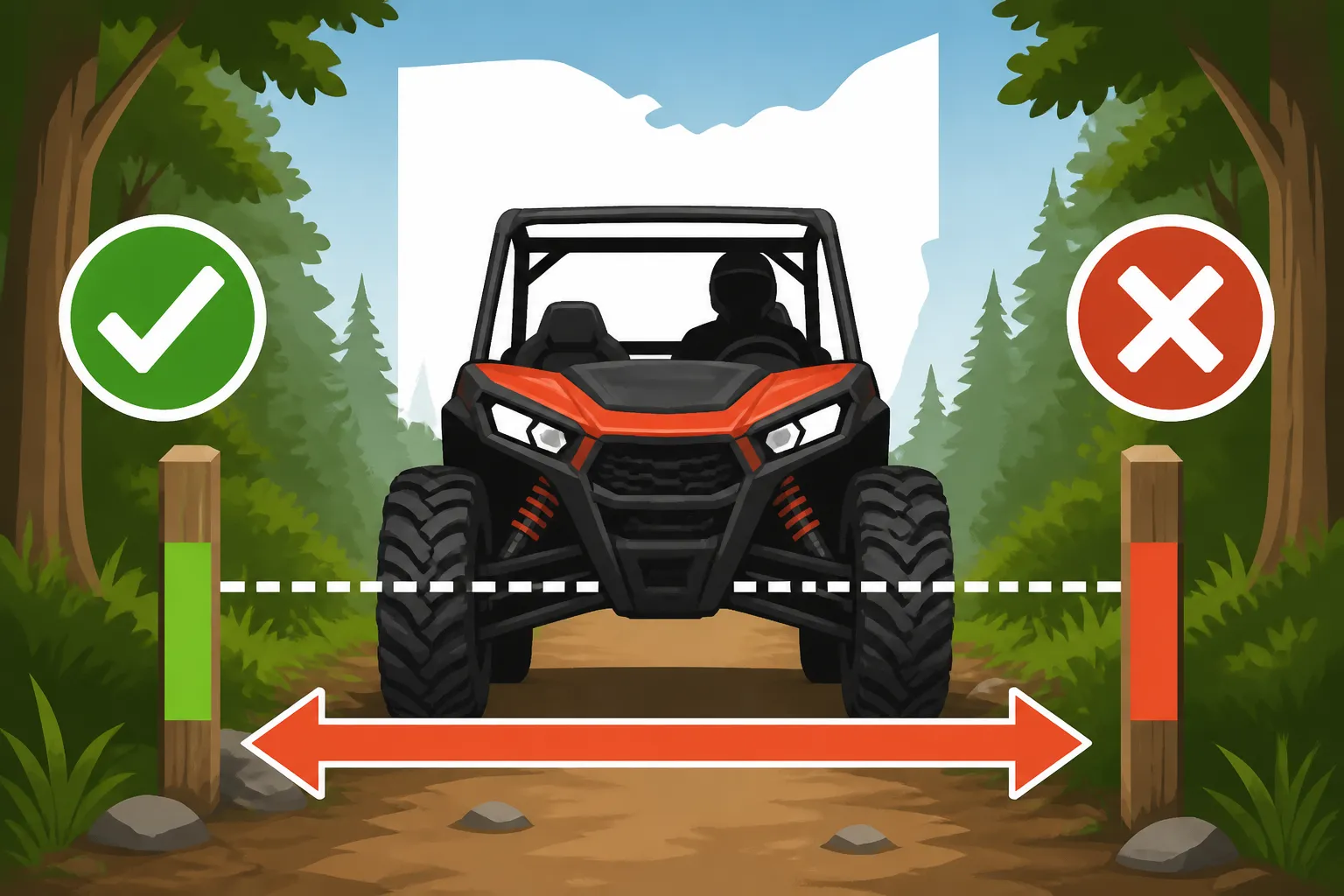
“Wider than the trail” can mean two things: your machine exceeds a posted or land-manager width limit, or it is within that limit but cannot safely fit through a particular stretch. Those are different problems, and meeting one limit does not guarantee that every trail will suit your machine.
Ohio state forest trails have a 62-inch machine-width limit. A machine wider than that should not be taken onto those trails, even if it appears able to squeeze between trees or fit through an open section. Check the rules for the specific riding area as well: a local restriction or sign may set a narrower limit.
Physical clearance matters too. Trails can narrow around trees, rocks, drainage features, gates, or other obstacles. A machine that meets the area’s maximum width can still be a poor fit for a particular trail. Don’t force it through, ride around an obstacle, or leave the marked route to find a wider path.
| Situation | What to do |
|---|---|
| Machine exceeds the area’s posted width limit | Do not ride it on that area’s trails |
| Machine meets the limit but cannot clear a stretch | Turn back or use an authorized alternative |
| Trail has a narrower posted limit | Follow the narrower limit |
| Width limit is unclear | Confirm it with the land manager before unloading |
| Machine is registered in another state | Check reciprocity and width rules separately |
The 62-inch limit is not a promise that every trail is at least 62 inches wide. It is a maximum machine width for the relevant state forest trails, not a minimum trail-clearance guarantee. For more on how the limit works, see Ohio’s 62-Inch State Forest Width Limit and Measuring Against the 62 Inch Limit.
Measure the machine before you choose a route
Start with the machine’s overall width, but don’t rely on a sales listing alone. Specifications can differ by trim, tires, wheels, or installed accessories. A wider tire setup, wheel spacers, or other changes can affect the space the machine occupies. If you are near the area’s limit, measure the machine in the configuration you intend to ride.
A practical check is to measure across the machine’s widest points while it is ready for the trail. That may include the tires or other fixed components that extend beyond the body. Record the result and compare it with the current rule for the riding area. If the official rule defines how width is measured, follow that method rather than assuming your own measurement settles the question.
A tape measure is useful for a quick check at home or before a trip. If you need one, a standard measuring tape from a hardware store or Amazon can do the job; the important part is measuring consistently and not rounding down a borderline result. Check any accessories that change the vehicle’s footprint, and repeat the measurement if you change tires or add equipment.
A few details can make a difference:
- Measure the widest point, not just the width of the cab or body panels.
- Check whether your tires, wheels, or add-ons extend farther than the vehicle’s main body.
- Don’t assume folding a mirror or removing a removable accessory makes the machine compliant. Confirm how the land manager defines vehicle width.
- If the measurement is close to the limit, ask the responsible office how it applies the rule before you travel.
- Recheck the route’s signs and current information. A width limit for one property or trail system may not apply everywhere.
Even a clearly compliant measurement can’t answer whether a particular trail is passable. A narrow bridge, tree gap, or sharp turn may leave less room than the machine needs. Trail conditions can also change after storms, maintenance, or seasonal closures. If the route looks too tight, stop and reassess rather than trying to squeeze through.
Don’t widen the trail or ride around a restriction
If the machine does not fit, the safe and responsible choice is to turn around. Do not cut branches, move barriers, drive over vegetation, or make a new line beside the trail. Those actions can damage the land and turn a short clearance problem into trail erosion or a violation of the area’s rules.
The same applies when a route is blocked or signed for narrower machines. A nearby opening is not permission to bypass the restriction. Stay on marked, authorized routes and obey closures. Ohio’s rules for riding off a marked route are separate from the machine-width limit, but both can matter in the same situation. See Ohio Rules for Riding Off a Marked Trail for more on staying within designated routes.
Before setting out, check the current information for the specific riding area, not just a general description of Ohio trails. Confirm:
- The machine-width limit.
- Whether the route is open to your type of machine.
- Whether any sections have a lower limit or temporary closure.
- What registration, permits, or passes are required.
- Whether the trail conditions are suitable for your machine and group.
A registration plate, permit, or pass does not override a width rule. Nor does permission to ride one property automatically cover a neighboring trail or road. Keep Ohio APV Permits Explained and Ohio Reciprocity for Out-of-State Machines in mind if you are planning a trip from outside Ohio or moving between different land managers’ areas. Reciprocity may address whether an out-of-state registration is accepted; it does not make a machine that exceeds a local width limit eligible for a narrow trail.
If you’re uncertain, contact the land manager before loading the machine. Ask about the exact area and route you plan to use, and describe the machine’s measured width and configuration. A general answer about “UTVs” may not resolve whether your particular machine fits a specific limit.
Choose a riding area that suits the machine
A machine that is too wide for a designated trail may still have lawful riding options, but those options need to be checked independently. Some private riding parks may offer routes or facilities suited to wider machines. Ask the park directly about its width limits, permitted vehicle types, current trail conditions, and any registration or equipment requirements. Don’t assume a private property is open to riding just because it has wide tracks or an open field.
Road use is another separate question, not an automatic fallback. Ohio does not grant APVs a general right to ride on every public road. A road must be open to the relevant use, and additional rules may apply to the vehicle and rider. A machine’s width does not itself make a road available. Check Ohio Counties That Allow APVs on Roads and Ohio Townships That Allow APVs on Roads, then verify the exact roads and local requirements before planning a route.
If a machine is too wide for the trail system you hoped to ride, consider these options:
- Use a riding area that confirms it allows your machine’s width.
- Choose a narrower machine for trails with strict width limits.
- Transport the machine to an authorized location rather than riding it to the trailhead over an unapproved road or path.
- Plan a different route that is specifically open to your machine.
- Postpone the trip if the land manager cannot confirm that the machine is permitted.
For a trip involving a side-by-side, also check width before relying on advice meant for quads. A quad may fit a route that a wider UTV cannot. The same caution applies to aftermarket changes: if a machine was compliant before a tire or wheel change, measure it again afterward.
The practical rule is simple: confirm the limit for the exact riding area, measure the machine in its riding configuration, and treat real trail clearance as a separate concern. If the machine is too wide under the rule, don’t enter. If it meets the rule but cannot safely fit, turn back. That protects the trail, avoids a needless citation or recovery problem, and helps keep your ride within the area’s rules.
Disclaimer
This article is for general informational purposes only and does not constitute professional advice. Laws, prices and regulations vary by location and change over time. Consult a qualified professional for guidance on your specific situation.