Ohio Rules for Retrieving Game by APV
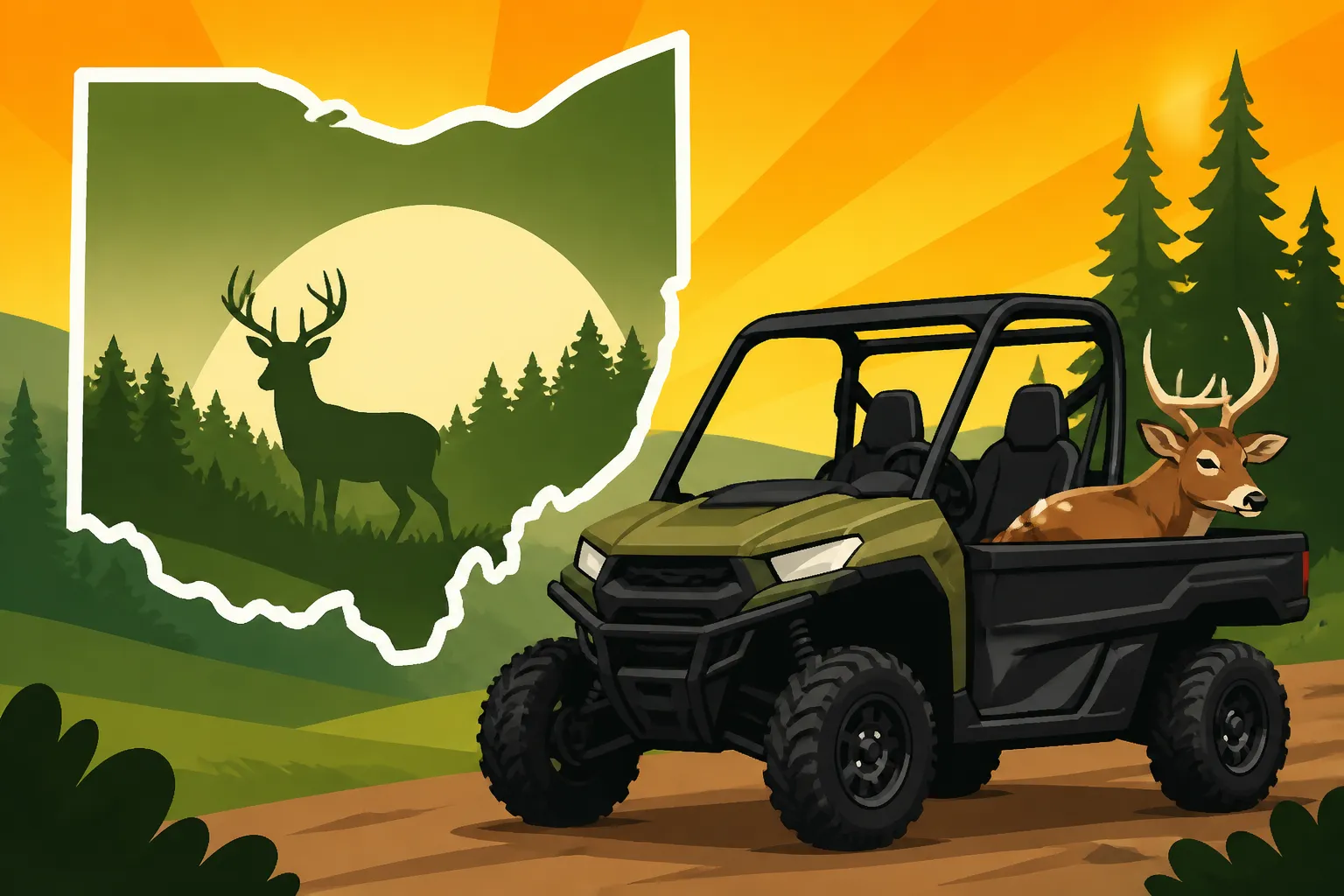
Recovering a deer or other game with an ATV or UTV can seem like a simple way to avoid a difficult carry. In Ohio, though, the route matters as much as the machine: permission to hunt or ride does not automatically authorize off-route travel. Here’s how to think through recovery on private property and public land, and what to check before you load up.
Separate game recovery from hunting by APV
A machine used to transport an animal that has already been legally taken is not necessarily being used to hunt. But the distinction can disappear if the APV helps locate, flush, chase, surround, or pursue wildlife. Keep the machine out of the hunt itself: do not use it to drive game toward a hunter, follow an animal to enable a shot, or search cover in a way that amounts to pursuit.
An APV is also not permission to hunt from a vehicle. Keep firearms and other hunting equipment under control, and do not discharge a weapon from or toward a machine. Rules about carrying a firearm, hunting from a vehicle, and recovering a harvested animal are separate questions. For the firearm issue, see Ohio Rules for Carrying a Firearm on an APV.
Before moving an animal, make sure the harvest is lawful and meet Ohio’s applicable tagging and reporting requirements. A machine does not change those obligations. Nor does an apparently short trip make it acceptable to cross land or use a route that is closed to motor vehicles.
A useful way to plan is to ask two questions independently:
- May the APV travel on this specific ground and route?
- Is the machine being used only to transport game already taken, rather than to pursue or take wildlife?
If either answer is uncertain, stop and verify the rule with the land manager or property owner before riding. A registration plate, hunting permission, or successful harvest does not settle both questions.
| Where the game is | What to check before using an APV | Practical approach |
|---|---|---|
| Private property | The owner’s permission and any conditions on motorized travel | Agree on the recovery route before riding |
| Wildlife area | The area’s current motor-vehicle rules and any designated routes | Do not assume hunting access includes APV access |
| State forest | Whether motorized use is allowed on the specific trail or road | Stay on routes open to the machine |
| Wayne National Forest | The rules for the particular road or OHV trail, plus any required access pass | Do not treat an OHV pass as permission to leave the route |
| Public road | Whether APVs may use that road and whether the machine meets applicable road-use rules | Don’t use a road connection to justify off-road travel |
Private land: get permission for the recovery route
On private land, permission to hunt and permission to drive an APV are related but not identical. A landowner might allow hunting but expect a hunter to carry game out by hand. Another may allow a machine on a farm lane while prohibiting travel through fields, woods, crops, or wet ground. Ask specifically about APV use and the route, rather than relying on a general invitation to hunt.
A short conversation before the season can prevent a difficult decision after a harvest. Clarify:
- Which machine, if any, may be used.
- Where it may travel, including farm lanes and gates.
- Whether the permission covers the whole property or only a named area.
- Whether there are limits during wet conditions, crop seasons, or other sensitive times.
- Where the animal may be loaded and whether the machine may be parked nearby.
Written permission can help avoid confusion, especially when several hunters share access or the person giving permission is not the landowner. It should describe the access actually granted; it cannot authorize travel across neighboring property or public land. For more on permission and boundaries, see Ohio Landowner Permission Rules and Riding Private Ground in Ohio.
Keep to the agreed route even if the ground next to it looks easier. An APV can leave ruts, damage crops, or disturb a property owner’s land, and a route that seems passable on the way in may become difficult after rain. If the animal lies beyond the permitted travel area, ask the owner before taking the machine farther. Do not assume that recovering harvested game creates an automatic exception to the owner’s conditions.
The same care applies when a machine is used on a farm lane. A lane may be private, public, or subject to restrictions that are not obvious from its appearance. Get permission for private access and confirm the route’s status before using it; Ohio Rules for Riding a Farm Lane explains why the label “farm lane” alone does not answer the access question.
Public land: a harvest does not open closed routes
Public ownership does not mean unrestricted APV access. Ohio wildlife areas, state forests, and national forest land each have their own motor-vehicle rules. A place where hunting is allowed may prohibit APVs, limit them to designated roads or trails, or close routes seasonally. A lawful harvest does not, by itself, allow you to leave an open route and drive to the animal.
This is the key practical distinction: where hunting is permitted and where motorized travel is permitted may not be the same place. Before the hunt, check the specific property’s current map, signs, and access rules. Look for closures, seasonal limits, vehicle restrictions, and whether the route is open to your type of machine. A trail that appears on a recreational map is not automatically an approved game-recovery route.
On wildlife areas, check the property-specific rules rather than assuming that a road, field edge, or maintenance track is open to APVs. Some public areas restrict motor vehicles to designated access routes, and rules may differ from one property to another. See Ohio Rules for Riding a Wildlife Area for more on why public hunting access should not be mistaken for general vehicle access.
State forest riding is also limited to routes and conditions that the land manager allows. Ohio’s APV registration and state-forest trail access do not grant permission to drive through the woods or across a closed area to reach game. Confirm the status of the particular route, and follow its posted limits. More detail is available in Ohio Rules for Riding a State Forest.
For Wayne National Forest, distinguish an approved OHV route from other forest roads, trails, and land. A pass or permit for a designated riding area does not authorize off-route travel to retrieve an animal. Check the current route information and any conditions set by the forest before the trip. Ohio Rules for Riding a National Forest covers this difference between access to an OHV route and general access across national forest land.
A state or visitor permit addresses only the access it is issued for. It does not override a closure, authorize travel on a route that is not open to APVs, or replace permission from a private landowner. If you ride across public land to reach private hunting ground, check the rules on every section of the route, not just the destination. Permit and reciprocity details are covered in Ohio APV Permits Explained.
Plan recovery before the shot
The easiest time to sort out a recovery route is before hunting, when there is no pressure to move quickly. Decide whether you can reach the hunting area by a permitted route, whether an APV is allowed there, and how you will bring game out if the machine cannot travel to the animal. A cart, game sled, or help from another person may be a better option where motorized access is limited.
Use this checklist before relying on an APV:
- Identify the land manager. Confirm whether the ground is private, a wildlife area, state forest, national forest, or another kind of public property.
- Check the exact route. Use current property maps and posted signs. Do not infer APV access from a hunting map, a trail on a consumer app, or tire tracks.
- Confirm the machine’s access status. Check registration, any applicable permits, and machine-specific restrictions. If you are visiting from another state, do not assume that out-of-state registration grants access to every Ohio route.
- Ask about exceptions in advance. If a disability-related accommodation or other special access arrangement may apply, confirm the process with the responsible land manager. Do not rely on an assumed exception.
- Plan an alternative. Be ready to carry, drag, or otherwise retrieve the animal without taking the APV off an approved route.
- Recheck conditions on arrival. Temporary closures, signs, weather, or changed access conditions may affect a route that was previously open.
If an animal is down beyond an authorized route on public land, do not make a fresh track through the woods simply because the animal is already harvested. Contact the property manager or conservation officer for instructions. They can clarify whether there is a lawful access option for that location. If you cannot confirm authorization, leave the APV on the permitted route and use another recovery method.
Avoid road and boundary assumptions
Road access can create its own confusion. An APV that may be used on a particular public road is not thereby allowed to travel off that road onto adjacent land. Likewise, crossing a road or riding a short distance along it does not give permission to continue through a closed area. Road rules depend on the road and location; check them separately from hunting and land-access rules.
Pay attention to property lines, gates, signs, and route markers, especially in areas where public and private land are close together. A forest road may lead toward private property without granting permission to ride onto it. A private access road may cross public land, or the reverse. If the boundary or status is unclear, stop rather than guessing.
During deer season, other users may be on the same roads and trails, including hunters on foot, landowners, and authorized workers. Ride slowly, keep sightlines clear, and avoid blocking a route while loading an animal. If the machine or cargo would make safe passage difficult, use a suitable staging spot that is actually open to you.
The safest rule is straightforward: use an APV for recovery only where the machine is allowed to travel, and only after the animal has been legally taken. Check public-land rules property by property, get explicit permission for private routes, and have a non-motorized recovery plan when access is restricted.
Disclaimer
This article is for general informational purposes only and does not constitute professional advice. Laws, prices and regulations vary by location and change over time. Consult a qualified professional for guidance on your specific situation.