Ohio Rules for Riding a Farm Lane
It can be incredibly frustrating trying to figure out the specific rules for riding your ATV or UTV on a farm lane in Ohio. You're just trying to get from one field to another, or maybe bring supplies to a barn, and suddenly you're wondering if you're breaking some obscure law. This guide is here to cut through that confusion and give you a clear understanding of what you can and can't do when operating your all-purpose vehicle on a farm lane in the Buckeye State.
Understanding What "Farm Lane" Really Means in Ohio
When we talk about a "farm lane," most of us picture a gravel path winding through fields, maybe leading to a farmhouse or a distant pasture. And for the most part, that's what it is. But legally, and practically, there are some nuances that are crucial for Ohio ATV and UTV riders to understand. It's not always as simple as "if it's on a farm, anything goes."
The Legal vs. Practical Definition
From a legal standpoint, a farm lane is generally considered private property. This is the key distinction. Unlike public roads, which are owned and maintained by the state, county, or township, a farm lane belongs to the landowner. This means the rules of the road for public thoroughfares often don't directly apply, which is a huge relief for many farmers and recreational riders who use their machines as vital tools. You're not typically worried about things like turn signals or horn requirements when you're just driving through your own cornfield. However, it also means that access is strictly controlled by the owner. If you don't own the land, you absolutely must have permission to be there. Ignoring this basic principle is how riders unfortunately find themselves in hot water for trespassing.
Practically, these lanes are built for specific purposes: moving livestock, transporting equipment, accessing fields for planting or harvesting, and getting around the property efficiently. They're rarely paved, often rutted, and can vary wildly in condition depending on the season and the land. Your ATV or UTV is perfectly suited for these conditions, offering the agility and ruggedness needed to navigate uneven terrain that a standard vehicle might struggle with. Many riders, especially those using their machines for demanding farm tasks, often equip their ATVs or UTVs with durable aftermarket parts, perhaps from a brand like SuperATV, to withstand the rigors of farm life.
When a Farm Lane Isn't Just "Yours"
While most farm lanes are straightforward private property, there are scenarios where things get a bit more complex. Sometimes, a farm lane might have an easement for a utility company, or perhaps it serves as access for multiple property owners. In these cases, while it might still feel like a private lane, there could be shared access rights or specific agreements in place. It’s always a good idea to clarify these details, especially if you’re riding on land that isn’t solely owned by you or your immediate family. You don’t want to inadvertently trespass on someone else’s easement or violate a neighbor’s right-of-way.
Another consideration is when a farm lane directly abuts or even crosses a public road. This is where the lines blur considerably, and knowing Ohio's specific regulations becomes paramount. What's perfectly fine on your private property can become a legal issue the moment your tire touches public asphalt without proper adherence to the law. Understanding these transition points is vital for staying safe and legal.
Navigating Ohio's Laws on Farm Lane ATV/UTV Use
Ohio law is pretty clear about the distinction between riding on private land and riding on public roads. When you're on a farm lane that is entirely within private property, the rules are much more relaxed. However, you still have responsibilities as a rider and, most importantly, you need permission.
Private Property vs. Public Access
The fundamental principle here is that private property is private. On your own farm, or on a farm where you have explicit permission from the landowner, you are largely free to operate your ATV or UTV without the burden of typical road-going vehicle requirements. This means no need for an Ohio APV plate or registration just for private farm use, no specific helmet laws (though safety is always paramount, so please wear one!), and no requirements for turn signals, mirrors, or other road-legal equipment. This freedom is why ATVs and UTVs are such workhorses on farms across Ohio, from hauling feed to checking fences. You can freely use your machine to pull trailers, carry tools, and generally get work done without worrying about state-mandated inspections or specific lighting for road travel.
However, this freedom vanishes the moment you leave private property and enter public land or roads. Even if it's just for a few feet to access another part of the farm that is technically separated by a public right-of-way, you need to understand the implications. Ohio law makes a distinct separation, and it's essential not to confuse the two. For a full breakdown of the general rules, you might want to read [Ohio Rules for Riding Private Land].
The Importance of Landowner Permission
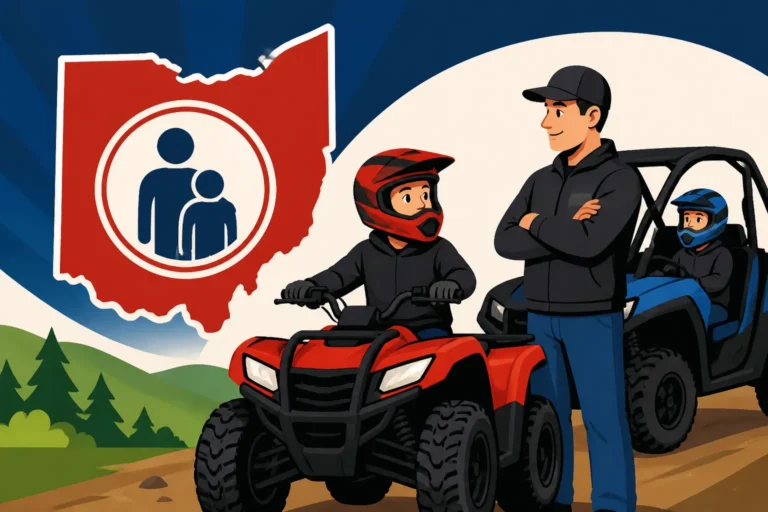
I cannot stress this enough: if you do not own the farm, you absolutely must have permission from the landowner to ride your ATV or UTV on their farm lanes. This isn't just common courtesy; it's the law. Riding on someone else's property without permission is trespassing, and it can lead to legal trouble, fines, and even impoundment of your machine. This applies whether you're just joyriding or genuinely trying to help with farm work.
- Get it in writing: While a verbal agreement might suffice between close friends or family, getting written permission is always the safest bet. It clarifies the terms of your access, including areas you can or cannot ride, and provides proof if there's ever a misunderstanding.
- Respect their wishes: Even with permission, be mindful of the landowner's specific instructions. They might have certain fields that are off-limits, or ask you to avoid riding near sensitive areas like livestock pens or newly planted crops. This respect builds trust and helps ensure future access. More details on this can be found in [Ohio Landowner Permission Requirements] and [Ohio Trespass Rules for Riders].
Specific Equipment and Safety Considerations for Farm Lanes
While legal equipment requirements are minimal on private farm lanes, safety should never take a back seat. Farm work can be inherently risky, and ATVs and UTVs, while incredibly useful, are not toys.
Here's a table outlining key safety considerations for farm lane use:
| Safety Aspect | Importance on Farm Lane |
|---|---|
| Helmets | Highly Recommended. Though not legally required on private land, collisions, rollovers, or impacts with low-hanging branches are always a risk. A good helmet, like a DOT-approved one, can be a life-saver. For more on general helmet rules, check out [Ohio Helmet Law for APV Riders]. |
| Eye Protection | Essential. Dust, debris, insects, and low-hanging branches are constant threats to your eyes. Goggles or a full-face helmet visor will protect your vision. This is generally good practice, whether legally mandated or not, as discussed in [Ohio Eye Protection Requirement]. |
| Proper Footwear | Sturdy, closed-toe boots are crucial. They protect your feet from impacts, provide grip, and keep mud and debris out. Avoid sandals or open-toed shoes. |
| Gloves | Protect your hands from blisters, cuts, and scrapes, and provide a better grip on the handlebars, especially when maneuvering heavy loads or in wet conditions. |
| Lighting | If riding at dawn, dusk, or night, working headlights and taillights are non-negotiable. Farm lanes can have unexpected obstacles, and visibility is key for safety. This is particularly important on farms, where tasks often extend past sunset. You can learn more about general lighting requirements in [Ohio Rules for Riding After Dark]. |
| Machine Maintenance | Regular checks on tires, brakes, fluids, and steering components are vital. A breakdown in a remote field can be more than just an inconvenience; it can be dangerous. |
| Machine Load Limits | Never overload your machine or exceed its towing capacity. This compromises stability and braking, increasing the risk of rollovers or loss of control, especially on uneven farm terrain. |
| Spark Arrestor | Absolutely critical, especially in dry conditions. A properly functioning spark arrestor prevents engine sparks from igniting dry grass or crops. Many machines come with them, but always ensure it's in good working order. |
For those using their UTVs for heavy-duty farm work, accessories from companies like SuperATV can enhance safety and utility, such as heavy-duty axles, upgraded suspension components, or durable windshields to keep dust and debris out of the cab.
Practical Tips for Responsible Farm Lane Riding
Riding on a farm lane is about more than just knowing the letter of the law; it's about being a responsible rider and neighbor. A little common sense and respect go a long way in ensuring you, and your fellow riders, can continue to enjoy the privileges of riding on private land.
Respecting the Land and Neighbors
When you're riding on a farm lane, remember you're often in someone's livelihood or even their backyard. Your actions can directly impact them.
- Stay on designated paths: Don't cut across fields, especially those with crops or new growth. Even seemingly bare ground can be sensitive. Stick to established lanes and trails.
- Control noise: While ATVs and UTVs aren't silent, try to be mindful of excessive noise, especially near homes, livestock, or during early morning or late evening hours. Many farms have neighbors who appreciate peace and quiet.
- Leave no trace: Pack out everything you pack in. Don't litter. If you see trash, consider picking it up. Leave the land cleaner than you found it.
- Watch for livestock: Always be vigilant for animals. Slow down, give them a wide berth, and avoid startling them. An spooked animal can be dangerous to itself, you, and the farmer.
- Be aware of farm operations: Tractors, combines, and other large machinery have the right-of-way. Give them plenty of space. Farmers are often busy and may not expect an ATV or UTV around every corner.
Maintaining Your Machine for Farm Duty
A well-maintained machine is a safe and reliable machine, especially when you depend on it for farm tasks. The demanding nature of farm lanes – dust, mud, rough terrain, heavy loads – means your ATV or UTV takes a beating.
- Regular cleaning: Mud, dirt, and crop residue can clog radiators, foul air filters, and accelerate wear on moving parts. A thorough wash after a day on the farm is not just cosmetic; it's preventative maintenance.
- Tire checks: Farm lanes are full of potential hazards like rocks, sharp sticks, and debris. Inspect your tires regularly for punctures, cuts, and proper inflation. The right tire pressure is crucial for stability and handling, especially with varying loads.
- Brake inspections: Hauling heavy loads or navigating hilly terrain puts extra strain on your brakes. Check your brake pads and fluid levels frequently.
- Fluid levels: Engine oil, transmission fluid, and coolant are vital. Regularly check and top off or replace fluids according to your owner's manual.
- Suspension and steering components: Rough farm lanes can take a toll on tie rods, ball joints, and shocks. Listen for unusual noises and feel for excessive play in the steering. Brands like SuperATV offer heavy-duty replacement parts that can stand up to the rigors of farm use.
What If a Farm Lane Crosses a Public Road?
This is where many riders get confused and where the potential for legal issues arises. It's common for a farm property to be bisected by a township road, or for a farm lane to briefly meet a county road before continuing on the other side. This brief encounter with public property changes everything.
The Quick Dash Across a Township Road
Ohio law does permit crossing a public road with an ATV or UTV, but it comes with strict conditions. You can't just cruise down the road for miles. The purpose of the crossing must be to get from one section of private property to another, and the crossing must be done in the most direct and safest manner possible. This isn't permission to ride your quad to the general store!
Here are the critical points for legally crossing a public road in Ohio:
- Purpose: Must be for accessing another part of the same private property.
- Directness: The crossing must be at approximately a 90-degree angle to the road. You can't ride parallel to the road for any distance.
- Visibility: Yield to all traffic on the public road. Ensure you have clear lines of sight in both directions before proceeding.
- Safety: The crossing must be made safely and without interfering with traffic.
- Local Ordinances: Always check if the specific township or county where the farm is located has any unique local ordinances. While Ohio state law sets the baseline, local authorities can sometimes add further restrictions or, in some cases, open up roads to APV use. For more on local rules, see [Ohio Rules for Riding a Township Road] or [Ohio Rules for Riding a County Road].
Equipment Needed for Brief Road Crossings
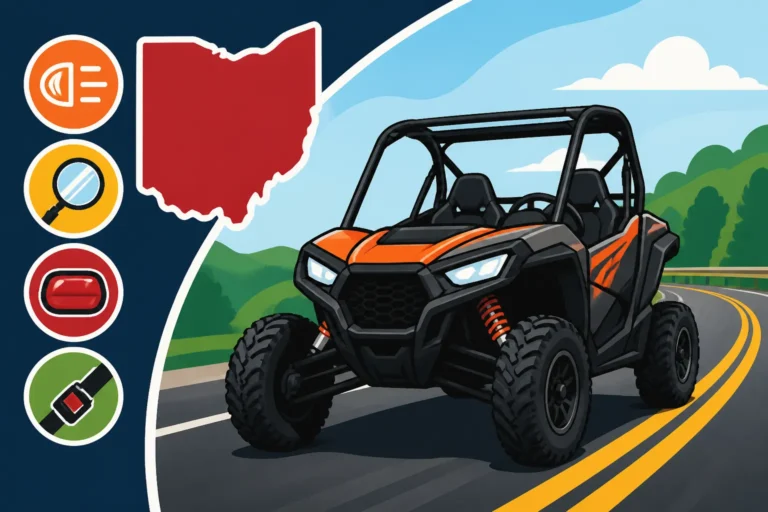
If your ATV or UTV touches a public road, even for a brief crossing, it must meet certain minimal equipment requirements as specified by Ohio law for all-purpose vehicles. This is a common point of contention and misunderstanding, as many farm machines are not outfitted for public road use.
Here's a list of what's generally required:
- Headlight: Must be on and visible from at least 500 feet to the front.
- Taillight: Must be on and visible from at least 500 feet to the rear.
- Brakes: The machine must have at least one brake system, capable of stopping the vehicle.
- Muffler: Must have an adequate muffler system to prevent excessive noise.
- Spark Arrester: A properly functioning spark arrestor is required.
- Plate & Registration: Your APV must be registered with the State of Ohio and display a valid APV plate. This is probably the biggest requirement that surprises many riders. Even for a momentary crossing, your machine needs to be street-legal in terms of registration. You can learn about this process in [Registering an APV in Ohio] and [Ohio APV Plates and Validation Stickers].
- Driver's License: The operator of the APV must possess a valid driver's license. If you're riding on a farm lane with just a permit or no license, you cannot legally cross a public road. Find more details on this in [Ohio Driver's License Rules for APVs].
- Insurance: If crossing a public road, you also need proof of liability insurance. While not required for private land use, it's essential for any public road interaction. Check [Ohio APV Insurance Requirements] for more information.
For UTVs, the requirements can be even more stringent if the specific local jurisdiction has opened its roads for UTV use, often requiring things like turn signals, mirrors, and even windshields. However, for a simple crossing to get from one private parcel to another, the basic APV equipment list generally applies. It’s always best to be over-prepared than under-prepared when it comes to road-adjacent riding. You can check out [Ohio APV Road Equipment List] and [Ohio UTV Road Equipment List] for more details on these requirements.
Always remember that safety is paramount. Even a brief crossing exposes you to road traffic. Be cautious, be visible, and follow all traffic laws.
Disclaimer
This article is for general informational purposes only and does not constitute professional advice. Laws, prices and regulations vary by location and change over time. Consult a qualified professional for guidance on your specific situation.