Riding Warren Township Roads
Oh, the age-old question for us ATV and UTV enthusiasts in Ohio: "Can I actually ride my machine on the road around here?" It's a valid frustration, isn't it? One moment you're dreaming of a quick cruise from your driveway to the local gas station, or maybe just connecting two sweet trail sections, and the next you're buried in obscure Ohio Revised Code sections and township resolutions. It feels like every county, and sometimes even every single township, has its own unique rulebook, leaving many riders scratching their heads. This guide is here to untangle the specifics of riding your all-purpose vehicle (APV) on the roads of Warren Township, Ohio, making sure you know exactly what you need to do to stay legal and enjoy your ride.
Understanding Ohio's Approach to APV Road Use
Let's get one thing straight from the start: Ohio is not a "street legal" state for ATVs and UTVs in the way some others might be. There isn't a blanket law that says, "Yes, all APVs can hit any road." Instead, Ohio takes a very localized approach, which can be both a blessing and a curse. This means that whether you can ride on public roads largely depends on the specific county commissioners or township trustees in your area. They're the ones who have the power to open up their roads to APVs.
Why Local Control Matters for Your Ride
This system of local control is precisely why you can have two adjacent townships with completely different rules. One might welcome APVs with open arms, seeing them as a boon for local tourism or a practical way for residents to get around, while the next might strictly prohibit them, citing safety concerns or noise. It's a patchwork quilt of regulations, and if you don't know the pattern for your specific square, you could find yourself in a heap of trouble. The default in Ohio is that if a road isn't explicitly opened by a local resolution, it's considered closed to APVs. This can be incredibly frustrating when you see others riding, but you're unsure if their situation applies to you or if they're simply unaware of the rules.
The Specifics of Warren Township
Thankfully, riders in Warren Township, often located within Washington County, have some good news. The township trustees have passed a resolution to allow the use of APVs on many of the roads under their jurisdiction. This means you're in a township that has embraced the idea of APV road access, which is a significant hurdle cleared! However, "allowing" isn't a free-for-all. It comes with a specific set of rules and requirements that riders must adhere to. Think of the resolution as the green light, but you still need to know the traffic laws. You'll want to be familiar with [A Township Trustees' Resolution in Ohio] to understand the nuances. Even with a resolution in place, it's always wise to check with the Warren Township clerk or their official website for the most current and specific details of their ordinance, as sometimes there are particular roads excluded or specific conditions to meet beyond the statewide minimums.
Essential Requirements for Riding Warren Township Roads
So, Warren Township has given you the green light to ride on certain roads – fantastic! But before you crank up your engine and hit the pavement, there are some non-negotiable requirements you absolutely must meet. These aren't just suggestions; they're legal mandates designed to ensure safety and accountability.
Getting Your APV Road-Ready and Registered
The first, and perhaps most fundamental, step is to make sure your APV is properly titled and registered with the state of Ohio. This isn't just for trail riding; it's a critical component for road legality anywhere in the state. If you haven't done this yet, you'll need to start by [Titling an APV at an Ohio Clerk of Courts]. Once that's squared away, you can proceed with [Registering an APV in Ohio]. When you get your registration, you'll receive a physical license plate. This plate isn't just a decorative item; it's your official proof of registration and must be securely mounted and visible on the rear of your machine. There are specific rules for [Keeping an Ohio Plate Distinctly Visible], so make sure it's not tucked away or obscured by mud or gear. This plate also acts as your permit for many state forest trails, but on the road, it tells law enforcement that your machine is recognized by the state.
Driver Licensing and Insurance Rules
Riding an APV on any public road in Ohio, even a township road, means you're operating a motor vehicle. And just like with a car, you need to be a legally licensed driver. That means you must possess a valid, unexpired driver's license. No temporary permits or learning permits for this activity on public roads.
Beyond your license, perhaps one of the most overlooked, yet absolutely critical, requirements for APV road use in Ohio is insurance. It's not enough to just have a basic policy for off-road use; your insurance policy must specifically cover liability for operating the APV on public roadways. This is a point where many riders get caught out, assuming their standard off-road policy is sufficient. Always verify with your insurance provider that your coverage extends to on-road incidents, as this is a specific requirement that law enforcement will check. Carrying proof of this insurance, along with your registration card and driver's license, is non-negotiable. It's all part of [Ohio APV Registration and Insurance Proof].
Equipment Mandates for Road Use
This is where the differences between ATVs and UTVs often become most apparent, and where your machine might need some upgrades to be fully compliant.
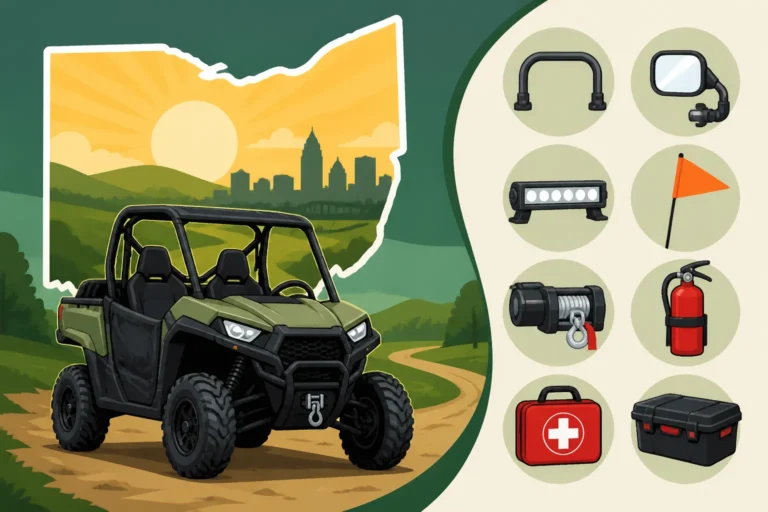
For all APVs (ATVs and UTVs) on Warren Township roads, you'll generally need:
- Headlights: Must be operational and used during hours of darkness or limited visibility.
- Taillights: One or more red lights visible from the rear.
- Brake Lights: Activated when you apply the brakes.
- Horn: A working horn is essential for signaling.
- Muffler: Must be in good working order and not excessively loud. There are noise ordinances to consider.
- Spark Arrester: Required to prevent fires, especially relevant if you also ride trails.
For UTVs (Side-by-Sides) specifically, the requirements often extend further, making compliance more involved:
- Turn Signals: Both front and rear, to indicate turns. Many UTVs don't come standard with these, so an aftermarket kit is often necessary. Brands like SuperATV offer complete turn signal kits designed to integrate seamlessly into various UTV models, making the upgrade process much simpler.
- Rearview Mirrors: Typically at least one mounted to provide a clear view of the rear. Some regulations might require two.
- Windshield: If your UTV has a windshield, it must be made of safety glass and, if applicable, equipped with a windshield wiper that functions. This is a big one; many off-road polycarbonate windshields might not meet the safety glass standard for road use. Again, SuperATV offers DOT-approved glass windshields that help meet this requirement.
- Seatbelts: If your UTV is equipped with them from the factory, they must be worn by all occupants.
Understanding these requirements is crucial. You can dive deeper into specific lists for different machines: [Ohio UTV Road Equipment List] and [Ohio APV Road Equipment List] provide excellent detail. Don't assume your stock machine is automatically ready for the road; a thorough check against these mandates is always a good idea.
Navigating Warren Township: Rules of the Road
So you've got your APV titled, registered, insured, and properly equipped for the road. Now what? Knowing the general requirements is one thing, but understanding how to ride safely and legally on Warren Township roads is another. There are specific rules of engagement that apply to APVs, and they often differ from what you're used to in a car or truck.
Speed Limits and Road Types
This is one of the most critical areas where APV road use differs from conventional vehicles. While Warren Township has opened its roads, there are typically restrictions on the types of roads and the speed at which you can travel.
Generally, APVs are restricted to roads with a posted speed limit of 35 mph or less. This is a statewide guideline that most townships adopt when opening their roads. This means that even if a particular township road for cars has an unposted speed limit of 55 mph, your APV might still be limited to 35 mph if that's what the local resolution stipulates. It's a common point of confusion and frustration for riders. You might be cruising along a quiet country road, perfectly safe at 40 mph, but if the default limit for cars is 55 mph and the township ordinance caps APVs at 35 mph, you're technically in violation. Always check for signs, but more importantly, understand the specific language of the Warren Township resolution regarding speed. Look for clarification on topics like [An Ohio Road Posted Thirty-Five or Less] or [Why an Ohio UTV Stops at Thirty-Five] in broader Ohio regulations, as these general principles usually apply.
Where You Can and Cannot Ride
Even in a friendly township like Warren, there are still boundaries. You absolutely cannot ride your APV on state routes (those marked with an "OH" shield, e.g., OH-550, OH-7), U.S. routes (marked with a "US" shield, e.g., US-50), or interstate highways (marked with an "I-" shield, e.g., I-77). These roads fall under state or federal jurisdiction and are almost universally off-limits to APVs, regardless of local township ordinances.
However, on the township roads that are open, you can generally travel freely within the stated speed and equipment parameters. You can also typically cross state or U.S. routes at designated intersections if you are continuing your journey on an open township road. This is a common practice for connecting ride areas. Furthermore, in many open townships, the law permits you to ride on the berm or shoulder of the road, provided it's safe to do so and doesn't impede traffic or create a hazard. This can be a useful option for staying out of the main travel lane, especially on narrower roads. However, always exercise caution, as berms can be uneven, soft, or have hidden obstacles. For more detail, you can check discussions around [Riding the Berm Beside an Ohio Lane].
Here's a quick comparison of road types:
| Road Type | APV Allowed? (Warren Twp.) | Notes |
|---|---|---|
| Warren Twp. Roads | Yes (with conditions) | Adhere to speed limits (often 35 mph cap), equipment rules |
| State Routes (OH-) | No (except crossing) | State jurisdiction, off-limits for travel, crossing allowed |
| U.S. Routes (US-) | No (except crossing) | Federal/State jurisdiction, off-limits for travel, crossing allowed |
| Interstates (I-) | No | Absolutely forbidden |
| Berm/Shoulder | Yes (with conditions) | If safe and not impeding traffic, check local nuances |
Rider and Passenger Safety Requirements
Safety isn't just a good idea; it's a legal requirement, especially when mixing APVs with other road traffic.
- Helmets: For any rider or passenger under the age of 18, wearing a DOT-compliant helmet is mandatory when riding an APV on public roads in Ohio. While adults over 18 might not always be legally required to wear a helmet on all township roads (check the specific township resolution, as some may require it for all riders regardless of age), it is always recommended. Your brain is worth protecting! For specific helmet rules, consult [Ohio Helmet Law for APV Riders].
- Eye Protection: All riders and passengers, regardless of age, must wear approved eye protection (goggles or a face shield) when riding an APV on any public road. This protects you from dust, debris, and insects, ensuring clear vision.
- Passengers: If your APV is designed to carry a passenger (i.e., it has a designated seat and handholds), then carrying one is generally allowed. However, the passenger must also adhere to all safety requirements, including helmet (if under 18) and eye protection. Make sure your machine is truly designed for two; an ATV meant for a single rider should only carry one. For minors riding, there are often supervision rules, so if you're riding with a younger family member, be aware of [Ohio Rules for Riding With a Parent].
Common Pitfalls and Practical Tips for Warren Township Riders
Even with the best intentions, it's easy to run afoul of the rules if you're not careful. Let's look at some common mistakes riders make and how you can avoid them, ensuring a smooth and enjoyable experience on Warren Township roads.
Verifying Road Openings and Avoiding Citations
The biggest pitfall is simply assuming. While we've discussed that Warren Township has a resolution, never take it for granted that every single road is open or that the rules haven't subtly changed. Township trustees can amend or revoke resolutions. Always verify. The best way to do this is to directly contact the Warren Township clerk's office. A quick phone call or a visit to their official website can confirm the current status of their APV ordinance. Don't rely solely on what you hear from other riders, as rules can be misinterpreted or outdated. Knowledge is your best defense against a citation. Understanding [Finding Out Which Roads Are Open] is crucial here. Getting pulled over for being on a closed road or not having the right equipment can lead to fines, and no one wants to deal with [What Happens After an Ohio Citation for No Registration].
Being a Good Neighbor on Township Roads
Beyond legal compliance, a critical aspect of ensuring continued road access for APVs is responsible riding. Think of yourself as an ambassador for the entire riding community. Excessive noise, tearing up shoulders, or generally disrespectful behavior can quickly lead to public complaints and, ultimately, a push to revoke APV road access.
- Muffler Compliance: Ensure your muffler is in good working order and not modified to be excessively loud. Ohio has sound limits, and loud machines are a primary source of resident complaints.
- Dust and Dirt: While you might pick up some mud on trails, try to keep it to a minimum on public roads. Don't intentionally spin tires or create excessive dust.
- Respect Private Property: Stay on the designated road. Do not trespass onto private property or ride in ditches alongside the road unless explicitly permitted and part of the legal berm riding allowance.
- Yield to Others: Remember that you are sharing the road with cars, trucks, and sometimes even Amish buggies. Be courteous, yield the right-of-way when appropriate, and signal your intentions clearly. This is especially true if you've added turn signals to your UTV, as a wave of the hand might not be seen or understood.
Equipping Your Machine for Safety and Compliance
Once again, the right equipment isn't just about legality; it's about safety and common sense. If you're going to be on the road, even for short distances, you need to be seen and heard, and your machine needs to function reliably.
For UTVs, specifically, investing in high-quality, road-legal accessories is paramount. For example, a proper set of DOT-approved mirrors from a reputable brand like SuperATV can drastically improve your situational awareness, making lane changes and turns safer. Their turn signal kits are often plug-and-play, ensuring all your signals function correctly, which is vital for communicating with other drivers. If your UTV has a plastic windshield, consider upgrading to a DOT-approved glass windshield. These are designed for clarity, durability, and safety, often coming with wiper systems to maintain visibility in inclement weather.
Beyond upgrades, regular maintenance is key. Before every road ride, do a quick check:
- Are all your lights (head, tail, brake, turn signals if applicable) working?
- Is your horn operational?
- Are your tires properly inflated and in good condition?
- Are your brakes functioning effectively?
- Do you have your valid driver's license, registration, and proof of insurance with you?
Taking these extra steps will not only keep you compliant with Warren Township's rules but also ensure your safety and the safety of others on the road, contributing to a positive image for all Ohio APV riders.
Disclaimer
This article is for general informational purposes only and does not constitute professional advice. Laws, prices and regulations vary by location and change over time. Consult a qualified professional for guidance on your specific situation.