Riding Salem Township Roads
It's incredibly frustrating when you just want to enjoy your all-purpose vehicle (APV), whether it's an ATV or UTV, but the rules about where you can legally ride on public roads in Ohio feel like a tangled mess of red tape. You hear whispers about certain townships opening their roads, but how do you know if your local area, like Salem Township, is one of them, and what exactly does that entail? This comprehensive guide is designed to cut through the confusion and give you a clear understanding of what it means to potentially ride your APV on Salem Township roads, covering everything from local ordinances to essential equipment and rider requirements.
Understanding Ohio's APV Road Rules: State vs. Local Control
Let's get real about Ohio's approach to all-purpose vehicles on public roads. It's not a free-for-all, and frankly, it often feels like you need a law degree to figure it out. The state generally has a pretty firm stance: ATVs and UTVs aren't just allowed to cruise down any road they please. This creates a lot of headaches for riders who want to connect trails, access services, or simply enjoy their machines closer to home. However, there's a crucial caveat that opens the door for local communities.
The Statewide Prohibition and Local Exceptions
At a foundational level, Ohio law typically prohibits the operation of APVs on public roads and highways. This is the blanket rule that every rider needs to understand first. It means you can't just assume your quad or side-by-side can go wherever your car can. This state-level restriction is why many riders resort to trailering their machines everywhere, which can be a real hassle and limit spontaneous rides. The rationale often boils down to safety concerns, given that APVs are designed primarily for off-road use and generally lack the safety features of traditional automobiles. It’s a point of contention for many, especially those who see their UTVs as perfectly capable of handling lower-speed road conditions.
But here's where it gets interesting – and a little complicated. Ohio law does provide a pathway for local political subdivisions, specifically counties and townships, to override this state prohibition within their own jurisdictions. This means that while the state says "no," your local township or county can, through a formal process, say "yes," or at least "yes, under these specific conditions." This push-pull between state regulation and local autonomy is precisely why you'll find a patchwork of rules across Ohio, leading to much of the confusion riders face. It means you can’t just ask a friend in the next county over what’s allowed, because their rules might be totally different from yours.
How Townships Open Their Roads
So, if a township wants to allow APVs on its roads, how does that actually happen? It's not as simple as a handshake agreement or a quick sign put up at the township line. Townships in Ohio have the authority to pass resolutions that permit the operation of APVs on their roads. This is a formal legislative act by the township trustees. They typically hold public meetings, discuss the pros and cons, consider public input, and then vote on a resolution. This process ensures that the community has a say and that any decision is officially documented.
Once passed, such a resolution will outline the specific conditions under which APVs can be operated. This might include designated roads, specific hours of operation, speed limits, and mandatory equipment. For example, a township might decide that only roads with a speed limit of 35 MPH or less are open to APVs, or that APV use is only allowed during daylight hours. They might even stipulate that certain main thoroughfares or state routes (which townships cannot control) remain off-limits. You can find more detail on this process in [How an Ohio Township Opens Its Roads]. It’s a crucial step because without this official resolution, the default state-level prohibition remains in effect, and you could be cited for illegal operation.
Riding in Salem Township: What You Need to Know
When it comes to riding your APV in a specific location like Salem Township, the statewide general rules are just the starting point. The real key lies in understanding any local resolutions that might be in place. This isn't just about avoiding a ticket; it's about being a responsible rider and ensuring you're operating within the bounds of what the community has deemed acceptable.
Confirming Salem Township's Resolution
The absolute first step before you even think about putting your tires on a Salem Township road is to confirm whether the township trustees have passed a resolution permitting APV use. It's a common frustration to hear rumors or see someone else riding and assume it's okay, only to find out later that you were misinformed. Relying on hearsay can lead to significant penalties.
The most reliable way to confirm is to contact the Salem Township Clerk's office directly. They are the official record-keepers for the township and can tell you unequivocally whether such a resolution exists and, if so, provide you with a copy of it. This resolution is your definitive guide to what's allowed. Don't be shy about calling; they're there to help residents understand local ordinances. Alternatively, you might find information on the township's official website if they maintain one, but always verify with a direct contact if you're unsure. You can also look for public notices or meeting minutes from the township trustees, which would document the passing of such a resolution. For broader guidance on finding this information, check out [Finding Out Which Roads Are Open].
Specific Rules for Salem Township Roads
Assuming Salem Township has passed a resolution, it’s imperative to understand the specific rules contained within it. These aren't suggestions; they are enforceable laws within the township's boundaries. While every township's resolution can vary, there are common themes you'll likely encounter.
Expect restrictions on speed. Many townships limit APV speed to 25 MPH or 35 MPH, regardless of the posted speed limit for other vehicles. This is a safety measure, recognizing the different handling characteristics of APVs. You might also find limitations on the types of roads, such as prohibiting APVs on state routes that pass through the township. Times of operation are another common restriction; some townships only allow APV use during daylight hours or specific periods of the year.
Beyond the "when" and "where," the resolution will almost certainly detail specific equipment requirements. This is where your machine's setup becomes critical. For instance, a township might require that your APV have working headlights, taillights, brake lights, a horn, and mirrors. They might even specify turn signals. Many UTVs, especially those primarily used off-road, might not come equipped with all these features from the factory. This means riders often turn to aftermarket solutions to get their machines up to snuff. For example, a SuperATV full glass windshield with a wiper kit can be an essential upgrade for those aiming for road-legal status, offering both visibility and protection. They also offer robust mirrors and comprehensive signal kits that make meeting these local requirements much easier.
Remember, these local rules are in addition to any statewide requirements for APV registration and titling. You can't just meet the township's criteria and skip the state's. Both sets of rules apply.
Essential Equipment and Rider Requirements for Township Roads
Even if Salem Township has opened its roads to APVs, you can't just hop on and ride. There are crucial equipment and rider requirements that mirror those for other vehicles, often with additional specific stipulations for APVs. Ignoring these can lead to fines, citations, and even impoundment of your machine. It’s not just about compliance; it's about safety for yourself, your passengers, and others on the road.
Must-Have Machine Equipment
For any APV venturing onto public roads, a standard set of safety equipment is usually mandated. This is where your machine needs to be more than just a trail warrior; it needs to be road-ready.
- Lights: You'll need functioning headlights, taillights, and brake lights. These aren't just for riding after dark; they're vital for visibility during the day, especially in less-than-ideal weather or when signaling your intentions. Many aftermarket lighting kits are available, including those from SuperATV, which offer integrated solutions for various UTV models, ensuring you meet the brightness and visibility standards. [Ohio Equipment Rules for an APV on a Road] covers these extensively.
- Mirrors: At least one rearview mirror is almost universally required, allowing you to see traffic approaching from behind. Some regulations might require two. Again, SuperATV offers a range of side and rearview mirrors that can easily be mounted to most roll cages, providing excellent visibility and durability.
- Turn Signals: While not always required for ATVs on roads, UTVs often need turn signals, especially if they are inspected for road legality. These are crucial for clearly communicating your intentions to other drivers. If your machine doesn't have them, you'll need to install an aftermarket kit.
- Horn: A working horn is a fundamental safety device, allowing you to alert others to your presence.
- Brakes: Your APV must have fully functional brakes on all wheels, capable of stopping the machine safely and effectively.
- Muffler and Spark Arrester: Ohio law also stipulates that APVs must be equipped with a muffler in good working order to prevent excessive noise, and a spark arrester to prevent trail fires.
It's important to remember that for UTVs specifically, if you intend to travel on county or township roads where a higher speed limit might apply (even if the APV ordinance lowers it for you), an actual inspection process might be required to ensure your vehicle meets specific street-legal criteria. This is detailed in [Ohio's UTV Inspection Before Registration]. This inspection goes beyond just having the basic parts; it ensures they function correctly and meet certain safety standards.
Rider Licensing, Insurance, and Safety Gear
The responsibility for safe operation extends far beyond just the machine itself. Riders also have a set of obligations that ensure they are qualified and protected on the road.
- Driver's License: This is non-negotiable. To operate an APV on any public road in Ohio, you must possess a valid Ohio driver's license. Your off-road driving skills don't negate the need for a license when you transition to public thoroughfares. You can read more about this in [Ohio Driver's License Rules for APVs].
- Insurance: Ohio requires proof of financial responsibility (insurance) for all motor vehicles operated on public roads. Your APV is no exception. While standard off-road insurance might cover you on trails, you'll need a policy that extends coverage to road use, meeting Ohio's minimum liability requirements. Always carry your proof of insurance with you. This is vital for any road riding, and [Ohio APV Registration and Insurance Proof] explains this further.
- Registration and Plate: Your APV must be properly registered with the Ohio Bureau of Motor Vehicles (BMV) and display a valid APV license plate. This plate also serves as your trail permit for state forest lands. The plate must be clearly visible on the rear of the machine.
- Helmets and Eye Protection: For riders under 18, helmets are mandatory on all public land and roads. While not always legally required for adults on township roads (unless specified by the local ordinance), wearing a DOT-compliant helmet and eye protection is always a smart choice for safety, regardless of age or legal mandate. Road conditions, even at lower speeds, can be unpredictable, and other drivers may not be looking for an APV.
Failing to meet any of these requirements can lead to serious legal repercussions, including fines, points on your driver's license, and potential impoundment of your vehicle. It’s far better to be prepared than to face the consequences. You should also be aware of [Ohio Fines for Illegal APV Road Use].
Navigating Salem Township and Beyond
Understanding the rules is one thing; safely and legally navigating the roads is another. When riding your APV on Salem Township roads, or any other approved township roads in Ohio, you must remain vigilant about where you are and what the rules are for that specific stretch of pavement. The joy of riding can quickly turn sour if you accidentally stray onto a prohibited road or violate a rule.
Staying on Designated Roads
The biggest challenge for many riders, once they've confirmed a township's roads are open, is staying strictly on the designated roads. It's easy to get caught up in the ride and inadvertently cross into an area where APVs are not permitted.
- Township Roads vs. County Roads: While a township resolution opens its own roads, it does not automatically open county roads within or bordering that township. You need to verify if the county commissioners have passed a similar resolution for county roads. [How County Commissioners Vote to Open Roads to APVs] can give you an idea of that process. The same applies to [Riding Muskingum Township Roads] or [Riding Newport Township Roads] – each township is unique.
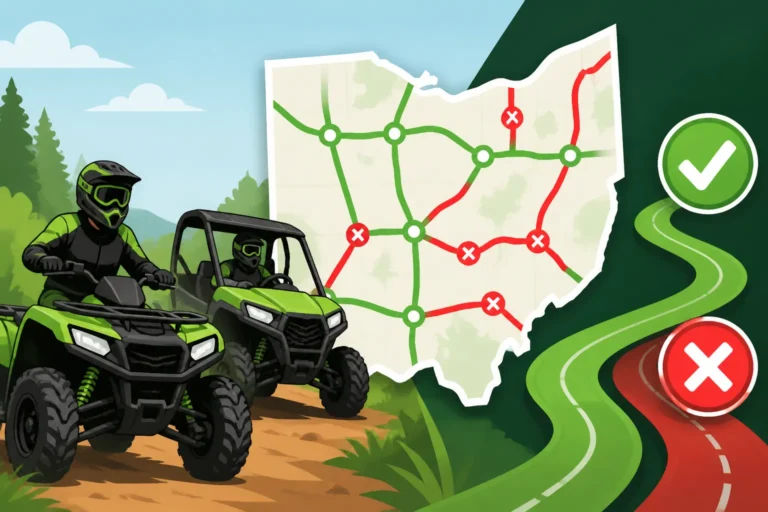
- Avoiding State Routes: This is a critical point of confusion and a common area for citations. Townships do not have the authority to open state routes (roads designated with a numbered shield, like SR-123 or US-50) to APV traffic. Even if a state route passes directly through Salem Township, it remains off-limits unless specifically allowed by state law (which is rare and under very specific conditions, usually for crossing at intersections). Attempting to ride a state route, even for a short distance, can lead to significant penalties. [Why State Routes Stay Closed in Ohio] explains this in more detail.
- Crossing Roads: You might be allowed to cross a state route or a county road to get from one approved township road segment to another. However, these crossings usually come with strict rules: crossing at a 90-degree angle, only at intersections, and yielding to all traffic. You can't just meander across. Check [Crossing a Highway on an APV in Ohio] for further guidance.
Always have a clear understanding of your route and, if possible, carry a map that differentiates between township, county, and state roads. Digital maps on your phone can be invaluable, but ensure you have signal in remote areas.
Avoiding Common Pitfalls
Even with the best intentions, riders can sometimes fall into common traps that lead to trouble.
- Unposted Roads and Speed Limits: Just because a road isn't explicitly posted with a speed limit doesn't mean you can go as fast as you want. Ohio law defaults unposted roads to 55 MPH. However, a township APV resolution will almost certainly set a lower maximum speed for APVs, typically 25 or 35 MPH. Always adhere to the township's specific APV speed limit, not the default car speed limit.
- Riding the Berm: It might seem safer or more considerate to ride on the berm or shoulder of a road. However, unless explicitly permitted by the local resolution, riding off the paved or graveled portion of the road can still be considered illegal operation off the roadway. Stick to the designated travel lanes, just like any other vehicle, unless the resolution specifically allows for berm riding. [Riding the Berm Beside an Ohio Lane] can provide more context.
- Private Property: Even if township roads are open, adjacent private land is not. Riding on private property without express permission from the landowner is trespassing and can lead to severe legal issues. Always respect property lines.
- Riding After Dark: If the township resolution specifies daylight-only operation, adhere to it strictly. Even if your APV has excellent lights, riding after sunset when it's prohibited is a direct violation. Ensure your lighting system is robust if night riding is permitted, as detailed in [Ohio Rules for Riding After Dark].
- Proof of Registration: You will also need to be able to provide proof of your APV registration. The physical registration card should be kept on your machine. [Registering an APV in Ohio] covers this requirement in full.
By being diligent, informed, and responsible, you can enjoy the privilege of riding your APV on Salem Township roads safely and legally. Always remember that these privileges can be revoked if not respected by the riding community.
Here's a quick reference for common APV requirements for road use in Ohio:
| Requirement | General Ohio Rule (for road use) | Typical Township Resolution (e.g., Salem Township) |
|---|---|---|
| Registration | Mandatory via Ohio BMV; display valid APV plate. | Mandatory; plate must be visible. |
| Title | Mandatory for all APVs. | Mandatory. |
| Driver's License | Valid Ohio driver's license required. | Valid Ohio driver's license required. |
| Insurance | Proof of financial responsibility (liability insurance) required. | Proof of financial responsibility required. |
| Helmet | Under 18: Mandatory. Adults: Recommended, often not legally required. | Under 18: Mandatory. Adults: May be mandated by local ordinance; recommended. |
| Eye Protection | Under 18: Mandatory. Adults: Recommended. | Under 18: Mandatory. Adults: May be mandated; recommended. |
| Headlights | Mandatory; must be on if visibility is reduced or at night. | Mandatory; often specified for all times of operation. |
| Taillights/Brake Lights | Mandatory. | Mandatory. |
| Mirrors | At least one rearview mirror (often two for UTVs). | At least one rearview mirror (often two for UTVs). |
| Turn Signals | Often required for UTVs undergoing inspection; recommended for all. | Often explicitly required; may be a condition for approval. |
| Horn | Mandatory. | Mandatory. |
| Muffler/Spark Arrester | Mandatory. | Mandatory. |
| Road Speed Limit | Varies by road type; APVs typically restricted to 25-35 MPH if allowed. | Explicitly stated in resolution (e.g., 25 MPH, 35 MPH max). |
| Road Types Allowed | Generally prohibited; exceptions by local resolution. | Only township roads covered by the resolution; state routes usually prohibited. |
| Time of Operation | No statewide restriction (if road legal); local rules vary. | Often restricted to daylight hours or specific times. |
This article is for general informational purposes only and does not constitute professional advice. Laws, prices and regulations vary by location and change over time. Consult a qualified professional for guidance on your specific situation.