Why a Quad Skips the Inspection
You're out there, trying to figure out the maze of Ohio's off-road vehicle laws, and suddenly you hit a wall: some folks are talking about inspections for their side-by-sides, but your quad-riding buddy says he never had to get his machine looked over. It’s enough to make your head spin! This guide is here to clear up that confusion, explaining precisely why an ATV (what Ohio often calls a quad or a three-wheeler) doesn't need to go through an inspection process to get its registration, while many UTVs do.
Understanding Ohio's "All-Purpose Vehicle" Definition and Road Use
Ohio's approach to off-road vehicles can feel a bit like reading a legal textbook written in another language sometimes. We've got "all-purpose vehicles" (APVs), which is the overarching term, but then within that, the state makes some pretty important distinctions between what we commonly call an ATV (all-terrain vehicle, or quad) and a UTV (utility terrain vehicle, or side-by-side). These distinctions are absolutely crucial to understanding why one needs an inspection for road use and the other typically does not.
The Legal Distinctions: ATV vs. UTV in Ohio Law
When Ohio law talks about an "all-purpose vehicle," it's casting a wide net. This term covers everything from the traditional three-wheelers and four-wheelers (ATVs) that riders sit astride, to the larger, often caged, side-by-sides (UTVs) where you sit side-by-side with a passenger, much like in a small car. The critical difference, from a regulatory standpoint, often boils down to design and intended use, even if both are primarily for off-road adventures.
ATVs, by their very nature, are designed for single-operator (or occasionally, two-up with a specific passenger seat) adventurous riding, often emphasizing agility and maneuverability on challenging terrain. They typically lack many of the safety and operational features found on street-legal vehicles. UTVs, on the other hand, especially modern ones, often come much closer to mimicking traditional vehicles with steering wheels, foot pedals, and sometimes even enclosed cabs. This design difference is fundamental. While the state's definition lumps them together under APV, the practical application for road use and associated requirements, like inspections, diverges significantly. You can dive deeper into the specific language with [How Ohio Law Defines an APV].
Road Use Permitted and Prohibited for ATVs
Here's the really important part that underpins the inspection question: the general rule in Ohio is that ATVs are not permitted on public roads. There are very limited, specific exceptions, but these are granted at the local level by county commissioners or township trustees through official resolutions. This means that while some townships or counties might open their roads to APVs, these are typically specific, posted roads, and often with significant restrictions regarding time of day, speed, and safety equipment.
For most ATV riders in Ohio, their machines are strictly for off-road trails, private property, or designated riding areas like the state forests. The idea of routinely taking an ATV down Main Street or using it for daily errands simply isn't a widespread reality under Ohio law. This stark contrast with UTVs, which have a clearer, albeit still restricted, path to road legality, directly influences the inspection requirements. If your machine isn't really intended or allowed for widespread road use, the need for a comprehensive road-worthiness inspection diminishes. We explore this more in [Where Ohio Law Allows APVs on Roads].
Why Ohio Distinguishes for Inspections: Form vs. Function
The heart of the matter lies in how Ohio views the potential for these machines to safely interact with standard road traffic. UTVs, with their more car-like features, are seen as having the capability to be made "road-ready," while ATVs are generally not. This isn't about one being "better" than the other, but purely about their fundamental design and the practicalities of making them safe for public roadways.
The UTV Inspection Before Registration: What It Entails
If you own a UTV in Ohio and want to operate it on public roads where allowed by local resolution, you absolutely have to get it inspected. This inspection is a crucial step before you can even get your plate and registration. The state wants to ensure that these vehicles, which will share asphalt with cars and trucks, meet a baseline of safety equipment.
What exactly does this inspection look for? It's a comprehensive check. Think of it as a mini-motor vehicle inspection. The inspector will be looking for things like:
- Headlights and Taillights: Are they functional, properly aimed, and visible?
- Brake Lights: Do they illuminate when the brakes are applied?
- Turn Signals: Front and rear, working correctly. This is often an aftermarket add-on for many UTVs.
- Horn: Is there a working audible warning device?
- Rearview Mirrors: Typically at least one, often two (side mirrors).
- Windshield and Wipers: A safety glass windshield and functional wipers are usually required for street legality.
- Muffler and Spark Arrester: To ensure noise and fire safety standards are met.
This list transforms a typical off-road UTV into something that can at least signal, see, and be seen in a road environment. Passing this inspection is the gatekeeper for getting your special APV license plate and being able to ride on approved roads. [The Ohio Inspection a UTV Must Pass] goes into more detail about this process. It's a real undertaking for many UTV owners, often involving substantial aftermarket purchases from places like SuperATV to get their machine up to spec.
The ATV's Simpler Status: Why No Inspection?
Now, here's why your quad-riding friend doesn't have to jump through those hoops: ATVs, by their fundamental design, are not built to be easily adapted for safe, routine road use. They lack the enclosed passenger compartment, the steering wheel, and often the stability that lends itself to a road-going vehicle. While an ATV has headlights, taillights, and brakes, they typically don't have turn signals, rearview mirrors, windshields, or wipers. Trying to add all these components to an ATV to meet UTV road-legal standards would be a significant, if not impossible, engineering challenge for many models.
Because Ohio law has largely kept ATVs off public roads, with only very specific local exceptions, there's no widespread need to certify them as "road-ready." The state isn't asking you to bring your quad to an inspection station because the expectation is that it won't be regularly used on public thoroughfares in the same way a road-legal UTV might be. The equipment rules that do exist for an ATV, should it be on an approved road, are much simpler and focus on basic visibility and operational safety for limited crossing or short stretches, not full integration with traffic. For example, [Ohio Equipment Rules for an APV on a Road] lists items like a working muffler and spark arrester, and adequate lighting, but notably omits the more extensive requirements for UTVs.
So, it's not that ATVs are inherently unsafe; it's that their design purpose and the legislative framework for their use don't align with the requirements for a comprehensive road-worthiness inspection. The state essentially acknowledges that attempting to make a quad street-legal to the same standard as a UTV is generally not feasible or required. This streamlines the registration process for ATV owners who primarily use their machines for off-road recreation, avoiding an unnecessary inspection step.
Practical Implications for Ohio Riders
Understanding this distinction between ATVs and UTVs regarding inspections can save you a lot of headache, time, and potentially money. It dictates what you need to do to legally operate your specific type of APV in Ohio, whether you're hitting the trails or navigating a short stretch of approved county road.
What This Means for ATV Owners
If you own an ATV, you can breathe a sigh of relief on the inspection front. When you go to register your machine, you won't be asked to present it for a road-worthiness inspection. Your focus will be on the paperwork: providing proof of ownership (like a Certificate of Origin for new machines or a title for used ones), completing the necessary forms like [Filling Out Form BMV 3722], and paying the required fees. The process of [Registering an APV in Ohio] for an ATV is primarily administrative, not mechanical.
However, this doesn't mean "anything goes" if you happen to find yourself on a permissible road. Even if your ATV isn't subject to the full UTV inspection, if you're riding on a county or township road where APV use is explicitly allowed, you are still expected to have basic functional equipment. This usually includes working headlights and taillights, operational brakes, a muffler with a spark arrester, and potentially eye protection and a helmet depending on the rider's age and local ordinances. While not an "inspection," these are still important safety considerations. Your ATV doesn't need turn signals or a windshield, but it does need to be safe for its limited road interactions.
What This Means for UTV Owners Seeking Road Legality
For UTV owners, the path to road legality, if permitted by local resolution, is a bit more involved. You will need to get your machine inspected. This means evaluating your UTV against the state's requirements for road-legal equipment and making any necessary upgrades or additions. This is where many UTV owners turn to aftermarket parts and accessories to ensure their vehicle can pass the inspection. Companies like SuperATV offer a wide range of products—from turn signal kits and rearview mirrors to full safety glass windshields—specifically designed to help UTVs meet these demanding standards.
Aftermarket additions are almost always a part of this process. It’s rare for a factory-stock UTV to have every single piece of equipment necessary for an Ohio road inspection without some modification. You'll need to schedule this inspection, usually at a designated location or with an authorized inspection agent, before you head to the Clerk of Courts for titling and registration. Understanding [Ohio UTV Inspection Requirements] thoroughly is essential to avoid repeated trips and frustration. Once your UTV passes, you’ll receive the necessary documentation to proceed with getting your APV plate and sticker.
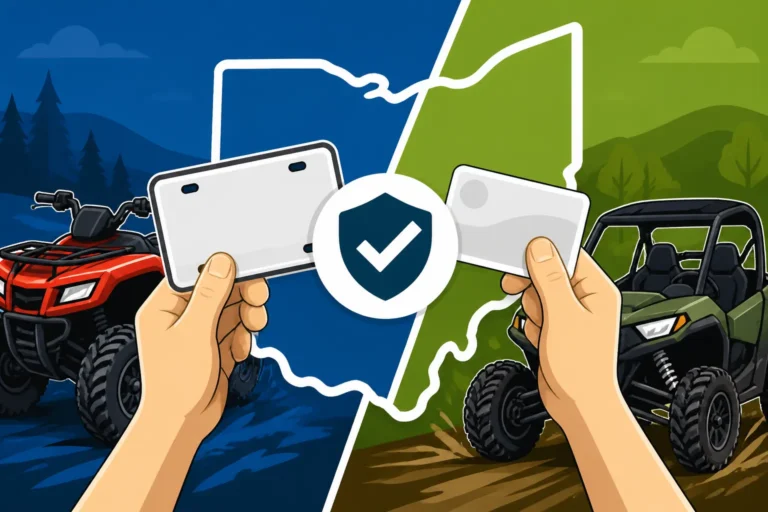
Here's a quick comparison of the key differences:
| Feature/Requirement | ATV (Quad) | UTV (Side-by-Side for Road Use) |
|---|---|---|
| Pre-Registration Inspection | NOT REQUIRED for state registration or titling. | REQUIRED for obtaining road-legal APV plate. |
| Primary Intended Use | Off-road recreation, trails, private land. | Off-road recreation, trails, private land, and permissible public roads. |
| Road Use Permission | Very limited, specific local county/township resolutions only. | Limited, specific local county/township resolutions only. |
| Required Road Equipment | Basic lighting, muffler, spark arrester. (Varies by local ordinance) | Extensive: turn signals, horn, mirrors, safety glass windshield, wipers, etc. |
| Typical Design | Straddle seating, handlebar steering, open-air. | Side-by-side seating, steering wheel, often roll cage/cab. |
| Aftermarket for Road-Legal | Generally not pursued or feasible for full road conversion. | Common and often necessary for road-legal equipment. |
So, the takeaway is clear: while both ATVs and UTVs fall under Ohio's "All-Purpose Vehicle" umbrella, their journey to legal operation, especially concerning road use and the dreaded inspection, takes significantly different paths. ATV owners largely bypass this step, focusing on proper registration and safe off-road practices. UTV owners, however, must be prepared for the inspection and any necessary upgrades if they intend to utilize their machine on Ohio's permissible local roads. Knowing this upfront will save you time, effort, and any unexpected surprises as you navigate Ohio's APV regulations.
Disclaimer
This article is for general informational purposes only and does not constitute professional advice. Laws, prices and regulations vary by location and change over time. Consult a qualified professional for guidance on your specific situation.