Do Rented Machines Come Already Registered and Plated?
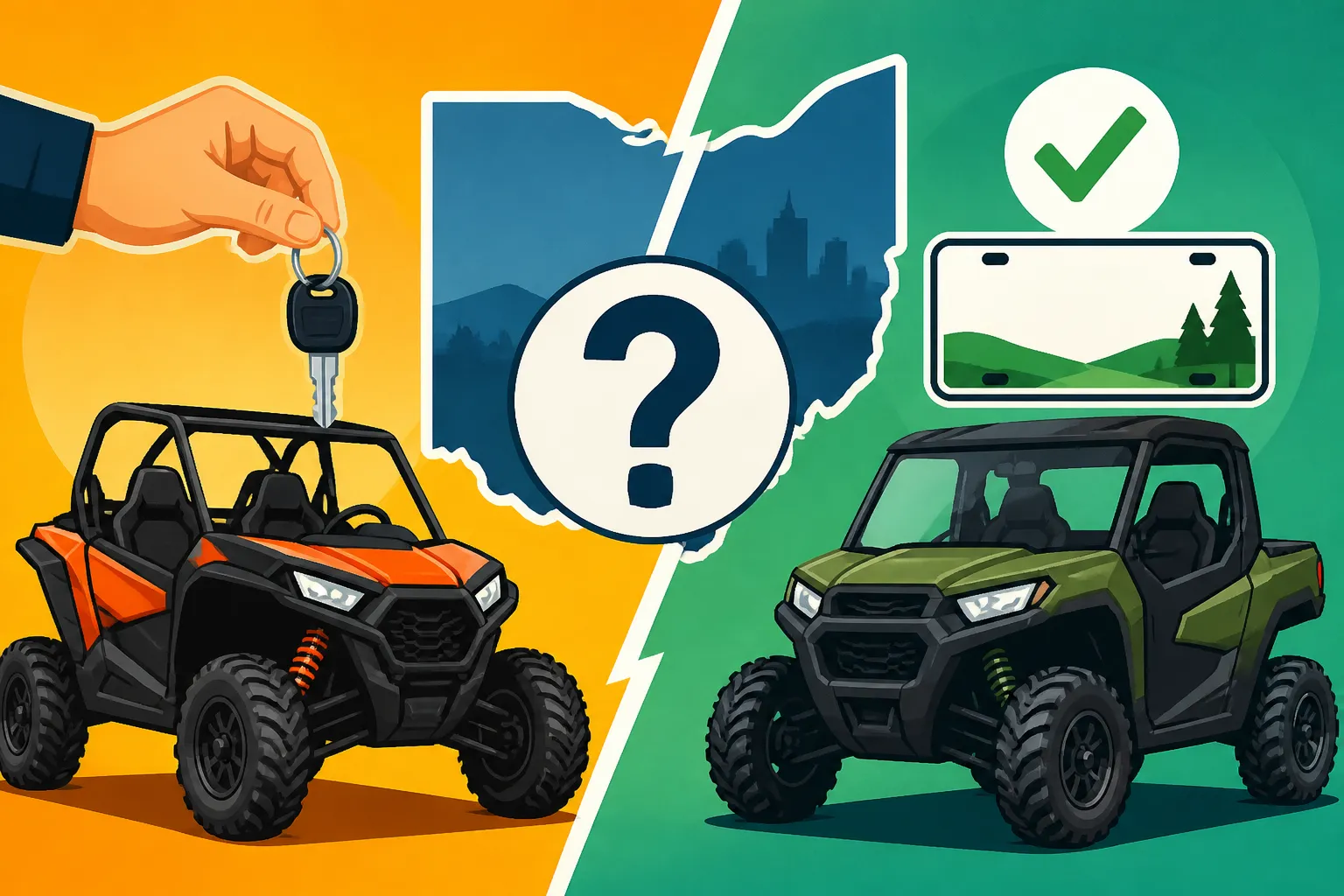
Renting an ATV or UTV in Ohio saves you from transporting and maintaining a machine, but it can leave one important question: does the rental include legal registration and a visible plate? Usually, the rental operator should provide a machine ready for the permitted ride. Still, check the plate, paperwork and trail-specific passes before you leave the counter.
What registration and a plate should come with a rental
On Ohio trails where APV registration is required, a rented machine must meet the same basic registration rules as a privately owned one. The rental company, as owner, generally handles registering its fleet. A rental agreement or the fact that a machine is being rented does not, by itself, replace registration.
Before setting off, check that the machine has a plate that is present, legible and mounted as required. A plate that is missing, obscured by a rack or badly damaged is a reason to pause and ask the operator to fix the problem or provide another machine. A verbal assurance that “the paperwork is handled” is less useful than being able to see the plate and confirm what documents are supplied.
In Ohio, the plate is also connected to trail access: Why the Ohio Plate Is the Trail Permit. Registration and local or land-manager access requirements can be separate, though. A plate does not automatically mean the rental includes every pass needed for the route you plan to ride.
| Item to check | What to look for | Why it matters |
|---|---|---|
| Registration plate | A visible, readable plate attached to the machine | Helps show that the machine is properly registered for places requiring registration |
| Registration documents | Ask what proof the operator supplies and where it is kept | You may need to show proof during a stop or inspection |
| Machine identity | Confirm the plate and documents relate to the rented machine | Prevents confusion if the company has several similar machines |
| Trail or forest pass | Ask whether the planned riding area requires a separate pass | Registration may not cover access to every land manager’s trails |
| Rental agreement | Check who is responsible for permits, equipment and roadside issues | Makes it clearer what the company supplies and what you must arrange |
A rental fleet may have different arrangements from a privately owned ATV or UTV, but the company should be able to tell you how its registration is handled. If a plate is present but the operator cannot explain whether it is current or what riding areas it covers, do not assume that the machine is ready for every destination.
The paperwork process is worth asking about at pickup. Find out whether the registration card stays with the machine, is held by the rental business, or is provided in another form. Do not remove documents from a storage compartment or alter anything; ask the staff to show you the proof and explain what you should do if an officer asks for it. Keep the rental agreement accessible as well, but do not treat it as a substitute for registration proof.
For a broader overview of the plate and access rules, see Ohio APV Permits Explained. If the rental is for a state forest trail, also confirm that the machine’s registration is valid for that use. A rental operator may know its fleet’s status, but it may not know which specific routes you intend to ride.
Passes, forest rules and out-of-state registration
A registered machine is not necessarily cleared for every Ohio riding area. Different land managers can have separate access rules, so plan around the exact trail system rather than asking only whether the rental is “legal in Ohio.”
For example, Wayne National Forest has a separate OHV permit requirement. That permit is distinct from the machine’s registration, and you should ask the rental company directly whether it is included. If it is not, find out which permit you need and how to obtain it before arriving at the trailhead. How the Wayne National Forest OHV Permit Works explains the separate permit system, while Does a Rental Include the Forest Pass? focuses on the question to settle with the rental operator.
Do not assume that one permit covers the whole group. Ask whether the pass is tied to the machine, the rider or each person who will ride or ride as a passenger. Confirm age-related requirements too, especially if children or teenagers are in your party. If the rental company cannot answer, check with the relevant forest office before your trip.
The same care applies when a rental machine carries a plate from another state. Ohio’s reciprocity rules may allow certain out-of-state registrations for riding, but the answer depends on the registration and the place you plan to ride. The rental company’s location, or the fact that it rents machines in Ohio, does not tell you which state registration is on the vehicle. Look at the plate and ask the operator where the machine is registered and whether it qualifies for your destination. See Ohio Reciprocity for Out-of-State Machines and What a Visitor From a Registering State Must Show for more on the documents and rules that can apply.
A private riding park may use its own admission process and may not have the same requirements as public land. Ask the park and the rental business what is needed for that specific ride. Do not treat permission to rent a machine as proof that you can take it onto a nearby trail, road or public property.
Before booking, describe your plan in plain terms: where you will ride, whether the route includes Wayne National Forest or Ohio state forest trails, and whether you will cross any roads. A rental operator may supply a machine suitable for one location but not another. If you are unsure which permit applies, Ohio Rules for a Rented Machine is a useful starting point, but confirm current access requirements with the land manager.
What to confirm before you ride away
A quick check at pickup can prevent a frustrating trip back to the rental counter—or a ride that cannot legally continue. Ask the operator to walk you through the machine’s plate, proof of registration and any passes included in the rental. If the answer is unclear, resolve it before unloading or entering a trail.
Use this checklist:
- Match the machine to your plan. Tell the rental company the specific trail, forest or private park you intend to visit. Ask whether the machine is approved and registered for that use.
- Inspect the plate. Make sure it is attached and readable. Ask for a replacement machine if it is missing, covered or visibly damaged.
- Ask where registration proof is kept. Have the staff show you the document or explain the company’s process for providing it. Keep any paperwork you receive with the machine.
- Confirm the plate’s state and status. If it is from outside Ohio, ask whether that registration is accepted for the destination and what proof you should carry.
- Separate registration from access passes. Ask whether a Wayne National Forest OHV permit or another site-specific pass is required and whether the rental includes it.
- Check who must hold a pass. Ask whether passes apply per machine or per rider, and whether passengers have their own requirements.
- Ask what to do if stopped. Find out what documents to show and who to call if the registration information is missing or unclear.
- Review the rental limits. Confirm where the machine may be taken, who may operate it and what happens if the route is closed or inaccessible.
If the company cannot provide a clear answer about registration, do not rely on a promise that it will be sorted out later. Ask for a manager, request a different machine, or contact the trail authority before riding. This is especially important if you are traveling a long distance or have booked a group outing, where one unregistered or unsuitable machine can disrupt the plan for everyone.
Also check the machine’s condition before accepting it. Registration does not make a vehicle safe or appropriate for a particular trail. Look over the tires, brakes, lights and steering, and ask how to operate the controls. Make sure the machine is the width and type allowed on the route. Ohio state forest trails have equipment and access rules that may rule out some larger machines; a rental business should be able to identify which of its vehicles fit your intended destination.
A rental operator may offer a brief orientation, but it is still your responsibility to understand the route and follow posted restrictions. Do not ride around a closed gate or assume that a road is open just because it appears on a map. If your route involves public roads, check the applicable rules separately; trail registration alone does not grant permission to use every road.
If the rental company says the machine is registered but cannot show you the plate or explain what proof accompanies it, stop before you ride. A clear answer at pickup is easier to resolve than a registration question at a trailhead or during a roadside stop.
Disclaimer
This article is for general informational purposes only and does not constitute professional advice. Laws, prices and regulations vary by location and change over time. Consult a qualified professional for guidance on your specific situation.