Ohio Rules for Riders Under 16
It's a huge joy to see your kids light up when they're on an ATV or UTV, exploring trails and building confidence. But as parents, that joy often comes with a big dose of worry. Are they safe? More importantly, are they allowed to be doing this, and what exactly does Ohio law say about young riders? Ohio's rules for underage operators can feel like a tangled mess of age limits, supervision requirements, and equipment specifics, leaving many folks scratching their heads. This comprehensive guide will break down everything you need to know to keep your kids riding legally and safely in the Buckeye State.
Understanding Ohio's Baseline for Young Riders
Before we dive into the specifics of different riding areas, it's crucial to grasp the overarching legal framework Ohio has established for All-Purpose Vehicles (APVs), which include both ATVs and UTVs. These laws are designed to protect minors from harm and ensure that they operate these powerful machines responsibly. Disregarding them can lead to citations, fines, and even a forced end to your family's riding fun.
Ohio's Minimum Age to Operate an APV
For the most part, Ohio law sets a baseline that an All-Purpose Vehicle (which broadly includes ATVs and UTVs) cannot be operated by someone under 12 years of age on any public land or publicly accessible private land. This isn't just a suggestion; it's a legal requirement. Think of it as a gatekeeper rule for riding in most official capacities across the state.
This minimum age is in place for a very good reason: developmental readiness. Operating an ATV or UTV requires a certain level of physical coordination, judgment, and risk assessment that typically isn't fully developed in children younger than 12. They need to understand the machine's controls, anticipate terrain changes, and react quickly to unexpected situations. A younger child might struggle with the weight of the machine, the reach to the controls, or the cognitive ability to make split-second decisions that prevent accidents. This rule protects them from situations they aren't yet equipped to handle, even under direct supervision.
However, there's a critical nuance here: this 12-year-old minimum isn't absolute for all situations. Ohio law often distinguishes between public and private land. For example, a child under 12 might be able to operate an appropriately sized APV on private land owned by their parent or guardian, or with explicit written permission from the landowner, provided the parent or guardian is also present and supervising. This exception recognizes the unique control and responsibility a parent has on their own property, but it doesn't diminish the safety concerns. Even on private land, common sense and a deep commitment to safety training should always prevail, regardless of legal age limits.
When a Minor Cannot Ride an APV
Beyond the minimum age, Ohio law also specifies certain conditions and locations where minors, regardless of their age (even if they are 12 or older), are strictly prohibited from operating an APV. These prohibitions are often tied to the inherent dangers of specific environments or the need for a higher level of maturity and licensure. It's not enough for your child to just be old enough; they must also be in the right place and under the right circumstances.
One of the clearest restrictions involves public roads. Ohio generally considers ATVs unsuitable for road use due to their design and lack of safety features like seatbelts, airbags, and turn signals. While UTVs can sometimes be made street legal in specific Ohio counties or townships, this typically requires the operator to hold a valid driver's license. Since minors under 16 cannot possess a full driver's license in Ohio, they are effectively prohibited from operating any APV on public roads where such a license is required, even if the road is otherwise open to UTVs. This means that if you're riding in a county like Washington County that has opened its roads to UTVs, your 14-year-old, no matter how skilled, cannot legally take the wheel on those public thoroughfares. [Ohio Rules for Riders Under 16]
Furthermore, minors are often prohibited from operating APVs if they do not meet specific safety training or supervision requirements. For instance, on designated state forest trails, merely being 12 years old isn't enough; supervision by a licensed adult is mandatory for riders under 16. If your child is caught riding alone on public land where supervision is required, they could face the same legal consequences as an adult, including fines and having their riding privileges revoked. Understanding these prohibitions is key to preventing legal trouble and, more importantly, keeping your child safe.
Age-Specific Requirements on Ohio State Forest Trails
Ohio is home to several fantastic state forests with dedicated APV trails, offering miles of adventure for riders. However, these natural playgrounds come with their own set of specific rules, especially when it comes to younger riders. It’s vital to understand these distinct regulations before you load up the trailer, as they are often more stringent than general statewide laws.
Ohio State Forest Minimum Age and Supervision
On Ohio's four state forest APV areas—Monday Creek, Hanging Rock, Pine Creek, and Maumee—the absolute minimum age to operate an APV is 12 years old. This is a hard-and-fast rule; if your child is 11, they cannot operate an APV on these trails, even if they are skilled and supervised. This rule aligns with the general state law but is strictly enforced on state-managed lands.
For riders aged 12 through 15, simply being 12 years old isn't enough to ride independently. Ohio law mandates that these young riders must be under the direct supervision of a licensed adult who is at least 18 years old. This isn't passive supervision; the adult must be present and capable of intervening if necessary. Typically, this means the adult is also riding an APV on the same trail system, remaining within sight or sound of the minor. Imagine a scenario where a 13-year-old rider, new to a particularly steep climb at Monday Creek, suddenly loses traction. Having a supervising adult right there, ready to offer guidance or assistance, can make all the difference. This supervision requirement ensures that young riders have immediate support and guidance from an experienced individual, mitigating risks on potentially challenging terrain. [Ohio Minimum Age for State Forest Trails]
It’s important to clarify who can be this supervising adult. It doesn’t necessarily have to be a parent, but it must be an adult aged 18 or older who holds a valid driver's license. This ensures they have a baseline understanding of operating a motorized vehicle and can be held accountable. If a state forest officer encounters a 14-year-old riding alone on the trails, even if they are otherwise competent, that minor (and potentially their parent or guardian) could face a citation for violating the supervision rule. Always remember to carry proof of age and the supervisor's driver's license when riding with minors on state forest lands.
Wayne National Forest's Distinct Regulations for Youth
While Ohio's state forests have their rules, the Wayne National Forest, which includes trail systems like Monday Creek and Hanging Rock, operates under federal regulations that sometimes have additional layers, especially regarding youth riders. It's critical not to confuse state forest rules with national forest rules, as they are managed by different entities and can have subtle but important distinctions.
One key difference for Wayne National Forest is the requirement for all riders, including passengers aged 16 and older, to have an OHV permit. While state forest trails often consider your Ohio APV plate your permit, the Wayne National Forest requires a separate permit, whether it's a day pass or a season pass. For minors, this means that even if they meet the age and supervision requirements, they (or their supervising adult) must ensure a valid Wayne National Forest OHV permit has been purchased for each rider who needs one. A common scenario is a family heading to Monday Creek. The 14-year-old rider meets the age and supervision rules, but if the family hasn't purchased a Wayne National Forest permit for them, they are technically in violation. [Wayne National Forest OHV Permit Cost]
Another important aspect of Wayne National Forest rules for youth is the emphasis on safety training. While Ohio doesn't mandate a safety course for APV operation, the Wayne National Forest strongly encourages it, and some of their rules are built around the idea of a rider being "certified." For instance, while a 12-year-old can ride under supervision, the overall spirit of federal regulations often leans towards ensuring competence and safety awareness. Organizations like the ATV Safety Institute (ASI) offer youth-specific training courses that align with these principles, teaching fundamental riding skills and safety practices. Investing in such a course, even if not strictly required by law for all federal lands, can be invaluable for your child's safety and confidence. Plus, it shows a commitment to responsible riding, which is always a good thing when you're out on the trails.
Crucial Supervision Requirements for Young Riders
Ensuring proper supervision is perhaps one of the most critical aspects of letting a minor operate an APV in Ohio. It's not just about having an adult somewhere in the vicinity; it's about active, responsible oversight that can prevent accidents and respond effectively if one occurs. The specific requirements can vary depending on the type of land, so understanding these nuances is essential.
Ohio's Licensed Adult Supervision Rule
When a minor operates an APV on public lands or publicly accessible private lands in Ohio, direct supervision by a licensed adult is generally a non-negotiable requirement for those under 16. This adult must be at least 18 years of age and possess a valid driver's license. The "licensed" part is key here; it signifies that the adult has demonstrated a basic level of driving competence and responsibility. This isn't just about driving a car; it implies a general understanding of road rules, vehicle operation, and the importance of safety.
This rule ensures that a responsible party is always on hand. Imagine a situation at Pike State Forest where a 13-year-old is navigating a tricky descent. If they misjudge a turn or hit an unexpected obstacle, the immediate presence of a supervising adult who can communicate guidance, assess the situation, and even physically assist if needed is paramount. The supervisor should be riding an APV themselves, allowing them to keep pace with the minor and maintain direct observation. They need to be close enough to hear commands, see potential hazards, and intervene if the young rider makes a mistake or gets into trouble. Being "on the same trail system" is generally interpreted as riding together, not just being somewhere in the same general forest. [Ohio Rules for Riding With a Parent]
For parents, this means you can't just drop your 14-year-old off at the trailhead and pick them up later, even if they're with a group of friends. An eligible adult must be actively supervising. This also applies to situations where a younger rider might be tempted to "just try" an APV for a moment on a non-designated area. Any operation by a minor on public or publicly accessible land without this direct, licensed adult supervision could lead to a citation. The goal is to provide a safety net for young, developing riders who might lack the experience or judgment to handle every situation autonomously.
Parental or Guardian Presence and Responsibility
While any licensed adult over 18 can supervise, there's an inherent responsibility that falls on parents or legal guardians when it comes to their children riding APVs. Even if a relative or friend is the direct supervisor on the trail, the ultimate legal and moral responsibility for ensuring the minor adheres to all rules and operates safely often rests with the parent or guardian. This includes making sure the child has the right gear, understands the rules, and is riding an appropriately sized machine.
Consider a family trip to a private riding park. While the park's rules might be different from state forests, parents are still responsible for their child's safety. If a child under 12 is permitted to ride on private land (with landowner permission or if the parent owns the land), the parent’s presence and active guidance are absolutely essential. They are the primary instructors, teaching the child how to start, stop, turn, navigate obstacles, and respond to emergencies. It’s also the parent’s duty to ensure the APV is well-maintained and suited for the child's size and skill level. Trying to ride a full-size ATV that's too heavy or powerful for a young child, even with a parent right beside them, can lead to serious injury. SuperATV, for instance, offers a range of accessories that can enhance safety and control for various machine sizes, which can be a valuable consideration for parents looking to optimize their child's riding experience.
Furthermore, parental responsibility extends to ensuring their children are aware of and adhere to all local ordinances. Some townships or counties in Ohio might have specific rules for youth riding on open roads, even if they allow UTVs. A parent should always check with local authorities for specific regulations if they plan to ride near residential areas or on community roads. The general principle is that while the law provides minimums, a parent's commitment to safety and responsible education should always exceed these minimums to foster a safe and enjoyable riding environment for their children.
Essential Safety Gear for Ohio's Young Riders
Safety gear isn't just a recommendation; it's a non-negotiable requirement for young APV riders in Ohio, designed to mitigate serious injuries in the event of an accident. While adult riders might have more leeway depending on the riding environment, the rules are much stricter for minors, and for good reason. The potential for injury on an ATV or UTV is significant, and proper gear acts as the first line of defense.
Mandatory Helmet and Eye Protection Rules
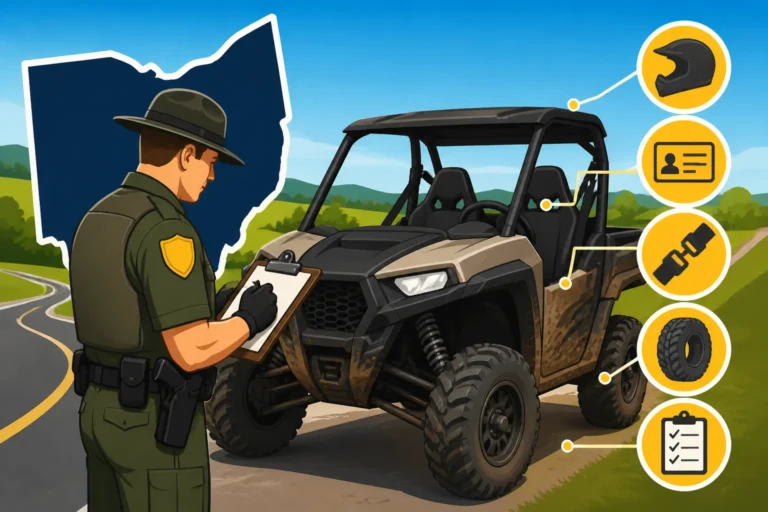
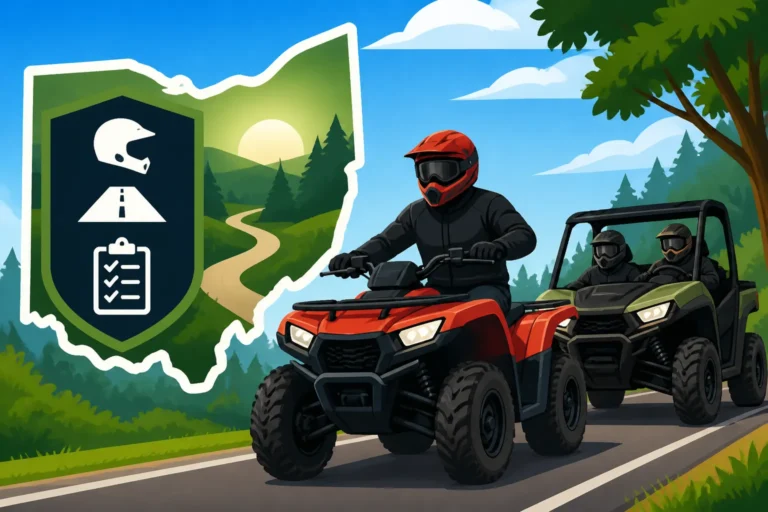
Ohio law is very clear: any person under 18 years of age operating or riding as a passenger on an APV must wear a protective helmet. This isn't just any helmet; it must be one that meets the standards established by the United States Department of Transportation (DOT FMVSS 218). These helmets are rigorously tested to ensure they can withstand impacts and provide adequate head protection. A novelty helmet or a bicycle helmet simply won't cut it legally or safely.
Imagine a situation where a 15-year-old rider, navigating a rocky section of trail at Richland Furnace State Forest, misjudges a line and takes a tumble. Even at low speeds, hitting your head on the ground or an exposed rock can lead to severe, life-altering injuries. A DOT-approved helmet significantly reduces the risk of such outcomes. It’s the single most important piece of safety equipment a young rider can wear. The rule applies equally to passengers. So, if your younger child is riding shotgun in a side-by-side, they must also be properly helmeted. [Ohio Helmet Law for APV Riders]
In addition to a helmet, all riders under 18 must also wear eye protection. This can be goggles specifically designed for off-road use or a helmet with a full face shield. The trails are full of hazards: kicked-up dust, flying rocks, low-hanging branches, and insects. Any of these can obscure vision or cause injury, leading to a loss of control. Picture riding through a dusty stretch of trail at Maumee State Forest; without goggles, a sudden cloud of dust could blind a young rider, causing them to veer off course. Eye protection ensures clear vision, allowing the rider to focus on the trail and react safely. [Ohio Eye Protection Requirement]
Encouraged Riding Attire Beyond the Mandates
While helmets and eye protection are legally mandated, there's a wider array of gear that is highly recommended for young riders to protect them from various injuries, even if not strictly required by law. Thinking beyond the minimum can significantly reduce the risk of scrapes, bruises, and even broken bones. This includes sturdy clothing that covers the limbs, over-the-ankle boots, and gloves.
Long pants and long-sleeved shirts, preferably made of durable materials like denim or thick synthetic fabric, offer protection against abrasions, cuts from branches, and exhaust heat. A short-sleeved shirt and shorts might feel comfortable on a hot day, but they offer almost no protection if a rider slides off the machine or brushes against rough terrain. For instance, a simple tip-over in soft mud could still result in a nasty raspberry on an exposed arm or leg, which could be avoided with proper clothing. SuperATV also offers protective accessories for machines, like skid plates and brush guards, which indirectly contribute to rider safety by safeguarding the vehicle itself from damage that could lead to an unexpected stop or spill.
Sturdy, over-the-ankle boots are crucial for protecting feet and ankles. They prevent feet from slipping off footpegs, guard against hot engine parts, and offer support in a rollover. Flip-flops or sneakers simply aren't appropriate footwear for APV riding. Gloves, while often overlooked, protect hands from blisters, provide better grip on the handlebars, and shield against minor impacts and abrasions from branches. Consider a scenario where a young rider needs to quickly grab a hot metal part after a minor adjustment or falls and puts their hands out to break the fall; gloves can prevent burns or serious scrapes. While Ohio law doesn't explicitly mandate these additional items, every responsible parent and guardian should insist on them for their young riders.
Training and Educational Pathways for Youth Riders
Beyond legal requirements for age and supervision, actively engaging in safety training and education is perhaps the most impactful step a parent can take to ensure their child's safety on an APV. While Ohio doesn't universally mandate a safety course, the benefits of formal training are immeasurable, and parental teaching methods are equally vital.
Ohio ATV Safety Course Options
Unlike some other states, Ohio does not legally require an ATV safety course for all operators, including minors, to register or ride an APV. However, this absence of a mandate should not be interpreted as a sign that training is unnecessary. On the contrary, taking a certified safety course is one of the best investments a parent can make in their child's riding future. These courses provide structured, hands-on instruction that goes far beyond what most parents can teach informally.
The most widely recognized and respected courses are offered through the ATV Safety Institute (ASI). ASI-certified instructors teach essential riding techniques, such as proper starting and stopping, turning, climbing and descending hills, traversing obstacles, and emergency braking. They also cover critical safety principles, like choosing the right size ATV, pre-ride inspections, and understanding riding environments. For a young rider, learning these skills in a controlled environment with professional guidance can build confidence and competence exponentially faster than trial-and-error. Think of a scenario where a child learns how to properly shift their weight to navigate an off-camber turn under the watchful eye of an instructor, rather than figuring it out themselves at speed. This structured learning reduces the likelihood of accidents due to inexperience. [Does Ohio Require an ATV Safety Course?]
Many of these courses are specifically designed for youth, using appropriately sized machines and teaching methods tailored to younger learners. While there might be a fee associated with these courses, the peace of mind and the enhanced safety skills your child gains are priceless. Some insurance companies even offer discounts for riders who have completed an approved safety course, which can help offset the cost. Even without a legal requirement, encouraging your child to complete such a course demonstrates a commitment to their safety and responsible riding practices.
Parental Responsibility in Teaching and Reinforcing Safety
Even with formal training, the role of parents in teaching and reinforcing safe riding habits is continuous and paramount. Parents are the primary role models, and their actions and words carry immense weight. This involves not only teaching specific skills but also instilling a strong safety mindset that governs every ride.
Initial teaching should occur in a safe, open, and controlled environment, such as a large field on private property, far from traffic or complex obstacles. Start with the basics: how to mount and dismount, the location and function of all controls (throttle, brakes, kill switch), and the importance of wearing all safety gear every single time. As the child progresses, gradually introduce more challenging terrain and scenarios. For example, once they're comfortable with flat turns, introduce gentle slopes, teaching them how to shift their weight properly. Never push a child beyond their comfort zone; allow them to set the pace of their learning. [Teaching a Young Rider in Ohio]
Crucially, parents must consistently reinforce the rules and safe practices. This means no riding without a helmet, no horseplay, no exceeding speed limits for the terrain, and always respecting posted signs and environmental regulations. If a child makes a mistake or deviates from safe practices, it's an opportunity for constructive feedback, not just punishment. Discuss what went wrong, why it was unsafe, and how to do it correctly next time. A parent who consistently models safe behavior—always wearing their own helmet, conducting pre-ride inspections, and following trail rules—sends the clearest message about the importance of safety. This ongoing education helps develop responsible riders who understand not only what to do, but why it's important for their own well-being and the safety of others on the trails.
Road and Public Way Restrictions for Young APV Riders
The allure of riding an APV can sometimes lead riders, especially younger ones, to consider venturing onto roads or other public ways. However, Ohio has very strict regulations regarding where APVs can operate, and these rules are even more stringent and prohibitive for minors. Understanding these limitations is crucial to avoid serious legal trouble and, more importantly, dangerous situations.
Why Most Roads are Off-Limits to Minors
For the vast majority of public roads in Ohio, ATVs are expressly prohibited, regardless of the operator's age. They are not considered "street legal" vehicles due to their design, lack of safety features, and inability to meet state and federal highway standards. This means that a 14-year-old on an ATV cannot legally ride on a state route, a county road, or even most township roads. Violating this rule can result in significant fines and potentially having the machine impounded.
UTVs present a slightly different, though still restricted, scenario. While some Ohio counties and townships have passed resolutions to open their local roads to UTVs, there's a critical catch for minors: these resolutions almost universally require the operator to hold a valid driver's license. Since a minor under 16 cannot possess a full driver's license in Ohio, they are automatically excluded from operating a UTV on any public road, even those that have been "opened" to adult UTV use. For example, if you live in Washington County, which has opened all county roads to UTVs, your 15-year-old, even if they're a skilled operator, cannot legally drive your side-by-side down the road to a gas station or a friend's house. [Are ATVs Street Legal in Ohio?]
The reasoning behind these restrictions is clear: public roads are designed for vehicles that meet specific safety standards and are operated by licensed drivers who understand traffic laws. APVs, especially ATVs, are designed for off-road use and handle very differently on pavement. Their narrow high-pressure tires can make them unstable, and their lack of traditional safety features makes them dangerous in collisions with cars. For minors, who may lack the experience and judgment of a licensed driver, the risks are compounded. Attempting to ride an APV on a prohibited public road exposes the minor, and their supervising adult, to severe hazards and legal penalties.
Road Crossings and Berm Riding Rules
While continuous riding on most public roads is off-limits, Ohio law does allow for limited road crossings under very specific conditions. These are not broad permissions but narrow exceptions to facilitate access between trails or private properties. However, even for these limited maneuvers, the rules are often still difficult for minors to meet safely and legally.
When crossing a road, the operator of an APV must do so at approximately a 90-degree angle to the roadway, yielding to all oncoming traffic, and only after ensuring the crossing can be made safely. This isn't a casual dart across the asphalt; it requires careful observation, good judgment, and quick, decisive action. For a minor, especially one who doesn't possess a driver's license, making these judgments in traffic can be incredibly challenging and dangerous. While the law might not explicitly prohibit a 12-year-old from executing a legal road crossing if they are under direct supervision, the practical risks are very high. A parent needs to carefully weigh whether their child has the necessary skills and awareness to perform such a maneuver safely, even with supervision.
Similarly, "berm riding"—operating an APV on the shoulder or berm alongside a public road—is generally not permitted in Ohio, with very few exceptions. The berm is still considered part of the public right-of-way, and APVs are largely excluded. If a minor is found riding the berm, they would likely face the same citations as if they were riding on the main roadway. There are very limited circumstances, often dictated by specific local ordinances or for immediate access to private property, where berm riding might be tolerated, but these are rare and should never be assumed. Always consult local county or township resolutions if you believe there's an exception, and remember that for minors, the legal and safety hurdles for any road-related operation are typically insurmountable.
Riding on Private vs. Public Land: What Changes for Kids?
The landscape of rules for young APV riders in Ohio shifts significantly depending on whether you're on private property or public land. While public lands, like state forests, have clear and enforced regulations, private land often allows for more flexibility, placing a greater emphasis on landowner permission and parental discretion.
The Importance of Landowner Permission on Private Property
When it comes to riding an APV on private land, the most paramount rule, regardless of the rider's age, is obtaining explicit permission from the landowner. Trespassing is illegal and can lead to serious legal consequences, not to mention damaging relationships with property owners. Even if you believe the land is unused or abandoned, always seek permission.
For minors, this takes on an additional layer of importance. If a parent allows their child to ride on private property they don't own, they must ensure they have that permission in writing. This protects both the rider and the parent from potential liability issues. Imagine a scenario where a 14-year-old is riding on a friend's farm with verbal permission, and an accident occurs. A written agreement can clarify responsibilities and liabilities. Furthermore, a parent should always scout the private land first to ensure it's safe for their child's skill level and that there are no hidden hazards like unmarked fences, open wells, or abandoned equipment. Just because it's private land doesn't mean it's automatically safe or suitable for young riders. [Ohio Landowner Permission Requirements]
Some private riding parks in Ohio operate under their own sets of rules regarding age and supervision, which can sometimes be more flexible than state regulations, or even stricter. For example, a private park might allow a skilled 10-year-old to ride a youth-sized ATV under direct parental supervision, provided the parent signs a comprehensive waiver and the child passes a riding assessment. These parks are usually well-maintained, with designated trails and safety protocols. However, parents should always thoroughly review the park's specific rules and waivers before allowing their child to ride, ensuring they are comfortable with the environment and the level of risk.
Parental Discretion and Liability on Private Land
On private land that is owned by the parent or guardian, or where explicit, written permission has been granted, Ohio law generally offers more flexibility regarding the minimum age for APV operation. The 12-year-old minimum for public lands often does not apply in these strictly controlled private settings. Here, parental discretion takes center stage, but with it comes significant liability and a heightened moral responsibility for safety.
If you own acreage, you might choose to let your 10-year-old child learn to ride a small, youth-specific ATV on your property. In this scenario, the law allows for such an activity, provided you maintain direct supervision. However, this freedom comes with the full weight of parental responsibility. You are entirely liable for your child's safety and any incidents that occur. This means ensuring the machine is the correct size and power for the child, that the riding area is free of hazards, and that the child is wearing all appropriate safety gear. It's an opportunity to teach skills in a very controlled environment, but it requires constant vigilance. Many parents choose to add aftermarket safety features, perhaps from SuperATV, to their youth machines, like speed limiters or remote kill switches, to further enhance control during these learning phases.
For example, a parent teaching their 8-year-old on a small, 70cc youth ATV in a large, flat, open field on their own property is making a judgment call based on their child's abilities and their own supervision. While this would be illegal on a state forest trail, it is permissible on private land. However, if that child were to accidentally injure themselves, the full burden of responsibility would rest with the parent. Therefore, while private land offers flexibility, it demands an even greater commitment to safety protocols, responsible teaching, and a thorough understanding of potential risks. Parents should always consider their homeowner's insurance policy and whether it covers accidents involving APVs on their property.
Common Violations and Potential Penalties for Underage Riders
Understanding the rules is one thing, but knowing the potential consequences of breaking them is another. For underage APV riders in Ohio, violations can range from minor citations to more serious charges, affecting both the minor and the supervising adult or parent. Ignorance of the law is never an excuse, and law enforcement takes these regulations seriously, particularly when children are involved.
What Happens If a Minor Is Caught Riding Illegally
If a law enforcement officer, such as an Ohio Department of Natural Resources (ODNR) officer, a county deputy, or a state trooper, observes a minor operating an APV in violation of Ohio law, the immediate outcome will likely be a stop and investigation. The exact penalties can vary depending on the nature of the violation, the location, and the discretion of the officer, but they are designed to deter unsafe and illegal riding.
One of the most common violations for minors is operating an APV without proper supervision on public lands (if they are between 12 and 15) or operating under the minimum age of 12 on public lands. For example, if a 14-year-old is riding alone on a Monday Creek trail, they would likely receive a citation. This citation could result in a fine, and in some cases, the minor might be required to appear in juvenile court. The supervising adult or parent could also face charges, as they are often legally responsible for ensuring the minor complies with the law. This dual accountability underscores the seriousness of the supervision requirement. [Ohio Fines for an Unregistered APV] (While this link discusses unregistered APVs, the principle of fines applies to other violations too).
Another critical violation is riding an APV on a prohibited public road. As discussed, ATVs are generally illegal on roads, and UTVs operated by minors are almost always illegal due to driver's license requirements. If a 15-year-old is caught operating a UTV on a county road that is open to adult UTVs, they would be cited for operating without a valid driver's license, in addition to potentially other infractions. In serious cases, especially repeat offenses or those involving reckless behavior, the APV itself could be impounded, leading to additional fees for its release. These penalties serve not just as punishment, but as a strong deterrent to prevent future violations and ensure public safety.
Consequences for Parents and Guardians
The legal and financial consequences for violations involving underage APV riders in Ohio often extend directly to the parents or legal guardians. This is a critical point that every parent needs to understand, as their responsibility goes beyond simply allowing the child to ride; it includes ensuring all laws are followed.
When a minor receives a citation for an APV violation, the parent or guardian is typically held accountable, either jointly with the minor or solely, depending on the specific infraction. For instance, if a 10-year-old is caught operating an APV on a state forest trail, the parent could be cited for allowing an underage operator on public land. These citations can carry significant fines, which become the financial responsibility of the parent. Beyond fines, repeated or severe violations could potentially lead to more serious legal actions, especially if an accident occurs resulting in injury or property damage due to a child's illegal operation. Imagine the financial burden if your child caused damage to public property while illegally riding an APV; the costs could be substantial.
Furthermore, parents could face liability in civil lawsuits if their child's illegal APV operation leads to injury of another person or significant property damage. While insurance might cover some aspects, operating outside the law can void policy coverage. This is why thorough knowledge of the rules, strict adherence to them, and robust safety training are not just about avoiding citations, but about protecting your family from potentially devastating legal and financial repercussions. It's a heavy responsibility, but one that comes with the privilege of allowing your children to enjoy the exciting world of APV riding.
Table: Ohio APV Rules for Riders Under 16 by Land Type
This table provides a quick overview of the key rules for young APV riders in Ohio, categorized by the type of land they are riding on. Remember, "APV" includes both ATVs and UTVs under Ohio law.
| Rule Category | Ohio State Forests (e.g., Monday Creek) | Wayne National Forest (Federal Land) | Open County/Township Roads (for UTVs) | Private Land (with permission) | Parent-Owned Private Land |
|---|---|---|---|---|---|
| Minimum Age to Operate | 12 years old | 12 years old | N/A (requires driver's license) | Varies (often 12, but landowner discretion) | No state minimum (parental discretion) |
| Supervision Required | Yes, for ages 12-15 (licensed adult 18+) | Yes, for ages 12-15 (licensed adult 18+) | N/A (requires driver's license) | Highly Recommended | Highly Recommended |
| Driver's License Needed | No | No | Yes, for ALL operators (16+) | No | No |
| DOT Helmet Required | Yes, for ALL riders under 18 | Yes, for ALL riders under 18 | Yes, for ALL riders under 18 (if allowed) | Yes, for ALL riders under 18 | Yes, for ALL riders under 18 |
| Eye Protection Required | Yes, for ALL riders under 18 | Yes, for ALL riders under 18 | Yes, for ALL riders under 18 (if allowed) | Yes, for ALL riders under 18 | Yes, for ALL riders under 18 |
| OHV Permit Needed | Ohio APV Plate acts as permit | Yes, separate Wayne NF permit (per rider 16+) | N/A | Not typically | Not typically |
| ATV Safety Course | Recommended | Strongly Encouraged | Recommended | Recommended | Recommended |
| Road Use Allowed | No | No | Not for minors (due to license) | Only for very limited access (check local) | Yes, if private road |
Understanding Machine Type Differences for Minors
While Ohio law often lumps ATVs and UTVs together under the umbrella term "All-Purpose Vehicle," there are practical differences between these machine types that can impact how and where minors can legally and safely operate them. These distinctions become especially relevant when considering road access, passenger rules, and appropriate machine sizing.
How ATV Rules Differ from UTV Rules for Underage Riders
For the most part, Ohio's general rules regarding minimum age (12 years old on public land) and helmet/eye protection requirements (under 18) apply equally to both ATVs and UTVs when operated by minors. Where the most significant differences emerge is in the context of road use and passenger capacity.
ATVs (All-Terrain Vehicles) are typically single-rider or two-rider machines, where the operator straddles the seat like a motorcycle. Their design, with handle-bars and active rider input for balance and control, makes them highly unsuitable for public road use. Therefore, for minors, an ATV is almost universally prohibited from any public road in Ohio. A 14-year-old on an ATV trying to cross a state route, even with supervision, is in a very precarious and likely illegal situation. Furthermore, carrying a passenger on an ATV that is not specifically designed for two riders is generally illegal and highly dangerous, regardless of age. If a child is riding an ATV, they should be the sole operator, on a machine appropriately sized for them. [Ohio Rules for a Passenger on an APV]
UTVs (Utility Terrain Vehicles), also known as side-by-sides, are designed with bench or bucket seating, a steering wheel, and roll cages, resembling miniature cars. While they offer more stability and are the machine type that can sometimes be made "street legal" in specific Ohio localities, this often requires a licensed driver. As established, since minors cannot possess a full driver's license, they are almost entirely excluded from operating a UTV on any public road, even those opened for adult UTV use. However, UTVs do allow for passengers in designated seating positions, meaning a younger child could ride as a passenger in a UTV if they meet helmet and eye protection requirements, and the UTV is being operated by a legal, licensed adult in an approved area. This makes UTVs a popular choice for family outings where younger children can participate as passengers rather than operators.
Appropriately Sizing Machines for Young Riders
Beyond the legal age limits, one of the most critical safety considerations for minors is ensuring they operate an APV that is appropriately sized for their age, weight, and skill level. Ohio law emphasizes the importance of matching the rider to the machine, though specific displacement limits aren't always explicitly detailed for all situations.
For ATVs, this typically means starting with youth models that have smaller engine displacements (e.g., 50cc to 90cc) and reduced top speeds. A common guideline is that a child should be able to comfortably reach all controls (handlebars, brakes, throttle) while seated, and their feet should be able to touch the ground. If an ATV is too large, the child may struggle to steer, brake, or shift their weight correctly, leading to a loss of control. For instance, putting a 12-year-old on a powerful 450cc sport quad, even with supervision, is an inherently dangerous decision. While not a strict legal mandate on private land, common sense and safety training (like ASI courses) heavily advocate for progressive sizing as a child grows and gains experience. [Youth Machine Sizes and Ohio Rules]
For UTVs, sizing is less about individual rider fit and more about the machine's overall power and features. Youth UTVs exist, often with speed limiters and smaller engines, designed for supervised operation. When a minor is operating a UTV, even on private land, the parent must ensure the machine is not overpoweringly fast or complex for the child to handle. The presence of a roll cage and seatbelts in UTVs provides a level of passive safety, but it doesn't negate the need for the operator to be competent. Regardless of machine type, parents are responsible for making sure their child can safely operate the APV under their guidance. A machine from SuperATV or similar reputable brands might offer specific youth models or adjustable components that allow for better fit and control, reinforcing the importance of proper sizing for safety.
Disclaimer
This article is for general informational purposes only and does not constitute professional advice. Laws, prices and regulations vary by location and change over time. Consult a qualified professional for guidance on your specific situation.