Measuring Against the 62 Inch Limit
A machine can be properly registered and still be too wide for an Ohio state forest trail. The 62-inch limit makes a careful width check important, especially on a side-by-side with added accessories. Here’s how to measure your machine for a practical fit check, what the limit does and doesn’t tell you, and what else to confirm before you haul it to a trail.
What the 62-inch limit means
According to the Ohio Department of Natural Resources, permitted APVs on designated state forest trails must be no wider than 62 inches. That is a maximum-width rule for those trails, not a general guarantee that every machine under the limit can use every riding area. Trail access is limited to specific off-highway vehicles, and other site rules still apply.
The rule matters at four state forests with trails accessible to specific off-highway vehicles: Maumee, Richland Furnace, Pike, and Perry, according to the Ohio Department of Natural Resources. A machine’s width is one of the first things to check when deciding whether a state forest ride is an option. For a broader look at the measurement limit and its effect on where you can ride, see Ohio’s 62 Inch State Forest Limit and Why Machine Width Decides Where You Ride in Ohio.
| Check | What to know |
|---|---|
| Maximum width | The Ohio Department of Natural Resources sets the maximum at 62 inches for permitted APVs on designated state forest trails. |
| Eligible machines | The Ohio Department of Natural Resources says state forest trails are accessible to specific off-highway vehicles; check the rules for the area and vehicle type. |
| State forest locations | The Ohio Department of Natural Resources names Maumee, Richland Furnace, Pike, and Perry state forests as having trails accessible to specific off-highway vehicles. |
| State forest registration | The Ohio Department of Forestry says vehicles in state forest areas require a State Recreational Vehicle Registration with the BMV. |
| Trail hours | The Ohio Department of Natural Resources allows riding from one-half hour before sunrise until one-half hour after sunset. |
| Parking speed | The Ohio Department of Natural Resources sets the parking-area speed limit at 5 mph. |
Think of the limit as a trail-access constraint, not as an equipment specification for all Ohio roads or private riding areas. A machine that exceeds the state forest maximum may still have other lawful uses, but you should not assume it can ride a designated state forest trail. Private property, local roads, and other riding areas may have different rules. For an overview of forest requirements, see Ohio Rules for Riding a State Forest.
The limit also does not replace registration requirements. Under Ohio law, all-purpose vehicles and off-highway motorcycles are motor vehicles and must be titled, according to the Ohio BMV. Titling an APV requires completing form BMV 3722 at a county title office, according to the Ohio BMV. Separately, the Ohio Department of Forestry says vehicles in state forest areas require a State Recreational Vehicle Registration with the BMV. In other words, title paperwork and the registration required for state forest use are different checks; neither changes the width limit.
How to measure your ATV or UTV
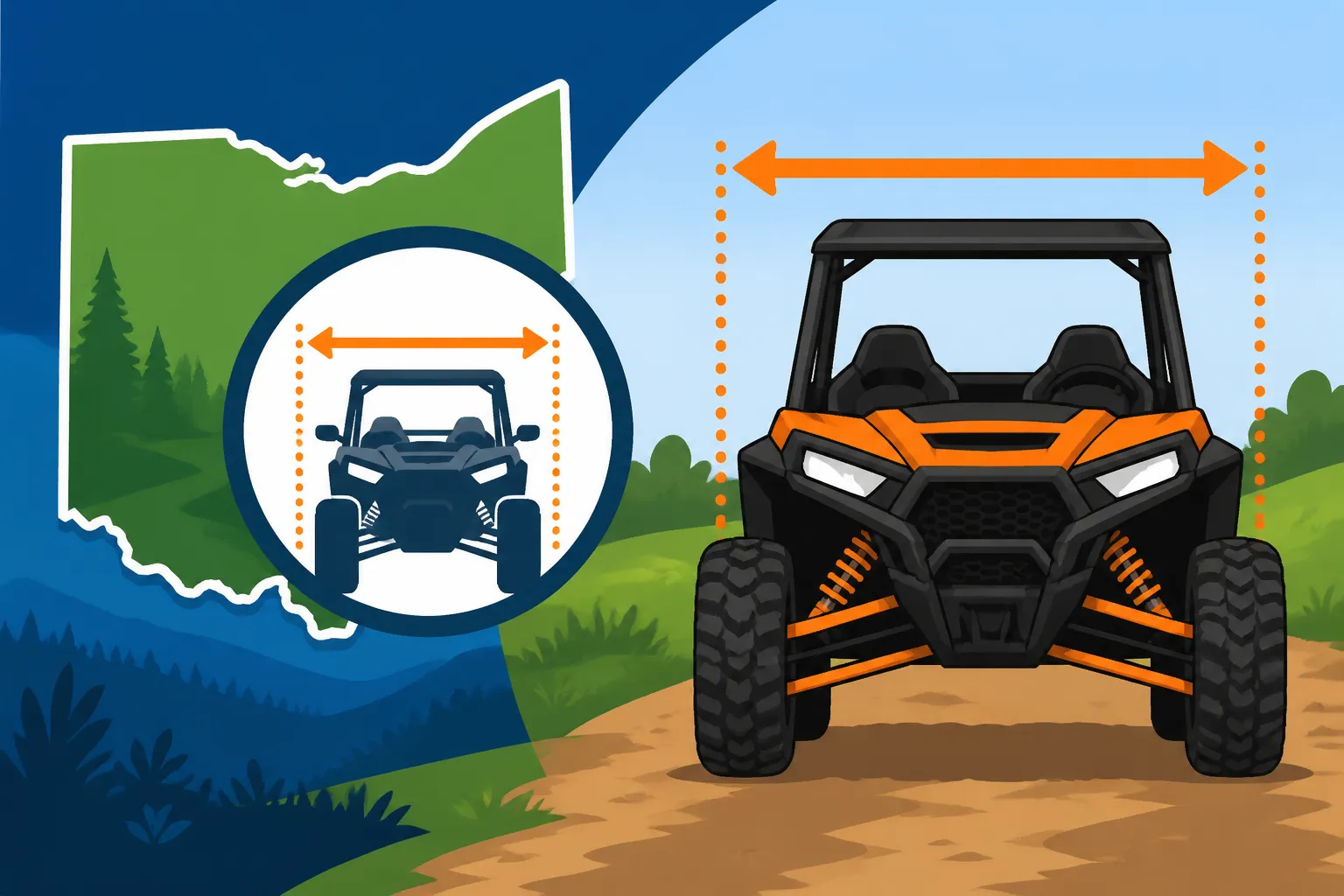
A manufacturer’s published width is a useful starting point, but don’t rely on it alone if the machine has been modified or fitted with accessories. The measurement you need for planning is the machine’s widest side-to-side dimension in the configuration you intend to ride. If you are unsure how the forest authority applies the limit to a particular part or accessory, ask before traveling rather than assuming it will be excluded.
A straightforward home check can help you identify a likely problem:
- Park the machine on firm, level ground, with the steering straight.
- Identify the widest points from side to side. Check both sides rather than assuming the machine is symmetrical.
- Measure across those points with a tape measure, keeping the tape level and perpendicular to the machine’s direction of travel.
- Repeat the measurement to check that you have not angled the tape or chosen a narrower point.
- Write down the result and note the machine’s setup, including any installed accessories that extend outward.
A helper can make it easier to hold the tape level and identify the outer edges. A basic tape measure from a hardware store or Amazon is usually enough for a screening measurement; you do not need a specialized measuring device to decide whether to contact the forest office. If the result is close to the maximum, treat it as a reason to get confirmation, not as proof of eligibility.
Check more than the factory body
Look for anything that sticks out beyond the body or tires. Depending on your setup, that might include wheel spacers, aftermarket wheels or tires, fender extensions, mirrors, a plow mount, or other add-ons. This is a conservative practical check, not a statement that the Ohio Department of Natural Resources has specified how every one of those items is counted. The key is to avoid measuring only the narrowest part of the machine and then discovering that the complete setup is wider.
If you have removable equipment, measure the machine both with and without it. You can then decide whether removing the accessory is practical and whether the machine’s riding configuration meets the limit. Do not assume that a removable part will be disregarded during an official check. Ask the relevant forest office how it treats that equipment.
For a side-by-side, check the full outside-to-outside width rather than measuring only the cabin or seating area. Tires and bodywork may extend beyond the cab. For a quad, check the widest points across the tires or other protruding components. These are sensible places to inspect, but they are not a substitute for confirmation if the machine is near the cutoff.
Compare the measurement with the limit carefully
If your own measurement is below 62 inches, that is encouraging but not a guarantee that the machine qualifies for a particular trail. You still need to confirm that the vehicle type is permitted, that the area is open, and that the required registration and other rules are met. If the measurement is at or close to 62 inches, do not round down or rely on an approximate manufacturer listing. Recheck your setup and contact the forest office for guidance.
If your machine measures above 62 inches in the configuration you plan to ride, do not take it onto designated state forest trails that use this maximum. A registration card, title, or valid plate does not override the width restriction. If your machine is near the boundary, it may be worth checking whether a different riding area is a better fit; Where to Ride a Side-by-Side Over 62 Inches Wide covers that question.
Width is only one part of state forest access
A width check is useful before you load the trailer, but it is only one item in the planning process. Trail availability, registration, operating hours, and vehicle-specific rules can all affect whether a ride works.
The Ohio Department of Natural Resources says APV areas and trails at Pike, Perry, and Richland Furnace state forests close annually during the winter season. The Maumee State Forest APV area remains open during winter to allow for snowmobile use, according to the Ohio Department of Natural Resources. Check current access information before leaving; a machine that meets the width maximum cannot use a trail that is closed.
The Ohio Department of Natural Resources says state forest APV areas remain open during regular deer gun season to provide access for people with disabilities. That seasonal access detail is not a general invitation to ride anywhere outside the designated area. Follow posted signs and the instructions for the specific forest.
Operating time is another independent limit. According to the Ohio Department of Natural Resources, riding in the APV area is allowed from one-half hour before sunrise until one-half hour after sunset. The parking-area speed limit is 5 mph, according to the Ohio Department of Natural Resources. The Ohio Department of Natural Resources also requires accidents to be reported to forest headquarters within 24 hours. Build those requirements into your plan rather than treating width as the only rule to check.
For firearms and other weapons, the Ohio Department of Forestry says operators in state forest areas must ensure they are unloaded and securely encased. That requirement is separate from the Ohio Division of Wildlife rules for designated APV access areas. The Division of Wildlife says there are 15 designated APV access areas statewide that it manages, and qualified APV permit holders may hunt from an APV on private property. Its permit holders are exempt from the firearm discharge prohibition on designated access roads. Do not assume a rule for a wildlife access area automatically applies to a state forest trail.
For more detail on the different permit and registration questions, see Ohio APV Permits Explained and Ohio Rules for Riding a State Forest. If you are unsure whether an area is a state forest trail or a different kind of access area, confirm the land manager before you ride.
What to confirm before you travel
Before choosing a trail, confirm both the machine and the destination. This is especially important if you ride a wide side-by-side, have made modifications, are visiting from another state, or are planning to use an area managed for a different purpose.
Use this checklist:
- Measure the actual setup. Check the widest points on the machine as you plan to ride it, including outward-extending accessories. Repeat the measurement if it is close to 62 inches.
- Confirm the trail accepts your vehicle. The Ohio Department of Natural Resources limits designated state forest trails to specific off-highway vehicles. Do not assume that a trail open to one vehicle type is open to every ATV or UTV.
- Check the area’s status. Seasonal closures differ among state forests. Confirm current access information before loading up.
- Check registration. The Ohio Department of Forestry says vehicles in state forest areas require a State Recreational Vehicle Registration with the BMV. If you need to sort out the paperwork, Ohio APV Registration Paperwork may help.
- Check reciprocity if you are visiting. The Ohio Department of Natural Resources says out-of-state riders from states without reciprocity must obtain an annual Temporary Operating Permit from the BMV. Reciprocity and width are separate questions: a registration accepted for access does not make an over-width machine eligible for a designated state forest trail. See Ohio APV Reciprocity With Other States and The Ohio Temporary Permit for Visitors.
- Ask about a borderline measurement. If the machine is very close to the maximum, get confirmation from the forest office before you travel. Explain the model, your measurement method, and any accessories that extend beyond the body.
Road access is a separate issue from riding a state forest trail. The Legislative Service Commission says snowmobiles, off-highway motorcycles, and all-purpose vehicles may cross highways safely while yielding to traffic, and may be operated on county or township road systems when local authorities permit it. The Legislative Service Commission also describes limited operation off and alongside a street or highway from an unloading point, and operation on a highway berm or shoulder when terrain permits safe travel without entering traffic lanes. Those rules do not extend the state forest trail width maximum or establish permission to ride a particular road. For road questions, check Where Ohio Law Allows APVs on Roads.
For visitors, it is also worth keeping the paperwork questions distinct. Ohio’s title requirement, a State Recreational Vehicle Registration for state forest use, and an out-of-state Temporary Operating Permit are not interchangeable documents. The Ohio BMV says an APV is titled using form BMV 3722 at a county title office. The Ohio Department of Forestry requires the State Recreational Vehicle Registration for vehicles in state forest areas, while the Ohio Department of Natural Resources says certain out-of-state riders must obtain the annual Temporary Operating Permit. Confirm which requirements apply to your machine and your home-state registration before setting out.
A measurement at home cannot guarantee how an official will assess a machine at a trail area, particularly when its width is near the maximum or accessories are involved. Use your measurement to catch obvious fit issues early, then confirm anything uncertain with the managing office. That small check can prevent an avoidable trip with a machine that cannot use the trail.
Sources
- Ohio BMV — Ohio BMV (checked November 3, 2026)
- Ohio Department of Natural Resources — APV Trails in State Forests (checked November 3, 2026)
- Ohio Division of Wildlife — APV Riding (checked November 3, 2026)
Disclaimer
This article is for general informational purposes only and does not constitute professional advice. Laws, prices and regulations vary by location and change over time. Consult a qualified professional for guidance on your specific situation.