Ohio Supervision Rules on Forest Trails
Ohio’s forest-trail supervision rules can be easy to misread: a child’s age, the adult’s role, and the type of public land all matter. Before taking a young rider out, confirm who may ride, who must accompany them, and what the trail operator requires. The practical steps below help you plan without assuming one forest’s rules apply everywhere.
Who may ride Ohio state forest trails
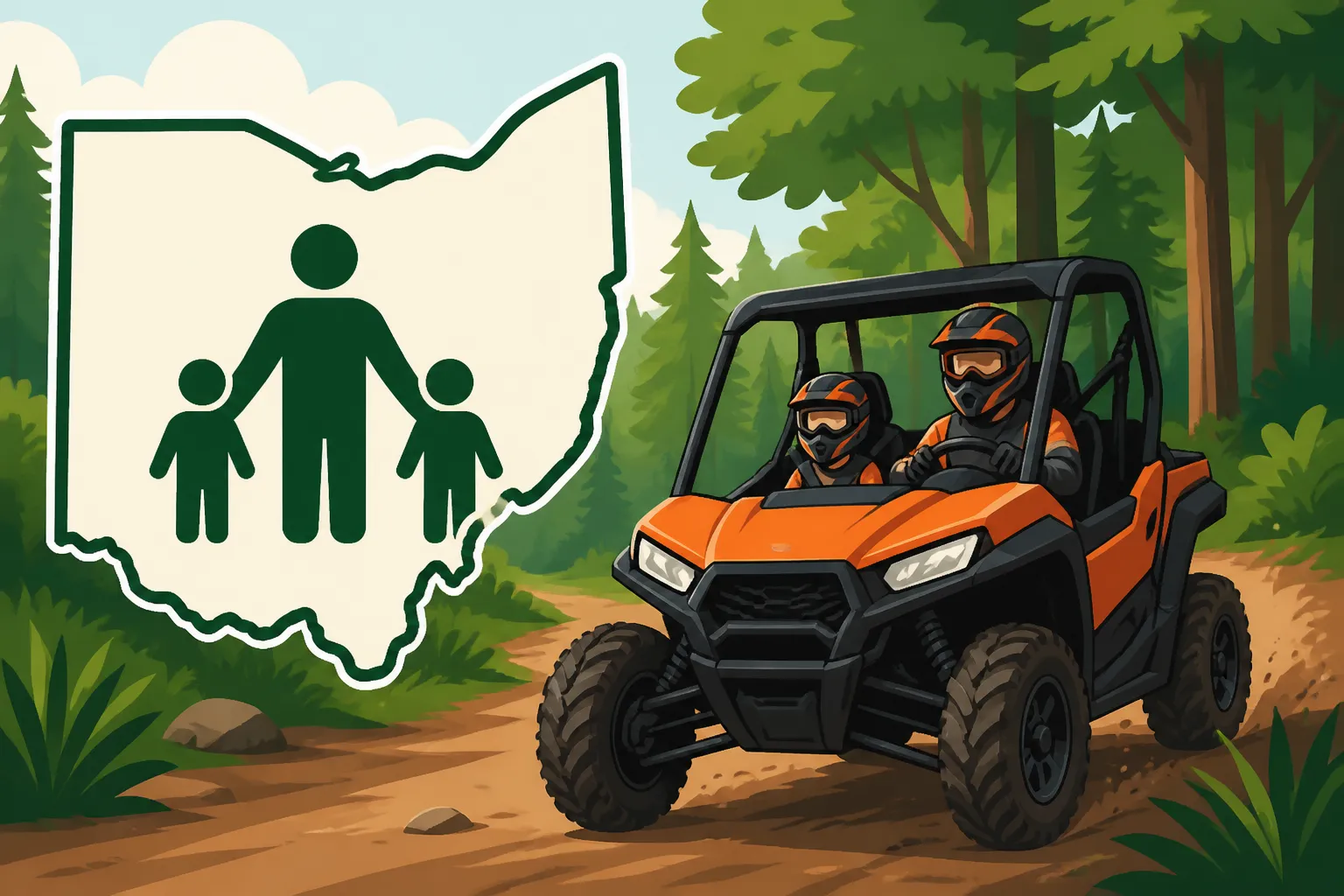
For Ohio state forest trails, the key age line is 12. Children younger than 12 are not eligible to operate an APV on these trails. Riders aged 12 through 15 may ride only when accompanied by a parent or legal guardian who has a valid driver’s license. Riders who are 16 or older do not fall under that under-16 supervision condition, though all riders still have to meet the other applicable rules.
That does not mean a child can ride alone simply because a licensed adult is somewhere at the trailhead or back at camp. Plan for the adult and young rider to stay together throughout the ride. The safest practical approach is to keep the child in sight and close enough to communicate, rather than splitting up across trails or sending the child ahead. For the age threshold and related details, see Ohio Minimum Age for State Forest Trails and [Ohio Rules for a Rider Aged 12].
| Rider’s age | Ohio state forest trail planning point |
|---|---|
| Under 12 | Do not plan for the child to operate an APV on an Ohio state forest trail. |
| 12 through 15 | The rider needs the required accompanying parent or legal guardian, who must have a valid driver’s license. |
| 16 or older | The under-16 supervision condition no longer applies, but other trail, equipment, and permit rules still do. |
The age rule is about operating a machine. It does not by itself answer whether a child may ride as a passenger, whether a particular machine is suitable for them, or what a trail operator requires of passengers. Check the rules that apply to the vehicle and the land, and do not assume that an age rule for riders automatically settles passenger eligibility.
A child’s age should also be considered alongside the machine. A youth rider needs a machine they can control, with an appropriate fit and working controls. An adult’s presence cannot make a machine that is too large, powerful, or unfamiliar safe for a child to operate. If you are choosing a machine for a young rider, Youth Machine Sizes and Ohio Rules and Matching a Machine to a Child in Ohio can help you think through the fit and legal questions.
What the supervising adult needs to do
For a rider aged 12 through 15, the supervising adult is not just another member of the group. The adult must be the rider’s parent or legal guardian and must have a valid driver’s license under the state forest supervision rule. A friend, older sibling, or other adult should not be treated as a substitute unless the applicable rule expressly allows that person to supervise. The distinction matters because general riding rules and land-specific rules are not always identical.
Do not assume that having a license is enough if the adult is not the required parent or guardian. Nor should you assume that a parent’s presence is enough if that parent does not meet the license condition. If an unusual family or guardianship situation makes it unclear who qualifies, confirm it with the land manager before the trip. Which Adult Can Supervise an Under-16 Forest Rider and A Licensed Parent With an Under-16 Rider in Ohio address those questions more closely.
A sensible supervision plan is specific, not vague. Before unloading, agree on which adult is responsible for the young rider, the route you will take, where the group will stop, and what to do if anyone becomes separated. Keep the group together through intersections, trail junctions, and any difficult section. If the child is tiring, overwhelmed, or struggling to control the machine, end the ride or take an easier route rather than relying on the adult to catch up later.
“Accompanied” should not be treated as permission to leave a young rider to navigate independently while the adult rides elsewhere. Even where the rule does not spell out every moment-to-moment detail, staying together is the clearest way to honor its purpose and respond quickly to a problem. A child can lose control, encounter another trail user, or become disoriented faster than a distant adult can help.
The adult should also make sure the child understands basic trail conduct before starting: follow marked routes, slow down where visibility is limited, leave room between machines, and stop when directed. A quick conversation at the staging area is not a substitute for practice. If the rider is new, begin with a manageable route and ride at a pace the child can maintain safely.
Supervision is only one requirement. Riders still need to use the appropriate protective equipment and follow the rules for the land and machine. Review Helmets and Eye Protection on Ohio Forest Trails before riding, and check Ohio Rules for Riding a State Forest for the broader set of state forest conditions. A helmet, suitable eye protection, and a capable adult reduce risk, but none of them waives an age or supervision restriction.
Check which forest and rules apply
“Ohio forest trail” can refer to more than one kind of public land. Ohio state forest trails and routes in Wayne National Forest are not interchangeable for rule-checking purposes. Different land managers may set separate access, permit, equipment, and rider conditions. A rider who qualifies under one system should not assume that the same arrangement is automatically allowed on another.
Before you travel, identify the trail system and the land manager responsible for it. Check that the specific route is open to the kind of machine you plan to bring, and verify the current youth and supervision rules directly with the responsible agency. Trail signs and posted notices matter too. A general state rule does not guarantee that every route is open or suitable for every rider.
For state forest riding details, start with Ohio Rules for Riding a State Forest and confirm the operating window in Ohio State Forest Riding Hours. A machine also has to fit the trail’s restrictions; the state forest width limit is covered in Ohio’s 62 Inch State Forest Width Limit. For a trip to Wayne National Forest, check the separate permit information in How the Wayne National Forest OHV Permit Works rather than assuming the state forest system’s rules cover it.
A useful pre-ride check is:
- Confirm the exact trail system and land manager.
- Verify that the trail is open and allows your type and size of machine.
- Check the current age and adult-accompaniment rules for that land.
- Confirm any required plate, permit, or pass and what each rider must carry.
- Review protective-equipment requirements, riding hours, and trail notices.
- Make a plan to keep the young rider with the responsible adult for the whole ride.
This also matters for visitors. Ohio’s state forest supervision requirements do not disappear just because a machine is registered in another state. Reciprocity and trail access are separate questions: a home-state registration may be recognized for some purposes, but the rider still needs to satisfy the applicable Ohio land rules. See Ohio APV Reciprocity With Other States and What a Visitor From a Registering State Must Show before bringing an out-of-state machine.
If the child is visiting from a state with different minimum ages or supervision rules, do not use the home-state rule as the trip’s standard. Check the Ohio requirements and the rules for the specific forest. Likewise, do not assume that a private riding park, county park, wildlife area, or national forest uses the same age threshold as an Ohio state forest. The location is part of the answer.
A safer ride plan for a young operator
The legal minimum is a starting point, not a recommendation that every child at that age is ready to ride. A young operator needs the strength, coordination, judgment, and attention to manage the machine and respond to changing trail conditions. The adult should assess those abilities honestly before the trip, especially if the child has little experience or the trail is unfamiliar.
Choose a route that matches the rider’s current skill, not the most experienced person in the group. Narrow trails, steep slopes, deep mud, loose surfaces, and limited sight lines can turn a manageable ride into a stressful one. Start conservatively, stop often enough to check in, and be ready to turn around. The aim is not to finish a loop at all costs; it is to keep the rider in control and the group together.
Prepare the child before arriving at the trail. Explain that the rider should not pass the adult, leave the marked trail, or follow another group. Agree on a clear way to signal a stop. Make sure the child can start, stop, steer, and use the controls reliably in a safe place before entering a busy or challenging trail. If the rider cannot manage those basics, postpone the trail ride.
The supervising adult should avoid distractions and ride in a position that allows them to monitor the child. Keep the pace slow enough for the least experienced rider, leave stopping distance, and avoid pressure to keep up with faster machines. If the group includes several children, assign an adult to each young rider who needs supervision rather than assuming one adult can watch multiple machines in different places.
Weather and trail conditions can change the difficulty quickly. Rain can make clay slippery and ruts deeper; dust can reduce visibility; fatigue can make a child’s control less consistent. Check conditions before setting out and reassess as the ride progresses. If visibility drops or the child is no longer riding comfortably, stop in a safe place and adjust the plan.
Finally, carry the information needed to resolve questions at the trailhead: the machine’s registration or permit documents as applicable, identification, and contact details for the responsible land manager. Check official trail notices shortly before leaving, because closures and operating conditions can change. A bit of preparation makes the supervision rule easier to follow and gives the young rider a better chance to enjoy the trip safely.
Disclaimer
This article is for general informational purposes only and does not constitute professional advice. Laws, prices and regulations vary by location and change over time. Consult a qualified professional for guidance on your specific situation.