Why Take a Safety Course Ohio Does Not Require
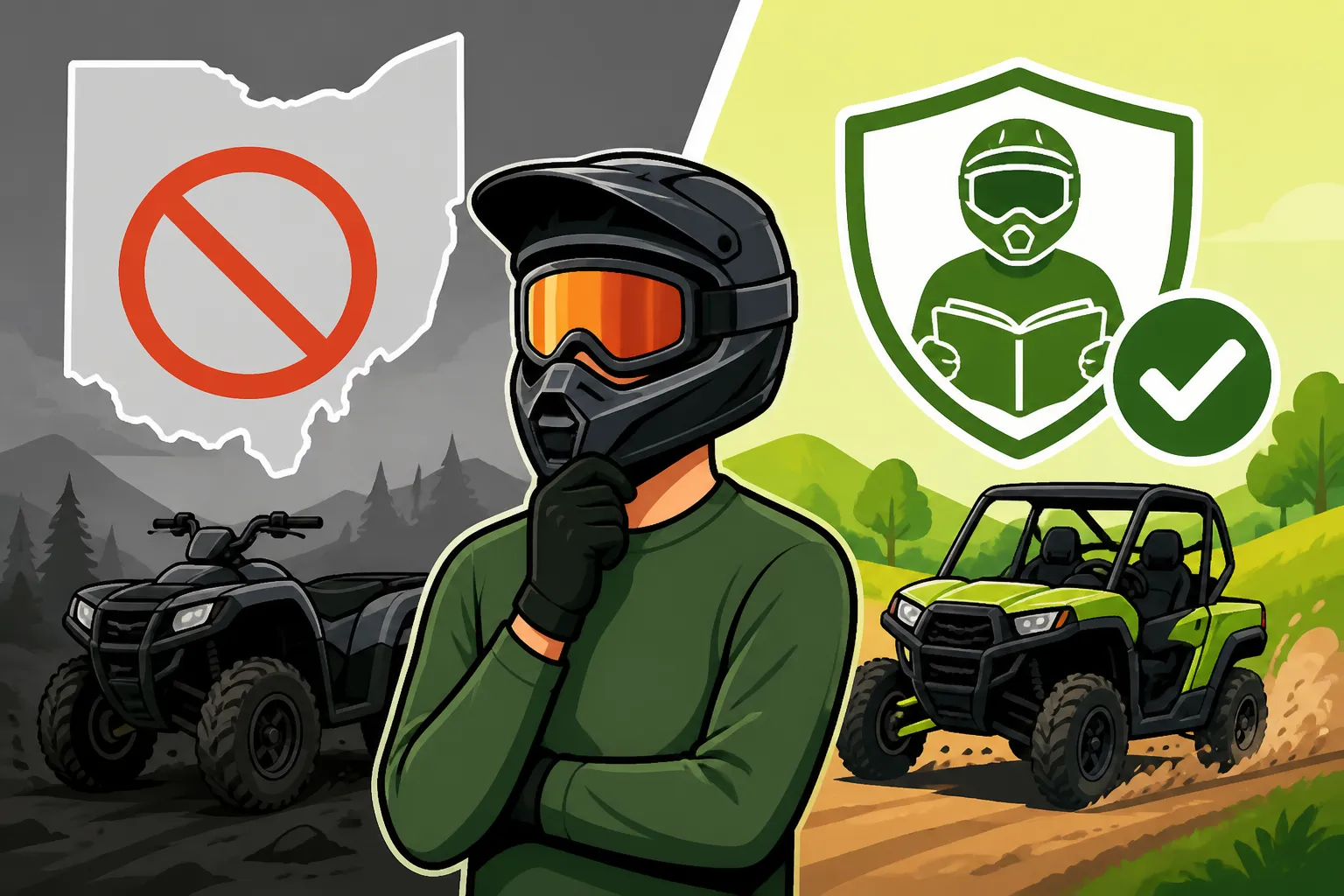
Ohio does not generally require ATV riders to complete a safety course, but that can leave new riders unsure what they should know before heading out. A course can help fill that gap. Here’s how to decide whether training is worthwhile, what it can teach, and which Ohio rules still apply whether or not you take one.
Does Ohio require an ATV safety course?
For ordinary riding, Ohio does not generally require an ATV safety course as a statewide condition of registering or operating an all-purpose vehicle. That does not mean every trail, property owner, rental operator, or event has the same requirements. Check the rules for the place and activity you have in mind before you ride.
Ohio uses the term all-purpose vehicle, or APV, for vehicles that many riders call ATVs, quads, or UTVs. A course is a separate issue from registration, permission to ride, and compliance with age, supervision, helmet, and equipment rules. Taking training does not replace any of those requirements. Skipping training does not exempt you from them either.
For instance, state forest trail rules can apply differently to younger riders than the rules a private landowner sets for their property. A course completion card does not by itself establish that a rider meets a minimum age or supervision requirement. For age-specific details, see Ohio Minimum Age for State Forest Trails and Ohio Supervision Rules on Forest Trails.
A trail system, private riding park, rental business, club, or event organizer may also set conditions for participation. Those conditions can be stricter than the state’s general requirements. Ask the operator whether a course is required, whether it must include hands-on instruction, and what proof they accept. Do this before paying for a course if you need it to meet a particular rule.
| Question | Practical answer |
|---|---|
| Is a course generally required for Ohio APV registration? | No statewide course requirement generally applies to ordinary registration. |
| Does course completion let you ride anywhere? | No. You still need to follow access, registration, age, supervision, and land-use rules. |
| Could a particular operator require training? | Yes. Check with the park, rental company, event organizer, or property owner. |
| Is a course useful if it is optional? | Often. It can build safe habits and help riders understand their machine. |
The distinction matters because “not required by Ohio” is not the same as “not required by anyone.” If you are riding a rented machine or joining a supervised event, ask the provider about its conditions directly. If you are choosing a public riding area, check its current access rules and any posted requirements before loading your machine.
For an overview of the topic, Does Ohio Require an ATV Safety Course? explains the state-level question, while Ohio Safety Training for Riders is a useful next step if you are comparing training options.
Why take a course if it is optional?
An ATV can feel straightforward to operate, especially on familiar ground, but steering, braking, and weight transfer change with speed, slope, mud, and passengers. A safety course gives riders a chance to understand those differences before a difficult moment forces them to react. The goal is not to make anyone an expert after one class. It is to build sound habits and help riders recognize situations that exceed their skills.
Good training typically covers topics such as:
- Basic controls, starting, stopping, and turning
- Choosing a speed and line that suit the ground
- Shifting body weight and maintaining balance
- Braking and handling slopes
- Recognizing hazards, including ruts, loose surfaces, and blind corners
- Riding within the machine’s capacity and the rider’s ability
- Protective equipment and pre-ride checks
- How to respond to a breakdown or an injured rider
A course can be especially helpful for someone who has moved from a small youth machine to a larger ATV, or from a quad to a side-by-side. The vehicle’s size and controls may be familiar in broad terms, but its weight, turning behavior, braking distance, and passenger capacity can be different. A larger machine is not automatically easier or safer to handle.
Training also helps experienced riders identify habits they may have picked up over time. A rider who has managed years of farm use may still be unfamiliar with narrow, marked trails, shared routes, or riding with a group. Likewise, a new owner who has read the manual may benefit from practicing controlled turns and stops with an instructor rather than learning those skills on a crowded trail.
For families, a course can establish shared expectations. Parents and young riders can discuss where the child may ride, when an adult must supervise, what protective gear is expected, and when to stop. The state’s rules remain controlling, but training can make it easier to explain the reasons behind them. Teaching a Young Rider in Ohio offers more context for preparing a child to ride responsibly.
A course is also a useful opportunity to learn what the machine can and cannot do. Riders sometimes assume that four wheels, a roll cage, or a high-powered engine make a vehicle stable in every situation. They do not. A machine can tip, lose traction, or become difficult to control on a slope, in a rut, or during a sharp turn. A rider who understands basic limits is better placed to avoid overconfidence.
The course is most valuable when it matches the rider and machine. A short online class may introduce rules and concepts, but it cannot provide the same practice as in-person instruction. Hands-on instruction can allow a rider to practice controls in a supervised setting and get feedback. Before enrolling, ask what the course includes and whether its completion record is recognized by the organization that may require it.
Choosing training that fits your rider and machine
Start with the reason you are considering a course. If a park, rental company, or event requires training, ask that organization what it accepts. If you simply want to become safer, you have more flexibility: look for clear instruction, a suitable level for the rider, and practical content relevant to the machine and terrain.
Consider these points when comparing options:
- Confirm the provider’s requirements. Ask whether the course must be from a specific provider, whether an online course counts, and whether you need to show a card or certificate.
- Choose the right age and experience level. A first-time youth rider needs different instruction from an adult who already operates a side-by-side.
- Ask about hands-on practice. If practical skills are your priority, check whether the course includes supervised riding or only classroom and online material.
- Match the course to the machine. A course focused on quads may not cover all the considerations involved in driving a UTV, carrying passengers, or using a machine with a cab.
- Check equipment and machine requirements. Find out what participants must bring and whether the provider supplies a training machine or protective gear.
- Keep completion records. Save any certificate or course card, but do not assume it grants access or replaces other paperwork.
A helpful course should make safety practical rather than reduce it to a checklist. The instructor should explain how to assess terrain, manage speed, and choose when not to ride. Training should also make clear that a rider’s ability, visibility, and judgment matter as much as the machine’s features.
For young riders, the adult’s role does not end when a course is complete. An adult should check that the machine fits the child, set clear boundaries, and supervise as required by the rules for the riding area. A child may understand a lesson in a controlled environment but still need close oversight when confronted with other machines, changing trail conditions, or an unexpected obstacle. See A Licensed Parent With an Under-16 Rider in Ohio for related supervision considerations.
If a course is meant to satisfy a particular program or venue, verify acceptance before registering. Similar-sounding courses may have different content or completion records. Ask the provider or venue rather than relying on an assumption that any safety certificate will meet the requirement.
What training does not replace in Ohio
Safety training is one part of preparing to ride. It does not create permission to use a road, trail, forest, private property, or event course. Before riding, confirm that the land is open to your type of machine and that you have the required registration, permit, or authorization. Ohio’s rules differ by location, and private operators can impose their own conditions.
A course also does not substitute for protective gear. Follow the helmet and eye-protection rules that apply to your riding location and situation, and use appropriate gear even where a particular item is not required. See Helmets and Eye Protection on Ohio Forest Trails for information related to forest riding.
Nor does completing a course make an unsuitable machine safe for a particular rider. Check that the rider can reach and operate the controls, handle the machine’s weight, and follow instructions. Follow the owner’s manual for passenger limits and loading. Do not carry a passenger on a machine that is not designed for one.
Before each outing, take a few minutes to prepare:
- Check tires, brakes, lights, controls, and visible fluid leaks.
- Confirm the machine is suitable for the route and the rider.
- Review the route, closures, weather, and expected riding conditions.
- Carry required documents and emergency supplies.
- Tell someone where you are going and when you expect to return.
- Agree on group signals, spacing, and a plan if someone becomes separated.
A course can help you make better decisions, but it cannot guarantee a trouble-free ride. Conditions change, machines can fail, and riders can misjudge an obstacle. The safest approach is to combine training with careful planning, suitable equipment, and a willingness to turn back when the situation exceeds your ability or the machine’s limits.
If you are unsure whether training is expected for your specific ride, ask the organization or land manager before you go. If no course is required, decide based on the rider’s experience, the machine, and the terrain—not just on whether a rule makes training mandatory. For many new riders and families, a well-matched course is a practical way to build confidence without treating confidence as a substitute for caution.
Disclaimer
This article is for general informational purposes only and does not constitute professional advice. Laws, prices and regulations vary by location and change over time. Consult a qualified professional for guidance on your specific situation.