Ohio Fines for Riding Without a Plate
Ohio Fines for Riding Without a Plate
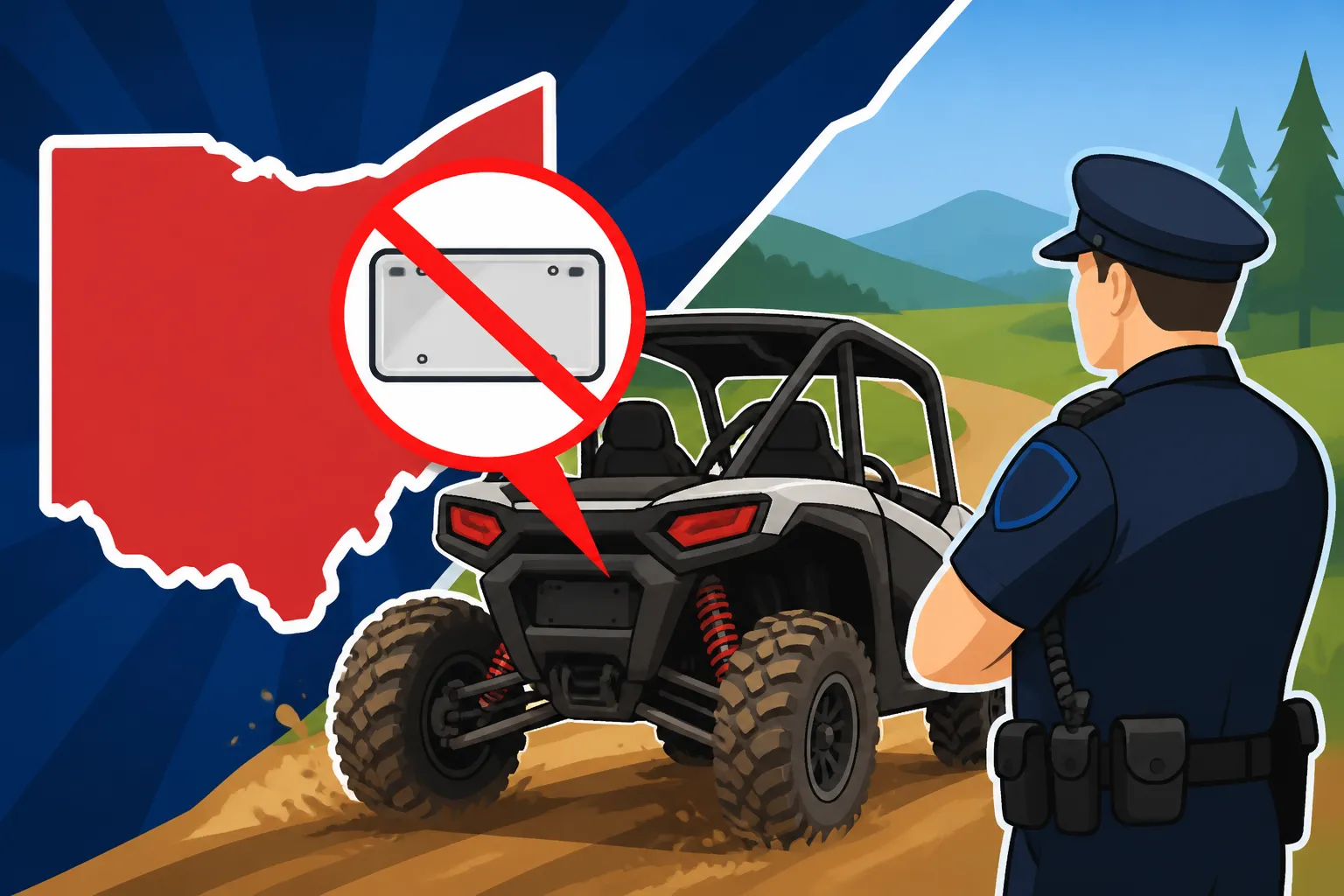
Riding an ATV or UTV without a required plate can turn a trail day into a citation and an unexpected trip home. The tricky part is that “no plate” can mean an unregistered machine, an expired registration, a plate that is missing or unreadable, or a visitor relying on the wrong paperwork. Here’s how to understand the risk and sort out what your machine needs before you ride.
What “Riding Without a Plate” Can Mean in Ohio
Ohio’s all-purpose vehicle rules distinguish between having valid registration and displaying the required plate. Those are related requirements, but they are not identical. A machine might be registered but still appear unregistered if its plate is missing, obscured, damaged, or not displayed as required. Conversely, a visible plate does not necessarily prove that the registration is current or valid for the rider’s situation.
The machine’s category matters, too. Ohio uses the term all-purpose vehicle, or APV, for covered off-highway vehicles. ATVs and many UTVs fall within that category, although the legal classification depends on the machine and its use. How Ohio Law Defines an APV explains the category; The New Vocabulary Ohio Law Uses for UTVs can help clarify why familiar vehicle labels do not always match Ohio’s legal terminology.
In practical terms, a plate-related citation may involve one or more of these situations:
- The machine has never been registered when registration is required.
- Its registration has expired.
- The plate was lost, stolen, damaged, or removed.
- The plate is present but cannot be read because of dirt, damage, or how it is mounted.
- The rider has paperwork but no plate displayed on the machine.
- A visitor assumes that a home-state document or permit is enough when it is not.
- A machine is being used in a place or manner for which its registration does not provide permission.
A rider may describe all of these as “not having a plate,” but the officer’s citation will identify the alleged violation. That detail matters. A missing plate on a currently registered machine is not necessarily treated in the same way as operating an unregistered machine, and a registration violation is separate from riding on a closed trail or road.
Ohio registration is not simply a piece of paperwork to keep in a pocket. The plate is part of the machine’s registration display. A registration card, title, bill of sale, or photograph of the plate may help explain a situation, but none should be assumed to replace a required plate. For a closer look at the physical display, see Ohio APV Plates and Validation Stickers and Keeping an Ohio Plate Distinctly Visible.
| Situation | What may be wrong | Useful next step |
|---|---|---|
| No plate and no current registration | The machine may be operating without required registration | Check whether the machine needs Ohio registration, a valid out-of-state registration, or a visitor permit |
| Plate missing, but registration may be current | The display requirement may not be met | Arrange a replacement and avoid riding until the required plate is displayed |
| Plate is present but registration has expired | The machine may not have valid current registration | Confirm the expiration and renewal process before operating |
| Plate is dirty or hard to read | The required identifying display may not be legible | Clean or repair the plate and mount it so it remains visible |
| Visitor has a home-state registration | Reciprocity may or may not apply | Confirm Ohio’s current rules for that state and riding location |
| Plate is valid, but the rider is on a closed route | The issue is road or trail access, not merely registration | Check local road authorization and land-specific rules |
Do not assume that a plate cures every other legal problem. Ohio registration does not automatically make an APV street legal, open a township road to riders, or authorize travel on private property. Rules for road use are a separate question. Start with Street Legal APVs in Ohio: The Short Answer and Ohio Counties That Allow APVs on Roads if your ride includes public roads.
When Ohio Requires a Plate and Registration
The answer depends on where and how the machine is being operated. A rider using an APV in an area open to public riding should not assume that a title or proof of purchase is enough. Ohio registration requirements and land-use rules apply independently: the registration addresses the machine’s status, while the land manager or road authority determines whether riding is allowed in that place.
That distinction is easy to miss. A rider might have a registered machine but ride on a closed trail, or might be on an authorized route with a machine that is not properly registered. Either situation can create a problem. Before loading up, check both the machine’s paperwork and the rules for the particular route, forest, road, or park.
For many Ohio riders, the state-issued APV plate is also the relevant registration display for riding in state forest areas. Ohio does not use a separate state forest trail sticker in the same way some riders may expect. That does not mean every trail is open to every machine: location-specific rules still apply, including restrictions on where and when riding is allowed. Why the Ohio Plate Is the Trail Permit explains the relationship between the plate and state forest access.
Wayne National Forest is a different case to check carefully. Its OHV access requirements are separate from Ohio APV registration. An Ohio plate does not, by itself, satisfy every federal forest access requirement. Riders should confirm which permits or passes apply to their planned route and who needs one before the trip. How the Wayne National Forest OHV Permit Works covers that separate requirement.
The two-counter registration process can also confuse new owners. Titling and registration are related but are not the same transaction. A title establishes ownership; registration authorizes the machine’s covered operation and provides the required plate. If you have recently bought a machine, you may need to complete both steps. Where to Title an APV in Ohio and Where to Register an APV in Ohio explain which office handles each task.
Registration may also be time-limited, so an old plate or old receipt is not proof that the machine is currently registered. Check the registration period and expiration information rather than relying on memory or the date of purchase. See How Long an Ohio APV Registration Lasts and When an Ohio APV Registration Expires for details.
A few common assumptions can lead riders astray:
- “I have the title, so I can ride.” A title is proof of ownership, not a substitute for required registration.
- “The machine came with a plate.” A plate from a prior owner does not automatically establish that the registration is current or transferred correctly.
- “I only ride occasionally.” Infrequent use does not, by itself, answer whether registration is required in the place you plan to ride.
- “I’m only riding on a trail.” Trails have their own access rules, and a plate may be required even when no public road is involved.
- “I’m on private property.” Private-property use can have a different registration analysis, but permission from the landowner and other applicable rules still matter. Do not extend a private-land exception to a public trail or road.
- “The route is open, so my machine is legal there.” Route access and machine registration are separate checks.
If you are unsure whether your machine is classified as an APV, whether the place is public land, or whether a particular exemption applies, resolve that before riding. The details can depend on the machine and its use. Ohio APV Registration Paperwork is a practical place to start if you are preparing an application or checking what documents are involved.
What a Citation May Cost and What Can Happen Next
There is no single reliable dollar figure to use for every “no plate” situation. The amount written on a citation, any court costs, and the possible outcome can depend on the specific offense cited, the circumstances, and the court handling the case. Fines and court charges can change, so confirm the current amount with the court named on the citation or another official source before budgeting or deciding how to respond.
A citation may also allege more than one issue. For example, the officer could identify a registration or plate-display problem and a separate violation involving where the machine was operated. A missing plate does not automatically mean the rider was also on an illegal road, but separate facts can produce separate allegations. Read the citation rather than relying on a verbal summary of what happened.
There can be consequences beyond the fine. Depending on the circumstances, a rider may be told not to continue operating the machine until the issue is resolved. That can mean arranging transportation, retrieving the machine later, or ending the ride early. Do not treat that practical possibility as a guaranteed outcome or as a substitute for reading the officer’s instructions.
The citation itself should tell you what law or offense is alleged and where to respond. Keep the paperwork together, note any response deadline, and contact the listed court if you do not understand how to appear or submit a response. Failing to respond can create a separate problem. If the citation includes several alleged violations or has consequences you do not understand, consider speaking with a qualified attorney.
When looking at the amount, distinguish the fine from other charges. A court may list a fine and court costs separately. The total due may also depend on the disposition of the case. Ask the court for the current total and available response options; do not assume the fine printed in a general online discussion is the amount you will owe.
A useful way to assess a citation is to ask:
- What exact violation is listed? Look for the charge or statute, not just the shorthand description “no plate.”
- Was the issue registration, display, or both? A machine with current registration but a missing plate presents a different factual question from a machine that was never registered.
- Was another riding rule cited? Road access, trail closures, equipment, and age or supervision rules can be separate matters.
- What does the court require? Confirm the response date, payment options, and whether an appearance is required.
- Can you document the facts? Save current registration records, purchase documents, photographs of the machine and plate, and any correspondence that relates to the issue.
Do not alter, cover, or move a plate to make it less visible after receiving a warning or citation. If the plate is damaged or missing, focus on correcting the problem through the proper replacement process. Replacing a Lost Ohio APV Plate and Ordering a Replacement Plate in Ohio describe the replacement issue. If the registration itself has expired, use Renewing an Ohio Registration Ninety Days Early to understand renewal timing and avoid waiting until the next ride.
If you believe the citation is mistaken, gather records that address the actual allegation. A current registration card may be relevant to whether the machine was registered, while a photo of the plate’s placement may help explain a display issue. A bill of sale or title can establish ownership but may not prove valid current registration. Follow the court’s process for contesting a citation rather than assuming that showing paperwork roadside will close the matter.
Visitors, Reciprocity, and Situations That Need Extra Checking
Visitors to Ohio should not assume that every state’s registration is treated the same way. Reciprocity depends on Ohio’s rules and the visitor’s home-state requirements. Some riders may be able to use a valid home-state registration; others may need an Ohio temporary permit or other documentation. A plate from another state is not automatically proof that the rider meets Ohio’s requirements.
Check these points before crossing the state line:
- Is the machine registered in its home state?
- Does that state issue off-highway vehicle registrations or require them?
- Does Ohio recognize the registration for the kind of riding planned?
- Does the riding area require an additional land-specific permit?
- Is the machine permitted on that particular trail or road?
- Does the rider need to carry the registration card or other proof?
Ohio’s treatment of a visitor can differ depending on whether the home state registers comparable machines. The permit process may also depend on how long the visitor plans to ride. Confirm the current rule and permit term with the appropriate official office before the trip, rather than relying on another rider’s experience or an old forum post. Ohio APV Reciprocity With Other States gives a broad overview, while The Ohio Temporary Permit for Visitors is relevant when a visitor may not qualify through home-state registration.
A temporary permit or accepted out-of-state registration should not be confused with permission to ride anywhere. A valid document does not open a closed state forest route, authorize a ride on private land without permission, or make a township road available if local authorities have not opened it. Check the access rules for the specific area as well as the registration rule.
Visitors can also be caught by separate access requirements at federal recreation areas. Check the rules for the exact forest and trail system, including whether an additional pass applies to the machine or riders. Which Trails a Wayne Forest Pass Opens can help separate that question from Ohio’s state registration requirement.
For Ohio residents, a state registration does not necessarily settle every issue when riding across state lines. The state where the ride takes place sets its own access and registration rules, subject to any applicable reciprocity. If a machine is registered in Ohio but the destination state requires another permit or has different trail restrictions, the Ohio plate alone may not be enough.
If you moved to Ohio, bought a machine out of state, or inherited one with another state’s paperwork, do not assume that the old plate can simply stay on the vehicle. Check whether the title must be transferred and what registration steps are required. Registering an Out-of-State Machine in Ohio covers that situation.
How to Avoid a Plate Citation Before You Ride
A short pre-ride check is more effective than trying to explain missing paperwork at a trailhead or roadside stop. Build the check into loading the machine, especially after a purchase, a move, a long period in storage, or any repair that involved the plate or its mount.
- Identify the machine and riding location. Confirm whether it falls under Ohio’s APV rules and whether the destination is state forest land, a national forest, a private park, a public road, or private property.
- Check registration status. Verify that the registration is current and applies to the machine. Do not rely only on a previous owner’s paperwork or a plate found on the vehicle.
- Inspect the plate. Make sure the required plate is attached and plainly visible. Clean off mud and check for cracks, bending, loose fasteners, or anything blocking the identifying information.
- Carry the necessary records. Keep required registration information accessible. A phone photo can be useful as a backup, but do not assume it replaces a required physical document or plate.
- Check reciprocity if you are visiting. Confirm that Ohio accepts the home-state registration for the planned use or determine whether a temporary permit is needed.
- Check separate access rules. Verify any forest pass, trail restriction, road authorization, machine-width limit, or seasonal closure that applies to the route.
- Fix problems before unloading. If the plate is missing or the registration is uncertain, pause and contact the appropriate office. Riding first and sorting it out later exposes you to an avoidable citation.
If the plate has been lost, do not improvise a replacement or rely on a handwritten substitute unless an official authority has specifically told you that it is acceptable. Ask the relevant registration office how to replace it and whether the machine may be operated while the replacement is pending. Until you have a clear answer, the cautious option is not to ride in a place where the plate is required.
If the sticker or other validation information is expired, damaged, or hard to read, check the registration record and renewal options. A plate can look intact while its registration has lapsed. Conversely, the registration may be current while the plate or validation display needs attention. The remedy depends on which part of the requirement is missing.
For a recently purchased machine, check the title and registration separately. Get the transfer completed rather than assuming the seller’s plate covers the buyer. Buying a Used APV in Ohio and Ohio APV Registration Transfer can help with those next steps. If the machine’s identifying number or ownership documents do not match, resolve that discrepancy before attempting registration.
Finally, treat access as a separate pre-ride checklist. A correct plate reduces the risk of a registration citation, but it does not authorize every road, trail, or parcel. Confirm the local rules for the route you intend to use, and keep a backup plan for a closed trail or a route that does not allow your machine.
Frequently Asked Questions
Is there one fixed fine for riding an ATV without a plate in Ohio?
There is no single figure that applies to every case. The amount can depend on the exact offense and court, and court costs may be separate. Check the citation and contact the court for current amounts.
Can I ride if my plate is lost but my registration is current?
Do not assume that current registration alone is enough when the required plate is missing. Ask the appropriate registration office how to replace it and whether operation is allowed while you wait.
Does an out-of-state plate automatically let me ride in Ohio?
No. Ohio’s treatment of out-of-state registration depends on the applicable reciprocity rules and where you plan to ride. Visitors should confirm whether their registration is accepted or whether they need a temporary permit.
Does an Ohio APV plate let me ride on any road?
No. Registration and road access are separate. A road must be open to APVs under the applicable state or local rules, and other requirements may apply.
Is a title enough to avoid a no-plate citation?
No. A title documents ownership; it does not substitute for required registration or the plate display. Check that the registration is current and that the plate is properly displayed.
Disclaimer
This article is for general informational purposes only and does not constitute professional advice. Laws, prices and regulations vary by location and change over time. Consult a qualified professional for guidance on your specific situation.