Why Ohio Riding Starts a Half Hour Before Sunrise
Ohio’s state forest APV trails can open before sunrise, but that early start is a defined riding window—not permission to ride in darkness whenever you arrive. Knowing how the half-hour rule works helps you plan a legal, safer launch, especially when sunrise times shift, trail conditions change, or your route takes longer than expected.
What the half-hour-before-sunrise rule means
The rule applies to a specific riding window
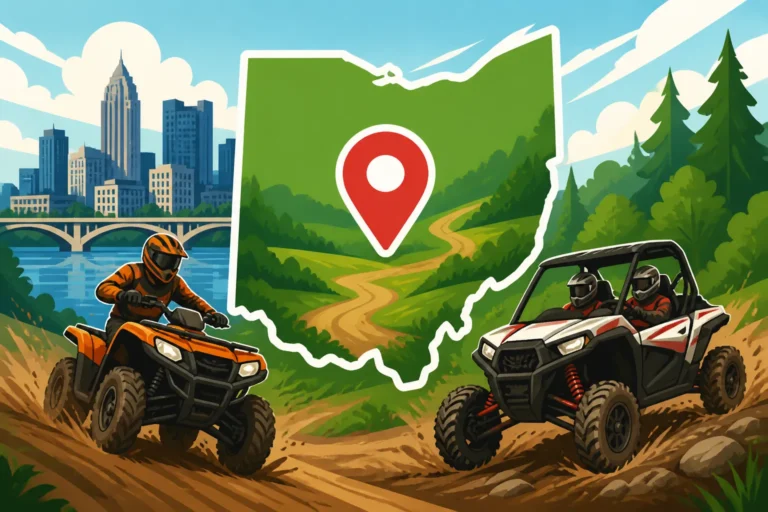
On Ohio state forest trails designated for all-purpose vehicles, the riding day generally begins one-half hour before sunrise and ends one-half hour after sunset. That means a rider may be able to start before the sun appears above the horizon, provided the trail is open and the ride stays within the permitted hours.
The rule is easy to misread as “ride whenever it’s light enough.” It is not. The official window is tied to sunrise and sunset, not to whether the sky looks bright, whether your headlight is powerful, or whether you think you can see well enough. A cloudy morning can feel like nighttime even after the allowed window begins; a clear morning can look bright before it does.
This schedule is also not a blanket rule for every place an ATV or UTV might be ridden in Ohio. A state forest trail, a Wayne National Forest route, a private riding park, and a township road may each have different access rules. Before using the early-start window, confirm that the specific trail system allows it. For background on how permitted hours work, see [Ohio State Forest Riding Hours] and [Half an Hour Before Sunrise in Ohio].
Sunrise times change, so the start time changes too
The half-hour window moves with the local sunrise. It is not a fixed clock time for the whole year. A trail start that is legal on a summer morning may be too early on a late-fall morning, even if both outings begin at the same time on your watch.
That matters when you are meeting friends or trying to make the most of a weekend. Imagine a group planning to unload at first light. If one rider assumes “first light” means the same thing as the legal opening, the group could end up waiting at the trailhead—or setting off before access begins. Check the sunrise time for the area you will ride, then work backward by 30 minutes.
For a route near Nelsonville or Athens, check the time for the trail area rather than relying on a sunrise time for a distant city. The difference may be small, but the rule is based on the local day, and a small discrepancy can matter when you are trying to time your first movement onto a trail.
The rule does not override closures or local restrictions
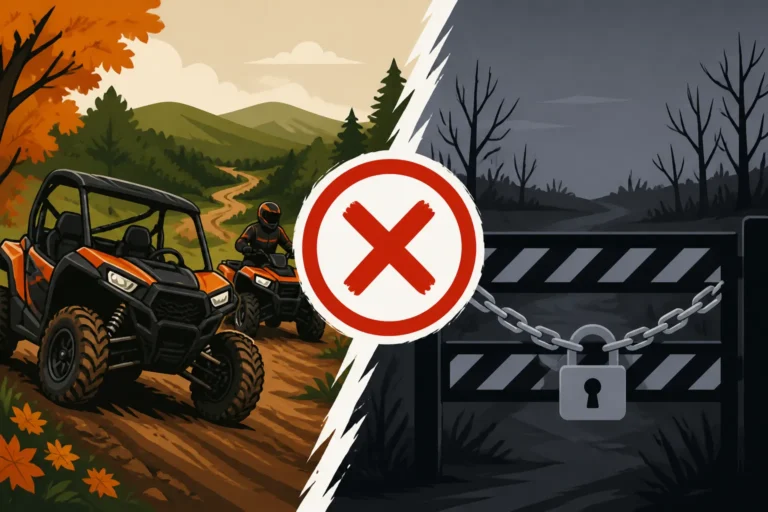
The permitted riding window only helps when the trail is open. A seasonal closure, temporary maintenance closure, weather-related restriction, or posted instruction at the site still takes priority. Don’t treat the early start as an exception to a closed gate or a trail notice.
Before loading the machines, check the trail system’s posted information and current conditions. [Ohio Trail Closures to Check First] is useful context for understanding why a route that was open on your last visit may not be available today. If a sign at the entrance gives a narrower schedule or a specific restriction, follow that sign.
It is also worth separating the “when” from the “where.” The hours tell you when riding may be allowed; they do not authorize riding on an unmarked route, a closed segment, or land that does not permit APVs. If you are unsure whether the trail you want to use is part of the designated riding area, confirm it before unloading.
| Planning question | What to check | Why it matters |
|---|---|---|
| Is the trail open today? | Trail notices, gates, and posted signs | A closure overrides the usual riding window |
| When does the riding window begin? | Local sunrise time, minus 30 minutes | The opening shifts through the year |
| When must the ride end? | Local sunset time, plus 30 minutes | A long route can run past the allowed window |
| Does this rule cover the place I’m visiting? | The specific land manager and trail system | State forests, federal land, and private parks can differ |
| Is my route suitable for an early start? | Map, terrain, weather, and group ability | Poor visibility and delays can affect safe travel |
Why Ohio allows an early start
It gives riders more usable time on the trail
A half-hour earlier opening can make a practical difference when a riding day includes unloading, checking machines, riding a long loop, and getting back before the evening cutoff. It can help a group use more of the permitted day without needing to ride late into the evening.
That extra time is especially helpful when riders have a long drive home. Someone traveling from Columbus toward southern Ohio, for instance, may want to reach the trailhead early, complete a manageable loop, and pack up with enough daylight left for the trip back. The early window can ease the schedule, but it does not remove the need to plan a route that fits the available hours.
The half-hour is a modest extension, not a promise that every trail can be completed before sunset. A muddy section, a mechanical issue, a slower rider, or a stop to regroup can add time. Build in a buffer rather than planning to reach the trailhead at the exact end of the legal window.
It recognizes that riders may be ready before full daylight
Some riders prefer to get organized before the sun comes up. They may need time to unload, check tire pressure, fasten helmets, confirm the route, and get the group moving. The early opening can provide a small amount of additional riding time for people who have already handled those tasks responsibly.
But “allowed to begin” does not mean “safe for every rider in every condition.” Low light can make trail markers, ruts, branches, rocks, and other riders harder to spot. In wooded areas, the canopy can make the trail noticeably darker than an open staging area. Fog, rain, dust, and shaded hollows can reduce visibility further.
A sensible group may choose to wait until there is enough natural light to see clearly, even when the official window has begun. The schedule sets the boundary for access; it does not require you to use every available minute.
It can support a careful, daylight-focused ride plan
The early window works best when it is part of a broader plan: know where you are going, know when you need to turn back, and make decisions based on the least experienced rider in the group. A confident rider may be comfortable navigating in dim light, while a newer rider may struggle to read the trail surface or follow markers.
Before leaving the staging area, agree on a route and a turnaround point. Identify where the group can stop safely if someone needs help. If you are riding a system with multiple junctions, use a map and make sure each rider knows the basic route. [Ohio Trail Maps From ODNR] can help you think through route planning, while [Ohio's Four State Forest APV Areas] provides context for the designated state forest riding areas.
A mapping tool such as onX Offroad can also help riders review a route and keep track of where they are, particularly when a group is unfamiliar with the area. It should support—not replace—posted signs, official trail information, and good judgment on the ground.
How to plan a safe early ride
Prepare before you reach the trailhead
Early starts tend to go badly when the first preparation happens in a dark parking area. Pack the gear you need the night before, charge phones and navigation devices, and check the forecast and trail notices before leaving home. If you need to make a last-minute decision about whether the trail is open, do it before you have driven several hours and unloaded the machines.
At the staging area, take time to inspect the machine and confirm that everyone is ready. Check lights, tires, controls, fuel, and any equipment required for your ride. Make sure helmets and eye protection fit properly, and that riders know what to do if the group becomes separated. These steps may feel routine, but they are easy to rush when everyone is eager to get moving.
If the group uses onX Offroad or another navigation tool, open the map and confirm the planned route before setting out. In areas where cell reception is unreliable, prepare for that possibility rather than assuming a live connection will be available. Keep a backup plan, and do not let a digital route lead you past a closure or onto a route that is not open to APVs.
Set a conservative pace in low light
The first stretch of a morning ride is a poor time to race, pass aggressively, or assume the trail will be clear around the next bend. Ride at a speed that allows you to stop within the distance you can see. Leave room between machines, particularly where dust, foliage, or a rise in the trail could block your view.
Take extra care at intersections and on narrow trails. Another group could be approaching from the opposite direction, and a rider may not see your machine until the last moment. Use lights appropriately, keep to the marked route, and slow down before junctions rather than braking abruptly at the last second. For shared-trail etiquette and practical habits, read [Ohio Trail Etiquette on Narrow Trails].
The same caution applies to changing weather. A cool, damp morning can leave leaves slick; fog can reduce contrast; and a shaded section may remain dim after the sun is up. If conditions make it hard to see hazards, stop somewhere safe and reassess. There is no benefit in using the early opening if the group cannot ride comfortably and responsibly.
Plan the return before the ride begins
The end of the permitted window deserves as much attention as the start. Estimate how long your loop will take, then leave room for slower terrain, breaks, and unexpected delays. If the route has several branches, decide in advance which shorter option the group will use if time runs short.
A common mistake is to start a long loop near the end of the day because the group believes it can “make up time.” That can turn a relaxed outing into a rushed ride, especially when the trail is muddy or a machine needs attention. It is better to shorten the route while everyone is still well within the allowed hours than to push the pace late in the day.
Keep the sunset cutoff in mind even if the group is still having fun. Ohio’s permitted window generally extends to one-half hour after sunset on applicable state forest trails, but the fading light can make the final stretch harder than the clock suggests. For the closing boundary, see [Half an Hour After Sunset in Ohio]. When planning by season, [Ohio's Trail Season by Forest] can also help frame the larger question of when a particular riding area is typically available.
Common mistakes riders make with the early opening
Treating “half an hour before sunrise” as a fixed time
The most obvious mistake is using the same departure time every weekend. Sunrise shifts as the seasons change, so a fixed start can eventually fall outside the allowed window. Check the date and location each time instead of relying on last month’s schedule or a friend’s memory.
Another trap is confusing sunrise with the time the sky begins to lighten. Those are not necessarily the same. If you are coordinating several vehicles, send the group the actual plan—where to meet, when to unload, and when riding may begin—rather than saying “we’ll head out at first light.”
Assuming every Ohio riding area follows the same schedule
Ohio has different kinds of riding areas, and the rules for one do not automatically transfer to another. A state forest APV trail rule should not be assumed to govern a national forest route or a private park. Even within a broader region, a land manager’s posted requirements may differ.
Use the official trail information for the exact destination. If your trip involves more than one system, check each one separately. A route-planning app can help you visualize where you intend to go, but the map is not a substitute for confirming the rules with the land manager. This distinction is especially important when riders cross between nearby areas or follow roads to connect trail sections.
Leaving too little time to get back
A pre-sunrise start can create a false sense that there is plenty of time. In reality, the day’s useful riding period still has a firm end, and trail conditions can slow progress. Mud, steep sections, fallen branches, a flat tire, or a rider who needs a break can all change the schedule.
Choose a loop that fits the group rather than the most ambitious route on the map. If you are riding with children, beginners, or machines with different capabilities, allow more time than the fastest rider expects to need. Keep the plan flexible and turn around early if the pace is slower than expected.
A tool such as onX Offroad may help with route awareness, but build in time to stop, check the map, and make a decision. Navigation should make the ride more organized, not encourage the group to push beyond its ability or ignore changing conditions. The best early start is one that gives you a calm, well-paced day—not a reason to hurry.
Disclaimer
This article is for general informational purposes only and does not constitute professional advice. Laws, prices and regulations vary by location and change over time. Consult a qualified professional for guidance on your specific situation.