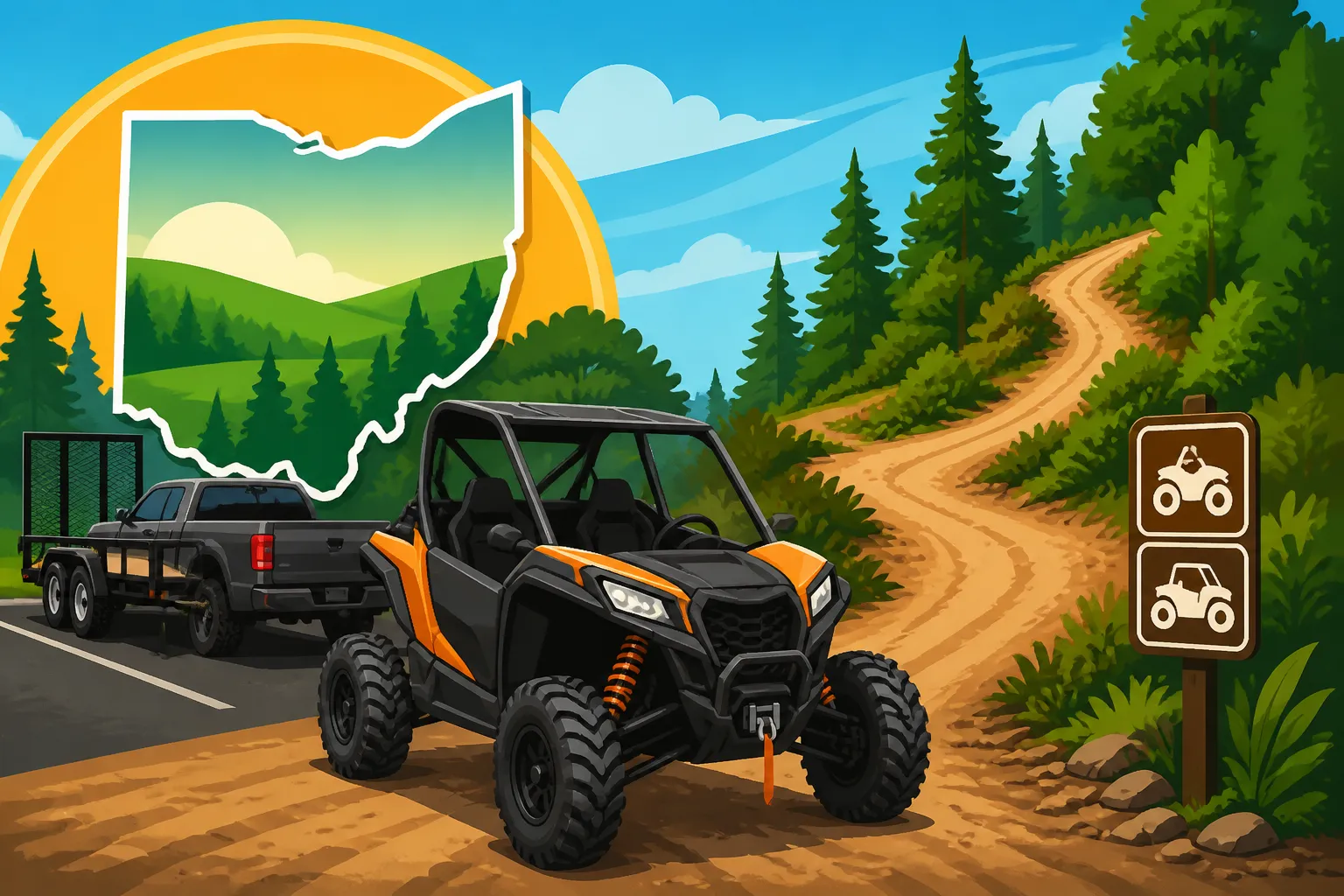
Ohio Trails With a Staging Lot
If you’re hauling an ATV or UTV across Ohio, finding a trail is only half the job: you also need a place to park the truck and trailer without blocking a gate or arriving at a closed entrance. This guide explains where riders can look for established staging areas, how to prepare for each trail system, and what to check before unloading.
Ohio trail systems with places to stage
Ohio’s main public riding options include several state forest areas and the Wayne National Forest trail systems. These are not interchangeable: rules, permits, seasonal access, and trail widths can differ. A marked staging area or trailhead is the best place to begin, but verify that it is open and suitable for your trailer before making the drive.
| Riding area | General location | What to check before leaving |
|---|---|---|
| Monday Creek | Near Nelsonville in southeastern Ohio | Trailhead access, current closures, and room for your trailer |
| Hanging Rock | Near the Ironton area in southern Ohio | Which entrance serves your planned route and whether the system is open |
| Pine Creek | In the Ironton District area of southern Ohio | Whether you plan to start near Lyra or Wolcott and which trails are accessible |
| Perry State Forest | Near New Lexington in southeastern Ohio | Seasonal access, vehicle-width rules, and the designated parking area |
| Pike State Forest | Near Waverly in southern Ohio | Trail status, staging access, and current forest rules |
| Richland Furnace State Forest | In southern Ohio | The designated trail entrance, closures, and available parking |
| Maumee State Forest | Near the Oak Openings region in northwestern Ohio | The correct riding area entrance and the rules for the route you intend to use |
Monday Creek near Nelsonville
Monday Creek is a useful starting point for riders exploring southeastern Ohio. Its system is associated with the Nelsonville area, so it can work for a day trip or as part of a longer ride through the Hocking Hills region. Before towing there, look up the designated access point rather than navigating only to a town name. A town can have several roads and trail-adjacent locations, and not every pull-off is a legal staging lot.
The parking area is part of the ride plan, not an afterthought. Check whether your truck and trailer can fit without occupying the space needed by other riders or blocking the entrance. If your group is meeting there, agree on a specific trailhead before the drive. “We’ll meet near Nelsonville” can become a frustrating string of calls when cell service drops and several people arrive at different access points.
Conditions in the hills can change the feel of a route quickly. A trail that seems manageable on a dry day may be slick after rain, while steep or rutted sections can make turning around difficult. Review [Monday Creek Near Nelsonville] and [Monday Creek’s 75 Miles] for system-specific planning, then check current conditions before unloading.
Hanging Rock and Pine Creek in southern Ohio
Hanging Rock and Pine Creek offer other established riding options in the Ironton District area. They can be appealing when you want to explore the southern part of the state, but don’t assume one parking area gives you access to every nearby trail. Confirm the trailhead for your chosen system and follow the signs at the entrance. If your route depends on a particular access point, save its location before you lose mobile coverage.
Pine Creek riders may see references to starting near Lyra or Wolcott. Those names are helpful when comparing access options, but they are not a substitute for checking the route and lot you intend to use. A staging area can be open while a particular trail segment is closed, or an entrance can be unsuitable for a long trailer. Use the posted information at the lot as the final check before riding.
For a more detailed plan, compare [Hanging Rock’s 26 Miles], [Pine Creek’s 20 Miles], and [Starting a Ride at Lyra]. Riders deciding between trailheads can also review [Starting a Ride at Wolcott]. If you’re using onX Offroad to save a route or mark a parking location, treat it as a planning aid; confirm access and closures with official trail information and signs on the ground.
State forest areas and other places to ride
Perry, Pike, Richland Furnace, and Maumee are among the Ohio state forest areas riders may consider. Their locations span different parts of the state, so the best choice depends on where you’re starting, how far you want to tow, and whether the area suits your machine. A staging lot doesn’t guarantee that every vehicle or trailer can use it comfortably. Check for posted parking instructions, gates, and any restrictions on the road leading to the lot.
State forest access is also subject to rules that may not apply in the same way at a private riding park. Ohio’s state forest systems have trail and machine-width requirements, and some areas operate seasonally. Maumee is often discussed differently from the southern forest systems, so check its current access information rather than assuming the same opening and closing dates apply everywhere. [Ohio’s Four State Forest APV Areas] and [Ohio’s 62-Inch State Forest Width Limit] are useful references when narrowing down your options.
If the public trailhead parking situation doesn’t suit your group, a private riding park may offer a different setup, sometimes with more services or a designated entrance area. Confirm that the park permits your machine and trailer, and check its own admission and operating rules before traveling. For a broader comparison, see [Comparing a Forest Trail to a Private Park].
How to choose a staging lot that works for your vehicle
A trailhead can look straightforward on a map and still be awkward with a long truck and trailer. The last miles may include narrow gravel roads, tight turns, a gate, or limited space to turn around. Choosing a suitable lot means checking more than whether a marker appears on a navigation app.
Check the approach, parking, and turnaround
Before leaving home, look at the approach road as well as the trailhead itself. Satellite imagery can help you spot the general layout, but it may not show recent changes, muddy conditions, a locked gate, or whether parking is currently restricted. If the entrance is on a narrow road, think about whether you can safely pull over while unloading or whether you’ll need to enter and park fully inside the designated area.
A staging lot should give you enough room to park, unload, secure the trailer, and move without blocking other users. Do not assume that an open patch beside the road is an authorized overflow lot. Parking outside a designated area can obstruct access for other riders, land managers, or emergency vehicles. If the lot looks full when you arrive, avoid improvising in a way that blocks a gate or narrows the road.
For larger trailers, it is worth checking the route from a main highway to the trailhead before committing. A narrow bridge, steep gravel approach, or tight turn can turn a simple unloading stop into a stressful maneuver. A mapping app such as onX Offroad can help you mark a planned entrance, but compare that plan with official directions and current signs. When details are unclear, contact the relevant ranger district or land manager before towing.
Match the lot to the ride you actually want
A convenient lot is not necessarily the right lot for your ride. Think about the trail length, your group’s experience, available daylight, and the machine you’re bringing. If you’re traveling with newer riders or children, you may prefer an access point that makes it easier to start on a manageable route and return to the vehicle without a complicated navigation plan.
Machine width matters, particularly on Ohio state forest trails. A wide side-by-side may not be permitted on routes with a narrower limit, even if it fits comfortably in the staging area. Check the applicable width rules before you load. A mismatch can leave you with a long tow and nowhere suitable to ride. Likewise, confirm that the machine is properly registered and that you have any required trail pass for the land you’re visiting.
Use an app such as onX Offroad to save a route, note the parking area, and share the meeting point with your group, but avoid treating a saved track as permission to ride every line shown on a map. Trail boundaries, temporary closures, and private land can be easy to misread. The signs at the trailhead and the land manager’s current information take priority.
What to check before unloading
A good staging-area plan still needs a final check on ride day. Trail access can change because of weather, maintenance, seasonal schedules, or land-management decisions. Arriving prepared reduces the chance of unloading only to discover that a route is closed or your group is missing required paperwork.
Verify access, season, and permits
Confirm that the riding area is open on the day you plan to go. State forest trail seasons may not match the schedule for Wayne National Forest, and an area’s general opening does not necessarily mean every trail is available. Heavy rain can also make trail surfaces especially rough or lead to temporary restrictions. Check the relevant land manager’s updates shortly before departure and read every notice posted at the entrance.
Understand what your registration allows. Ohio’s APV plate and Wayne National Forest OHV access requirements are not the same thing. Riders heading to a Wayne system should check the applicable permit rules and make sure each rider who needs a pass has one. State forest rules and access requirements should be checked separately. The guides [Why the Ohio Plate Is the Trail Permit] and [How the Wayne National Forest OHV Permit Works] explain why it matters to distinguish the two.
Carry proof of registration and any required permit in a place where you can find it quickly. Keep a copy of your route and the staging location available offline, too. onX Offroad can help with saving map information in advance, which is useful where reception is unreliable. Still, download or save what you need before you leave, and bring any official trail information you may need to consult.
Prepare for parking and trailhead etiquette
When you arrive, park where signs direct you and leave room for other trucks and trailers. Don’t unload in a way that blocks the entrance, a neighboring space, a gate, or a road used by land managers. If your group is large, one person can help direct vehicles while others unload, provided everyone stays clear of traffic and follows posted rules.
Secure your trailer and loose equipment before riding. A strap or tool left on the ground can become a hazard, and unsecured gear may be difficult to retrieve after a long ride. Take note of where you parked, especially if you expect to return after dark or if several lots look similar. Saving the parking location in a mapping app is useful, but also notice nearby signs and landmarks in case your phone battery runs low.
Keep the trailhead clean and respect any restrictions on fires, overnight parking, or camping. A staging lot is not automatically a campsite, and an empty lot does not mean overnight parking is allowed. Check the posted rules before leaving a vehicle there. If the area is busy, be patient while others load up, and don’t use the lot as a place to test a machine or spin tires.
A practical plan for your first visit
For a first trip, choose one riding area rather than trying to cover multiple systems in a single day. That gives you time to find the correct lot, review trail signs, understand the terrain, and return without rushing. A simple plan is often more enjoyable than a long route that depends on perfect weather, full phone coverage, and no delays.
Use this before-you-go checklist
- Choose a specific riding area and trailhead, not just a nearby town.
- Confirm the trail system is open and check for temporary closures.
- Review vehicle-width limits, registration rules, and any separate permit requirements.
- Check the route to the parking area for narrow roads, gates, and trailer access concerns.
- Save the trailhead, planned route, and parking location offline.
- Tell someone where you’re riding and when you expect to return.
- Bring the required documents, basic tools, water, and appropriate riding gear.
- At the lot, follow posted parking instructions and confirm the route before unloading.
This approach is especially helpful when traveling with a group. Before the trip, share the same trailhead location and agree on a backup meeting point. If someone gets separated on the drive, a saved location is more useful than a vague instruction to “meet at the forest entrance.” If cell service is limited, arrange a time to check in rather than relying on messages to go through.
Keep the first ride flexible
A staging lot gives you a place to start and finish, but it does not tell you how the trail will feel once you’re moving. Start at a comfortable pace and reassess the route as conditions change. In southern Ohio, hills, clay, loose rock, and wet ruts can challenge riders who expected an easy cruise. If the trail is rougher than expected, turning back early is a sensible choice, not a failed ride.
Leave enough time to return to the lot before your planned end of day. A slow section, a mechanical issue, or a longer-than-expected stop can add time. Keep your fuel and water plans realistic, and don’t assume you’ll find services beside the trail. When planning with onX Offroad or another navigation tool, use the map to support your decisions, not to push beyond your group’s comfort or the posted route.
Finally, make the staging area part of your overall trip plan. Know where you’ll park, what land rules apply, which route you intend to ride, and what you’ll do if the lot is full or the trail is closed. That small amount of preparation can spare you the most aggravating kind of riding-day surprise: arriving with the machines loaded and no clear, legal place to unload.
Disclaimer
This article is for general informational purposes only and does not constitute professional advice. Laws, prices and regulations vary by location and change over time. Consult a qualified professional for guidance on your specific situation.