Why Fifty-Five Closes an Unposted Road
It's incredibly frustrating, isn't it? You've got your all-purpose vehicle (APV) — maybe it's a nimble ATV or a rugged side-by-side — and you just want to get from your driveway to the trailhead, or even cruise down a quiet country lane. But Ohio's road laws for APVs feel like a confusing maze, especially when you encounter an unposted road. This guide is here to clear up one of the biggest head-scratchers: why a seemingly innocent unposted road might actually be off-limits for your APV due to an invisible 55 mph speed limit.
Understanding Ohio's APV Road Use Laws
Navigating the rules for riding your ATV or UTV on public roads in Ohio can feel like trying to hit a moving target. Unlike some states with clear statewide regulations, Ohio's approach is a patchwork quilt, largely putting the power in the hands of local governments. This means what's perfectly legal in one township might land you a citation just a few miles down the road in another. It's enough to make any rider want to throw their hands up in exasperation!
The core challenge stems from the fact that Ohio state law doesn't grant a universal right for APVs to use public roads. Instead, it creates a framework that allows counties and townships to pass resolutions or ordinances permitting APV use on certain roads under specific conditions. This local control is both a blessing and a curse. On one hand, it allows communities to tailor rules to their unique needs and traffic patterns. On the other, it places the burden on riders to constantly verify local regulations, which can change without much fanfare. You can't just assume; you have to check. This often leads to situations where riders are unknowingly breaking the law, simply because they didn't realize the local rules shifted, or because an unposted road holds a hidden legal restriction. It’s vital to understand [Ohio Rules for Riding a County Road] and [Ohio Rules for Riding a Township Road] before heading out.
The Default Rule: Unposted Roads and Speed Limits
Here's where a lot of riders get caught off guard, and it’s a crucial detail that can make all the difference between a pleasant ride and an unwelcome interaction with law enforcement. In Ohio, if a road doesn't have a posted speed limit sign, it doesn't mean there is no speed limit. Quite the opposite, in fact. State law dictates that unless otherwise posted, the maximum speed limit on any county or township road is 55 miles per hour. This "default 55" is the silent killer of many riders' road-use plans.
The connection to APV use is direct and unforgiving. Ohio Revised Code (ORC) Section 4519.20, which governs the operation of all-purpose vehicles, specifically states that APVs can only be operated on public roads, streets, or highways where the posted speed limit is not more than thirty-five miles per hour. Notice that crucial phrase: "posted speed limit." If there's no sign, the speed limit defaults to 55 mph, which immediately puts it over the 35 mph threshold. This means that an unposted road, even a quiet, gravel lane that feels like a 25 mph road, is legally a 55 mph road, and thus off-limits for your APV. This is precisely Why Fifty-Five Closes an Unposted Road.
Imagine you're driving your truck down a back road. If you don't see a sign, you instinctively know it's 55 mph. The same applies to APV law, but with the added layer of exclusion. This creates a real challenge because many of the rural roads that seem perfect for APV travel are exactly the ones that don't have regular speed limit signage. It’s not about how fast you intend to drive; it’s about the legal speed limit assigned to that particular stretch of pavement or gravel, whether explicitly marked or not. This is a common point of confusion and frustration for riders across the state, highlighting [Why Ohio Has No Statewide Road Right].
The "Thirty-Five or Less" Clause
Let's dig a little deeper into the specific language of the law, because understanding the nuances can save you a lot of grief. The legal text is pretty clear: APVs are permitted on roads where the posted speed limit is 35 mph or less. This isn't just a suggestion; it's a hard limit. If a county or township passes a resolution to open its roads to APVs, that resolution must specify which roads are open, and crucially, those roads must already have a speed limit posted at 35 mph or below.
So, if you're looking at a map or even driving through a township that has opened its roads to APVs, you can't assume every road is fair game. You need to actively look for those speed limit signs. If you're on a road, and you don't see a 35 mph (or lower) sign, but you also don't see a 55 mph sign, that road still defaults to 55 mph in the eyes of the law, and your APV shouldn't be on it. This means that [An Ohio Road Posted Thirty-Five or Less] is the only type of road you should consider.
This strict interpretation means that a resolution passed by [A County Commissioners' Resolution in Ohio] or [A Township Trustees' Resolution in Ohio] must be very specific. They can't just declare "all roads" open; they have to identify roads that meet the speed limit criteria. This is why you'll often see specific routes or entire road systems designated, typically within areas where lower speed limits are already common, such as residential areas, small villages, or specific recreational corridors. Always verify with the local authorities or check their official websites for the most current and accurate list of approved roads. Riding on a road that has a hidden 55 mph default can lead to significant penalties, even if you were just trying to be careful and stay under what you thought was a reasonable speed.
Why Speed Limits Dictate APV Access
The rationale behind restricting APV road use to roads with lower speed limits largely boils down to safety — both for the APV rider and for other motorists. While your side-by-side might feel sturdy, and your ATV can certainly zip along, these machines are fundamentally different from cars, trucks, or motorcycles when it comes to road dynamics. They're designed primarily for off-road environments, not for sharing lanes with higher-speed traffic.
Consider the engineering differences: APVs often have a higher center of gravity, which can make them less stable at higher speeds, especially when maneuvering quickly or encountering uneven pavement. Their braking systems might not be designed for the same stopping distances as a passenger vehicle traveling at 55 mph. Tires are typically knobby and designed for traction in dirt or mud, not for optimal grip and longevity on asphalt at highway speeds. Furthermore, APVs generally lack the same safety features as cars, like crumple zones, airbags, or even enclosed cabs with safety glass (though many UTVs are adding more robust roll cages and windshields, some even from companies like SuperATV, for increased protection). When an APV meets a car at 55 mph, the outcome is almost always catastrophic for the APV rider.
The state's goal is to minimize the risk of serious accidents. By limiting APV use to roads posted 35 mph or less, the speeds of all vehicles on those roads are generally lower, allowing more reaction time for everyone involved. It reduces the speed differential between the APV and other vehicles, making interactions safer and less prone to severe consequences. While it might feel restrictive, this regulation is a direct effort to protect riders from themselves and from the dangers inherent in mixing off-road vehicles with high-speed road traffic. It's a pragmatic, if sometimes inconvenient, safety measure.
Legal Implications of Riding on a 55 MPH Road
Ignoring the 35 mph posted speed limit rule, whether intentionally or through ignorance of the default 55 mph on unposted roads, can lead to a host of unpleasant legal consequences. This isn't just a slap on the wrist; depending on the jurisdiction and the specific circumstances, you could face significant fines, court costs, and even have your machine impounded. Law enforcement officers are well aware of the state laws regarding APV road use, and they don't take violations lightly, especially when safety is a concern.
A citation for illegal APV road use typically falls under a misdemeanor charge, which means it goes beyond a simple traffic ticket. You might have to appear in court, and the penalties can range from hundreds of dollars in fines to potentially losing your driving privileges for a period. If you're involved in an accident while riding illegally on a 55 mph road, the consequences escalate dramatically. Your insurance policy might not cover damages, leaving you personally liable for repairs, medical bills, and potential lawsuits. Many insurance policies have clauses that void coverage if the vehicle is being operated illegally. So, while you might have coverage for off-road use or even for legal road use, operating on a prohibited road could negate that protection entirely. These are serious considerations that emphasize the importance of knowing and following the law to avoid [Ohio Fines for Illegal APV Road Use].
How to Identify Open Roads
Given the localized nature of Ohio's APV road use laws, proactively identifying which roads are actually open for your machine is paramount. This isn't a "guess and check" situation; it requires a bit of homework before you even load up your trailer. The most reliable way to find out is to consult the official sources for the county and township you plan to ride in.
Start by visiting the websites of the county commissioners and township trustees. Many local governments will post their resolutions and ordinances online. Look specifically for documents related to "all-purpose vehicles," "ATVs," or "UTVs" and their authorized use on public roads. These resolutions will often list the specific roads or sections of roads that are open and will reiterate the 35 mph speed limit requirement. If you can't find information online, don't hesitate to call the county or township clerk's office directly. They are the official custodians of these records and can provide definitive answers or direct you to the correct resource. Always ask for clarification on the "unposted road" rule and how it applies in their specific jurisdiction. While not an official source, local riding clubs or forums can sometimes offer anecdotal information, but always cross-reference it with official government sources. Remember, the absence of a "No ATVs" sign does not mean "Yes, ATVs are allowed." The presence of a "35 MPH" sign, coupled with an explicit resolution, is what you're looking for.
Navigating Open Roads and the Exception for Crossings
So, you've done your homework, found the approved roads, and you're ready to ride. That's great! But even on open roads, there are rules to follow. And then there's the sticky situation of encountering a major highway or a primary state route that you need to cross to get to another section of trails or open roads. This is where the distinction between "riding" and "crossing" becomes absolutely critical for APV operators in Ohio.
Generally, even if a county or township opens its local roads, state routes and U.S. highways typically remain off-limits for continuous APV travel. These roads are under the jurisdiction of the Ohio Department of Transportation (ODOT) and usually carry higher speed limits, making them inherently unsafe for APV use. However, state law does often provide a narrow exception for crossing such roads. This is a vital provision for riders who need to connect different segments of a legal trail system or move from one allowed township road to another when a higher-speed road divides them. Understanding this distinction is key to staying legal and safe. For more general information, you can always refer to [Ohio Rules for Riding Off and Alongside an Ohio Road].
The "Crossing" vs. "Riding" Distinction
This is a nuance that can save you a ticket, or worse. Ohio law often allows APV operators to cross a state route or other higher-speed road, even if continuous travel on that road is prohibited. The operative word here is "cross." This means proceeding directly across the road at approximately a 90-degree angle, typically at an intersection, with due regard for traffic, and only when it's safe to do so. It does not mean riding alongside the road for any distance, even on the berm or shoulder. It's a quick, direct transit from one side to the other.
The intent behind this allowance is practicality: to avoid forcing riders to trailer their machines for short distances between legal riding areas. However, this privilege comes with strict responsibilities. You must yield to all traffic, cross at a safe location (ideally a marked intersection), and complete the crossing as quickly and safely as possible. Lingering, stopping unnecessarily, or attempting to ride the berm for an extended period could be interpreted as illegal road use, not a crossing, and you could face penalties. It's crucial to understand these rules, especially when it comes to [Ohio Rules for Crossing a State Route]. A crossing is a temporary, single-purpose maneuver, not a means to extend your ride on a prohibited thoroughfare.
Equipment Requirements for Road Use (Where Allowed)
Even when you're riding on legally open, low-speed roads (35 mph or less), your APV isn't exempt from certain equipment requirements. Ohio law mandates that any APV operated on a public road must be equipped similarly to a street-legal vehicle to ensure visibility and safety. This includes essentials like working headlights, taillights, brake lights, and a horn. You'll also need a rearview mirror (or two), and some local ordinances might require turn signals. Many riders choose to upgrade their machines with aftermarket parts from companies like SuperATV to ensure they meet these requirements, adding items like side mirrors or robust signal kits.
For UTVs in particular, if they have a windshield, it generally needs to be made of safety glass or a similar material, and some jurisdictions might require a working wiper. While ATVs typically don't have full windshields, ensuring proper eye protection for the rider is critical. The general idea is to make your APV as visible and controllable as possible when sharing the road with other vehicles, even at lower speeds. Always carry proof of registration and insurance, and ensure you have a valid driver's license. Before you hit the pavement, even briefly, double-check all your lights, brakes, and audible warning devices. Proper equipment isn't just about avoiding a ticket; it's about making sure you're seen and can react safely to unexpected situations. For a comprehensive list, consult [Ohio Equipment Rules for an APV on a Road].
Road Use Laws: Unposted vs. Posted Speed Limits
Here's a quick summary to help clarify the situation on Ohio roads:
| Road Type | Speed Limit (Default/Posted) | APV Use Allowed? | Key Factor |
|---|---|---|---|
| Unposted Road | 55 MPH (Default) | No | Defaults to 55 MPH, which is above the legal 35 MPH APV limit. |
| Posted 35 MPH | 35 MPH (Posted) | Yes (If local law allows) | Meets the "35 MPH or less" state requirement, if opened by local resolution. |
| Posted < 35 MPH | < 35 MPH (Posted) | Yes (If local law allows) | Same as 35 MPH, but even lower, making it legally permissible for APV use. |
| Posted > 35 MPH | > 35 MPH (Posted) | No | Exceeds the state's maximum 35 MPH limit for APV road use. |
| State/US Highway | Varies, usually > 35 MPH | No (Continuous Travel) | Generally restricted for APV travel, but crossing may be allowed. |
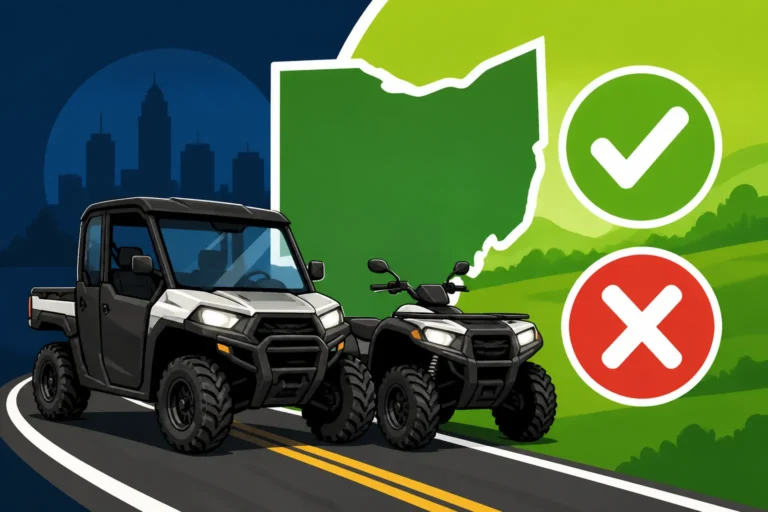
This table clearly illustrates that the absence of a sign on a county or township road is not a green light; it's a red one, due to the implicit 55 mph speed limit. Always look for a posted speed limit of 35 mph or less, and verify that the local government has explicitly opened that specific road to APV use.
The world of Ohio APV road laws can feel like a minefield, with hidden dangers like the default 55 mph speed limit on unposted roads catching many riders off guard. But by understanding this crucial detail, along with the "35 mph or less" rule and the distinction between riding and crossing, you can confidently and legally enjoy your APV. Always do your homework, check local resolutions, and make sure your machine is properly equipped. Stay safe out there, and happy trails!
Disclaimer
This article is for general informational purposes only and does not constitute professional advice. Laws, prices and regulations vary by location and change over time. Consult a qualified professional for guidance on your specific situation.