Ohio Rules for Riding During Fire Restrictions
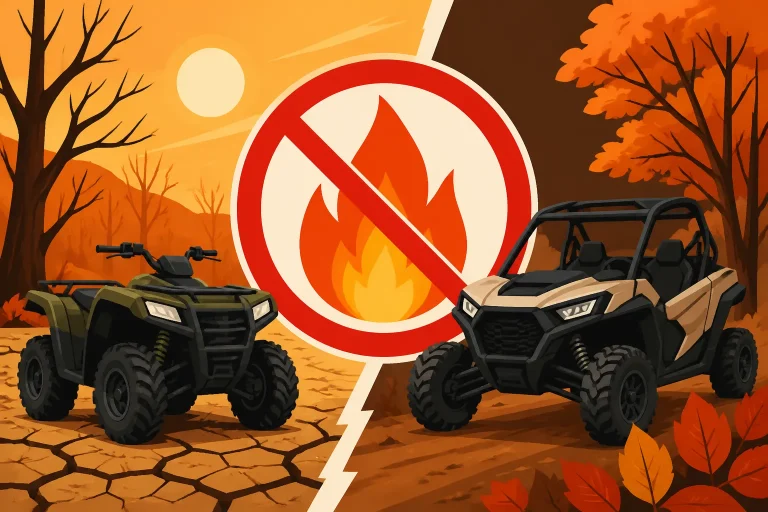
Ohio fire restrictions can change what you may do at a trailhead, campsite, or on a riding area, but they do not always mean every ATV or UTV trail is closed. The key is to identify who issued the restriction, where it applies, and which activities it names. Use those details to decide whether to ride, adjust your plans, or stay home.
What fire restrictions can mean for ATV and UTV riders
A fire restriction is a temporary rule or closure intended to reduce the chance of a fire starting or spreading. Its scope can vary. One notice may prohibit campfires but leave trails open; another may close a specific recreation area or suspend motorized use. The word “restriction” alone does not tell you what is allowed.
The practical question is not simply, “Is there a fire ban in Ohio?” It is, “Is there an active order for the land I plan to use, and does it limit my activity?” A statewide weather warning, a county burn restriction, and a land manager’s trail closure are not interchangeable. They may come from different authorities and cover different places.
For a rider, restrictions may address activities such as:
- Campfires, charcoal grills, or other open flames
- Smoking or disposing of cigarettes
- Fireworks
- Welding, cutting, or using equipment that can produce sparks
- Parking or driving off designated surfaces
- Access to a trail, campground, road, or entire recreation area
- Carrying or using fuel and other flammable materials
These are examples, not a universal checklist. A notice may cover only some of them, define exceptions, or impose additional limits. Read the actual order rather than relying on a general summary or an old social media post.
A fire restriction is not automatically an ATV ban
An ATV or UTV is a motorized machine, but that does not by itself answer whether it is allowed during a fire restriction. If a notice bans campfires only, it may not close the riding trails. If it closes an area to public access or motorized vehicles, riding there is not allowed even if the trail surface looks dry and passable.
A restriction can also make a planned ride impractical without formally closing the trail. For example, a campground might remain open while fires and charcoal cooking are prohibited. Riders can still use the trail if trail access is open, but they need another plan for meals and overnight arrangements.
Always separate three questions:
- Is the riding area open? Check the land manager’s current closure and alert information.
- Is motorized use allowed on the route? Confirm that the particular trail, road, or area is designated for your machine.
- What fire-related activities are prohibited? Follow the restriction’s wording at the trail, staging area, and campsite.
For the normal rules governing a particular forest, see Ohio Rules for Riding State Forest Land and Ohio Rules for Riding a National Forest. A temporary fire order can add limits to ordinary access rules, so those general rules do not replace checking for current closures.
The land manager matters
Ohio riders may encounter different rules on state forest land, national forest land, private riding parks, county property, wildlife areas, and privately owned ground. A notice issued for one type of land does not automatically apply everywhere nearby.
For example, an alert for a national forest recreation area does not by itself establish that a nearby private park is closed. The private park may have its own fire policy, or it may close voluntarily because of conditions. Likewise, a county restriction may apply within the county’s jurisdiction without necessarily closing a separate federal recreation area. Check the authority responsible for the exact place you intend to ride.
Ohio’s state forest riding areas and Wayne National Forest riding areas have their own access systems. A regular registration plate or required trail permit does not override a temporary closure. For permit basics, see How the Wayne National Forest OHV Permit Works and Why the Ohio Plate Is the Trail Permit. A permit or plate confirms only the relevant registration or access requirement; it is not permission to ignore an active fire order.
How to find out whether a restriction applies
Before loading the machine, identify the exact riding area and land manager. “Riding near the forest” is too vague to check reliably. Note the trail system, staging area, road, campground, and county. Then look for current information from the authority responsible for that location.
A useful check takes more than one step:
- Check the land manager’s current notices. Look for alerts, closures, fire restrictions, and changes to trail or campground access.
- Read the full notice. Confirm its geographic boundaries, effective period, prohibited activities, and any exceptions.
- Check the local entrance information. Read signs at the trailhead or campground when you arrive. A notice posted on-site may give details that are easy to miss online.
- Call the responsible office if the wording is unclear. Ask whether motorized trails are open, whether your planned route is inside the affected area, and whether the restriction includes vehicle use or only fire-related activities.
- Check again shortly before departure. Conditions and orders can change. An older screenshot, saved webpage, or last week’s trail report may no longer be reliable.
The trailhead board can help explain current conditions and local rules, but it is not a substitute for an active closure notice that applies to the area. What the Trailhead Board Tells You Before a Ride offers more on reading that information, and Calling a Ranger District Before You Load can help when you need to clarify a national forest question.
Read the boundaries, not just the headline
A headline such as “fire restrictions in effect” may leave important details out. Look for the named lands, roads, recreation sites, and activities. A notice might apply to a particular district, campground, or group of trails rather than an entire county or forest. It might also distinguish between open fires and devices with contained fuel or other specific features. Do not assume an exception applies unless the written rule says so.
Pay attention to effective dates and the way an order ends. Some notices remain in force until the issuing authority lifts them; others identify a period or a review date. A rain shower or cooler evening does not automatically cancel an official restriction. Confirm that the authority has changed or lifted it.
If the alert uses unfamiliar language, contact the responsible land manager. Describe the location and activity precisely: “May I ride the designated ATV trail from this staging area today?” is more useful than “Are ATVs allowed in the forest?” Ask about the proposed route and any nearby roads you may use to reach it.
Do not treat an online map as proof of access
Maps show routes, not necessarily current conditions. A trail can appear open on a map while a temporary closure is in effect. A route may also cross between public and private land, or between areas managed by different agencies. If a restriction is posted for only part of a route, the map may not show where the boundary falls.
When a planned loop crosses several jurisdictions, check each one. If the route depends on an uncertain crossing or an unclear boundary, choose a simpler route or postpone the trip. Do not ride through a gate, around a closure sign, or along an unmarked detour to get back to a familiar trail. General riding rules about staying on marked routes still apply; see [Ohio Rules for Riding Off the Trail].
Riding and camping safely when trails remain open
If the land manager confirms the trail is open and the restriction does not prohibit your planned activity, you still need to adapt the outing to dry conditions. A machine can create heat and may have components that contact vegetation or debris. The risk is not a reason to invent your own interpretation of the order; it is a reason to follow posted requirements carefully and avoid unnecessary hazards.
Before leaving, inspect the machine for conditions that could create trouble: packed dry leaves or grass near hot components, damaged wiring, loose parts, fluid leaks, and debris around the exhaust. Check that the machine is in good working order. Avoid riding through dry brush, tall grass, or areas beyond the designated route. Staying on the trail protects the land and reduces contact with vegetation that may be unusually dry.
Do not idle or park over dry grass, leaf litter, or other readily ignited material. Use the designated staging and parking areas. Follow signs about where vehicles may be left and do not move barriers to create a parking spot. If the restriction closes a road, trail, or parking area, do not use a machine to bypass the closure.
Treat campfires, grills, and smoking as separate questions
If the order prohibits open fires, do not have a campfire, even in a familiar fire ring. A built fire ring does not create an exception unless the order specifically provides one. Do not burn trash or brush, and do not assume that a small cooking fire is allowed because it is contained or attended.
Check the exact wording before using a camp stove, grill, lantern, or other device involving flame, heat, or fuel. Some orders distinguish between types of devices; others prohibit broader categories. Do not infer permission from the fact that a device is sold for camping. If the rule does not make the answer clear, ask the land manager or avoid using the device.
Smoking rules can also be specific. If smoking is prohibited in a posted area, follow that rule. If it is allowed, dispose of materials safely and only as directed; never toss a cigarette or match into vegetation or from a moving machine. A vehicle’s exhaust or a discarded ember can have consequences well beyond the rider who caused it.
Review [Ohio Rules for Campfires on Forest Land] for regular forest-land campfire considerations. During a temporary restriction, the current order controls where it is stricter. Do not rely on routine campsite practices when the land manager has issued new instructions.
Fuel, tools, and emergency equipment
Carry only the fuel needed for your trip and secure it appropriately. A fuel container should be in good condition, closed, and kept away from heat and ignition sources. Follow any local restrictions on fuel storage or transport, and do not refill a hot machine beside dry vegetation. Ohio Rules for Carrying Fuel covers the general riding context; a temporary fire order may impose additional conditions.
A small shovel or other basic recovery equipment can be useful for ordinary trail problems, but it does not authorize a rider to dig, cut vegetation, or alter the trail. A fire extinguisher may be useful safety equipment if it is appropriate for the machine and maintained according to its instructions. It is not a substitute for keeping the machine in good condition, obeying a closure, or contacting emergency services when there is an actual fire.
If you see smoke or flames, stop in a safe location, move away from immediate danger, and report the fire to emergency services or the posted land-management contact. Give a clear location, such as a trail name, nearby trail marker, staging area, or access road. Do not ride toward a fire to investigate, and do not leave the route to approach it. Follow directions from emergency personnel and land managers.
When to change or cancel your ride
The right choice depends on the order, the area, and the conditions. If the restriction closes the trail or the whole recreation area, do not ride there. If the trail is open but your planned cooking or camping activity is prohibited, you may be able to change that part of the trip. If you cannot confirm the boundary or whether your route is allowed, the safer choice is to use a location with clear, current access information or postpone.
| What you find | Practical response |
|---|---|
| The riding area is formally closed | Do not enter, even if the entrance appears unattended or the route looks clear. |
| The trail is open, but campfires are banned | Ride only if other access rules allow it; plan meals and camping without a prohibited fire. |
| The notice restricts motorized use or vehicle access | Do not ride the affected route or area. Ask the land manager about an authorized alternative. |
| The notice is vague about the area or activity | Contact the issuing authority before going. If you cannot confirm permission, choose another plan. |
| There is no listed fire order, but the land manager reports a closure | Follow the closure and check for updated information before traveling. |
| A route crosses multiple land jurisdictions | Verify access and restrictions with each responsible authority. |
| The restriction is lifted, but trails remain closed or damaged | Follow the trail closure; the end of a fire order does not automatically reopen every route. |
Changing the plan can be straightforward. Select another trail system whose manager confirms it is open, choose a private park with clear current operating information, or postpone until conditions improve. Do not assume that a nearby area is unaffected simply because it is outside the boundary named in one notice. It may have a separate order or its own closure.
The same care applies to camping. A trail may stay open while a campground limits fires, closes certain facilities, or changes access. Confirm the campground’s current rules separately from the riding route. If you plan an overnight trip, check whether the site is open and whether your cooking method is allowed before you set out.
Also consider how conditions affect the ride itself. Dry vegetation, dust, poor visibility, and high temperatures can make a familiar route harder and riskier. A fire restriction may be one sign that conditions deserve extra caution, even if riding remains permitted. Keep the ride within your group’s ability, carry drinking water, and leave enough time to return without rushing.
Keep the trip within the permitted route
A closure may lead riders to look for another way through, especially if a road or trail is blocked. Do not create your own detour across private land, a closed trail, a utility corridor, or an unmarked route. A legal route is not just a line on a map; it depends on the land manager’s rules and current access.
If the planned route is unavailable, check for an officially open alternative. You can also contact the responsible office for guidance. If no permitted route is available, reschedule. The cost of a canceled ride is usually less than the consequences of entering closed land, damaging the trail, or starting a fire.
Pay attention to rules that remain in force even when there is no fire restriction. Registration, permits, helmet and equipment requirements, riding hours, and trail-width limits may still apply. A temporary order changes only what it says it changes; it does not waive unrelated requirements. For more on the underlying access rules, see [Ohio Rules for Riding a State Forest] and Ohio Rules for Riding a National Forest.
Check more than once
A useful routine is to check before planning, again before loading, and once more when you arrive. If an order changes during a multi-day trip, obey the new direction. Keep a phone number or contact information for the land manager available, but do not count on cell service in remote riding areas.
A call can be particularly helpful if you are already on the way and receive conflicting information. Ask the official who issued the notice, or the office responsible for the land, rather than relying only on another rider’s interpretation. If you reach a closed gate or posted closure, treat it as controlling until the responsible authority confirms otherwise.
Frequently Asked Questions
Does an Ohio fire restriction automatically close ATV and UTV trails?
No. The restriction’s wording and the land manager’s closure notices determine what is closed. A restriction may prohibit fires while leaving trails open, or it may close motorized routes or the entire area. Check the current order for the exact location and activity.
Can I ride if campfires are banned but the trail remains open?
Possibly, if the land manager confirms that motorized access remains open and your planned activities comply with the restriction. A campfire ban does not necessarily close the trail, but it does prohibit the fire-related activity it covers. Check cooking devices, smoking rules, and camping conditions separately.
Does my Ohio plate or forest permit let me ride during a closure?
No. A plate or permit does not override a temporary closure or fire order. It may meet a registration or access requirement, but you must still obey current restrictions for the land and route.
If rain has fallen, can I ignore a fire restriction?
No. Do not assume that rain ends an official order. Follow the restriction until the issuing authority lifts or changes it, and check whether any separate trail closure remains in effect.
Who should I contact if the notice is unclear?
Contact the land manager or agency responsible for the specific trail, campground, or recreation area. Give the exact location and describe your planned activity. If different jurisdictions are involved, check with each one.
Disclaimer
This article is for general informational purposes only and does not constitute professional advice. Laws, prices and regulations vary by location and change over time. Consult a qualified professional for guidance on your specific situation.