What an APV Ticket on a Township Road Costs
Getting an APV ticket on a township road in Ohio can feel like a real punch to the gut. You might have thought you were doing everything right, or perhaps you were just trying to get from one section of trail to another, only to be met with flashing lights. It's frustrating, confusing, and can quickly turn a fun day into a costly headache. This guide is here to break down what an APV ticket on an Ohio township road might actually cost you, going beyond the initial fine to cover all the potential financial and practical impacts.
Understanding the "Why" Behind the Ticket on a Township Road
Riding an All-Purpose Vehicle (APV), which includes your ATVs and UTVs, on Ohio's roads is a complex beast. It’s not a statewide free-for-all, and that’s where a lot of the confusion and, unfortunately, tickets come from. You see, the state leaves much of the decision-making to local governments.
The Nuances of Ohio's APV Road Rules
The biggest hurdle for riders in Ohio is that whether you can legally ride your APV on a specific road often comes down to individual county commissioners and township trustees. They have the power to pass resolutions opening their roads to APVs, but these resolutions aren't always uniform. One township might open all its roads, another might open only specific ones, and the next township over might ban them entirely. It’s a patchwork quilt of rules that can be incredibly difficult to navigate, especially if you’re riding through multiple jurisdictions in one day.
This local control means that even if a township has opened its roads, there are almost always specific conditions that come along with it. We’re talking about things like designated riding hours, maximum speed limits (often much lower than you’d expect for a road), and strict equipment requirements. For example, some resolutions explicitly state that APVs must stick to roads with a posted speed limit of 35 miles per hour or less. So, you might think you’re in the clear, but if you’re on a road with a 45 mph limit, you’re suddenly in violation, even if the township allows APVs generally. It’s a classic case of thinking you’re following the spirit of the law, only to fall foul of the letter. This is why it's crucial to understand [Ohio Rules for Riding a Township Road].
The temptation to ride on what looks like a quiet, open road, especially if you see tire tracks from other machines, can be strong. But appearances can be deceiving. That road might not be officially open, or you might be missing a critical piece of equipment that's required for road use in that specific area. This inconsistency is a huge source of frustration for riders who just want to enjoy their machines responsibly.
Common Violations Leading to a Township Road Ticket
So, what are the typical reasons a deputy might pull you over and issue a citation on a township road? It usually boils down to a few key areas:
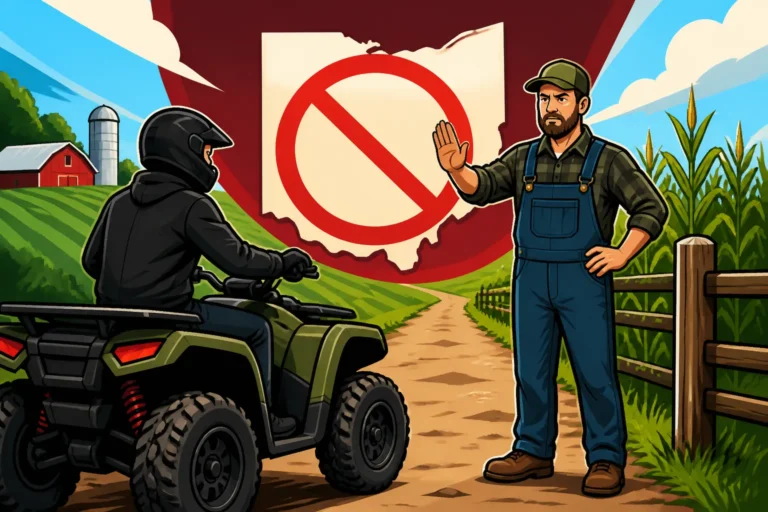
One of the most straightforward violations is simply riding on a township road that hasn't been officially opened to APVs. This is where the local resolutions come into play. If the township trustees haven't passed a resolution, or if the road you're on isn't included in the resolution, you're trespassing, and you're riding illegally. The deputy isn't usually trying to be difficult; they're simply enforcing the local ordinances that are in place.
Another frequent issue is speed. Many township resolutions that do open roads to APVs include specific speed limits, often capped at 35 miles per hour. While your UTV might easily hit 50 or 60 mph on a gravel lane, exceeding that 35 mph limit, even on an unposted road, can land you a ticket. Remember, even if there’s no speed limit sign, the local ordinance dictates what your machine can do. You can learn more about this by researching [Why an Ohio UTV Stops at Thirty-Five] and [An Ohio Road Posted Thirty-Five or Less].
Equipment violations are also a big one. For an APV to be legally ridden on any public road in Ohio (even those township roads that are open), it must meet certain equipment standards. This can include things like a working horn, rearview mirror, brake lights, headlights, and sometimes even turn signals. If your machine is missing any of these, or if they aren't functioning properly, you're at risk. Some areas might also have specific helmet requirements, especially for younger riders or if crossing certain types of roads. It’s worth checking [Ohio Equipment Rules for an APV on a Road] to ensure your machine is up to snuff.
Finally, registration issues are always a potential problem. If your APV isn't properly registered with the state, or if your plate and validation sticker are expired, you're riding illegally regardless of the local road rules. The fees from [Ohio APV Registration Cost] help maintain trails, so ensuring your machine is properly plated is essential. A deputy will absolutely check for a valid plate, and riding without one can result in significant fines. These kinds of infractions are covered in more detail in [Ohio Fines for an Unregistered APV].
Breaking Down the Costs: What an APV Ticket Entails
When you get pulled over and handed that piece of paper, the first thing your eyes gravitate to is usually the "fine" amount. But it's rarely just one number. An APV ticket can come with a whole host of financial repercussions, some immediate and some that linger.
The Initial Fine and Court Costs
Let's start with the most obvious: the initial fine. This amount can vary quite a bit depending on the specific violation and the jurisdiction (which township or county issued the ticket). For minor misdemeanors related to traffic or local ordinances, fines in Ohio can range from a couple of hundred dollars to several hundred, or even more for more serious offenses. For example, riding on a clearly posted closed road might have a different base fine than an equipment violation. It's not a one-size-fits-all situation, and different judges or magistrates can have some discretion within legal limits.
But here’s the kicker: the fine you see on the citation is often just the beginning. Almost universally, you’ll also be on the hook for court costs. These aren't penalties for your offense; rather, they're administrative fees designed to cover the processing of your ticket, the judge's time, clerk services, and all the other bureaucratic necessities of the court system. These court costs can easily add another $100, $200, or even more on top of your base fine. So, a $150 fine could quickly become a $350 or $400 bill once court costs are factored in.
Imagine this scenario: you're riding your UTV on what you thought was an open township road, but it turns out the township never passed the necessary resolution. A deputy pulls you over and issues a citation for illegal road use. The base fine might be, say, $175. However, when you go to pay, the total includes $185 in court costs, bringing your total outlay to $360. That's a significant chunk of change that was definitely not in your riding budget.
Potential Secondary Costs and Consequences
Beyond the immediate hit to your wallet from the fine and court costs, an APV ticket can trigger several other, often less obvious, financial and practical consequences.
One of the most frustrating potential secondary costs is an increase in your insurance premiums. While APV insurance isn't always tied to your regular auto insurance, some violations can still impact your overall driving record, especially if a driver's license was required for the specific road use, or if the court reports the offense to the Bureau of Motor Vehicles. If your insurance company sees a moving violation or a significant non-moving violation on your record, they might decide to adjust your rates, making your annual [Ohio APV Insurance Cost per Year] higher. This is one of those hits that keeps on taking, long after you’ve paid the initial ticket.
Then there's the cost of rectifying the violation. If you were ticketed for an equipment issue – say, no turn signals, an improper horn, or a missing rearview mirror – you'll need to purchase and install those items if you want to legally ride on opened roads again. This could mean a trip to a local dealer or an online order from a company like SuperATV for a new turn signal kit or a DOT-approved windshield. These parts and the time to install them are an added expense directly attributable to the ticket.
Don’t forget the value of your time. If you decide to contest the ticket, you’ll likely need to take time off work or other responsibilities to appear in court. There’s travel time to and from the courthouse, parking fees, and the general stress and inconvenience of the legal process. Even if you just pay the ticket, simply navigating the payment system and understanding all the associated fees can eat into your valuable time.
In more severe cases, or for repeat offenders, there's always the possibility of your machine being impounded. While not common for a first-time, minor offense, if your APV is deemed unsafe, unregistered, or you're a habitual violator, a deputy could have it towed. Impoundment fees, daily storage charges, and towing costs can quickly escalate into hundreds of dollars, adding another layer of financial burden to your situation.
How Location and Specific Offense Affect the Price Tag
The "cost" of an APV ticket in Ohio isn't uniform, and it's heavily influenced by two main factors: where you got the ticket and what exactly you were cited for. This is where the complexities of Ohio's APV laws truly manifest.
Different townships, and even different municipal courts within a county, can have their own schedules of fines for various infractions. A ticket for riding on a closed road in Muskingum Township might have a different base fine than the same offense in Salem Township, even though both are in the same general area. This localized variation is a major source of confusion for riders, as what's "normal" in one area might be much steeper just a few miles down the road. This also means that if you're riding in a popular APV area, the local courts might have more streamlined (and perhaps higher) fine schedules due to the volume of tickets they process.
The specific offense also dictates the severity of the financial hit. A simple registration violation, while definitely an annoyance, might carry a fixed fine that's relatively standard. However, something like reckless operation, operating under the influence, or multiple simultaneous violations (e.g., no registration, no helmet, and speeding) will almost certainly result in substantially higher fines, more significant court costs, and potentially more severe secondary penalties like license suspension or even jail time in extreme cases.
To give you a clearer picture, here's a general idea of how different violations might stack up:
| Violation Type | Potential Base Fine Range (Estimate) | Typical Court Costs (Estimate) | Other Potential Impacts |
|---|---|---|---|
| Riding on a Closed Township Road | $100 – $350 | $150 – $250 | Possible impoundment, increased insurance |
| Exceeding Township Road Speed Limit | $75 – $250 | $150 – $250 | Points on driving record, increased insurance |
| Equipment Violation (e.g., no mirror) | $50 – $200 | $150 – $250 | Must purchase/install equipment, re-inspection |
| Unregistered APV | $150 – $500 | $150 – $250 | Must register immediately, possible impoundment |
| Operating Without Required Insurance | $200 – $1,000+ | $150 – $250+ | License suspension, proof of future insurance required |
Note: These ranges are illustrative and can vary significantly based on local ordinances, judicial discretion, and specific circumstances.
What to Do If You Get an APV Ticket on an Ohio Township Road
Receiving a ticket is never fun, but knowing your options can help you navigate the process and potentially mitigate some of the costs and consequences.
Understanding Your Options After a Citation
Once you have that citation in hand, you generally have a few paths forward. The most common and often simplest option for many people is to simply pay the fine. By doing this, you're essentially admitting guilt to the offense as charged. While it might seem like the easiest way to make it disappear, remember that you'll be on the hook for both the base fine and all the associated court costs. Make sure you understand exactly what you're paying and what the total sum will be. For some, the cost of fighting it might outweigh the direct financial hit of simply paying.
However, if you believe you were wrongly cited, or if there were mitigating circumstances, you absolutely have the right to contest the ticket. This means you'll need to appear in court on the date specified on your citation. You’ll have an opportunity to present your case to the judge or magistrate. This could involve showing proof that your registration was indeed current, that your equipment met the requirements, or explaining why you believed the road was open based on available signage or information. It's often helpful to gather any evidence you have, such as photos of the road, your machine's equipment, or copies of local ordinances you relied upon. The process for [Appealing an Ohio APV Citation] can be involved, so be prepared.
For more serious offenses, or if the potential fines and consequences are significant, seeking legal advice is a wise move. An attorney specializing in traffic or local ordinance law can review your case, explain your rights, and represent you in court. They might be able to negotiate a plea bargain, get the charges reduced, or even dismissed, saving you a substantial amount in the long run, even after attorney fees. This is especially true if you're facing multiple violations or if there's a risk of license suspension.
Preventing Future Tickets: Know Before You Go
The best way to deal with an APV ticket is to avoid getting one in the first place! It takes a bit of homework, but it’s well worth the effort and peace of mind.
First and foremost, you absolutely must check local township resolutions and county ordinances before you even think about riding your APV on public roads. Don't assume anything. What's legal in one township might be strictly forbidden in the next. You can usually find this information by checking the county commissioner's website, the individual township's website, or by calling the township clerk's office. Don't be afraid to ask direct questions about which roads are open, what the speed limits are, and what equipment is required. Being informed about [How to Find an Ohio Township Resolution] is your first line of defense.
Second, always ensure your APV is properly registered and plated in Ohio. This means your registration is current, and your physical plate and validation sticker are clearly displayed and legible. Without a valid registration, you're opening yourself up to fines and potential impoundment, even if you're riding on otherwise permissible roads. Check out [Registering an APV in Ohio] for all the details on keeping your machine legal.
Third, equip your machine appropriately for any road riding, even if it's just a short hop between trails or to get to a gas station. This often means having working headlights, taillights, brake lights, a horn, a rearview mirror, and sometimes turn signals. Many riders turn to reputable brands like SuperATV for quality turn signal kits or DOT-approved windshields to meet these requirements. Ensuring your machine meets [Ohio APV Road Equipment List] can save you a lot of hassle.
Finally, always adhere strictly to posted speed limits and any other rules outlined in the local ordinances. If a township resolution states a maximum APV speed of 25 mph on its roads, then that's your limit, regardless of the posted limit for cars. It's about being a responsible rider and respecting the local laws that govern where and how you can ride.
Disclaimer
This article is for general informational purposes only and does not constitute professional advice. Laws, prices and regulations vary by location and change over time. Consult a qualified professional for guidance on your specific situation.