Are ATVs Street Legal in Ohio?
It's a question that nearly every ATV and UTV owner in Ohio has pondered, usually after staring at their machine in the garage, longing to take a quick spin to the gas station or a friend's house without loading it onto a trailer. The dream of just hopping on and riding down the road is powerful, but the reality of Ohio's laws can be incredibly confusing and often frustratingly restrictive. This guide is here to untangle the web of regulations, help you understand what "street legal" really means (or doesn't mean) for your off-road machine in the Buckeye State, and clarify where and how you might legally roll onto a public road.
The Nuance of "Street Legal" in Ohio: It's Not a Blanket Term
When we talk about whether an ATV or UTV is "street legal" in Ohio, it's crucial to understand that the state doesn't have a simple "yes" or "no" answer that applies everywhere. This isn't like registering your car, where once it's legal, it's legal on any public road. For All-Purpose Vehicles (APVs), which is what Ohio law calls ATVs, side-by-sides, and other off-road machines, the rules are far more granular and often localized.
The biggest frustration for many riders is discovering that there isn't a statewide blanket allowance for APVs on public roads. You can't just slap a license plate on your quad or side-by-side and expect to cruise down a state route or city street without consequence. Ohio law defines an APV very clearly, and that definition doesn't automatically grant road access. Instead, road access for APVs is largely a local decision, piece by painful piece. This means that what's perfectly fine in one township might be strictly prohibited just across the county line, leading to a patchwork of rules that can feel impossible to navigate without a detailed map and a lawyer on speed dial. It's enough to make you throw your hands up in exasperation!
Understanding Ohio's APV Definition
First, let's nail down what Ohio considers an "All-Purpose Vehicle." This is key because the regulations apply specifically to this category. An APV, under Ohio law, is a motorized vehicle designed for off-highway use, having a width not exceeding 74 inches, a dry weight less than 2,000 pounds, and traveling on three or more non-highway tires. It includes traditional ATVs, which usually have handlebars and straddle seating, and also encompasses what many of us call UTVs or side-by-sides, which often have steering wheels, bucket seats, and roll cages. The law doesn't explicitly differentiate between ATVs and UTVs in its primary definition, lumping them all under the APV umbrella. This distinction is vital when discussing general registration requirements, which apply to all APVs used on public land. [How Ohio Law Defines an APV]
However, when it comes to road use, Ohio law does introduce distinctions, particularly regarding equipment for UTVs versus ATVs. This is where the waters get murky. While all APVs need to be registered and titled for off-road use, the equipment needed to even consider road use, if allowed locally, can vary significantly between a standard ATV and a larger UTV. This means your side-by-side might have a clearer path to limited road access than your quad, simply due to the type of safety equipment it can accommodate or is legally required to have.
Why Ohio Has No Statewide Road Right
The simple answer to why there's no statewide road right for APVs is that the state legislature has opted to grant local control over the issue. Rather than enacting a sweeping law, the power to open county or township roads to APV traffic has been delegated to county commissioners and township trustees. This approach aims to allow communities to decide what makes sense for their specific infrastructure, traffic patterns, and resident preferences.
While this sounds reasonable in theory, in practice, it creates a labyrinth for riders. A rider might live in a county where APVs are allowed on certain roads, but travel a few miles to recreate in a neighboring county where no such ordinances exist. This means constantly checking local laws, sometimes even down to the township level, before venturing onto any public asphalt. It's not uncommon to find a county road open to APVs, only to have the access abruptly end at the entrance to a state route or a municipality that hasn't passed its own ordinance. This fragmented system is a huge source of confusion and potential citations for riders who aren't meticulously informed about every stretch of road they plan to traverse. [Why Ohio Has No Statewide Road Right]
Where You Can Ride on Ohio Roads (and the Big Caveat)
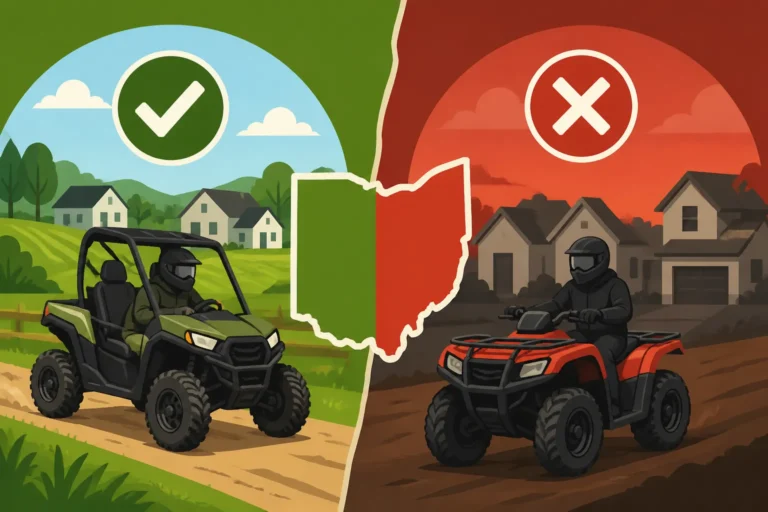
So, if there's no blanket "street legal" status, where can you ride your ATV or UTV on Ohio roads? The answer lies entirely in local ordinances passed by county commissioners or township trustees. These local bodies have the authority to open specific roads within their jurisdiction to APV use. But here’s the big caveat: even if a road is "open," it usually comes with strict conditions and equipment requirements.
It's a common misconception that if a county opens its roads, you're free to roam. Not quite. You'll still find that state routes (like those marked with an "OH" shield) and interstates are almost universally closed to APVs. This means you might be able to ride a county road, but you'll have to find alternative ways to cross or bypass state highways. This is especially true for busy commercial routes and faster roads. The rationale behind keeping state routes closed is usually about safety, given the higher speed limits and greater volume of traffic.
County and Township Resolutions: The Gateways to Road Access
The primary way an APV gains limited road access is through a resolution passed by a county's Board of Commissioners or a township's Board of Trustees. These resolutions specify which roads, if any, are open to APV traffic. It's not an automatic process; residents or riding groups often have to petition their local officials, present arguments for road access, and sometimes even compromise on restrictions like speed limits or time of day for riding. [How an Ohio County Opens Its Roads]
For example, Washington County has been a leader in this area, with its commissioners passing a resolution to open every county road under its control to APVs. This is a significant move, but it's important to remember that this still excludes state routes and roads within incorporated villages or cities that haven't passed their own separate ordinances. In contrast, many other counties or townships have either not passed any resolutions at all, or they've opened only a very limited number of roads, perhaps connecting trail systems or small rural communities. [Washington County Resolution 2024-1114] This variation underscores why it's so critical to [Finding Out Which Roads Are Open] directly from the source or through reliable local resources.
Crossing Roads and Riding the Berm
Even on roads where APVs are generally prohibited, Ohio law often allows for certain exceptions. For instance, you might be permitted to cross a state highway where it's safe to do so, typically at an intersection, to get from one section of an open county or township road to another. This is not about riding on the state highway, but merely traversing it.
Similarly, there are provisions for riding the "berm" or shoulder of a road. This means you might be allowed to ride alongside a road, rather than directly in the traffic lane, where the berm is wide and stable enough and where local ordinances permit. The idea here is to minimize conflict with faster-moving vehicular traffic. However, this isn't a free pass; the conditions for riding the berm are usually strict, often requiring you to be far right and yielding to all other traffic. It's not a substitute for riding on a fully designated open road, but rather a temporary measure to link trails or access open road segments. [Riding the Berm Beside an Ohio Lane]
What Equipment You Need for Road Use (If Permitted)
If you're fortunate enough to live or ride in an area where local ordinances have opened roads to APVs, you're still not done. Your machine must meet specific equipment requirements to be legally operated on those public roads. These requirements are in place for safety and visibility, ensuring that your APV can interact with other traffic as safely as possible. Neglecting these could lead to a citation even if you're on an "open" road.
This is where aftermarket parts and accessories really come into play. Many riders turn to companies like SuperATV for the necessary components to get their machines up to snuff. They offer a wide range of products designed to meet legal requirements, from turn signal kits to mirrors and specialized windshields.
UTV Road Equipment Requirements
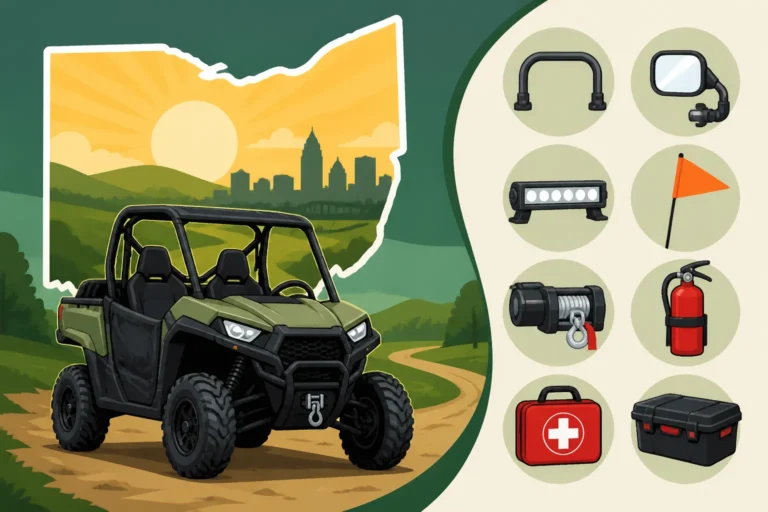
For UTVs (side-by-sides), the equipment list can be quite extensive, often mirroring many of the requirements for traditional automobiles. If a UTV is to be operated on an authorized public road in Ohio, it generally must pass an inspection and be equipped with:
- Headlights and Tail Lights: Must be functional and used when required (e.g., half an hour after sunset, half an hour before sunrise, or in adverse weather).
- Brake Lights: Essential for signaling when you're slowing down or stopping.
- Turn Signals: Both front and rear, to indicate your intentions to other drivers. This is often an aftermarket addition for many UTVs.
- Rearview Mirror(s): Typically at least one mounted on the left side, or a center rearview mirror and an exterior mirror on the left.
- Horn: A working horn is mandatory to alert others.
- Windshield: For UTVs, if equipped with a windshield, it must be made of safety glass and equipped with a working wiper system. Many stock UTV windshields might not meet this standard, requiring an upgrade. [Wipers and Glass on an Ohio UTV]
- Seatbelts: For all occupants, and they must be worn.
- Tires: Must be in good condition, without excessive wear or damage.
- Muffler and Spark Arrester: To control noise and prevent wildfires.
The inspection process for UTVs is a critical step, usually performed by the Ohio State Highway Patrol. This ensures that the vehicle meets all the necessary safety and equipment standards before it can be legally registered for road use where permitted. [Ohio UTV Inspection Before Registration]
ATV Road Equipment Requirements
For traditional ATVs, the requirements for road operation, if allowed by local ordinance, tend to be less stringent than for UTVs, primarily because ATVs are not designed with enclosed cabs. Typically, an ATV needs:
- Headlight and Tail Light: Functional for visibility.
- Brake Light: To signal braking.
- Muffler and Spark Arrester: For noise control and fire prevention.
- Rearview Mirror: At least one, typically on the left handlebar.
- Helmet: While not strictly equipment on the machine, wearing a DOT-compliant helmet is generally required for ATV riders on public roads, regardless of age. [Ohio Helmet Law for APV Riders]
- Eye Protection: Goggles or a face shield are also usually required.
Noticeably absent from the ATV list are items like turn signals and windshield wipers, which are impractical for the design of most ATVs. This simplification in equipment is one reason why [Why a Quad Skips the Inspection] that a UTV must pass. However, this doesn't mean ATVs are inherently safer on roads; it simply reflects the different design and operational characteristics.
Driver's License and Insurance
Beyond the vehicle equipment, the operator must also be properly licensed and the machine insured. If you're operating an APV on a public road in Ohio, even one opened by local ordinance, you need a valid driver's license. This is not just for your protection, but also for liability in case of an accident. [A Driver's License on an Ohio Road]
Furthermore, you are required to carry proof of financial responsibility (insurance). Just like with a car, if you're involved in an accident on a public road, you'll need to demonstrate that you have the necessary liability coverage. Many standard auto insurance policies do not cover off-road vehicles, so you'll likely need a specific APV or recreational vehicle insurance policy. It's always a good idea to confirm with your insurance provider that your policy covers road use in areas where it's legally permitted. [Ohio APV Insurance Requirement]
The Reality of Road Riding in Ohio: What to Expect
Let's be realistic: while limited road access for ATVs and UTVs is becoming more common in certain rural parts of Ohio, it is far from a widespread convenience. The dream of freely cruising your quad to the local store is largely still just a dream for most Ohioans. The reality involves a lot of research, careful planning, and often, dealing with skepticism or confusion from other motorists and even law enforcement.
Navigating the Patchwork of Laws
The biggest hurdle for riders in Ohio is the inconsistent nature of the laws. You might encounter a situation where one township allows APVs on its roads, but the adjacent township, or even a village within the same county, does not. This means you need to be constantly aware of your exact location and the specific ordinances that apply there. There’s no central map that universally shows all open APV roads across the state, so riders often rely on local government websites, community groups, or direct calls to county and township clerks for information. [How to Find an Ohio Township Resolution]
This can lead to frustrating scenarios where a great ride is interrupted by an arbitrary boundary, forcing you to load your machine back onto a trailer or find an alternative route. It's a logistical challenge that takes away from the spontaneity of riding. Imagine planning a route only to realize a small, unposted village you must pass through doesn't permit APVs, effectively cutting off your journey.
Enforcement and Public Perception
Even in areas where road riding is permitted, you might still encounter deputies or state troopers who are less familiar with the specific local ordinances. This isn't necessarily due to malice, but simply the complexity of different rules in different jurisdictions. Always carry your registration, proof of insurance, and if possible, a copy of the local ordinance opening the roads, especially if you're riding in an area you don't frequent. This can help clarify the situation quickly if you're stopped. [What an Ohio Deputy Checks Roadside]
Public perception also plays a role. Not everyone is happy to see ATVs and UTVs on public roads, even if it's legal. Some concerns might include noise, dust, or perceived safety risks. As riders, it's our responsibility to be good ambassadors for the sport: ride respectfully, obey all traffic laws, keep speeds appropriate for conditions, and make sure your machine isn't excessively loud. Doing so helps maintain the privilege of road access where it exists and might encourage other communities to consider similar ordinances.
The Future of APV Road Access in Ohio
The conversation around APV road access in Ohio is ongoing. There have been legislative efforts to create more uniform statewide rules or streamline the process for local governments. However, these discussions are often complex and involve balancing recreational opportunities with safety concerns and local control. While no significant statewide changes have come into effect that would make APVs broadly "street legal," the trend in some rural areas to open roads is slowly growing. As more people own UTVs and rely on them for tasks beyond pure recreation, the pressure for sensible road access is likely to continue. For now, being informed, equipped, and respectful is the best way to enjoy your APV on the limited public roads Ohio permits. [Why the 2025 Ohio Bill Is Not Law]
| Feature / Requirement | ATV (All-Purpose Vehicle) | UTV (All-Purpose Vehicle) |
|---|---|---|
| Statewide Road Access | No (Local Ordinances Only) | No (Local Ordinances Only) |
| Local Ordinance Required | Yes | Yes |
| Ohio Plate Required | Yes, for any public land/road use | Yes, for any public land/road use |
| Driver's License | Yes | Yes |
| Insurance Proof | Yes | Yes |
| Headlights | Required | Required |
| Tail Lights | Required | Required |
| Brake Lights | Required | Required |
| Turn Signals | Generally not required on machine | Generally required (Often aftermarket like SuperATV kits) |
| Rearview Mirror(s) | Required (at least one) | Required (at least one or center + left) |
| Horn | Required | Required |
| Windshield | Generally not applicable | Required to be safety glass with wipers if equipped |
| Wipers | Generally not applicable | Required if equipped with windshield |
| Seatbelts | Not applicable | Required for all occupants |
| Inspection Required | No | Yes, by Ohio State Highway Patrol |
| Helmet Requirement (on road) | Generally Yes | Varies; recommended, often tied to age |
Disclaimer
This article is for general informational purposes only and does not constitute professional advice. Laws, prices and regulations vary by location and change over time. Consult a qualified professional for guidance on your specific situation.