A Driver’s License on an Ohio Road
One of the trickiest parts about owning an ATV or UTV in Ohio isn't just figuring out where you can ride it, but understanding the tangled web of rules for how you can ride it, especially if you ever need to venture onto a public road. Many folks assume their regular driver's license covers them, but the reality is more nuanced, leading to real head-scratching and anxiety about whether they're following the letter of the law. This comprehensive guide will walk you through Ohio's specific requirements regarding driver's licenses for operating all-purpose vehicles (APVs) on the state's diverse roadways, clarifying when you need one and when you might not.
The Basics: Do You Need a Driver's License for Your APV in Ohio?
Let's cut right to the chase because this is the question on everyone's mind: If you're going to operate an all-purpose vehicle (APV) on an open public road in Ohio, you absolutely need to hold a valid driver's license. It's not a suggestion; it's a legal requirement. This might come as a surprise to some, especially those who primarily think of their ATV or side-by-side as a recreational trail machine. However, the moment your tires touch pavement that's designated for public vehicular traffic, even for a short stretch, you're expected to be a licensed operator.
Understanding Ohio's APV Definition and Road Use
Ohio law has a very specific definition for what an "all-purpose vehicle" is, and it's important to understand this definition because it dictates how these machines are regulated, titled, and registered. An APV includes ATVs, side-by-sides, and other vehicles primarily designed for off-road use. When it comes to road use, Ohio townships and counties have the authority to pass resolutions that open up their local roads to APVs. This means that while state routes and interstates are generally off-limits, you might find certain county and township roads that permit APV travel. However, the privilege of riding on these open roads comes with responsibilities, one of the most fundamental being possession of a valid driver's license. Whether you're navigating a backroad in Washington County or simply crossing a minor road to get to another trail section, that license needs to be in your wallet.
Imagine you're out exploring a new area, and you come across a county road that's been designated as open for APVs. You might be thrilled to connect two different trail systems or access a local gas station. But if you don't have your driver's license with you, or if it's suspended or expired, you're immediately putting yourself at risk for a citation. This isn't just about proving you can operate a motor vehicle; it's about demonstrating you understand the rules of the road and have passed the state's requirements to do so safely. The expectation is that if you're going to share the road with cars and trucks, you need to meet the same basic licensing standards as their drivers.
The Core Rule for Driving on Open Public Roads
The core rule is simple and unwavering: if the road is open to public vehicular traffic and you're operating an APV on it, you must possess a valid driver's license. This applies whether you're driving a quad, a three-wheeler, or a robust side-by-side. The law doesn't differentiate between the type of APV; it focuses on the act of operating any vehicle on a public roadway. This means that even if you're just driving a few hundred feet to access another trail or moving your machine from one side of your property to another via a county road, a license is required.
This can be a point of frustration for many APV owners who feel they are perfectly capable of handling their machines. However, the state views the operation of any motorized vehicle on a public road as requiring a certain level of demonstrated competence, which a driver's license signifies. It's not just about controlling the machine; it's about knowing traffic laws, understanding right-of-way, and being aware of other vehicles and pedestrians. A deputy registrar will emphasize the importance of this when you're going through the registration process, understanding that an APV plate implies the potential for road use. For instance, if you're operating a side-by-side that has been equipped with a SuperATV windshield and mirrors to make it road-legal, you've taken steps to comply with equipment rules, but the driver's license is equally critical for the operator. [Ohio Driver's License Rules for APVs] outlines this clearly, emphasizing that the same licensing standards apply as if you were driving a car.
Different Scenarios, Different Rules: When a License Matters (and When it Doesn't)
While the general rule for public roads is clear, Ohio law does account for various situations where an APV might be operated, and not all of them demand a driver's license. It's crucial to understand these distinctions to stay on the right side of the law and avoid unnecessary headaches or fines.
Riding on Private Land and Designated Trails
Here's where things get a bit different. If you are operating your APV entirely on private property where you have permission to ride, or on designated off-road trails within an approved state forest or private riding park, a driver's license is generally not required by state law. This is because these areas are not considered public roads. The rules of the road, including licensing, largely pertain to the public thoroughfares maintained by the state, county, or township.
Think about it: when you're tearing up the trails at the Wayne National Forest or a private park, you're not sharing the space with daily commuters or delivery trucks. The environment is designed for recreational riding, often with its own specific set of rules (like helmet requirements or width restrictions), but not typically requiring a state-issued driver's license. Many young riders, under the legal driving age, enjoy these trails precisely because a driver's license isn't a prerequisite. However, it's always wise to check the specific regulations of any private park or public trail system you plan to visit, as they might have their own age or supervision requirements, regardless of a driver's license. [Ohio Minimum Age to Ride an APV] and [Ohio Supervision Rules for Minors] provide more details on age-related restrictions in these settings.
Operating a Farm Machine on Public Roads
Ohio law provides a specific exemption for certain agricultural uses of APVs. If your APV is being used exclusively for agricultural purposes – for instance, moving between fields, hauling equipment, or checking livestock – and its use on a public road is incidental to these farming operations, a driver's license might not be strictly required. However, this is a very narrow exemption and comes with strict conditions. The vehicle must be clearly identifiable as farm equipment, and its road use must be directly related to agricultural work. It's not a free pass to take your recreational side-by-side to town just because you also own a farm.
This exemption is designed to allow farmers to efficiently manage their land without unnecessary bureaucratic hurdles for short, necessary road transfers. However, if that "farm machine" starts to look less like agricultural equipment and more like a recreational vehicle on a joyride, law enforcement can (and likely will) step in. It's crucial for farmers relying on this exemption to ensure their use of the APV on public roads is genuinely incidental to farm operations and not an attempt to circumvent standard registration and licensing laws. Always err on the side of caution; if there's any doubt about its "agricultural purpose," assume a license is needed.
Youth Riders and Supervised Operations
Ohio law is very clear when it comes to young riders. While children and teenagers can enjoy APVs on private land and designated trails (often with age restrictions and supervision requirements), they are absolutely prohibited from operating an APV on any public road, regardless of whether they have a temporary permit or if the road is open to APVs. This isn't just about a driver's license; it's about the legal age to operate a motor vehicle on public roads.
Even if a county or township has passed a resolution opening its roads to APVs, a rider must still meet the fundamental requirement of holding a valid driver's license to operate any vehicle on those roads. This means a 15-year-old, even if they have a temporary instruction permit for a car, cannot legally drive an APV on an open public road. The responsibility for ensuring compliance often falls to parents or guardians. It's an important safety measure, as public roads present different challenges and risks compared to controlled trail environments. [Ohio Rules for Riding a County Road] and [Ohio Rules for Riding a Township Road] clearly state that operator licensing requirements mirror those for other motor vehicles.
UTVs on Ohio Roads: The Driver's License and Beyond
UTVs, or side-by-sides, often spark the most questions when it comes to road legality and driver's license requirements. Because many UTVs are larger, resemble small cars, and are increasingly marketed with road-legal kits, owners naturally wonder what it takes to get them onto Ohio's public roads legally. The driver's license is just one piece of the puzzle, albeit a foundational one.
The UTV Inspection and Road-Legal Equipment
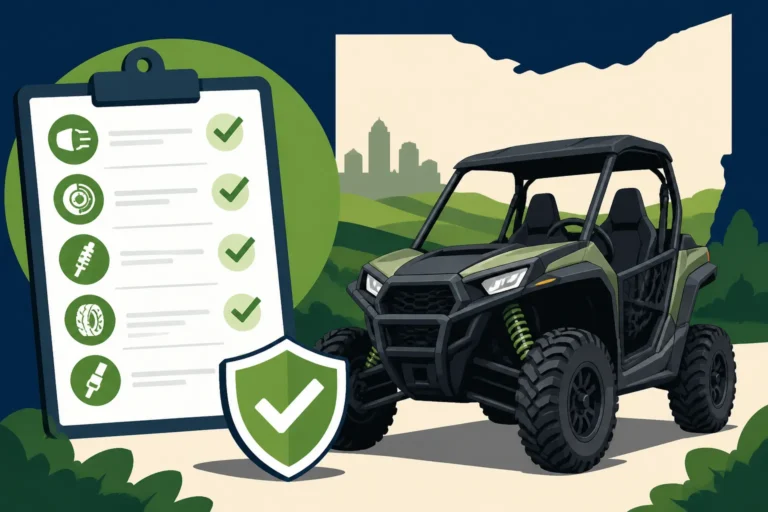
Before a UTV can even be considered for legal operation on Ohio's open public roads (where allowed by local ordinance), it must first pass a thorough inspection to ensure it meets specific equipment requirements. This is a critical step that ATVs generally bypass for road use. A UTV intended for road travel must be equipped with features like turn signals, headlights, tail lights, brake lights, a horn, a windshield with wipers, and mirrors (both rear-view and side-view). This equipment ensures the UTV can safely navigate public roads and communicate its intentions to other drivers. Many owners turn to aftermarket suppliers like SuperATV for these road-legal conversion kits, ensuring their machine meets all necessary specifications.
This inspection is about safety and visibility. A UTV on a public road needs to function much like any other registered motor vehicle. The process can be detailed, requiring specific types of glass for the windshield, properly functioning lights, and an audible horn. Only after your UTV passes this inspection will you receive the necessary documentation to then apply for its registration and plate. It's a significant investment in time and money, but it's essential for legal road use. Without this inspection and the proper equipment, even with a driver's license, your UTV cannot be legally operated on open public roads. [Ohio UTV Inspection Requirements] provides a full breakdown of what's checked, and [Ohio UTV Road Equipment List] details the required components.
Carrying Your License and Proof of Insurance
Once your UTV is properly equipped, inspected, and registered for road use, and you're ready to hit those open township or county roads, you must always carry your valid driver's license with you. Just like driving your car, the absence of your physical license, or proof of an invalid license, can lead to a citation. A law enforcement officer stopping you will expect to see proof that you are legally authorized to operate a motor vehicle on the public roads.
Beyond your driver's license, you also need to carry proof of financial responsibility – in other words, proof of insurance. Ohio mandates that all vehicles operated on public roads be insured, and APVs are no exception when used in these contexts. This insurance protects you and others in case of an accident. Operating an APV on an open public road without a license, or without valid insurance, can lead to severe penalties, including fines, license suspension, and impoundment of your vehicle. It’s not just a technicality; it’s about being a responsible road user and protecting yourself financially. Always keep your physical driver's license and your insurance card handy, perhaps in a waterproof pouch in your UTV. [Ohio APV Insurance Requirement] outlines what type of coverage is needed for road-legal APVs.
The Ramifications of Riding Without a License on Ohio Roads
Ignoring the driver's license requirement when operating an APV on an open public road in Ohio can lead to a host of unpleasant consequences. It's not just a minor slap on the wrist; the state takes the unauthorized operation of motor vehicles seriously, and APVs are no exception. Understanding these potential pitfalls should serve as a strong motivator to ensure you're always properly licensed before venturing out.
Potential Fines and Citations
The most immediate consequence of riding an APV on an Ohio public road without a valid driver's license is a citation. This is typically treated similarly to operating a car without a license, and the fines can be substantial. Depending on whether it's your first offense or if your license is suspended, the penalties can escalate significantly. You could be facing hundreds of dollars in fines, court costs, and potentially even misdemeanor charges. Imagine you're riding with friends on a scenic [Washington County Resolution 2024-1114] approved road, and a deputy pulls you over. The fun quickly grinds to a halt if you can't produce a valid license.
Beyond the initial citation, operating without a license can also lead to your APV being impounded. This means additional costs for towing and storage, not to mention the hassle of retrieving your machine. It's a situation that no rider wants to find themselves in, all for the sake of overlooking a fundamental legal requirement. The financial burden alone can quickly outweigh any perceived convenience of skipping the licensing process or forgetting your documents. [Ohio Fines for Illegal APV Road Use] can outline the exact monetary penalties you might face, which are certainly not negligible.
Insurance Implications After an Incident
The consequences extend beyond immediate fines. If you're involved in an accident while operating an APV on a public road without a valid driver's license, your insurance policy could be completely voided. Most insurance policies have clauses that explicitly state coverage is contingent upon the operator being legally licensed. If you were driving without a license, the insurance company could deny any claims for damages, leaving you personally responsible for all repair costs, medical bills, and any damages to other property or vehicles involved. This could amount to tens of thousands of dollars, completely unprotected.
Consider a scenario where you've invested in a quality side-by-side, perhaps even adding aftermarket accessories from a brand like SuperATV to enhance its performance and aesthetics. If you're involved in a collision while driving unlicensed, not only could your prized machine be totaled, but your insurance might refuse to pay for it. You'd be left with a damaged or destroyed vehicle and potentially substantial liability claims from other parties. It’s a stark reminder that a driver's license isn't just about avoiding a ticket; it's a critical component of your safety net when operating on public roads. Without it, you're exposed to immense financial risk, making the requirement far more significant than many riders initially realize.
Best Practices for Responsible APV Road Use in Ohio
Riding an APV on open public roads in Ohio is a privilege, not a right, and it comes with specific responsibilities. To ensure you can enjoy this unique aspect of Ohio's riding scene safely and legally, it's vital to adopt best practices that go beyond simply having a license. These practices involve staying informed, equipping your machine appropriately, and always prioritizing safety.
Staying Informed About Local Ordinances
One of the biggest challenges for APV riders in Ohio is the patchwork nature of road access. Because the decision to open roads to APVs rests with county commissioners and township trustees, what's legal in one area might be strictly prohibited just a few miles down the road. This means you can't assume that because you rode on township roads in one county, you can do the same in the next. It's your responsibility to know the local laws. [How County Commissioners Vote to Open Roads to APVs] illustrates the process, highlighting why it varies so much.
Before planning a ride that involves any public road travel, always check with the local county sheriff's office or township clerk's office for the specific area you intend to ride. Many jurisdictions publish their resolutions online, but a quick phone call can often clarify any ambiguities. Failing to do so could lead to an unexpected citation, even if you have a valid driver's license and a fully road-legal machine. This diligence is crucial for a stress-free riding experience. Ignoring the specific local rules is a recipe for trouble, regardless of your license status.
Equipping Your Machine for Safety (and Legality)
Beyond the driver's license, a major part of responsible APV road use is ensuring your machine is properly equipped. For UTVs especially, this means passing an inspection to verify the presence and functionality of specific items like headlights, tail lights, brake lights, turn signals, a horn, mirrors, and a windshield with wipers. These aren't optional upgrades; they are legal necessities for road-worthy UTVs. Even for ATVs, which generally don't require the same rigorous inspection for basic road crossings, ensuring functional lights and clear visibility is always a smart move.
Making sure your machine is in top mechanical condition is also part of being a responsible operator. This means regularly checking your brakes, tires, steering, and suspension. If you're using aftermarket parts, ensure they are designed for road use and meet safety standards. Reputable brands like SuperATV offer a range of products specifically engineered to help riders meet these stringent requirements. After all, a driver's license signifies your capability to operate a vehicle, but a well-maintained and properly equipped machine is equally vital for safe travel on public roads, protecting not only yourself but other road users as well.
Disclaimer
This article is for general informational purposes only and does not constitute professional advice. Laws, prices and regulations vary by location and change over time. Consult a qualified professional for guidance on your specific situation.