Ohio Reciprocity for Out-of-State Machines
Ohio reciprocity can save an out-of-state ATV or UTV rider from applying for a full Ohio registration, but it does not grant blanket access to every trail or road. The key is whether the machine has a current registration recognized by Ohio. You’ll also need to check separate land-access permits, local road rules and the requirements for the place you plan to ride.
What Ohio Reciprocity Covers
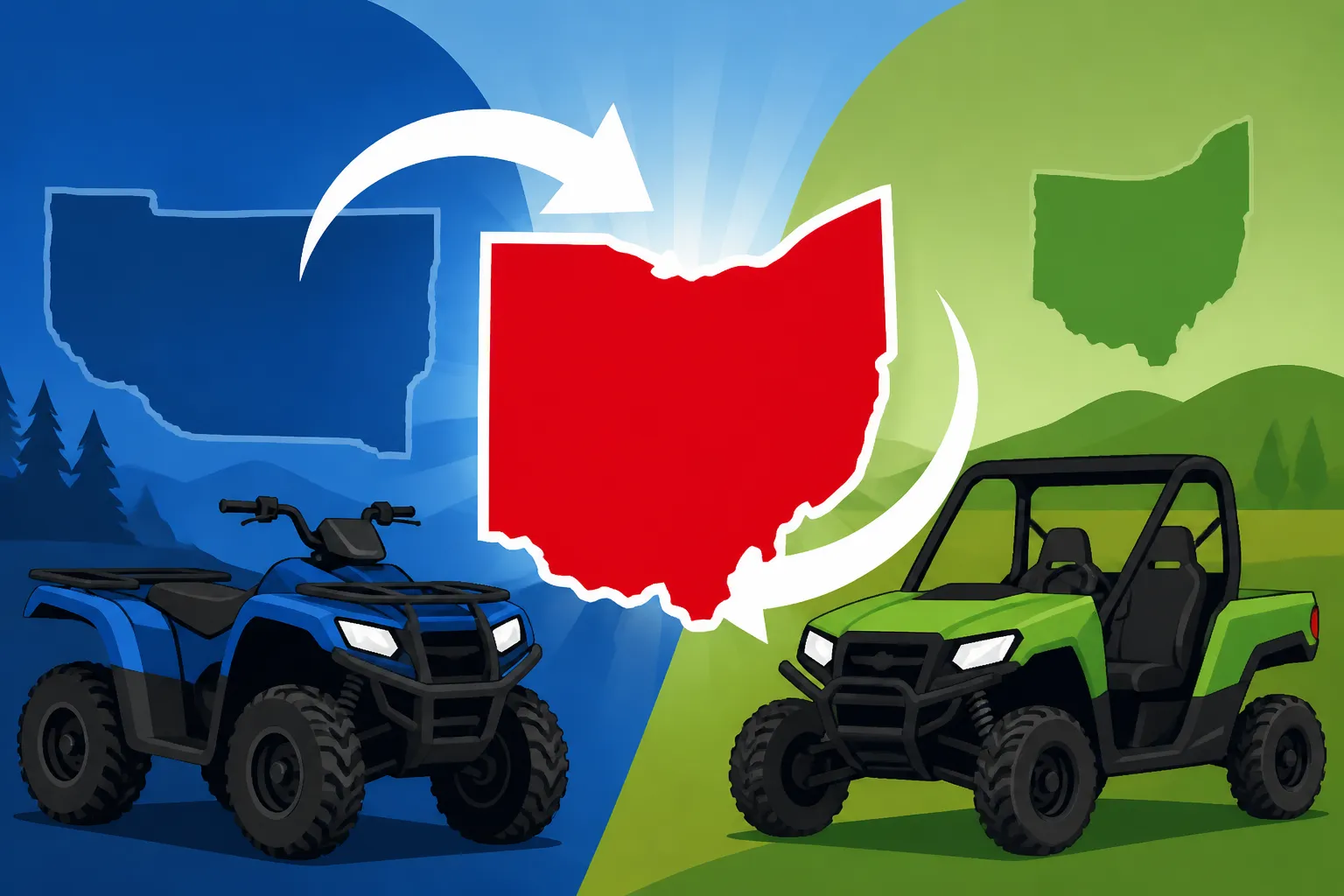
Reciprocity is about recognizing a machine’s registration from another state. If your ATV or UTV is properly registered in your home state, Ohio generally allows a nonresident to operate it here under that registration, subject to Ohio’s operating rules and the rules of the land being used.
That recognition can make a trip simpler: you may not need to obtain a standard Ohio registration just because you’ve brought your machine across the border for a visit. But reciprocity is not a universal riding permit. It does not override Ohio laws, local road restrictions, land-manager requirements or a separate permit system.
The distinction matters because several kinds of permission can apply at once:
- Registration identifies the machine and shows it is legally registered under the applicable system.
- Land access permission comes from the owner or manager of the property where you ride.
- A site-specific permit or pass may be required in addition to registration.
- Road-use permission depends on whether that particular road is open to APVs and whether the machine and rider meet the relevant requirements.
Ohio’s rules use the term all-purpose vehicle, or APV, for many machines riders commonly call ATVs and UTVs. The state’s terminology and legal category are explained in Why Ohio Says All-Purpose Vehicle. Reciprocity applies to a qualifying machine, not automatically to every vehicle that someone might casually describe as an ATV.
A valid home-state registration is also not the same as a dealer receipt, bill of sale, title, insurance card or trail pass. Those documents can be useful for other purposes, but they do not necessarily establish that the machine has current registration for use in Ohio.
| Your situation | What to check before riding in Ohio |
|---|---|
| Your state registers your machine and its registration is current | Carry proof of registration and confirm it covers the machine and intended use |
| Your state does not register this type of machine | Check Ohio’s visitor-permit process before riding |
| You plan to ride on Ohio state forest trails | Check the forest’s access rules, permitted machine types, hours and current closures |
| You plan to ride in Wayne National Forest | Check its separate OHV permit and rider requirements |
| You plan to use a public road | Confirm the road is open to APVs and check the applicable equipment, license and insurance rules |
| You plan to use private land | Get permission from the landowner and follow any site conditions |
If you’re unsure whether your home-state paperwork counts as registration, don’t assume that a plate or sticker settles the question. Check what the issuing authority calls the document, whether it is current and whether it applies to the machine you’re bringing. The details behind Ohio Reciprocity for Out-of-State Machines are narrower than a broad “my state allows it” understanding of reciprocity: Ohio must recognize the relevant registration for the visitor’s machine.
When a Home-State Registration Is Enough
For many visitors, the practical starting point is simple: bring a current registration issued by the state where the machine is registered. Keep its proof with you while riding, and make sure it identifies the machine you actually brought. If you have more than one ATV or UTV, confirm each one is covered; a registration for one machine does not cover the whole trailer or group.
Ohio’s treatment of a visitor’s registration is not a substitute for reading the conditions on the registration itself. A home state may limit the machine’s use, impose renewal dates or issue documents that are not equivalent to registration. If your state uses a registration certificate, plate, decal or a combination, check that the credential is valid and displayed as required by your home state. Ohio’s recognition does not erase the underlying obligation to keep that home-state registration current.
Before leaving home, check four details:
- The registration is active. Look at the expiration information, not only whether a plate or decal is physically attached.
- It belongs to the machine you’re transporting. Compare the vehicle identification number, or VIN, with the registration paperwork where available.
- It is registration, not just ownership paperwork. A title proves ownership; it does not, by itself, establish current registration.
- You can produce proof. Carry a paper copy or another form accepted by the relevant authority. Do not rely on being able to retrieve a document later if you lose signal.
When crossing a state line, riders sometimes assume that a home-state sticker automatically works everywhere. That may be true for a particular registration, but the controlling question is whether Ohio accepts the registration for the machine and use in question. For a more specific checklist, see What a Visitor From a Registering State Must Show.
It’s also useful to distinguish a resident’s Ohio registration from a visitor’s recognized out-of-state registration. Ohio residents generally follow Ohio’s registration requirements. A nonresident with an accepted home-state registration may have a different route. The state’s standard process, including where to complete it, is covered in Registering an APV in Ohio and Where to Register an APV in Ohio.
A visitor should not treat a trip to an Ohio riding area as a reason to switch registrations without checking the facts. The right option depends on residence, where the machine is registered, the kind of registration issued by the home state and the planned use. If you have recently moved to Ohio, or the machine has been registered in a different state than your residence, the situation may not fit the ordinary short-term visitor scenario. Check Ohio’s requirements rather than assuming the nonresident exception applies.
If Your Home State Does Not Register the Machine
Not every state uses the same registration system, and some may not require registration for a particular type of off-highway machine. In that case, there may be no home-state registration for Ohio to recognize. A state’s lack of a registration requirement does not necessarily mean a visitor can ride in Ohio without any state credential.
Ohio provides a temporary permit route for eligible nonresident visitors whose home state does not register the machine. This is different from transferring the machine to Ohio’s regular registration system. It is intended for temporary use, and its terms, period of validity and application details should be confirmed before the trip. See The Ohio Temporary Permit for Visitors and What a Visitor From a Non-Registering State Must Buy for the visitor-specific process.
Do not confuse a temporary visitor permit with a temporary operating permit issued for another reason, or with a pass sold by a trail system or federal land manager. The names can sound similar while the permissions are different. Ask what the credential authorizes, which machine it covers, where it is valid and how long it remains valid.
If the home state requires registration but you simply have not completed it, that is not the same as living in a state that does not register the machine. An expired registration, a lost card or a pending renewal can also create a different issue from a state that has no registration program for that vehicle type. In those cases, resolve the registration status with the home state or confirm the correct Ohio procedure before riding.
Where You Plan to Ride Changes the Answer
Reciprocity does not decide whether a specific trail, forest, road or private property is open to your machine. It addresses one part of the problem: whether Ohio recognizes the machine’s registration. Access rules still come from the land manager, road authority or owner.
Ohio State Forest Trails
Ohio’s state forest riding areas have their own access conditions. A recognized out-of-state registration does not mean every state forest allows motorized riding, and it does not make a closed trail open. Before heading out, confirm that the particular forest has an authorized APV trail system, that it is open for the intended date and that your machine fits the applicable rules.
Check the route, not just the name of the forest. Some properties have areas or roads where motorized vehicles are not allowed, and seasonal closures or other restrictions may apply. Width can also matter on state forest trails. A machine that is too wide for the applicable limit may be excluded even if its registration is valid. See Ohio’s 62 Inch State Forest Limit and Measuring Against the 62 Inch Limit before loading a wide side-by-side.
The registration credential and forest access rules should be checked independently. A rider can have valid home-state registration and still be turned away because the machine is too wide, the trail is closed, or the rider does not meet an age, supervision or safety requirement. Ohio Rules for Riding State Forest Land is a useful companion when you’re checking the on-site rules.
Wayne National Forest
Wayne National Forest has a separate OHV permit system. Do not assume an Ohio registration plate, an out-of-state registration or an Ohio visitor permit replaces the national forest permit. Likewise, having the federal permit does not make an unregistered machine legal for Ohio use.
Before your trip, check the current Wayne National Forest requirements for the machine, each rider and the area you plan to use. Confirm which trails the permit covers, whether every rider or passenger needs an individual credential, what documentation to carry and where permits can be obtained. Requirements and permit terms can change, so use the current information from the forest before setting out. The distinction between state registration and the forest credential is explained in How the Wayne National Forest OHV Permit Works.
Private Parks and Private Property
A privately operated riding park may have its own rules about registration, proof of ownership, machine type, rider age, helmets, waivers and day-use access. A park might accept an out-of-state registration for its own check-in process, but that is the park’s policy—not a statewide expansion of reciprocity. Confirm the park’s current requirements before you travel.
On other private land, the owner’s permission is essential. Registration does not give a rider the right to cross or ride on private property. A trail that appears to connect to a road or public riding area may cross private ground, and an old track or utility corridor is not automatically open to ATVs. Review Ohio Landowner Permission Rules and Ohio Trespass Law and Off-Road Riders if your route involves private property.
Public Roads
Public-road use is a separate question from trail registration. An out-of-state plate does not make an Ohio road open to APVs. Access can depend on the road’s jurisdiction and whether the appropriate local authority has opened it to this kind of vehicle. State routes, county roads, township roads and municipal streets may have different rules.
Even where a road is open, the machine and rider may have to meet additional conditions, such as equipment, insurance, licensing or inspection requirements. A road-legal configuration in your home state is not necessarily enough to satisfy Ohio’s requirements. Check Where Ohio Law Allows APVs on Roads, Ohio APV Insurance Requirement and Ohio Driver’s License Rules for APVs before planning a road segment.
This is especially important for a route that joins trail riding with a short ride on pavement. A legal state forest trail does not automatically authorize the connecting road, and a local road opening does not guarantee that a nearby trail is open. Verify each segment rather than treating a ride as one continuous permission.
How to Prepare and Avoid Common Problems
A little preparation can prevent a long drive ending at a trailhead with missing paperwork or an ineligible machine. Use this sequence before you load.
- Identify the machine and its registration status. Check whether your home state registers that exact type of ATV or UTV, then verify that the registration is current and tied to the machine.
- Choose the riding area. Find out whether you’re going to a state forest, Wayne National Forest, a private park, private property or a public road. Each can have separate access conditions.
- Check local requirements directly. Review the current rules for the specific trail system, road authority or park. Look for closures, machine-width limits, operating hours and any required site pass.
- Arrange the correct credential. If your state registers the machine, carry proof of that registration. If your state does not register it, confirm whether you need Ohio’s temporary visitor permit and how to obtain it.
- Check the rider requirements. Verify age, supervision, helmet, eye protection, license and passenger rules for the places you’ll ride. Registration does not satisfy these conditions.
- Keep documents accessible. Carry registration proof and any required permits in a secure, dry place. Make sure anyone transporting or riding the machine knows where to find them.
- Recheck shortly before departure. Trail closures, access rules and permit procedures may change. Confirm the details again before making a long trip.
Common mistakes usually come from treating two different credentials as interchangeable. An Ohio temporary visitor permit is not necessarily a Wayne National Forest pass. A Wayne pass is not Ohio registration. A plate from another state does not provide permission to use a township road. And a bill of sale does not stand in for current registration.
Another frequent problem is relying on a photograph of paperwork without checking whether it will be accepted. A photo can help you keep a backup, but it may not substitute for the credential required by a law enforcement officer, ranger or park operator. Keep the required documents in the form specified by the issuing authority or land manager. If you use a digital copy as backup, keep the original or accepted proof available as well.
Check the machine itself before traveling. Make sure the registration information matches its VIN, that a plate or decal is displayed as required, and that it is legible and securely attached. If the plate or credential is missing or damaged, resolve that with the issuing state before relying on reciprocity. Ohio’s own display rules are discussed in Ohio APV Plates and Validation Stickers, but visitors should also follow their home-state requirements.
If your machine is rented, borrowed, financed or recently purchased, verify who is responsible for registration and which documents are available. A rental company may handle registration but not a separate forest pass. A borrowed machine may be registered to its owner, but the rider still needs to know where the proof is and whether the land manager permits that use. For rentals, see Ohio Rules for a Rented Machine.
A Practical Decision Guide for Visitors
Use this quick decision guide as a starting point, then confirm the details for your destination.
| Question | If yes | If no |
|---|---|---|
| Does your home state require registration for this machine? | Keep the current registration proof and confirm Ohio recognizes it | Check Ohio’s temporary permit process for nonresidents |
| Is the registration current and matched to the machine? | Carry the proof with you | Resolve the status with the issuing state before riding |
| Are you going to Wayne National Forest? | Check its separate OHV permit and rider rules | Check the rules for your chosen land manager |
| Will you use an Ohio public road? | Confirm the exact road is open and meet road-use requirements | Stay off the road unless a legal crossing or route is specifically allowed |
| Is any part of the route on private land? | Get the landowner’s permission | Reroute rather than assuming access |
| Is your machine wider than a typical ATV? | Verify any width limit for the riding area | Still check the site’s machine and trail restrictions |
When calling a trail office, ranger district, park or local authority, ask focused questions. For example:
- Does this area accept a current registration from my home state?
- If my state does not register this machine, which Ohio visitor permit applies?
- Do I need another permit or pass for this trail system?
- Does the permit apply to the machine, the rider or both?
- Is my machine’s width allowed on the trails I plan to ride?
- Are there age, supervision, helmet or passenger requirements?
- Are any roads in my planned route open to APVs?
- What proof should I carry, and must it be displayed on the machine?
Keep notes about the answer and the office or operator that provided it, especially if your trip involves multiple jurisdictions. A trail map may show a route but not answer whether a connecting road is open, whether a section crosses private land or whether a particular vehicle meets a width restriction.
If an officer or land manager asks to see your paperwork, be ready to show the registration and any site-specific permit that applies. Stay calm, follow instructions and ask which requirement they believe is not met if there is a question. If your trip plan depends on an uncertain road opening or a special permit, get that detail confirmed before riding rather than trying to resolve it at the trailhead.
The safest takeaway is to think in layers. First establish that the machine has valid registration recognized by Ohio—or obtain the visitor permit that applies if the home state does not register it. Then verify that the specific land or road is open and that the machine and riders satisfy its separate rules. Reciprocity can simplify the paperwork, but it does not replace checking where and how you may ride.
Frequently Asked Questions
Can I ride in Ohio with my home-state ATV registration?
Often, a nonresident can use a current, valid registration from a state that registers the machine. Carry proof and confirm that it covers your specific vehicle and intended use. Ohio’s trail, road and land-access rules still apply.
What if my state does not require ATV registration?
Check Ohio’s temporary permit process for nonresident visitors. A state that does not register the machine is different from a rider who has an expired registration or has not completed a required renewal.
Does out-of-state registration let me ride every Ohio trail?
No. It addresses registration recognition, not access to every property. State forest trails, Wayne National Forest, private parks and private land can each have separate rules or permits.
Does reciprocity let me ride an ATV on Ohio roads?
No. Road access is separate. Check whether the particular road is open to APVs and whether the rider and machine meet Ohio’s applicable road-use requirements.
Does an Ohio visitor permit replace a Wayne National Forest pass?
Do not assume so. Ohio registration or a visitor permit and a Wayne National Forest OHV permit serve different purposes. Confirm both requirements with the relevant authorities before riding.
Disclaimer
This article is for general informational purposes only and does not constitute professional advice. Laws, prices and regulations vary by location and change over time. Consult a qualified professional for guidance on your specific situation.