The Ohio Fund Your Registration Fee Pays Into
When you register an ATV or UTV in Ohio, the fee can feel like a routine charge at the counter. But it is not the same as a title fee or a general road-use payment. Here’s what the registration money is intended to support, how it relates to trail access, and what it does not automatically buy you.
The short answer: the fee goes into a dedicated recreational vehicle fund
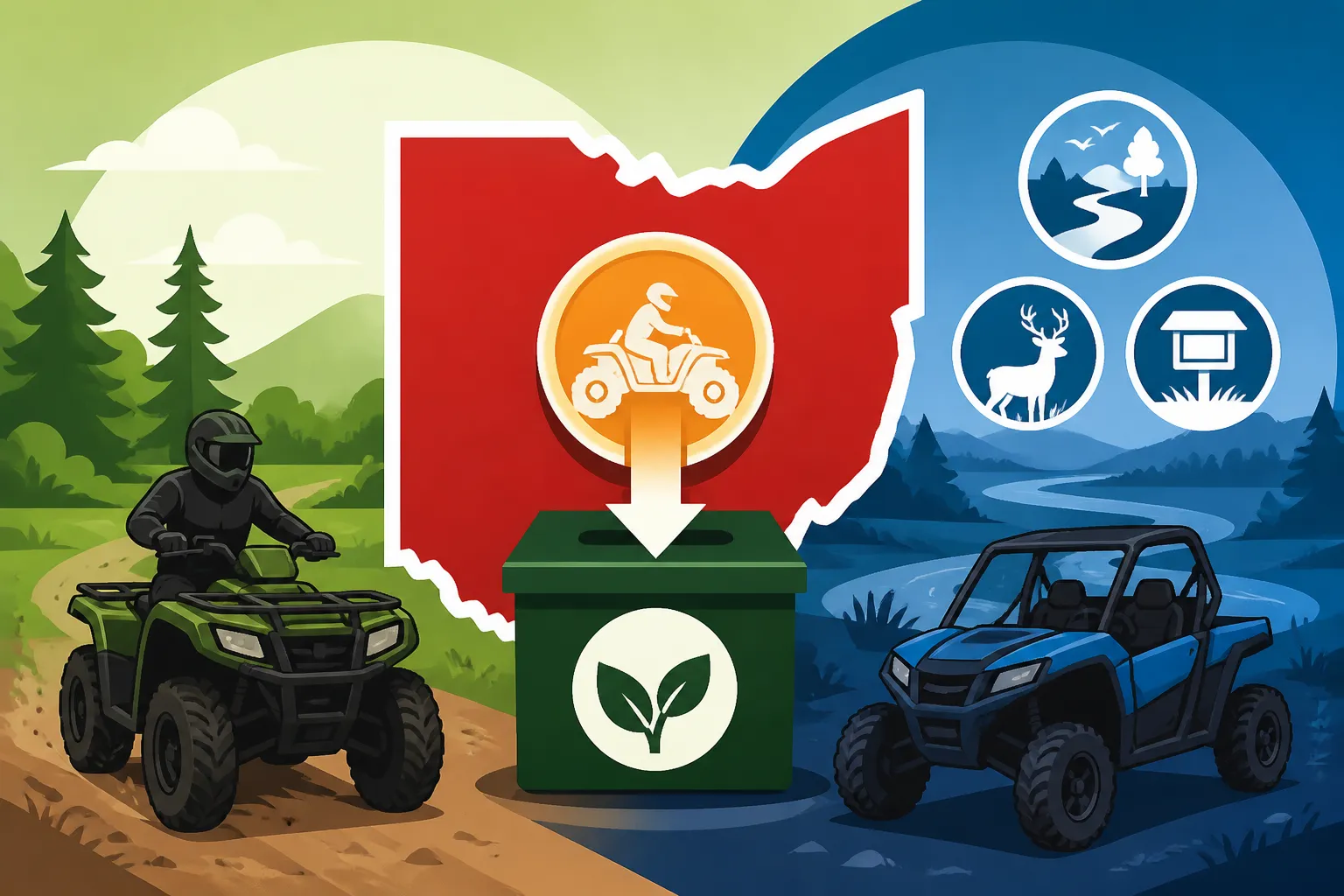
Ohio directs APV registration-fee revenue to a state Recreational Vehicle Fund. “APV” is the state’s registration term for all-purpose vehicles, which includes many machines riders casually call ATVs or UTVs. The important point is that the registration fee is earmarked for recreational-vehicle purposes under state law; it is not simply an unrestricted charge for using public roads.
That does not mean every dollar you hand over at a registration counter goes directly to a trail crew. A bill may include separate charges for separate services, and money in a dedicated fund still has to be administered and spent through the applicable state processes. The fund’s authorized uses and the way money is allocated matter as much as the name on the fund.
A useful starting point is to separate the registration fee from the other amounts that may appear during a transaction:
| Charge | What it generally relates to | Is it the same as the APV registration fee? |
|---|---|---|
| APV registration fee | Registration of the machine and the associated recreational-vehicle program | Yes, this is the fee most directly connected to the Recreational Vehicle Fund |
| Deputy registrar service charge | Processing the transaction at a deputy registrar | No |
| Title fee | Creating or transferring the ownership record | No |
| Sales or use tax | Tax on a taxable purchase or transfer | No |
| Wayne National Forest OHV pass | Access to designated federal forest routes under its own pass system | No |
| Private park admission | Access to a privately operated riding area | No |
Your exact transaction may include only some of these. For more on the state registration line itself, see Ohio APV Registration Cost and What Ohio Charges at the Counter Altogether. The ownership document is a separate matter; What an Ohio APV Title Costs explains that side of the process.
A dedicated fund is a way to connect a revenue source to a public purpose. It helps distinguish APV registration revenue from money collected for unrelated state services. But it does not guarantee that your individual fee will be spent on the exact trail, county, or forest where you ride. The state manages revenue as a program, not as a personal account assigned to each plate.
That distinction is easy to miss because riders often pay several charges close together. A title office may handle ownership paperwork, while a deputy registrar handles registration. The combined visit can make the costs look like one large “registration bill,” even though the money can be directed to different purposes. Two Ohio Counters for One Machine describes why the title and registration steps are separate.
What the Recreational Vehicle Fund supports
The fund exists to support recreational-vehicle purposes authorized by Ohio law. That can include costs associated with administering the registration program and supporting eligible trails, facilities, or related work. The precise activities funded in a given period depend on the law, state spending decisions, and available revenue.
For riders, the most visible connection is trail access and maintenance. A trail system needs more than a marked route on a map. Work can include inspecting or repairing trail surfaces, maintaining drainage, addressing erosion, replacing damaged structures, managing access points, and preparing areas for safe use. Facilities such as staging areas and related visitor infrastructure may also require upkeep.
However, “registration money supports trails” should not be read as “every registration dollar goes straight to trail construction.” Public programs have operating costs. Staff time, administration, compliance work, planning, and other authorized program needs can be part of the larger picture. The exact split can change, and a fund’s legal purpose does not itself tell you how much was spent on each activity in a particular year.
This is why it is more accurate to say that Ohio’s registration revenue contributes to the state’s recreational-vehicle program than to promise a direct, dollar-for-dollar return to each rider. A rider may pay for a plate in one county and later ride in a state forest elsewhere. Revenue is handled at the program level, rather than being reserved for the place where that particular transaction occurred.
The fund is also not the same as an open-ended promise that every public area will permit machines. Land managers decide where riding is allowed, and trail access depends on the rules for the specific property. Registration revenue does not turn a closed road or trail into an open one, and it does not override a land manager’s restrictions. See Ohio Rules for Riding State Forest Land for the separate access rules that apply on state forest property.
It can help to think about the money in three layers:
- Collection: A state registration process collects the APV registration fee.
- Program funding: The fee revenue is credited to the designated recreational-vehicle fund, subject to the governing rules.
- Spending decisions: Authorized state processes determine which eligible program needs receive funding.
Those layers explain why the person who takes your payment may not be the person who decides which trail gets repaired. A deputy registrar provides a transaction service. The state fund and the agencies responsible for administering recreational-vehicle programs handle the broader revenue and spending responsibilities.
For a deeper look at the fund itself, see What the State Recreational Vehicle Fund Pays For. If you want to focus specifically on spending that supports trails, How Registration Fees Pay for Trail Maintenance and Repair and Where Ohio Registration Money Is Spent address related parts of the picture.
What your registration does for trail access
The registration fee has a practical benefit for riders as well as a funding role: Ohio’s APV plate is part of the state’s trail-access system. For Ohio state forest APV riding, a valid Ohio registration is generally central to showing that the machine is properly registered for that use. The plate serves a different function from a separate trail decal system, which is why riders sometimes ask whether they need to buy another state forest sticker.
That does not mean a plate is a universal pass for every riding area. A machine’s registration status and the land manager’s access rules are separate questions. A valid plate does not authorize riding on private land without permission, on a closed route, or in a public area that prohibits APVs. Nor does it automatically cover separate access systems operated by another land manager.
The distinction is especially useful when planning a trip. Before loading the machine, identify the property you intend to ride and check its current rules. Confirm whether the route is open, whether your machine meets any width or equipment restrictions, and whether a separate pass or permit is required. Start with Do You Need a Permit for Ohio State Forest Trails? for the state forest question and Why Ohio Plate Is the Trail Permit for how Ohio’s registration plate relates to state trail access.
Wayne National Forest is a common source of confusion because it is federal land and uses its own OHV pass system. An Ohio APV registration does not replace a required Wayne National Forest pass. The registration and the forest pass serve different purposes: one concerns state registration and Ohio access requirements, while the other concerns riding on designated federal forest routes. Check How the Wayne National Forest OHV Permit Works before planning a Wayne ride.
Private parks are different again. A private operator may charge admission or require its own waiver, permit, or proof of registration. Paying Ohio’s registration fee does not pay a private park’s operating costs or guarantee entry. Treat park admission as a separate line in your riding budget.
A quick comparison helps keep the systems straight:
| Where you plan to ride | What Ohio registration may cover | What to check separately |
|---|---|---|
| Ohio state forest APV area | The state registration and plate requirements for the machine | Current trail openings, operating rules, machine limits, and any property-specific conditions |
| Wayne National Forest route | Ohio registration requirements that apply to your machine | The federal forest pass, designated routes, and current forest rules |
| Private riding park | Registration status where required by law or park policy | Admission, waivers, operating hours, and park-specific equipment rules |
| Private land | Registration requirements that still apply to the machine | Permission from the landowner and any applicable restrictions |
| Public road | Registration may be only one part of the requirements | Whether that road is open to APVs, equipment rules, insurance, and licensing requirements |
The same separation applies to out-of-state visitors. A visitor’s home-state registration may be accepted in some circumstances, but acceptance is not a general guarantee that the rider can use every Ohio trail without additional steps. The answer can depend on the visitor’s home-state rules, Ohio reciprocity requirements, and the specific land being visited. See Ohio APV Reciprocity With Other States and Which States’ Registrations Ohio Accepts on Its Trails before assuming that a home-state plate is enough.
If a visitor’s home state does not register the machine, Ohio may have a temporary-permit option for eligible riders. That is a separate route to compliance, not a way to avoid checking land access rules. The Ohio Temporary Permit for Visitors explains the visitor permit issue, while When a Home-State Registration Is Enough in Ohio focuses on when a home-state credential may satisfy Ohio’s requirements.
What the fee does not buy or guarantee
The registration fee is not a purchase of a dedicated trail pass for every place in Ohio. It is not a payment to ride anywhere, a road-use authorization, or permission to enter private property. It also does not guarantee that a particular trail will remain open throughout the year.
Trail systems can close for maintenance, weather, environmental conditions, timber work, safety concerns, or other management reasons. A route may be closed even though the state continues to collect registration fees. That is not necessarily a contradiction: maintaining a system sometimes requires closing it, and funds may support a broader network rather than an individual segment.
The fee also does not necessarily cover all expenses of running a riding season. Riders may still need to budget for a separate pass, park admission, fuel, transportation, machine maintenance, safety equipment, and lodging. For a state forest trip, check the trail rules and seasonal status shortly before leaving rather than relying only on a past visit or an old map.
Nor should you assume that a registration fee includes an ownership title. The title establishes who owns the machine; registration concerns the machine’s registration status. Buying a used ATV or UTV can involve both steps, and a private sale may require title paperwork even if the seller hands over a plate or registration card. Titling an APV at an Ohio Clerk of Courts and Buying a Used APV in Ohio cover those separate responsibilities.
Finally, payment does not by itself prove that a machine meets every rule for the place where you intend to ride. State forest routes can have width limits and other restrictions. Road use brings a different set of requirements, and local road access can vary. The fee is one part of responsible use, not a substitute for checking the rules.
How to follow the money and plan your own costs
If you want to understand where registration revenue goes beyond a general description, look for current information from the state agency responsible for Ohio’s natural-resource and recreational-vehicle programs. The useful questions are specific:
- Which agency administers the Recreational Vehicle Fund?
- What uses are authorized for the fund?
- What spending categories were reported for the period you are reviewing?
- Were funds used for administration, trail work, grants, facilities, enforcement, or other eligible purposes?
- Does the information distinguish money collected from money actually spent?
- Are there current program reports or public budget documents that explain the allocations?
The distinction between revenue collected and spending made is important. Receipts can be recorded in one period while projects are planned, approved, or completed later. A budget allocation also does not necessarily mean a project has already been built. If you are trying to trace a particular trail improvement, ask the land manager or program office about that project rather than inferring its funding from the existence of the statewide fund.
For day-to-day budgeting, keep the fee categories separate. Write down the registration charge, any service charge, title costs, taxes, and any trail or park pass as different items. That makes it easier to compare the cost of renewing a machine with the cost of buying or titling one. Ohio’s Three-Year APV Registration and Why Ohio Bills Registration in Three-Year Blocks can help explain the timing of registration payments; confirm current amounts and procedures with the appropriate office before you pay.
A small amount of recordkeeping also helps if you later need to renew, sell, or replace a plate. Keep the registration card and payment receipt somewhere dry and easy to find, and note the expiration information in your calendar. A basic waterproof document pouch—whether bought locally or through Amazon—can help keep paper records together in a trailer or storage area. Do not rely only on a photo if an agency or officer needs to see an original document.
If you buy a generic pouch or organizer through Amazon, check that it is sized for your paperwork and can be secured safely; it should not interfere with the machine’s controls or obscure the plate. Amazon is just one possible source for a simple recordkeeping item, not a source of official registration guidance. For official forms, current requirements, and fund information, use the relevant Ohio office or agency.
You may also want to save a copy of the fee breakdown from your transaction. If the total seems unclear, ask which line is the registration fee and which lines are service, title, or tax charges. A receipt makes that conversation much easier than trying to reconstruct the amount later. Amazon’s generic file sleeves may be convenient for keeping receipts and title records together, but the important part is retaining the actual paperwork and checking official records when needed.
When it is time to choose accessories, avoid assuming that an item sold online is compatible with your particular machine or satisfies Ohio’s legal equipment rules. For example, a plate bracket or lighting part should fit the vehicle and remain compliant with applicable requirements. Amazon may offer a broad selection of generic parts, but verify fitment and requirements before ordering; buying an accessory does not change what the registration fee covers.
The simplest way to make sense of the payment is to remember three things: the APV registration fee is directed to a dedicated recreational-vehicle fund; the plate is relevant to Ohio registration and access, but it is not a universal pass; and separate charges or land-manager rules may still apply. When you know which counter charge serves which purpose, it is easier to budget accurately and ride with the right paperwork.
Disclaimer
This article is for general informational purposes only and does not constitute professional advice. Laws, prices and regulations vary by location and change over time. Consult a qualified professional for guidance on your specific situation.