Meeting a Horse on a Shared Road
A horse and an ATV can meet on a narrow Ohio road with little warning, especially near farms, bridle routes, and trail access points. The engine noise and tight space can make a routine encounter stressful for the rider, the horse, and the ATV operator. This guide explains how to slow down, communicate, pass safely, and know when the road may not be open to your machine.
Why a Horse and an ATV Need Extra Space
A horse may react before its rider can explain
Horses can be sensitive to engine noise, vibration, movement, and unexpected sounds. An ATV that seems quiet to its operator may sound startling from a horse’s perspective, especially if it approaches from behind or revs while passing. A horse may sidestep, turn, or move quickly, leaving its rider with little time to respond.
That does not mean every horse will panic. Many are accustomed to traffic and machinery. The challenge is that you usually cannot know how a particular horse will react just by looking at it. Treat each encounter as unpredictable, and let the horse’s rider decide what feels safe.
Narrow roads leave little room for mistakes
On a two-lane road, a farm lane, or a narrow route beside a ditch, there may not be enough room for an ATV and horse to pass comfortably. The horse could move toward the shoulder, where the ground may be soft or uneven. A rider may also need room to guide the horse without brushing against your vehicle.
Keep in mind that an APV being registered does not automatically make every road legal to ride. Ohio road access depends on the road and the applicable local rules. Before planning a route, review Ohio Rules for Riding Alongside a Road and confirm whether the road is open to APVs. A map can help you plan, but posted signs and local restrictions still matter.
What to Do When You See a Horse
Slow down early and stop if there is any doubt
As soon as you spot a horse, ease off the throttle and reduce your speed gradually. Avoid charging toward the horse and then braking sharply at the last second. A calm, predictable approach gives the horse’s rider time to notice you and decide how to handle the encounter.
If the road is narrow, the horse seems unsettled, or you are unsure whether there is enough space to pass, stop well back. Leave a generous gap rather than pulling up close behind the horse. Keep your ATV steady and avoid revving the engine. If the horse’s rider asks you to wait, wait until they clearly indicate that you can proceed.
Make your presence known without startling the horse
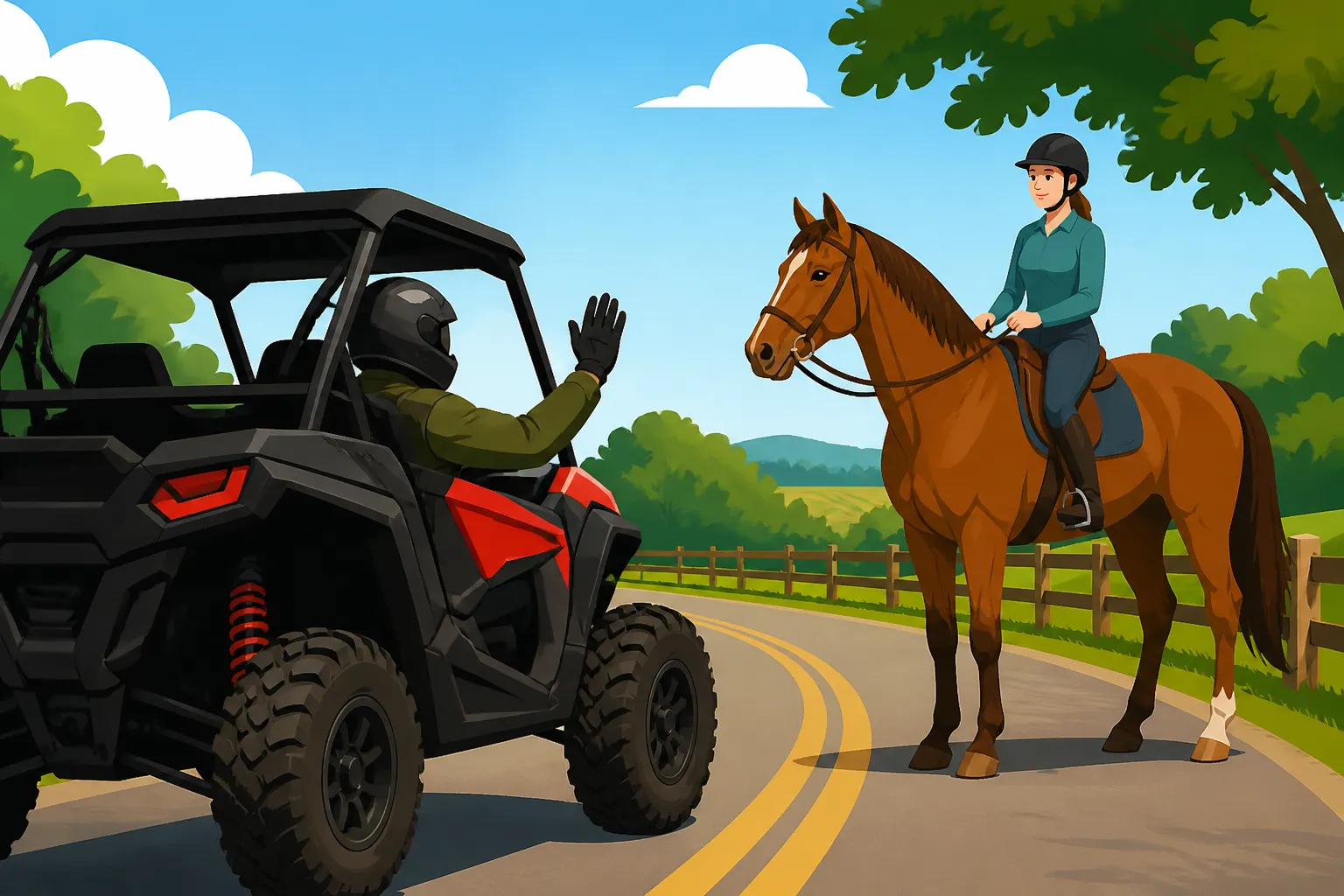
Do not assume the rider has heard or seen you. When you are far enough away, use your voice in a calm, ordinary tone or call out a brief greeting. Avoid using a horn, shouting, or making sudden noises unless there is an immediate safety need. The goal is to alert the rider without startling the horse.
Once the rider knows you are there, give them time to respond. They may ask you to stay still while they turn the horse, move to a wider shoulder, or position themselves so the animal can see you. Follow their directions rather than trying to decide for them what the horse can tolerate.
Pass only when the rider says it is safe
Do not squeeze by just because there appears to be a small opening. Ask whether the rider would like you to wait or pass, then follow their instructions. If they ask you to pass, move slowly and smoothly, leaving as much space as the road allows. Avoid sudden acceleration, sharp steering, or stopping directly beside the horse.
If the horse becomes tense, backs up, or shifts toward you, stop moving and give the rider room to regain control. Do not try to pet the horse, reach toward it, or drive close for a better look. A horse can move unexpectedly, and a person on an ATV may have few safe options if the animal steps into the vehicle’s path.
| Situation | Safer response | Avoid |
|---|---|---|
| You see a horse ahead | Slow down early and leave a large gap | Accelerating to get past quickly |
| The rider has not noticed you | Call out calmly from a distance | Honking or shouting suddenly |
| The road is narrow | Stop and ask what the rider prefers | Squeezing between the horse and shoulder |
| The rider asks you to wait | Stay still and quiet until they signal | Revving, creeping forward, or arguing |
| The horse seems nervous | Stop and give the rider space | Moving closer to “help” or get around |
How to Pass Without Escalating the Encounter
Keep your speed and engine sound steady
If the rider gives you the go-ahead, pass at a slow, controlled pace. Avoid a sudden burst of throttle, which can create a sharp change in noise and movement. If your machine has a loud exhaust or is carrying a passenger or cargo, take extra care not to crowd the horse.
Stay alert until you are well clear. Do not assume the horse is settled just because the front of your ATV has passed. The horse may react as the vehicle moves beside it or continues away. Once you have passed, keep your speed moderate and avoid accelerating hard immediately in front of the animal.
Choose a wide, stable passing space
The shoulder may look like extra room, but it can be soft, rutted, sloped, or covered in loose gravel. Do not force a pass that requires you to ride into an unstable edge or push the horse toward a ditch. If there is no safe width, wait for a wider area or follow the rider’s instructions for moving through together.
On roads open to APVs, the rules for riding on or beside the road still apply. Do not treat a horse encounter as permission to ride wherever there is space. For more on the legal and safety considerations, see Ohio Equipment Rules for an APV on a Road and Crossing a Two-Lane Safely.
Stay patient if the encounter takes time
Sometimes the safest response is simply to wait. The rider may need to turn the horse around, move to a gate, or reach a wider pull-off. That can take several minutes, and it may feel inconvenient if you are trying to reach a trailhead or keep up with a group. Still, waiting is better than causing a fall or forcing the horse into an unsafe position.
If you are riding with others, let your group know to remain behind you rather than bunching up around the horse. Multiple machines starting, idling, or moving at once can be more unsettling than one quiet ATV. Keep the group orderly and pass one at a time only when the rider says it is safe.
Plan Routes With Horses and Other Trail Users in Mind
Check that the route is open to your machine
A road that looks suitable for an ATV may be closed to APVs, restricted by a township, or intended for other users. The same applies to forest paths and bridle routes: a visible trail is not automatically open to motorized riding. Before heading out, check local rules and posted signs, and do not follow a horse trail simply because it connects to a road.
A planning app such as onX Offroad can help you review a route before you unload, but use it as one part of your preparation rather than the final word on access. Confirm important restrictions with the relevant land manager or local authority. If you want to understand how road access can vary from place to place, see How to Find an Ohio Township Resolution and Why One Township Says Yes and the Next Says No.
Expect horses near farms, bridle areas, and trail crossings
Horses may appear on rural roads near barns, farms, riding facilities, and designated bridle routes. They can also be led across a road or travel near a trail access point. Reduce your speed in areas where visibility is limited, including bends, tree-lined lanes, and hill crests. Being prepared to stop is especially important when you cannot see far ahead.
If your ride includes mixed-use areas, review Ohio Trail Etiquette on Narrow Trails before you go. It is also worth checking Ohio Trails That Suit a Dirt Bike if you are choosing a riding area for a machine type that may have different access or trail-width considerations. A little route planning can prevent the awkward moment of discovering that a route is unsuitable only after your group has arrived.
Make a simple group plan before starting
Before the ride, agree on who will lead, how riders will signal a stop, and what the group should do when encountering a horse. The lead rider can slow down first and keep the rest of the group from closing the gap. The other riders should remain in line and avoid passing the lead machine toward the horse.
You can use onX Offroad while planning to discuss where a route may narrow or pass through developed areas, then confirm access and conditions separately. If a horse encounter happens, keep the plan simple: slow down, stop at a safe distance, communicate calmly, and let the horse’s rider choose how to proceed. That approach protects everyone involved and makes the ride more considerate for the people who share Ohio’s roads and trails.
Disclaimer
This article is for general informational purposes only and does not constitute professional advice. Laws, prices and regulations vary by location and change over time. Consult a qualified professional for guidance on your specific situation.