Riding With a Group Across Two Forests
Riding with a group across two Ohio forest areas can make a memorable weekend, but the route may not connect the way it looks on a map. Trail rules, permits, operating seasons, and machine-width limits can change between destinations. This guide explains how to plan a two-forest ride, keep your group together, and avoid accidentally riding where machines are not allowed.
Understand what riding across two forests means
Treat each trail area as its own destination
In Ohio, “two forests” might mean two separate areas within Wayne National Forest, or a Wayne National Forest system paired with an Ohio state forest riding area. Those are not necessarily connected by legal ATV or UTV trails. A trail map may show roads, tracks, or open-looking ground between destinations, but that does not establish that off-highway vehicles are permitted there.
Plan on trailering between areas unless the official maps and land managers confirm a legal, continuous route. Do not use a public road, utility corridor, private lane, or unmarked path as a connector just because it seems convenient. Each has its own access rules, and a road that is open to APVs may have conditions different from those on a forest trail.
Ohio’s state forest riding areas and Wayne National Forest systems also operate under different land-management rules. The state forest areas are described in Ohio’s Four State Forest APV Areas, while Wayne National Forest’s Three Ohio Systems provides a useful starting point for understanding the national forest trail systems. Check the official information for the particular area you intend to ride, not simply a general map of southeastern or northwestern Ohio.
Know which rules apply at each stop
Before the group leaves home, make a simple list of destinations and confirm the rules for each one. A state forest riding area and a Wayne National Forest trail system may differ in permits, accepted registrations, season dates, hours, trail access, and machine restrictions. A permit or registration that satisfies one land manager may not cover the next stop.
Ohio APV registration matters for eligible machines using designated riding areas, while Wayne National Forest riding also involves its own OHV pass requirements. Visitors should check whether their home-state registration is accepted and what additional documentation or visitor permit may be needed. Don’t assume that a machine’s plate, a driver’s license, or one rider’s pass covers everyone in the group.
It helps to check each forest’s official trail information shortly before departure. Start with Ohio Trail Maps From ODNR, then check current rules and notices for the Wayne National Forest destination. A navigation app such as onX Offroad can help your group compare routes and orient itself, but treat it as a planning aid—not as proof that a track is open or legal to ride. Confirm access through the land manager’s maps and notices.
Plan the route, permits, and timing before the ride
Build the weekend around legal trail access
Choose the trail areas first, then work out how to get between them. If the areas are not connected by authorized trails, plan a trailer transfer, including a realistic time for loading, driving, parking, and unloading. Trying to squeeze in a road connection between trail systems can put the entire group in a difficult position, especially if local road access depends on a township or county rule.
For each destination, record the address or coordinates of the staging area, the route to the trailhead, parking arrangements, and the location of the nearest fuel and supplies. Keep a paper or offline map available in case cell service drops. onX Offroad can be useful for organizing waypoints and reviewing the area before the trip, but riders should still compare those details with official maps and posted trailhead information.
Confirm that every vehicle in the group fits the trail system’s requirements. For Ohio state forest riding areas, machine width is an important consideration; review Ohio’s 62-Inch State Forest Width Limit before inviting a wide side-by-side. A group may include machines that are legal for one private riding park but not suitable for a particular forest trail system.
| Planning question | What to confirm before the group departs |
|---|---|
| Are the areas connected by an authorized route? | Confirm through official maps and land-manager rules. Otherwise, plan to trailer between them. |
| What registration or permits apply? | Check the requirements for each destination and for every rider or machine where applicable. |
| Does every machine fit? | Review width, equipment, and trail restrictions for the specific area. |
| Is the trail system open? | Check operating dates, hours, closures, and temporary notices. |
| Where will the group stage? | Confirm parking, unloading space, and any restrictions on trailers or overnight parking. |
| What is the backup plan? | Choose an alternate ride area or activity if weather, closures, or access problems disrupt the plan. |
Check seasons, conditions, and closures
A two-area weekend can fail before the first ride if one destination is closed or has limited access. Forest riding seasons and operating hours can differ, and weather may affect trails even when an area is technically open. Check Ohio Trail Conditions Before You Ride and Ohio Trail Closures to Check First close to departure, then look again for notices at the trailhead.
Rain can turn clay into slick, deep ruts, while a dry stretch can make dust a bigger issue for riders following one another. Conditions may vary sharply between forests, especially if the group travels from one part of Ohio to another. Agree on a decision point: if a trail is too muddy, a gate is closed, or conditions are unsafe, the group will turn around rather than search for an unofficial bypass.
Build daylight into the schedule. Account for unloading, safety checks, group briefings, breaks, and the transfer between trail systems. A ride that looks manageable on a map can take longer when several machines are moving together, a rider needs help with a repair, or the group pauses at junctions to confirm everyone is still together.
Keep a mixed group safe and moving together
Set a pace and regrouping plan
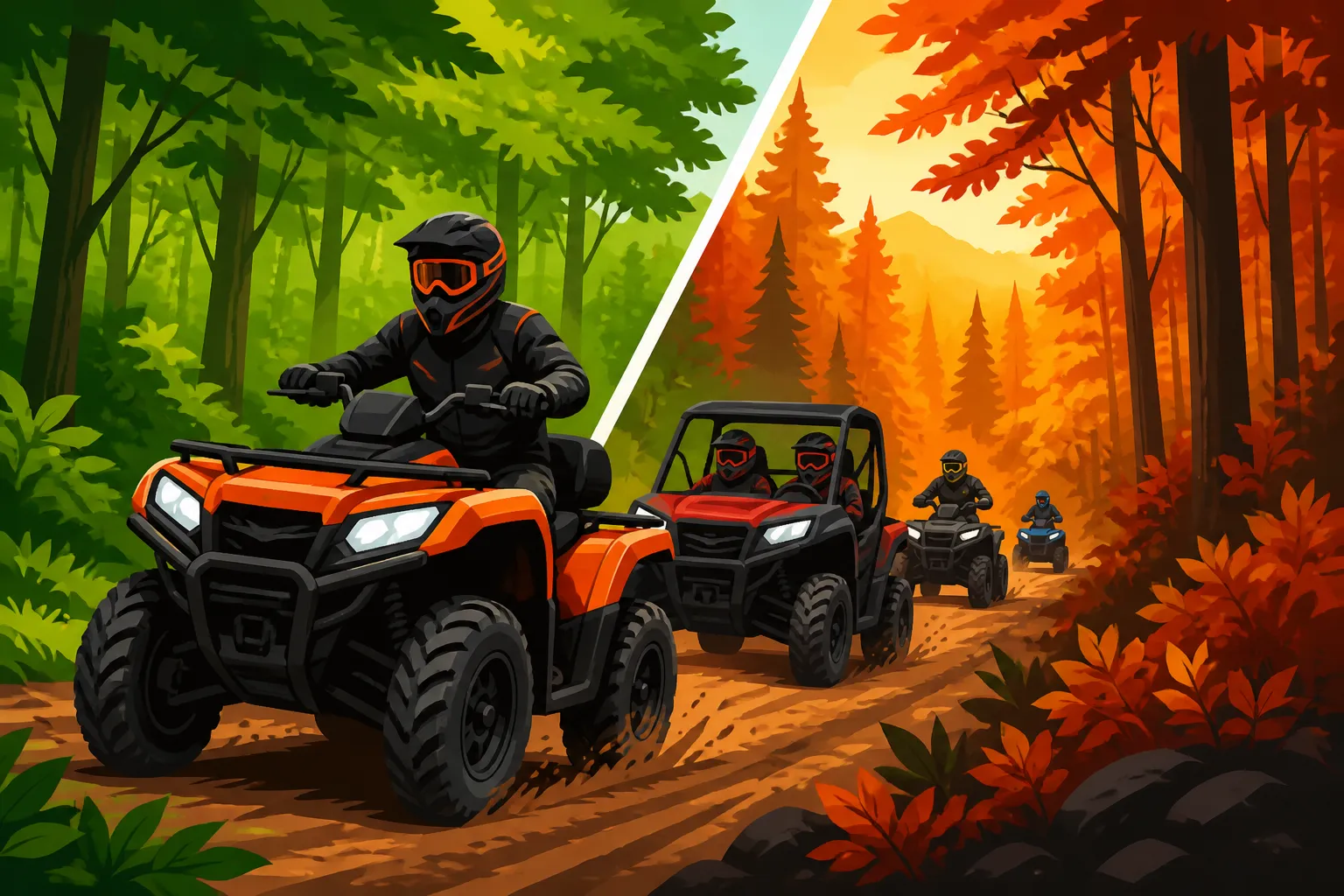
Groups usually include riders with different experience levels, different machines, and different ideas about a comfortable pace. Agree on the ride’s difficulty and pace before starting. The lead rider should know the route and be prepared to slow down at confusing junctions. A sweep rider should stay behind the last machine so that no one is left to manage a breakdown alone.
Choose regrouping points before you start. Useful spots include a signed junction, a trailhead, or a clearly identified stopping area that does not block the route. Tell everyone what to do if they lose sight of the group: stop somewhere safe, avoid taking an unplanned turn, and wait for the sweep rider or use the agreed communication method. Don’t rely on a phone signal in remote areas.
On narrow trails, leave room between machines. Dust, loose gravel, branches, and sudden stops can make close following uncomfortable or hazardous. Give oncoming riders space, slow down when visibility is limited, and avoid pulling over in a way that blocks a trail. The advice in Ohio Trail Etiquette on Narrow Trails is especially relevant when a larger group meets other riders, hikers, or forest users.
Prepare each machine and rider for two different days
Before loading, inspect tires, brakes, lights, steering, fluids, and tie-downs. Carry basic tools and supplies appropriate to the machines in the group, and make sure at least one person knows how to use them. A small issue can become a long delay when the group is far from the staging area, so agree in advance whether the group will stop for a repair, return together, or use another safe plan.
Each rider should have the required protective equipment and documents for the areas on the itinerary. Confirm helmet and eye-protection rules, registration and permit requirements, and any age or supervision restrictions that apply. If someone is visiting from another state, verify the rules before the trip rather than assuming their home registration is enough everywhere.
Pack for the conditions, not just the forecast. Bring drinking water, weather-appropriate layers, food, a first-aid kit, and a way to contact help. Store important papers and a backup map where they will stay dry. If the group plans to camp, confirm whether the campground is near the trail system and whether its access rules fit the schedule. Camping Near Ohio OHV Trails can help with that part of the planning.
Use a practical two-forest itinerary
Make the first trail area a test run
For a group that has not ridden together before, start the weekend at the area with the simplest logistics. Arrive early enough to unload without rushing, check the posted notices, and give riders a short briefing. Confirm the route, regrouping points, hand signals or radio plan, and what to do if a machine develops a problem.
Keep the first ride moderate. It gives the group a chance to learn how everyone handles turns, hills, dust, and stops before committing to a longer ride or a second trail system. If a rider is uncomfortable, adjust the pace or shorten the loop. This is easier to do early in the weekend than after a long drive to another staging area.
At the end of the ride, check the machines and talk through what worked. Note fuel use, any equipment concerns, and whether the group’s planned timing was realistic. Those details can help you decide whether to ride the second area as planned or scale back.
Make the transfer a real part of the plan
Treat the move between forests as a separate leg, not a brief pause in the ride. Confirm the driving route, trailer capacity, tie-downs, parking at the next location, and any restrictions on leaving a vehicle or trailer there. If the group has multiple trailers, establish a meeting point and a backup contact plan before anyone sets off.
Avoid asking some riders to navigate public roads on their machines unless the route is expressly legal for them and every relevant local requirement has been checked. Ohio road access can vary by jurisdiction, and the permission to ride a forest trail does not automatically authorize travel on nearby roads. When in doubt, trailer between destinations.
Keep the second area flexible. If the group arrives later than expected, conditions have deteriorated, or a closure changes the plan, choose a shorter permitted route or stop for the day. Planning a weekend across separate systems is easier when the group has alternatives; Planning a Weekend Across Two Systems offers another useful angle for organizing that kind of trip.
Close the loop before heading home
Before leaving the final area, account for every rider and machine. Check for damage, secure cargo, and make sure the group knows the route back to its meeting point. If one machine is being transported separately, confirm who is responsible for it and how the owner will get home.
After the ride, write down practical notes while they are fresh: where parking worked well, which official maps were useful, where the group lost time, and whether the trail difficulty suited everyone. Keep those notes with your trip plan, but check rules and closures again before your next visit. A successful two-forest ride is not just about covering more ground; it is about choosing legal routes, respecting each land manager’s rules, and making sure every rider gets back safely.
Disclaimer
This article is for general informational purposes only and does not constitute professional advice. Laws, prices and regulations vary by location and change over time. Consult a qualified professional for guidance on your specific situation.