Meeting a Logging Truck
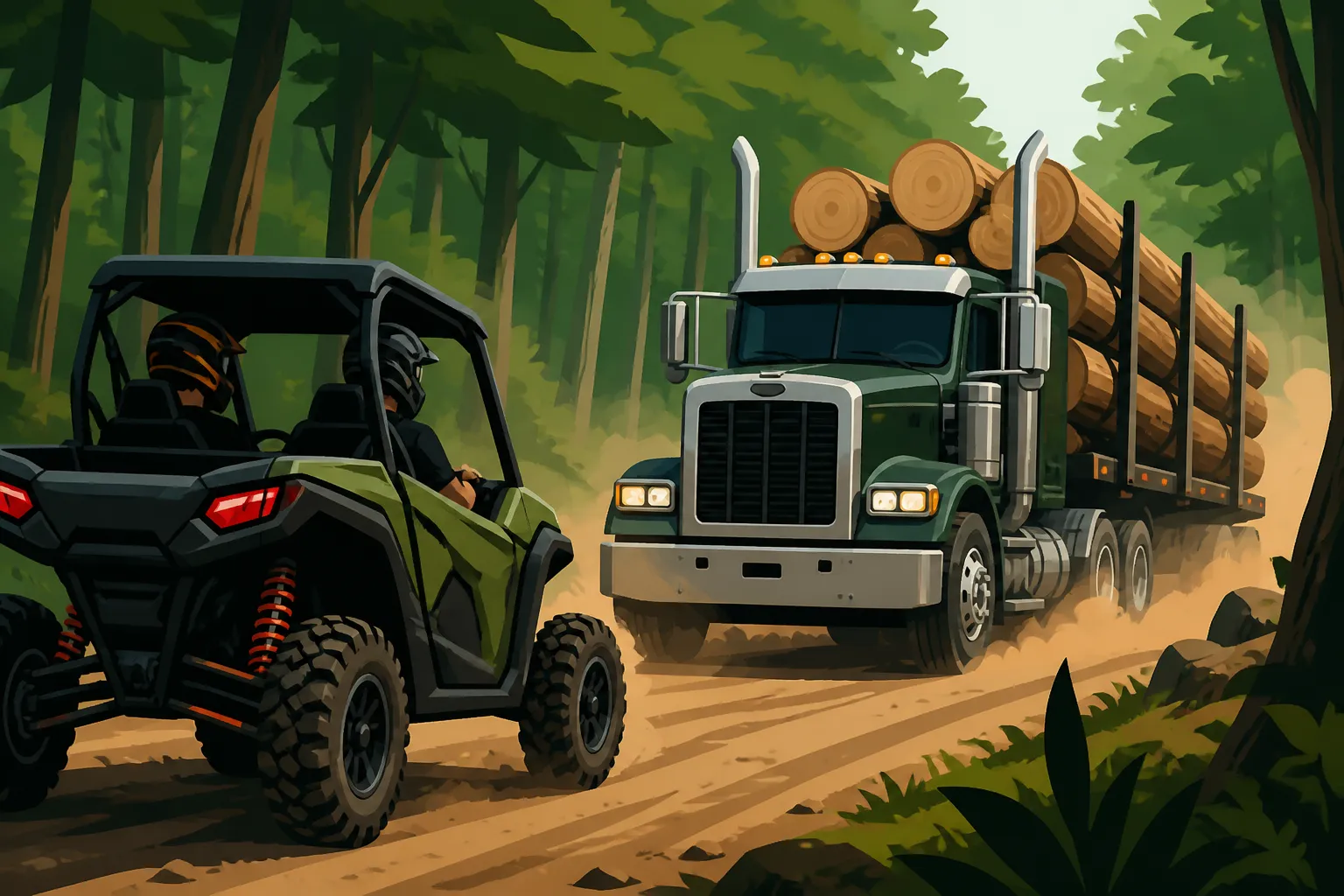
A logging truck can appear suddenly on a narrow forest road, around a blind bend, or near a trail crossing—and an ATV or UTV has very little protection if the two meet head-on. The safest response is to slow early, make yourself visible, yield well before the truck reaches you, and never assume its driver can stop or maneuver around you.
Why logging trucks change the risk on an Ohio ride
Expect large vehicles on active forest roads
Logging trucks are long, heavy, and often pulling loaded trailers. They need room to turn, may take up most of a narrow road, and cannot stop as quickly as a small off-road machine. The driver may also have limited visibility close to the truck, especially around the sides and rear.
A quiet road can become a work route without much warning. Logging equipment may be entering or leaving a timber site, and trucks can travel in both directions. Dust, engine noise, and trees or hills around a bend can make it harder to hear or see one coming. Treat any road that could serve a work area as a place where a truck might appear—even if you have not seen one yet.
This does not mean every forest road is open to ATV or UTV riding. Stay on routes that are open and permitted for your machine, and obey closures and signs. For background on how access can change during forest work, see Why a Forest Gate Closes During Timber Harvest and [Ohio Rules for Riding a Fire Road].
Watch for clues that work traffic may be nearby
Look for logging trucks, but also pay attention to signs of an active operation: fresh tire tracks, disturbed soil, sawdust, stacked logs, equipment sounds, work vehicles, or a gate and notice you did not see on an earlier ride. These clues are a reason to reduce speed and prepare to turn around if the route is closed or conditions feel unsafe.
Do not use a mapping app as permission to ride. A route shown on a screen may not reflect a temporary closure, a change in conditions, or whether a road is open to off-road vehicles. Tools such as onX Offroad can help you review a planned route, but posted notices and official information should guide your decision on the ground. Check Ohio Trail Closures to Check First and Ohio Trail Conditions Before You Ride before loading up.
If you are unsure whether an area is operating or a route is available, contact the appropriate ranger district before you head out. A quick call can prevent the frustrating experience of towing a machine to a trailhead only to find the route closed. Calling a Ranger District Before You Load is a useful next step when plans depend on a specific forest road or trail system.
Slow down before the road gets tight
The best time to react is before you see the truck. Keep your speed low enough to stop within the distance you can see clearly. On a narrow road with brush, slopes, or sharp curves, that distance may be short. Avoid cresting a hill or entering a blind bend at a speed that leaves no room to respond.
Keep to the marked route and avoid riding side by side where it narrows. Leave enough space from the rider ahead that you can brake without being pushed into them. On a group ride, agree beforehand that the lead rider will signal a hazard and that everyone will stop in a controlled way—not bunch up in the road.
| What you notice | Safer response |
|---|---|
| Dust, engine noise, or fresh heavy tire tracks | Slow down and prepare to stop |
| A truck approaching on a narrow road | Pull over only where there is firm, safe space |
| A blind bend or limited sightline | Reduce speed before entering and stay alert |
| A closure sign or active work notice | Do not proceed; turn around where it is safe |
| Soft, muddy shoulders or steep edges | Do not try to squeeze past or force a turnaround there |
What to do when a logging truck approaches
Stop early and make yourself visible
When you see or hear a truck, slow down smoothly and stop well before the narrowest part of the road. If there is a wide, stable turnout or firm shoulder, move out of the truck’s path without edging toward a ditch, drop-off, or soft ground. A small machine that slides off a muddy shoulder can be difficult to recover—and may leave you exposed while the truck is approaching.
Keep your machine under control and give the driver time to see you. If it is safe to do so, use your lights and make a clear, predictable move to the side. Do not dart across the road at the last moment. If you are riding with others, make sure the whole group is stopped and out of the travel path before the truck reaches you.
A logging truck may need much more room than it first appears to. Its trailer can swing wide on a turn, and the rear wheels may track differently from the cab. Leave a generous gap rather than assuming you can tuck beside it.
Let the truck pass without trying to squeeze by
Stay stopped until the truck has fully passed and the road is clear. Do not ride alongside it, follow close behind, or try to pass it where the road is narrow or visibility is limited. The driver may not be able to see you beside the vehicle, and dust or debris can make riding close behind unpleasant and hazardous.
If the truck stops, do not assume it is inviting you to pass. The driver could be waiting for another vehicle, managing a turn, or working around a load. Keep your distance and wait for a clear, safe opportunity to proceed. If the truck blocks the route and you cannot tell what to do, stay out of its path and follow the driver’s direction only when you can do so safely.
A rider might be tempted to slip through a gap beside a truck, especially after a long ride or when a group is eager to continue. Resist that urge. A few minutes of waiting is far better than being caught beside a moving trailer or on unstable ground.
Turn around when there is no safe place to wait
Sometimes there is no good pull-off. The road may be too narrow, the shoulder may be soft, or the terrain may drop away immediately beside the track. Do not force your machine onto a slope or into brush simply to make room. If the truck is still far enough away and you can reverse or turn around in a safe, visible area, retreat calmly to a wider spot.
If you cannot safely clear the route, stop where you are visible and follow any directions from the driver or work crew. Do not step into the truck’s path or stand where the driver may not see you. Keep children and passengers close to the stopped machine, away from the roadway, and under direct supervision.
When a route is actively being used for hauling, the safest choice may be to leave that section and choose another open trail. Never ride past a closure barrier, work-zone sign, or instruction to stay out. The trailhead board may explain restrictions or temporary access changes; review What the Trailhead Board Tells You Before a Ride before setting off.
How to prepare before you meet heavy equipment
Plan a route with safe stopping options
When reviewing your ride, think beyond the destination. Ask where you could stop if a truck appears: a wide trail junction, an open staging area, or a broad section of road is safer than a steep, muddy bank. Look at the route before you leave, but remember that map detail can be incomplete and conditions can change.
A tool such as onX Offroad may help you examine the planned route and nearby alternatives, but keep the official trail map and on-site signs in mind. Do not treat a line on a screen as proof that a road is open or safe. If your intended route depends on a narrow access road, identify an alternate route before the ride rather than trying to improvise with a truck bearing down on you.
If a road is wet, rutted, or recently disturbed, a safe pull-off may be harder to find. Rain can turn clay into slick mud and make shoulders unreliable. Take a conservative approach in those conditions and consult Ohio Trails After Heavy Rain when deciding whether the day’s route makes sense.
Set group rules before starting the ride
A group can make a tight encounter more complicated: several machines need room to stop, and riders may react differently when they spot a truck. Before leaving the staging area, agree on a few simple rules:
- The first rider who notices heavy equipment signals the group and slows down.
- Everyone stops in a controlled line rather than passing one another.
- The group yields well before a narrow section or blind corner.
- No one rides beside or close behind a truck.
- If the route is closed or there is no safe way through, the group turns back.
Keep enough distance between machines to avoid a chain reaction if the lead rider brakes. On a narrow trail, spacing also makes it easier to pull over without pushing another rider toward a ditch. Good habits described in Ohio Trail Etiquette on Narrow Trails matter even more when the traffic is a large work vehicle.
For a ride with children or less experienced riders, explain that stopping is part of the plan, not a sign that anyone has done something wrong. Young riders may be tempted to follow the adult ahead without noticing the hazard themselves. Put the most alert, experienced rider where they can spot trouble early, and keep the group together.
Keep the encounter calm and predictable
A truck meeting can feel intimidating, especially when the road is dusty or there is nowhere obvious to go. Focus on what you can control: reduce speed, keep a steady line, stop in a visible safe place, and wait. Avoid sudden turns, gestures that could be misunderstood, or attempts to hurry the driver.
If you use a navigation app such as onX Offroad, check it before the ride and when stopped safely—not while moving through a potential work area. Navigation should support attention, not replace it. Keep your eyes and ears on the road, and be ready to change plans if you encounter active work, a closure, or conditions that leave no safe room to pass.
When to turn back instead of continuing
Treat closures and work-zone directions as decisive
A closed route is not a challenge to work around. Do not go around a gate, move a barrier, or follow tire tracks into a restricted area. Work crews may be operating beyond the point where you can see them, and a road used for hauling may have hazards that are not obvious from the trail entrance.
If a sign or worker tells riders to stay out, choose another open route. If you are uncertain whether a notice applies to your machine or the road you planned to use, stop before entering and seek clarification through the appropriate official channel. The time spent checking is small compared with the risk of entering an active work area.
Turn around if the route leaves no safe escape space
Even without a closure sign, reconsider the route if you encounter repeated truck traffic, a narrow road with no safe pull-offs, unstable shoulders, poor visibility, or fresh work activity ahead. A route that looked manageable on a map may feel very different once you see the grade, mud, and available space in person.
Do not ride off the marked trail to make a new passing area. Leaving the route can damage the ground, create a trespass problem, or put you into terrain that is unsafe for your machine. If you need to retreat, do so only where you can turn or back up without sliding toward a slope or blocking traffic.
A good ride is not measured by how far you push into a route. Turning back early can be the most responsible choice for you, your group, the work crew, and the land. Check current route information, respect signs, and build enough flexibility into the day that changing plans does not feel like a failure.
Disclaimer
This article is for general informational purposes only and does not constitute professional advice. Laws, prices and regulations vary by location and change over time. Consult a qualified professional for guidance on your specific situation.