Camping at a State Forest Site
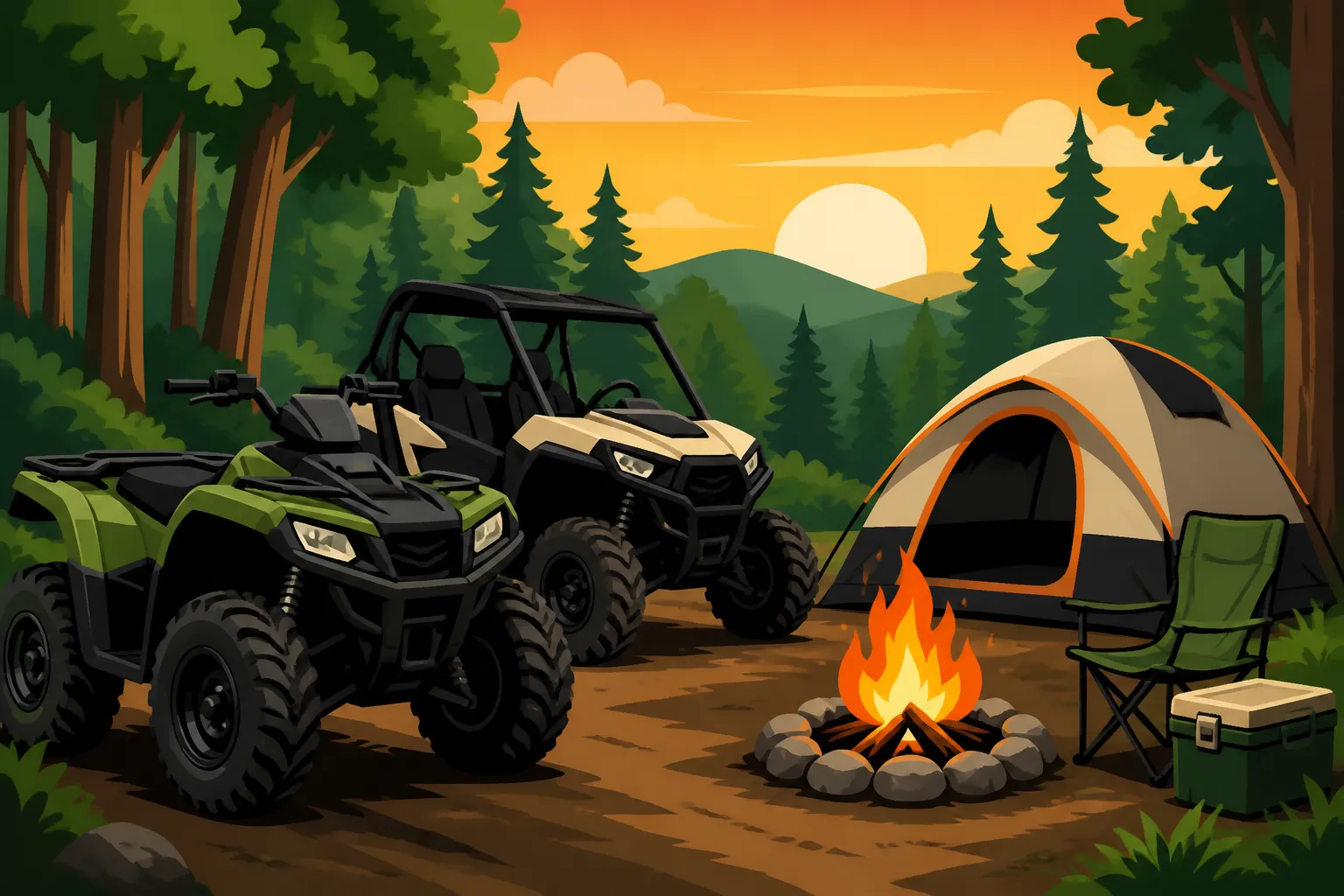
Camping near an Ohio ATV or UTV trail can make a weekend ride easier, but a trailhead is not automatically a campsite. State forests, nearby campgrounds, and the Wayne National Forest each have different boundaries and rules. This guide explains how to choose a legal place to stay, plan your ride and campsite together, and avoid arriving with a trailer only to find camping or riding is not allowed.
First, confirm what “camping at a state forest site” means
A trailhead is not necessarily a campsite
It is tempting to treat a forest parking area as a convenient overnight base, especially when you have driven a few hours to ride. But a place where trailers can be unloaded is not automatically approved for camping. Parking, overnight parking, and camping are separate permissions, and a gate or lot that is open during riding hours may not allow you to leave a vehicle there overnight.
Before you plan to sleep at a state forest site, identify the specific property and ask the land manager what camping is permitted there. Find out whether camping is restricted to designated sites, whether advance permission or a permit is needed, and whether vehicles and trailers may be parked overnight. Do not assume that a tent beside the truck, a camper in a trailhead lot, or sleeping in a vehicle is allowed just because the area is public land.
This distinction matters in Ohio because people may use “state forest camping” to mean several different things: a primitive campsite within a state forest, a developed campground near a forest, or a private campground used as a base for trail riding. Those options can have different facilities, access rules, and distances from the trail system. The useful question is not simply, “Can I camp near this forest?” It is, “Is this exact site open for my kind of camping, and can I legally reach my riding area from there?”
For a broader look at choosing a base that works for your itinerary, see Camping Near Ohio OHV Trails. If a listing or map shows a campsite close to a trail, treat that as a lead to investigate—not confirmation that the campsite is on the forest, permits ATV or UTV access, or allows overnight trailer parking.
State forest camping and nearby campgrounds are different options
A primitive site may appeal if you want a quieter, simpler stay. It may also mean limited or no services, such as potable water, electrical hookups, showers, waste disposal, or a staffed check-in area. Bring only what the site rules allow, and be prepared to manage food, rubbish, water, and sanitation responsibly. Never assume that a site has a toilet or a safe place to dump wastewater.
A developed campground nearby may offer more amenities and clearer reservation procedures, but it may not sit on the trail system. You might have to trailer your machine to an authorized staging area each day. Confirm the campground’s rules about ATVs and UTVs: some allow trailers but not riding through the grounds, while others may have restrictions on machine noise, operating hours, or where equipment can be parked.
| Camping option | What it may suit | What to confirm before booking |
|---|---|---|
| Primitive site in or near a state forest | Riders who are comfortable with a basic, low-service stay | Whether camping is allowed at that exact site, whether permission is needed, and what facilities are available |
| Developed campground near a trail system | Families or groups who want amenities and a designated place to stay | Whether ATVs or UTVs may be parked there, how to reach the trail legally, and whether the campground accepts trailers |
| Private riding park campground | Riders who want camping and riding access associated with one property | Which areas are open to your machine, what the park’s rules require, and whether reservations are needed |
| Public trailhead or staging lot | Day riding and unloading where permitted | Whether overnight parking or camping is expressly allowed; never infer permission from a daytime parking area |
Ohio has multiple riding areas and land managers, so make your camping decision based on the property—not just the nearest town or forest name. The state’s riding areas are not one continuous network with identical rules. Ohio’s Four State Forest APV Areas is a useful starting point for understanding which state forests have designated APV riding areas, but you still need to check the details for the particular forest and the camping location you plan to use.
Keep state forests and the Wayne National Forest straight
The Wayne National Forest is federal land, not an Ohio state forest. That difference can affect where you may ride, what access requirements apply, and which office or ranger district to contact. A campground that serves riders visiting the Wayne National Forest may be a practical choice, but its rules do not automatically apply to Ohio’s state forest riding areas—or the other way around.
If your weekend includes riding in more than one jurisdiction, write down the land manager for each place you intend to visit. Check the camping rules with the manager responsible for the campsite and the riding rules with the manager responsible for the trail. A single campsite can be close to two separate public-land areas, each with its own map, permitted routes, hours, and closures.
This is also where planning apps can be useful—but only as planning aids. For example, onX Offroad may help you organize a route and see how a campsite appears in relation to roads and trails. Use official land-manager information to confirm boundaries, closures, and legal access. A line on a map is not proof that an ATV route is open, and a pin marked as a campground is not proof that overnight camping is allowed there.
Choose a campsite that fits the ride
Match the campsite to the actual trail system
Start with the riding area, then look outward for camping. Find the approved staging point, identify the routes you are permitted to ride, and determine how you will get from the campsite to the trail. If the site is not directly connected to an authorized route, plan to trailer your machine rather than riding along a road, forest lane, or utility corridor without confirming that riding is allowed there.
This step can prevent a frustrating first morning. Imagine arriving at dusk with a loaded trailer, discovering that the campsite is several miles from the trailhead, and then learning the connecting road is not open to APVs. You may still be able to unload at the proper staging area the next day, but you will have lost time and may have to rearrange the whole group’s plans. Check your campsite, staging location, and legal route as separate points before leaving home.
When comparing sites, consider the practical details that affect a group ride: the space needed to park a tow vehicle and trailer, whether the access road can handle your setup, where machines may be stored overnight, and whether the campsite has a firm surface after rain. A compact car campground may be uncomfortable for a group traveling with multiple trucks and trailers, even if the campground is close to the forest.
Use onX Offroad or another mapping tool to sketch out your plan, mark the campground and staging area, and save useful locations before you lose cell service. Then compare those plans with official maps and instructions. For a more detailed planning approach, see Ohio Trail Maps From ODNR and Ohio Trail Conditions Before You Ride.
Check the machine and the trail before committing
A campsite can be perfect and still be a poor match for your machine. State forest riding areas may have machine-width restrictions, and a side-by-side that is comfortable on a private park’s wide routes may not be eligible for a narrower forest trail. Measure the machine as it is configured for the ride, including accessories that affect its width, rather than relying only on a sales brochure or model name.
Confirm the rules for the specific forest and route before you book nonrefundable camping or load the trailer. A group with several machines should check every vehicle, not just the smallest one. If one side-by-side exceeds the allowed width, that could mean splitting the group, selecting another riding area, or choosing a private park instead. The guide to Ohio’s 62-Inch State Forest Width Limit can help you understand why width matters, but verify the requirement for the destination you plan to ride.
Also check that each machine has the required registration or other accepted documentation for the type of land you will use. Out-of-state riders should not assume their home-state paperwork is accepted everywhere in Ohio. See Ohio APV Reciprocity With Other States for the broader issue, and confirm what applies to your machine and destination before traveling.
onX Offroad can help you keep a machine checklist alongside your route plan—for example, noting which machines need a width check or whose registration needs confirming. It cannot make an otherwise restricted machine eligible for a trail. Treat it as a reminder tool, not as a substitute for the rules from the land manager.
Plan for hours, closures, and changing conditions
A campsite may remain accessible when riding trails are closed, or a trail may be open while a nearby campground has its own seasonal schedule. Check both calendars. Look for the riding hours, seasonal opening and closing dates, temporary closures, and any restrictions linked to weather, maintenance, or land management.
Weather can change the experience quickly. After heavy rain, clay can become slick, low spots may hold water, and a trail that looked manageable on a map may be tiring or unsafe for a newer rider. A dry forecast does not guarantee dry ground in shaded or low-lying sections. If trail conditions are poor, consider a shorter ride, a different route, or a non-riding day rather than trying to force the original itinerary.
Save the contact details for the campground and the relevant forest or ranger office. A quick call before departure can answer questions that a general map cannot, such as whether a specific road is closed or whether a site is available for your type of camping. If you use onX Offroad to store your route, also save official contact information and offline maps where available. Cell service can be limited in wooded or hilly areas, so do not make a live connection your only way to navigate or check your plan.
Prepare for a simple, low-impact overnight stay
Pack for the campsite you actually have
Do not pack on the assumption that a primitive site will provide the supplies and services of a developed campground. Confirm water access, toilets, waste rules, fire restrictions, and any limits on generators or cooking equipment. If there is no potable water, bring enough for drinking, cooking, and basic cleanup, with a little extra in case the ride runs longer than expected.
Keep the riding gear separate from sleeping and cooking supplies. Muddy boots, wet gloves, and dusty helmets can take over a small tent or camper quickly. A lidded tote for trail gear, a separate bag for clean clothes, and a place to dry wet items can make a basic campsite much more comfortable. If you are traveling with children, agree on where they can play and where machines may be parked before anyone begins unloading.
Food storage deserves a little thought, too. Use sealed containers, keep rubbish contained, and follow the site’s instructions about wildlife and food scraps. Do not leave food, coolers, or rubbish scattered around the campsite overnight. If fires are allowed, use only the designated location and follow any posted restrictions. When fires are not allowed, choose a permitted cooking method rather than improvising.
Protect the site and respect other visitors
State forests are shared public spaces. Keep machines on authorized routes and use only approved parking or unloading areas. Avoid spinning tires at the campsite, riding around neighboring sites, or using a forest road as an informal shortcut. Those habits can disturb other visitors, damage soft ground, and create problems for future access.
Noise can carry much farther through a quiet forest than it does at home. Follow posted quiet hours, avoid revving engines near campsites, and plan your departure so that loading does not become an early-morning disturbance. If several vehicles are traveling together, agree on where they will park and unload before arriving. A little coordination is especially helpful when a lot is small or a site has limited maneuvering room.
Pack out what you bring in, including food wrappers, broken tie-downs, and small pieces of trail gear. Before leaving, check beneath the trailer and around the fire or cooking area. A short cleanup routine protects the site and makes it easier to notice anything you might otherwise leave behind.
Store and secure the machines thoughtfully
Ask where machines may be parked overnight and whether they must remain on a trailer or in a designated parking area. Do not block a gate, access road, turnaround, or neighboring campsite. If there is no secure storage, bring appropriate locks and keep keys, registration documents, and other valuables secured separately from the machine.
A machine parked near the campsite is not automatically authorized for use around the campground. Start and operate it only where allowed, and be especially considerate when loading in the morning or returning after a ride. A loose plan such as “we’ll just drive over to the trail” can lead to an unplanned road ride. Confirm whether a legal connection exists; otherwise, trailer from the campsite to the approved staging area.
For help planning where to unload and how to handle the trailer, see Parking a Trailer at a Forest Lot. The article [Ohio Rules for Riding State Forest Land] is also a useful companion when you are sorting out where riding is allowed once you leave camp.
Build a practical arrival and ride-day plan
Do the key checks before you tow
Make a short pre-trip checklist that separates campsite questions from riding questions:
- Confirm that the specific campsite is open and that your style of camping is allowed.
- Ask whether you need permission, a reservation, or a permit, and whether overnight vehicle or trailer parking is permitted.
- Confirm the campsite’s facilities, access road, check-in process, and any fire or quiet-hour restrictions.
- Verify which riding area you will use, where the approved staging point is, and whether your machines meet the applicable requirements.
- Check the official trail map, riding hours, seasonal dates, and current closures.
- Decide whether you will ride from camp only if there is a confirmed legal connection, or trailer to the staging area.
- Save directions and contact information in case cell service is weak.
This is a good time to call the campground or land manager with specific questions rather than asking only, “Can I camp there?” Explain whether you have a tent, camper, or truck setup; how many trailers you are bringing; and whether you intend to ride an ATV or UTV. Those details can reveal restrictions that a general answer might miss.
Keep a backup plan
A full campground, closed trail, or unsuitable road can derail a weekend if there is no alternative. Identify a second campground or a different riding destination before you leave. Make sure the backup actually fits your machines and group; a site that accepts tents may not have room for a long trailer, and a nearby trail system may have different rules.
If conditions turn poor after you arrive, reassess rather than treating the original plan as an obligation. You may be able to spend the day at a different permitted riding area, take a shorter loop, or postpone riding and enjoy the campsite. Flexibility is particularly useful when a group has mixed experience levels or different machines.
Finally, keep a distinction between what your map suggests and what the land manager permits. onX Offroad can be useful for organizing waypoints and understanding the surrounding area, but official directions, posted signs, and land-manager guidance take priority. Before unloading, check the trailhead information board and confirm that the route you intend to use is open.
Make the trip work for your whole group
A good camp-and-ride weekend is not just about being close to a trail. It is about making sure the campsite, machines, route, and group all fit together. A quieter primitive site may suit riders who are self-sufficient; a developed campground may be better for families who need showers or a reliable place to recharge. Neither choice is automatically better. The right choice is the one that matches the facilities you need and the rules you can follow.
For a mixed group, agree on a realistic riding schedule before arrival. Newer riders may want shorter loops and more breaks, while experienced riders may be tempted to stretch the day. Set a meeting point and a plan for returning to camp, especially if the group will divide into different routes. Carry what you need for the ride, and do not assume everyone will have phone reception.
Before you leave the site, check the ground for rubbish, secure loose equipment, and make sure the trailer is ready for the road. A few small preparations can prevent a campsite mix-up from becoming the defining memory of the weekend—and help keep Ohio’s forest riding areas enjoyable for the next group.
Disclaimer
This article is for general informational purposes only and does not constitute professional advice. Laws, prices and regulations vary by location and change over time. Consult a qualified professional for guidance on your specific situation.