Overnight Parking at an Ohio Forest Lot
An overnight ride can turn stressful fast if you arrive at an Ohio forest lot after dark and discover the gate is locked, overnight parking is not allowed, or your trailer blocks access for other visitors. This guide explains how to check the rules, plan a legal place to leave your vehicle, and avoid confusing overnight parking with camping.
Check whether overnight parking is allowed
Read the rules for the specific lot
There is no safe assumption that every Ohio forest parking area allows vehicles to remain overnight. A trailhead may be open for day use but have different rules after hours. A lot may also close seasonally, have a gate schedule, or prohibit overnight parking even when trails nearby are open.
Start with the signs at the lot and the rules for the land manager. Ohio state forests and Wayne National Forest are managed separately, so information for one area may not apply to another. Even two trailheads in the same general riding region can have different parking arrangements. If a sign says “no overnight parking,” treat that as clear direction. If the sign is missing or unclear, ask the responsible office before leaving your truck or trailer there overnight.
It helps to separate three questions that are easy to blur together: Can you park overnight? Can you camp overnight? And can you ride the trail during the hours you plan to be there? A yes to one does not automatically mean yes to the others. For example, a campground may permit overnight stays while a nearby day-use trailhead does not allow vehicles to remain after its posted closing time.
Confirm the rule before you load
Check the official information for the particular forest or riding area, then contact the managing office if the overnight-parking rule is not stated clearly. Give the staff the name of the trailhead or lot, not just the forest name. If you are towing, describe the full setup: tow vehicle, trailer, and how many spaces you expect to use. A compact truck may fit easily where a long enclosed trailer creates a different problem.
A quick call can prevent a long, frustrating drive back to a locked or unsuitable lot. It is especially useful if you are arriving late, riding during a seasonal opening period, or planning to return to a different lot after a multi-day trip. For a Wayne National Forest ride, Calling a Ranger District Before You Load is a useful reminder to confirm details with the office responsible for the area.
Maps can help you identify trailheads, but a mapped parking symbol is not permission to stay overnight. onX Offroad can be useful for planning routes and identifying nearby access points, but check land-manager information and posted signs for the parking rule itself. A digital map may show where a lot is; it may not show a recent closure, a gate schedule, or a local restriction.
Check for changing access conditions
Forest access can change with the season, weather, maintenance, or management needs. A lot that was available on a previous trip may be closed or restricted when you return. Trail status and parking access are related, but they are not the same thing: a trail closure does not always mean a lot is closed, and an open trail does not guarantee that overnight parking is permitted.
Before leaving home, review Ohio Trail Closures to Check First and Ohio Trail Conditions Before You Ride. Look for notices about temporary closures, storm damage, construction, or seasonal restrictions. If heavy rain has affected an unpaved access road, a large truck and trailer may also have trouble getting in or turning around, even if the riding area remains open.
When you arrive, read all posted signs rather than relying on what another vehicle is doing. Someone else may have permission, may be camping at a designated site, or may simply be taking a risk. If there is a gate, do not assume it will remain open because it was open when you arrived. Confirm the posted hours and leave enough time to get out before access changes.
Plan your parking and overnight stay
Distinguish parking from camping
Leaving a vehicle and trailer in a lot overnight is not the same as camping there. Sleeping in a truck, setting up a tent beside a trailer, cooking at a trailhead, or using a parking area as a campsite may violate rules that allow parking but prohibit camping. Conversely, a designated campground may welcome overnight guests while requiring you to park in a marked area rather than beside your campsite.
If your plan includes a tent, camper, or overnight stay, look for an established campground or designated camping area and confirm its rules separately. Camping at a State Forest Site can help you think through the difference between a forest campsite and an ordinary trailhead lot. Check whether the campsite is close enough to your riding area and whether it accommodates your vehicle and trailer; a site that accepts a passenger vehicle may not have room for a long rig.
Avoid turning a trailhead into an improvised campsite. Do not block gates, access roads, loading areas, or spaces needed by other visitors. Keep cooking, waste, and equipment within the rules for the site. If your overnight arrangement is unclear, choose an established place that explicitly permits it rather than trying to interpret a parking lot as a campground.
Make room for the trailer and other visitors
A lot can look spacious when empty and become awkward when several riders arrive with trucks and trailers. Before you commit, consider how you will turn around, unload, secure your machines, and leave without blocking someone else. A trailer parked across multiple spaces may make the lot unusable for other visitors, and a vehicle left near an entrance can interfere with emergency or maintenance access.
Review Parking a Trailer at a Forest Lot before your trip. When you arrive, use marked spaces where available, keep the hitch and trailer within your parking area, and leave room around gates and access lanes. If the lot is small or already crowded, do not assume that parking on the shoulder or beside a closed gate is acceptable. Find a legal alternative instead.
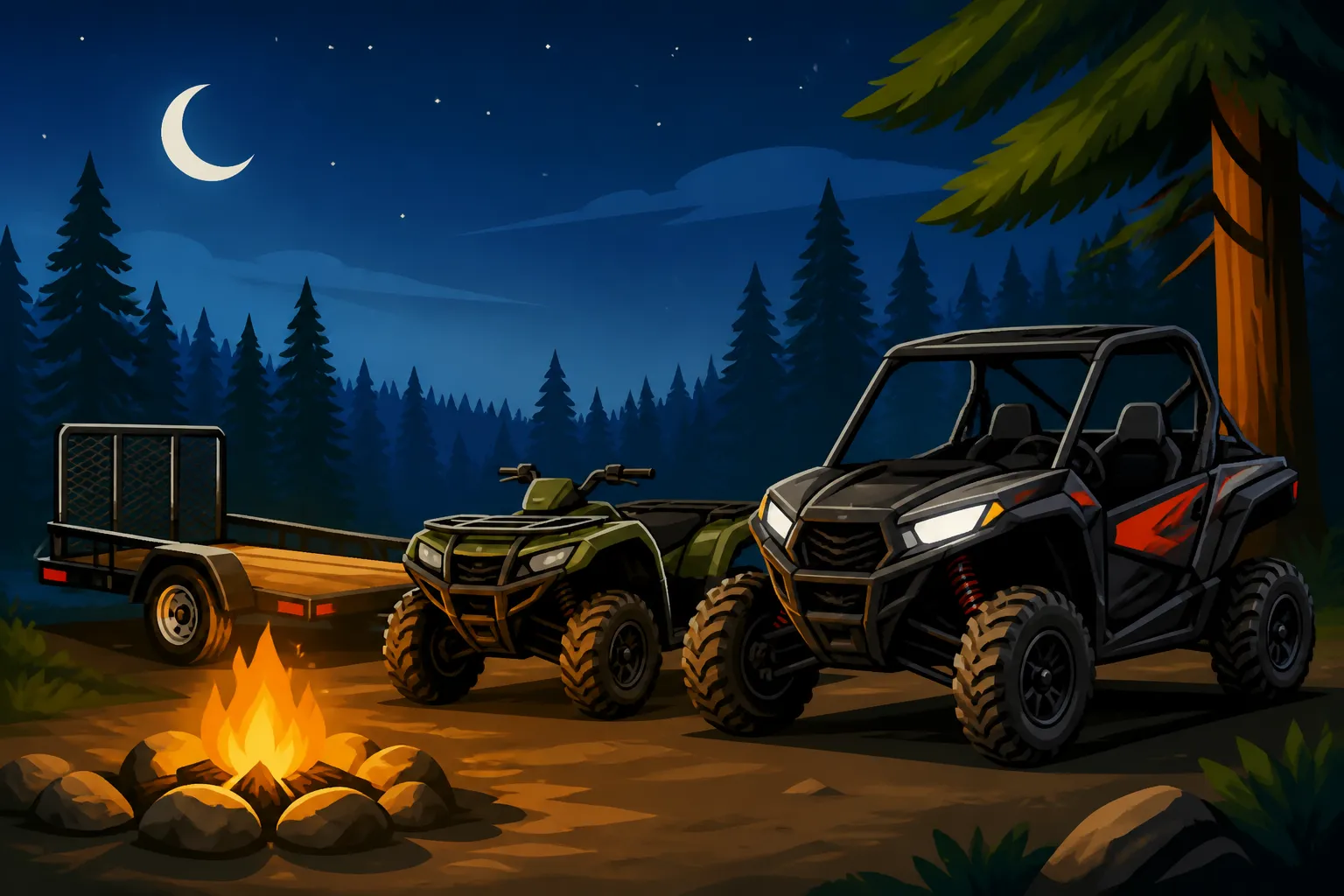
A practical example: you tow a side-by-side and two ATVs to a trailhead in a long enclosed trailer. The lot has a few short spaces and a narrow turning area. Even if overnight parking is allowed, your setup may not fit without obstructing traffic. Confirm the layout or ask the managing office whether a nearby permitted lot is more appropriate.
Choose an authorized backup
Have a second plan before you leave home. That might be a designated campground, a permitted private campground, or another parking area whose rules have been confirmed. Do not treat a business parking lot, roadside pull-off, or nearby trail access as a backup unless the owner or managing agency allows overnight vehicle storage.
A reliable backup matters most when you are arriving after a long drive or riding with family. If the first lot is full, closed, or unsuitable for your trailer, you can move directly to the alternative rather than scrambling to find a place in the dark. Save the address and directions offline, since cell coverage can be inconsistent in forested areas and hollows.
onX Offroad can help you organize waypoints for the primary trailhead and a planned alternative. Use it as a navigation aid, not as confirmation that overnight parking is allowed. Before you go, verify the second location’s rules just as carefully as the first.
| Question | What to verify | Why it matters |
|---|---|---|
| Is overnight parking allowed? | The posted rule or confirmation from the land manager | Day-use access does not automatically permit overnight parking |
| Can your trailer fit? | Lot layout, turning space, and marked parking areas | A long rig can block access even when parking is permitted |
| Is camping allowed? | Separate campground or campsite rules | Permission to park does not necessarily permit sleeping or camping |
| Are access hours changing? | Gate schedule, seasonal closures, and notices | You need to know when you can enter and leave |
| Is there a backup? | Another authorized lot or campground | A full or closed lot should not leave you stranded |
Prepare for a safe overnight trip
Keep your vehicle secure and accessible
Before leaving your tow vehicle, remove valuables from view, lock the cab, and secure loose riding gear. Use a hitch lock or other appropriate trailer security if you have one, while avoiding anything that blocks a gate or creates a hazard. Do not leave keys, registration papers, or important equipment exposed. Keep the vehicle’s paperwork accessible to you, but stored safely rather than displayed on the dashboard.
Think about how you will get back to the vehicle after the ride. Keep a phone, flashlight, and basic supplies with your riding group, and make sure everyone knows the return point. In a forest area, a small navigation mistake can turn a simple ride into a late return, especially when trails branch or cell service drops. Save useful information before you lose signal. onX Offroad may help with offline route planning where available, but check that your intended route is permitted and that your group understands how to use the map.
Leave the lot in the condition you found it. Pack out trash, secure fuel containers according to applicable rules, and avoid leaving parts, food, or equipment behind. A tidy departure helps preserve access for other riders and makes it less likely that a parking area becomes a source of complaints or restrictions.
Match your arrival and ride to posted hours
Overnight parking permission does not extend trail riding hours. Check the hours for the riding area and plan your launch and return accordingly. Ohio state forest riding hours and area-specific schedules may differ, so consult Ohio State Forest Riding Hours and [Ohio Rules for Riding a State Forest] for the rules that apply to your destination.
Plan to finish the ride early enough to secure your machines and return to the lot before any posted closing time. If you are riding with children, beginners, or a group that tends to stop often, build in extra time. A route that seems short on a map may take longer once you account for trail conditions, breaks, mud, mechanical issues, and slower riders.
Do not ride around a closed gate or continue onto a trail after its posted hours because your truck is parked nearby. If a late return seems possible, shorten the route or choose an authorized overnight arrangement that does not depend on staying beyond the lot’s permitted hours.
Use maps without treating them as permission
A paper or digital map can help with directions, route planning, and locating trail access, but it cannot replace current land-manager rules. Use Ohio Trail Maps From ODNR as a starting point for public information, then verify the particular trailhead and parking instructions. Check the trail system’s boundaries carefully so you do not mistake a nearby road, private parcel, or closed route for a legal connection.
onX Offroad can be helpful when organizing routes and marking a parking location, especially when riders are traveling in separate vehicles. Share the intended meeting point with the group and save key details before heading into an area with weak reception. Still, rely on posted signs and official guidance for closures, parking restrictions, and land access.
Also check whether the machines you plan to ride are permitted on the trails you intend to use. Parking access alone does not establish that the route is open to every vehicle type or width. For example, a side-by-side that fits in the lot may not fit within a particular trail system’s restrictions. Verify machine requirements and route limitations before unloading.
A practical checklist before you leave home
- Identify the exact forest, trailhead, and parking lot you plan to use.
- Confirm whether overnight parking is allowed at that specific lot.
- Ask separately whether camping or sleeping in a vehicle is allowed.
- Check access hours, gate information, seasonal closures, and current trail notices.
- Describe your truck and trailer when asking about parking capacity.
- Choose a verified backup location and save its directions.
- Save maps, addresses, and contact details for use if cell service is limited.
- Pack a flashlight, basic supplies, and the information your group needs to return safely.
- Read signs again when you arrive, even if you checked the rules in advance.
- Leave the lot clear, clean, and accessible when you depart.
The most common mistake is assuming that “forest access” means “overnight parking.” Treat each lot as its own location, confirm the rules with the responsible manager, and keep camping and trail hours as separate questions. A little checking before the drive is far easier than discovering at the trailhead that your planned overnight stay is not permitted.
Disclaimer
This article is for general informational purposes only and does not constitute professional advice. Laws, prices and regulations vary by location and change over time. Consult a qualified professional for guidance on your specific situation.