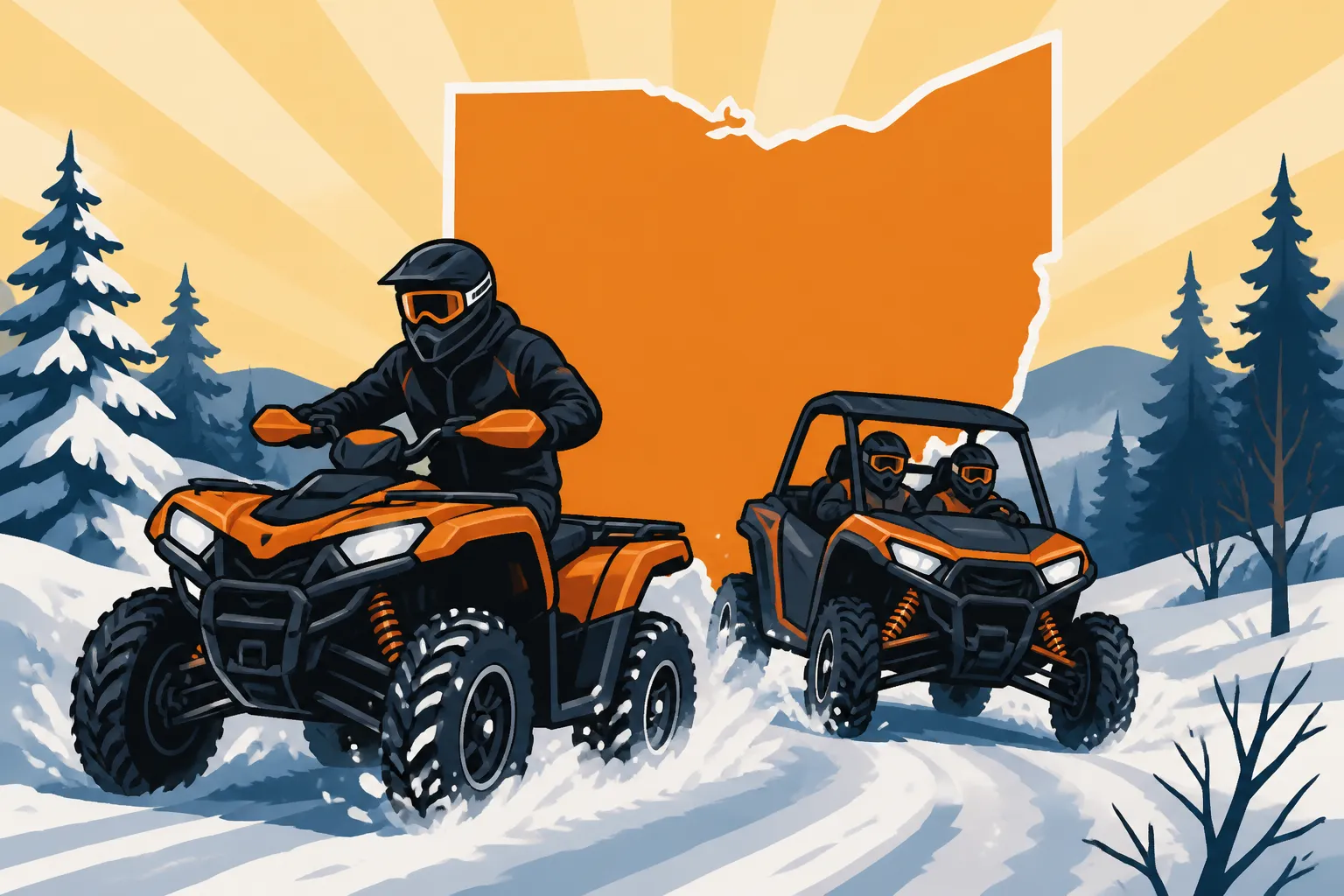
Ohio Trails Open in Winter
Winter riding in Ohio can be frustrating when a trailhead is closed, a route is muddy or icy, or a map makes a road look rideable when it isn’t. This guide explains where to look for winter ATV and UTV riding, how Maumee State Forest differs from seasonal areas, and what to check before loading up.
Where to ride an ATV in Ohio during winter
Ohio has far fewer winter riding options than summer ones. Many state forest trail systems have a defined riding season and close for part of the winter, while private parks set their own calendars. Maumee State Forest is the notable state forest option that is generally open for riding year-round, but “open year-round” is not a promise that every trail will be open on every winter day.
Before you choose a destination, separate three questions: Is the area normally open in winter? Is the trail currently open? Is your machine allowed on the route? A yes to the first does not automatically answer the other two.
Maumee State Forest is the main year-round option
Maumee State Forest, in northwest Ohio near Swanton, is known for its short off-highway vehicle trail system and year-round riding season. Its setting is different from the steep, winding trails in southern Ohio: expect a forest ride where winter weather can still change the experience quickly. Snow, standing water, frozen ground and thawing conditions all affect how a route feels under your tires.
Because the system is compact, it can work well for riders who want a winter outing without planning a long, full-day loop. That doesn’t mean you should arrive without checking. Temporary closures, maintenance, weather-related restrictions and trail conditions can affect access. Check the current information from the managing agency before you leave, and follow notices posted at the trailhead.
Also confirm that your machine fits the area’s rules. Ohio state forest trails have a width limit, and a side-by-side that is comfortable on a broad private trail may not qualify. Read [Ohio's 62-Inch State Forest Width Limit] and measure your machine as the rule requires rather than relying on a brochure’s model width.
Most other state forest systems are seasonal
Ohio’s better-known southern riding areas include Monday Creek, Hanging Rock and Pine Creek in the Wayne National Forest region, as well as other state forest systems. These routes are popular for their hills, woods and reclaimed mining terrain, but they should not be treated as dependable winter destinations. Many Ohio forest riding areas follow a seasonal schedule and close for a portion of the colder months.
A winter closure is not a suggestion to ride carefully. It means the route is not open for riding, even if the entrance looks accessible or a road appears passable. Riding a closed trail can damage soft ground, create ruts that remain after the thaw, and bring a citation. For background on the seasonal pattern, see [Why Three Forests Close and One Does Not] and [Ohio Trails Open in Winter].
Check the trail system’s own page or contact the managing office before driving several hours. A general map, an old social post, or a listing in a navigation app may not reflect a temporary closure. If you are considering a different season instead, [Ohio Trail Opening Day] and [Ohio Trail Closing Day] explain why dates and conditions matter when planning around the season.
Private parks may offer another winter option
Some private riding parks open in winter, but their schedules and conditions are park-specific. A property may close after heavy rain, open only on selected weekends, limit certain trails, or require advance arrangements. Others may not operate during the coldest months at all. Contact the park directly and ask about the exact date you plan to visit.
Private parks can be a practical alternative when state forest trails are closed because access rules are managed by the property rather than a statewide forest season. Still, ask whether your machine type is allowed, whether the entire trail network will be open, and what equipment or paperwork you need. A park’s general winter listing does not necessarily mean every route is suitable for a wide UTV or a beginner.
| Riding option | Winter availability | What to verify before you go |
|---|---|---|
| Maumee State Forest | Generally open year-round, subject to closures and conditions | Current trail status, machine-width rules, posted notices |
| Other Ohio state forest systems | Many are seasonal and may close for winter | The specific area’s season and any temporary closure |
| Wayne National Forest OHV systems | Do not assume winter access | Current operating schedule, route status and permit requirements |
| Private riding parks | Varies by property | Winter operating dates, trail access, reservations and machine rules |
For a wider comparison of riding options, see [Ohio Trails That Shut the Second Monday of December] and [Where to Ride When the Forests Close]. Treat any schedule you find as a starting point, then confirm it with the trail manager or park.
How to check whether a winter trail is actually open
The most discouraging winter riding mistake is arriving at a locked gate after a long drive. The second is finding a route that looks open but is closed, restricted or unsuitable for your machine. A few checks before departure can prevent both.
Confirm access with the land manager
Start with the official agency or property manager responsible for the riding area. Look for current notices about closures, maintenance, weather, access roads and operating hours. If the information is unclear, call the relevant office or park. Ask specifically whether the OHV trail is open on your planned date, not merely whether the forest or property is open to visitors.
That distinction matters. A forest can remain open for hiking, hunting or other recreation while its motorized routes are closed. Likewise, a private park may be open for a different activity but not for ATV or UTV riding. If you are heading to Wayne National Forest, review [Ohio's Four State Forest APV Areas] to understand the different trail systems and [How the Wayne National Forest OHV Permit Works] for access requirements.
Keep a backup plan. If the trail manager reports a closure, do not try to enter from another access point or follow an unmarked route around a barrier. Switch to a confirmed open destination or make it a non-riding day. A gate closure can reflect a safety issue, trail damage or a land-access restriction that is not obvious from the parking area.
Use maps as a planning aid, not permission
A digital map can help you find a trailhead, estimate driving time and see how roads connect. Apps such as onX Offroad can be useful for organizing a route and reviewing mapped access before a trip. But a line on a screen is not proof that a trail is open, legal for motorized use or passable in winter.
For a better plan, compare the route shown in your mapping app with information from the agency or property manager. Save the official trail map when available, identify the correct staging area and note any access-road restrictions. Be especially careful where public and private land meet. A route that appears continuous on a map may cross a boundary or enter a road that does not permit ATVs or UTVs.
onX Offroad can also help you keep track of where you intended to ride, but it cannot replace signs, closures or local rules. If an app and a posted notice conflict, follow the posted restriction and confirm the situation with the land manager. For additional planning guidance, [Ohio Trail Maps From ODNR] is a useful place to start with state-managed riding areas.
Check permits, plates and machine limits
Winter does not remove registration, permit or equipment requirements. Before you load, confirm that your machine’s plate and registration are current and that the riding area accepts your registration. Some areas have additional access rules, and national forest riding may involve a separate permit.
A plate is not a guarantee that every Ohio trail is open to your machine. Width limits, route designations and local restrictions still apply. Measure a side-by-side carefully if you plan to use state forest trails, and verify how the area defines machine width. A wide UTV may need a private park or another route that allows it. [Measuring Against the 62 Inch Limit] offers more detail on checking fit.
Preparing your ATV or UTV for cold-weather trails
Cold weather changes more than comfort. It affects traction, visibility, battery performance and how quickly a small problem becomes a difficult recovery. A winter ride deserves a little more planning than a warm-weather spin around a familiar loop.
Prepare for ice, mud and changing ground
Ohio winter conditions can swing between frozen ground, snow, rain and thawing mud. A trail that feels firm in the morning may soften as temperatures rise. In wooded areas, shaded sections can stay icy after exposed ground has begun to thaw. Slow down when the surface changes, leave room for the machine ahead and avoid abrupt steering or braking on slick ground.
Do not assume snow makes a trail safer or easier to read. It can cover ruts, rocks, branches and drainage channels. If you cannot see the route surface, reduce speed and avoid pushing into unfamiliar sections. Turning around is often the sensible choice when the trail becomes more slippery or damaged than expected.
Take a moment to inspect the machine before the ride. Check tires, brakes, lights, battery condition and fluid levels, and follow the manufacturer’s cold-weather recommendations. A machine that starts reliably in a warm garage may be slow to start after sitting outside in freezing temperatures. Carry gear suited to the forecast, including warm layers and dry gloves, and keep essential items protected from moisture.
Pack for a breakdown or delay
Short winter daylight and cold temperatures make a minor delay feel much longer. Bring a charged phone, a way to navigate if cell service is poor, basic tools and supplies appropriate to your machine. Tell someone where you plan to ride and when you expect to return. If your route changes, update them.
A tow strap, recovery equipment and a first-aid kit may be useful, but only bring equipment you know how to use safely. A winch or strap can create serious hazards if attached incorrectly or used without a clear plan. Avoid riding alone when conditions are uncertain, especially on unfamiliar routes or when snow and mud could make recovery difficult.
Navigation apps can help you keep your bearings, but don’t rely on cellular coverage being available. Save maps or route details before leaving home, and carry a backup way to identify your staging location. onX Offroad may help with offline route planning where its features and map coverage support your trip, but check the app settings in advance rather than waiting until you lose reception.
Respect winter closures and soft trails
Riding when a trail is closed or saturated can leave deep ruts and damage drainage. The result is not just a rough ride for the next visitor; it can contribute to longer repairs or closures. If the manager has closed an area, or if the trail is clearly too soft to ride without cutting it up, stay off it.
A practical rule is to avoid forcing a route. If you are spinning tires, sliding into the edge of a trail or leaving deep marks, stop and reassess. Do not widen the trail to get around a muddy section. Turn back if needed, and report concerning conditions to the appropriate manager rather than trying to fix them yourself.
Planning a safe winter riding day in Ohio
A good winter outing starts with modest expectations. The trail may be shorter than you hoped, the surface may require slower riding, or the weather may change enough to make an early return the best call. Building flexibility into the plan makes the day safer and less stressful.
Choose a route that matches your machine and experience
A short, familiar route is usually a better winter choice than an ambitious ride across several trail systems. Consider the width of your machine, the skill level of everyone in your group and how easily you could return to the staging area if conditions worsen. Beginners may be more comfortable at a managed private park that confirms its winter status and offers clearly marked trails.
For state forest access, verify the applicable machine-size rules before you travel. Some routes are not suitable for wider machines, and winter conditions can make narrow or uneven sections harder to negotiate. If your UTV exceeds the forest limit, do not assume you can simply stay on the broader-looking parts of the system. Choose an area where your machine is expressly permitted.
Make sure every rider understands the plan, including the turnaround point and what to do if someone gets separated. Keep the group together at intersections and wait for the last rider before continuing. In cold weather, frequent stops can make riders uncomfortable, so agree on a pace and check in with one another before anyone gets chilled or tired.
Recheck conditions on the day of the ride
Check the forecast and trail status again before leaving. A snowstorm, freezing rain, high wind or sudden thaw can change access and safety conditions. Review the route to the trailhead too: a remote forest road can be harder to drive with a trailer than the trail itself is to ride.
At the staging area, read the posted signs and confirm that they match your plan. Look for temporary notices, barriers and changes to the route. If you are unsure whether a sign applies to your machine or intended trail, ask the manager rather than guessing. Do not bypass a closed entrance because another vehicle has already gone through.
Finally, leave enough time to finish before dark and return safely. Ohio riding hours and local area rules can differ, so verify the applicable restrictions rather than planning around an assumption. A winter ride should end with enough daylight to load, secure the machine and drive home without rushing.
Keep a backup plan for a closed trail
If your preferred area is closed, having a second option saves the day. The backup could be a private park that has confirmed winter operations, a different legal riding area or a plan to reschedule. Check the backup’s access rules in advance; switching destinations at the last minute is not a reason to skip the permit, plate or width check.
It also helps to think through the drive home. Mud and slush can collect on the machine, while road salt can affect exposed metal and electrical components. After riding, clean the machine as appropriate, inspect it for damage and follow the manufacturer’s maintenance guidance. For more preparation ideas, see [Ohio Trails After Heavy Rain] and [Ohio Trail Conditions Before You Ride].
Winter riding in Ohio is possible, but the number of dependable options is limited. Check current access, respect seasonal closures, choose a route that fits your machine, and be ready to turn back when conditions call for it. That little bit of planning can prevent a wasted trip and help keep the trails in better shape for everyone.
Disclaimer
This article is for general informational purposes only and does not constitute professional advice. Laws, prices and regulations vary by location and change over time. Consult a qualified professional for guidance on your specific situation.