Accessible Restrooms at a Trailhead
A restroom can change the whole shape of an Ohio ATV or UTV day, especially when someone in your group needs step-free access, a wider stall, or reliable facilities nearby. Trailhead amenities vary, and a map pin rarely tells you whether a restroom is open or accessible. This guide explains how to check facilities before you leave, plan a practical backup, and avoid a stressful surprise at the staging area.
Why accessible restrooms need a little extra planning
A restroom nearby is not necessarily an accessible restroom
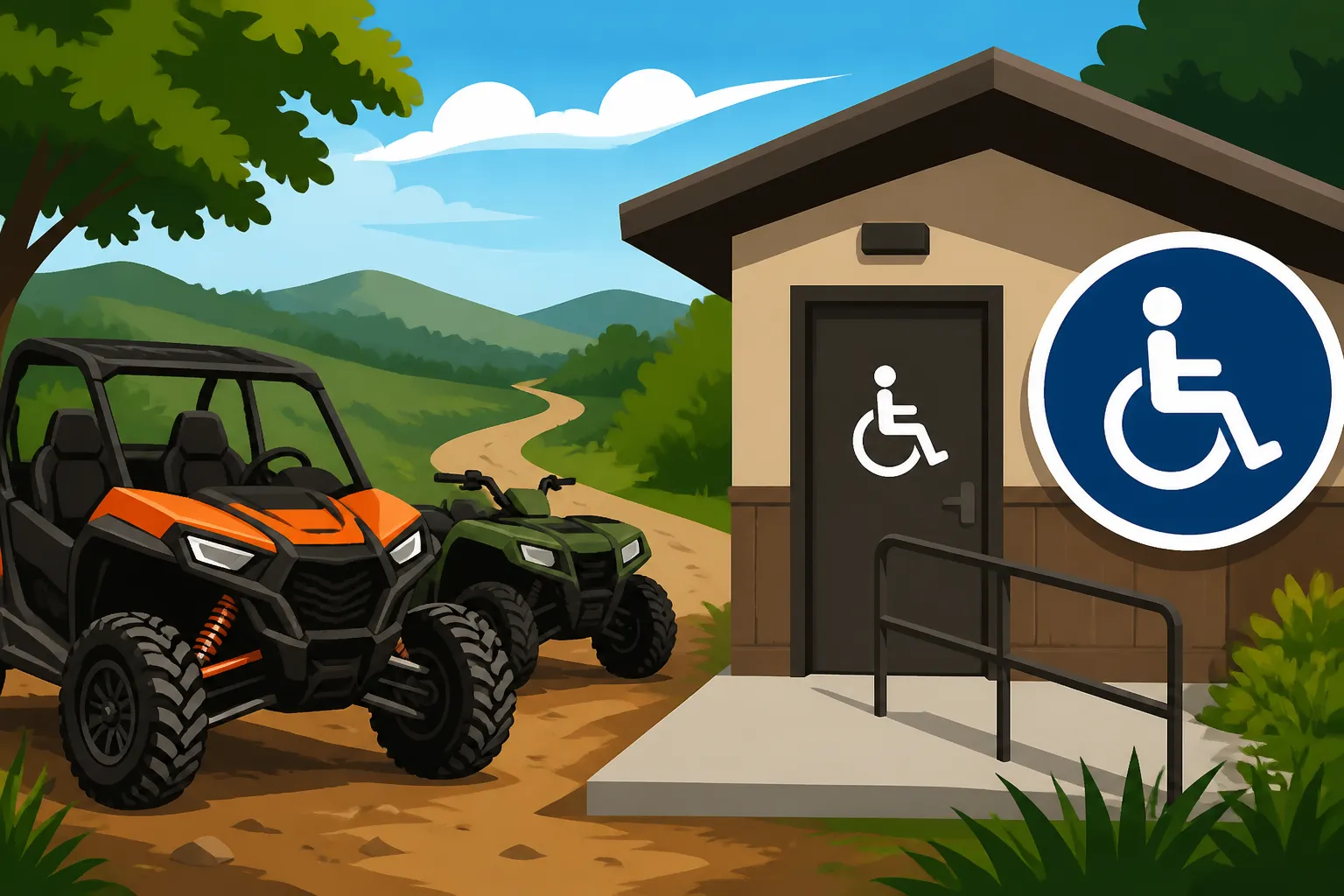
“Restroom available” can mean several different things at a trailhead. It might be a permanent building, a seasonal facility, a portable toilet, or a restroom elsewhere in a campground or recreation area. Those options can differ in opening hours, the route to the door, and how much space there is to maneuver inside.
For riders with mobility needs, the details matter. A restroom may be close to the parking lot but reached by a steep, loose, or uneven path. A door may be difficult to manage independently, or the facility may be locked when the trail system is open. Even when a site is described as accessible, it’s useful to confirm what that means for the person who will use it.
This is especially important when you’re planning a ride in a less-developed area. Ohio’s state forest trail systems and Wayne National Forest riding areas are spread across rural communities, where services may be some distance from a trailhead. Start with the [Ohio's Four State Forest APV Areas] guide to understand which areas are relevant to your trip, then check the specific site rather than assuming every staging area has the same facilities.
Trailheads and nearby campgrounds may have different facilities
A restroom at a nearby campground or recreation site may be a useful backup, but it isn’t automatically part of the trailhead. It could be on the other side of a road, available only to registered campers, or closed during a season when the trails themselves are open. If someone in your group needs an accessible facility, ask whether visitors can use it and whether there is an accessible route from the parking area.
This distinction can matter around popular riding areas such as [Monday Creek Near Nelsonville], [Hanging Rock in Southern Ohio], and [Pine Creek and the Ironton District]. These names describe riding areas, not a guarantee that a particular restroom will be open or meet your needs. Confirm the exact access point and facilities you plan to use.
It also helps to think beyond the restroom itself. Is there a firm, reasonably level route from the vehicle to the entrance? Is the restroom close enough for someone to reach comfortably before or after a ride? Can the rider or companion get back to the vehicle without crossing a busy access lane or navigating deep gravel? These practical questions can matter just as much as the facility’s label.
How to check trailhead restroom access before you go
Verify the exact facility, not just the riding area
Begin with the official information for the land manager responsible for the trailhead. A regional trail page may describe a broad riding area without listing the amenities at each parking location. Look for details tied to the specific access point you intend to use, and check whether the information distinguishes permanent restrooms from portable toilets or campground facilities.
If the available information is unclear, call the relevant ranger district, forest office, or site contact. A short, specific question is more useful than asking only whether there are “restrooms.” For example: “Is the restroom at this trailhead open on the day we plan to ride, and is there a firm, accessible route from the parking area?” You can also ask whether the facility is locked, seasonal, or shared with a campground. The guide [Calling a Ranger District Before You Load] can help you plan what to confirm before setting out.
Mapping apps can help you orient yourself, but treat them as navigation aids rather than facility guarantees. You might use onX Offroad to locate a trailhead or understand how the access road fits into your route, then confirm restroom availability with the land manager. A map marker does not necessarily show whether a toilet is open, accessible, or close to the parking area.
Use a simple checklist when asking about accessibility
The word “accessible” can be interpreted differently by different people, so describe the needs that matter to your group. You do not need to share private medical details. Ask clear questions about the route, entrance, and facility so you can decide whether it will work for the person using it.
| What to confirm | Why it matters | Useful question |
|---|---|---|
| Whether the restroom is open | Facilities may be seasonal or locked | Will it be open on our planned ride date? |
| Type of facility | A portable toilet may not suit everyone | Is it a permanent restroom or a portable unit? |
| Route from parking | Gravel, mud, slopes, or uneven ground can be difficult | Is there a firm route from the parking area to the entrance? |
| Entrance and interior space | Doorways and room to maneuver vary | Is the facility designed for wheelchair access? |
| Access rules | A campground restroom may be restricted | Can day visitors use it? |
| Backup options | Plans can change if a facility is closed | Where is the nearest alternative restroom? |
If you use onX Offroad to plan the route, note the exact access point and the distance to any possible alternative. Then verify those alternatives separately. This keeps a map from becoming a substitute for information about the actual facility.
Plan the ride around real-world access needs
Choose a staging area that works for the whole group
The shortest route to a trail is not always the easiest starting point. A staging area with suitable parking, a manageable route to the restroom, and a convenient place to regroup may make the day more comfortable, even if it adds a little driving. If a rider needs to use a facility before gearing up or after returning, consider how far they would need to walk and whether they would have to cross active vehicle traffic.
When comparing trailheads, look at the whole arrival process. Is there room to unload without crowding others? Is the surface likely to be manageable for a mobility device or for someone who has difficulty walking on loose ground? Is there a safe spot to wait while another member of the group unloads the machines? Details like these can reduce pressure at the start and end of a ride.
The [Parking a Trailer at a Forest Lot] guide can help you think through how your vehicle and trailer fit into the staging plan. If your group includes younger riders or people who benefit from a slower pace, [Ohio Trails Good for Kids] may also help you consider whether the broader outing suits everyone. Facility needs and riding ability are separate questions, but both belong in the same day-of planning conversation.
Keep a backup plan close and practical
Even careful planning cannot guarantee a restroom will remain open. A facility may be closed for maintenance, inaccessible after heavy rain, or farther from the trailhead than expected. Before you leave home, identify a second option that is actually reachable from your route, such as a public facility in a nearby town or an eligible campground facility. Check access rules and operating details rather than relying on a map label alone.
Be realistic about what “nearby” means. A restroom several miles away may be a reasonable backup for one group and impractical for another. If someone needs frequent access, the backup should be close enough to use without abandoning the day’s plan or making a difficult trip back along an unfamiliar road. Share the backup location with the group so nobody has to search for it while already uncomfortable.
A second mapping check can help you understand the route between the staging area and the backup, but confirm the facility itself independently. onX Offroad may help with route context; the land manager or facility operator is the better place to confirm whether a restroom is open and suitable. The same principle applies when a restroom is shown near a trail or campground: proximity on a screen does not establish permission to enter or access.
A practical pre-ride routine for restroom access
Confirm details again before loading
A quick check shortly before the ride can prevent a long, frustrating detour. Revisit the official trail information, check for notices about closures or access changes, and call if the restroom is central to your plan. Conditions can shift, especially when facilities are seasonal or when weather affects an access route.
Review [Ohio Trail Maps From ODNR] and [Ohio Trail Conditions Before You Ride] as part of your broader trip preparation. These resources can help you orient yourself and check trail-related information, but use the appropriate land manager or site contact for restroom details. Keep the trailhead name, address or directions, and backup location written down or saved where you can reach them without a signal.
It can also help to agree on a simple group plan: where to meet after unloading, who will stay with the machines, and what to do if someone needs to return to the vehicle or use a different facility. That way, one person’s needs do not become a rushed decision in a crowded lot.
Make the day more comfortable without overcomplicating it
Pack with the actual outing in mind. Keep any personal supplies a group member relies on within easy reach, rather than buried under riding gear or secured in a trailer that is difficult to access. If someone uses a mobility aid, plan where it will be stored safely and how it can be retrieved without blocking other vehicles or the trailhead.
If you’re staying overnight, campground facilities may offer additional options, but check who can use them and how far they are from your campsite or riding access point. The guide [Camping Near Ohio OHV Trails] can help with accommodation planning. Don’t assume that a campground bathroom is available to day riders just because it appears close to the trail system.
Finally, allow extra time. Building a little flexibility into the schedule is kinder than trying to make every stop fit a tight riding window. A comfortable plan does not require a perfect trailhead; it requires knowing what is available, what is uncertain, and what your group will do if the first option does not work.
Disclaimer
This article is for general informational purposes only and does not constitute professional advice. Laws, prices and regulations vary by location and change over time. Consult a qualified professional for guidance on your specific situation.