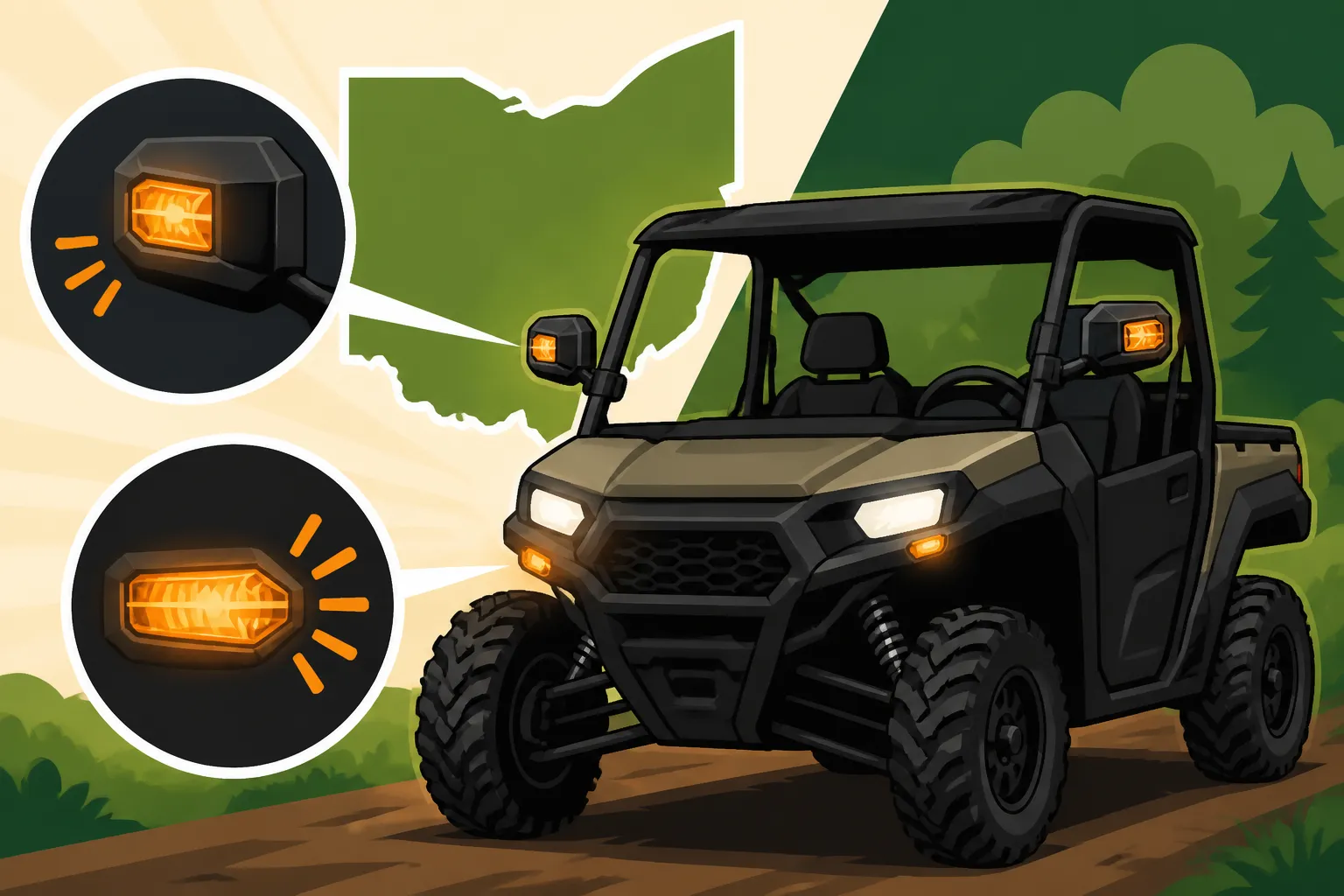
Turn Signals and Mirrors on an Ohio UTV
Riding your UTV on Ohio's roads can be an incredibly freeing experience, offering a whole new dimension to your off-road adventures. But the path from trail machine to road warrior often feels shrouded in mystery, especially when it comes to specific equipment like turn signals and mirrors. Many riders get frustrated trying to decipher the rules, worrying they'll spend money on parts only to fail an inspection. This guide is here to clear the air, breaking down exactly what Ohio law expects for turn signals and mirrors on your road-legal UTV.
The Road-Legal UTV in Ohio: A Different Animal
Let's face it, turning your UTV into something that can legally cruise down a county road isn't as simple as slapping on a license plate. Ohio has distinct requirements, and ignoring them can lead to a failed inspection, costly reworks, or worse, a citation from local law enforcement. It's about safety, of course, but also about integrating these powerful machines into the existing flow of traffic.
Why Ohio Demands Specific Equipment for Road Use
The moment your UTV leaves the dirt trail and ventures onto paved public roads, it steps into a different legal category. On private land or designated off-road trails, a UTV operates under one set of expectations. Once it's on a road, however, it must function like any other vehicle sharing that space. This means signaling intentions to other drivers, being aware of your surroundings, and ensuring you can see what's happening behind and to the sides of your machine. Ohio's legislature, and subsequently the Bureau of Motor Vehicles (BMV), has laid out these requirements to harmonize UTV use with traditional vehicle laws. They're not just trying to make things complicated; they're ensuring everyone's safety on shared roadways.
Imagine trying to merge onto a country road or make a turn at an intersection without turn signals. It would be chaos, and incredibly dangerous for you and anyone else on the road. Similarly, backing up or changing lanes without mirrors means operating blind in crucial moments. These aren't just suggestions; they are fundamental safety features for any vehicle operating in traffic, which is exactly what your UTV becomes when you take it on the asphalt.
The Core Distinction: APV vs. UTV on Pavement
One of the biggest points of confusion for Ohio riders is the difference between an All-Purpose Vehicle (APV) and a UTV, especially when it comes to road use. While the state broadly defines many off-road machines as APVs for registration purposes, the specific rules for road legality diverge significantly when we talk about UTVs. A standard ATV, or quad, typically isn't considered for road-legal status in the same way a UTV is, primarily due to inherent design differences. UTVs, with their side-by-side seating, steering wheel, and often more car-like controls, lend themselves much more readily to being adapted for road use.
The state’s criteria for a road-legal UTV are often much closer to those for a low-speed vehicle or even a car than they are to an off-road-only APV. This is why you'll find requirements like safety glass windshields, seatbelts, and, yes, the specific turn signals and mirrors we're discussing today. These items are generally not required for an APV used exclusively off-road, but they become absolutely non-negotiable for a UTV that you intend to ride on county or township roads. It’s a key distinction that impacts everything from the parts you buy to the inspection you’ll need to pass. For more detail, consider reviewing [Ohio UTV Road Equipment List].
Unpacking Ohio's Turn Signal Requirements for UTVs
When it comes to turn signals, Ohio isn't asking for anything outlandish, but it is asking for a complete and functional system that clearly communicates your intentions to other drivers. This isn't just about having lights; it's about having them in the right place, working correctly, and being visible from all necessary angles.
Essential Components of a Road-Legal Turn Signal System
To be considered road-legal in Ohio, your UTV must have a functioning turn signal system that meets specific criteria. This typically means four amber lights, one at each corner of the vehicle. These lights must flash in a coordinated manner when activated, indicating the direction you intend to turn or change lanes. It's not enough to have a single light on the front or back; the system needs to be comprehensive. The lights should be clearly visible from both the front and rear of the vehicle, even in bright daylight.
Beyond the lights themselves, a proper system includes a switch that controls their operation, usually mounted conveniently near the steering wheel. This switch allows you to easily select left or right turn. Many aftermarket kits, like those from SuperATV, will come with a self-canceling switch or at least an indicator light on the dash to remind you the signal is active. The system also requires a flasher relay that controls the blinking rate, ensuring it's within an acceptable range – not too fast, not too slow. All wiring must be properly installed, secure, and protected from the elements to ensure reliability.
Installation Tips and Common Pitfalls
Installing a turn signal kit on your UTV can range from a straightforward task to a bit of a challenge, depending on your mechanical skill and the complexity of the kit. The first tip is always to read the instructions thoroughly. Many kits are designed for universal fit, meaning some adaptation might be necessary for your specific UTV model. Plan out your wire routing before you start drilling holes or making connections. You want to avoid any areas where wires could be pinched, chafed, or exposed to excessive heat or water. Using weather-resistant connectors and proper electrical tape or shrink tubing will extend the life of your system significantly.
One common pitfall is not grounding the system properly, which can lead to intermittent operation or no function at all. Ensure all ground connections are clean, secure, and free from paint or rust. Another mistake is placing the lights in locations where they are easily obscured by cargo, a passenger, or even mud flung up from the tires. Remember, visibility is key for the inspection and for actual road safety. Test the system thoroughly before your inspection, checking all four lights, the dash indicator, and the flasher rate. It's better to discover a loose connection in your driveway than at the BMV inspection station.
Aftermarket Solutions and Compliance Checks
For most UTV owners, an aftermarket turn signal kit is the way to go. Very few UTVs come from the factory with a road-legal turn signal system, as they are primarily designed for off-road use. There are many reputable brands offering kits specifically designed for UTVs, often featuring all the components you need in one package. When choosing a kit, look for those that explicitly state they are designed to meet state-specific requirements for road use. Brands like SuperATV are well-known for offering comprehensive UTV accessories, including robust turn signal kits that are often compliant with road-legal standards.
Before purchasing, check customer reviews and installation videos for your specific UTV model if available. This can give you a good idea of the kit's quality and the installation process. Once installed, it's a good idea to perform your own "compliance check" before heading to the official inspection. Park your UTV in a well-lit area and have a friend walk around the machine as you operate the turn signals. Are they bright? Are they visible from the front, side, and rear? Do they flash consistently? Think about how they would appear to other drivers on the road. This self-assessment can help you catch any issues before the official inspection. Don't forget that a working horn is also typically required alongside turn signals; for a full rundown, see [Ohio UTV Equipment Rules Explained].
Mirrors: Seeing is Believing (and Legal) in Ohio
Mirrors are another non-negotiable item for road-legal UTVs in Ohio. They provide essential visibility, allowing you to monitor traffic behind and to the sides, which is crucial for safe operation on shared roadways. Just like turn signals, there are specific requirements to ensure they are effective and compliant.
The Mandatory Rearview Mirror
Ohio law specifically requires a rearview mirror for any UTV operated on public roads. This mirror must be positioned to give the driver a clear and unobstructed view of the road to the rear of the vehicle. For most UTVs, this means a centrally mounted mirror, often clamped to the roll cage or mounted directly to the windshield frame. The size and shape aren't always specified in minute detail, but the overarching principle is functionality: you must be able to see behind you.
When selecting a rearview mirror, consider one that offers a wide field of vision without distortion. Many UTV-specific rearview mirrors are designed to be durable and vibration-resistant, which is important for maintaining a clear image while driving. Some feature convex glass to provide a wider view, which can be very beneficial. Ensure that once installed, it doesn't obstruct your forward view in any way, nor should it become a hazard in the event of an accident. The mounting should be secure, allowing for adjustment but preventing excessive shaking or shifting during operation.
Side Mirrors: A Practical and Often Required Addition
While a single rearview mirror is technically the minimum requirement in some interpretations, having at least one exterior rearview mirror on the driver's side is often implicitly or explicitly required, and highly recommended, for UTVs on Ohio roads. Many vehicles require two outside mirrors if the inside mirror is obstructed. Given the nature of UTVs, an unobstructed view through a center mirror is not always guaranteed, especially with passengers or cargo. Therefore, adding side mirrors becomes a crucial safety feature and often a de facto requirement for passing a thorough inspection.
Side mirrors greatly enhance your situational awareness, particularly when changing lanes or preparing to turn. They eliminate blind spots that a single rearview mirror cannot cover, making your road experience much safer. Think about the scenario of pulling out from a stop sign or making a right turn; a passenger-side mirror gives you that extra layer of confidence. Brands like SuperATV offer a range of robust side mirrors, many designed with breakaway features to withstand trail abuse but still provide excellent road visibility. These are generally easy to install, clamping directly onto the roll cage.
Choosing the Right Mirrors for Your UTV
When choosing mirrors, durability is key. UTVs are subjected to vibrations, dust, and sometimes even impacts, so flimsy mirrors won't last long. Look for mirrors with shatter-resistant glass or high-impact plastic housings. Adjustable mounts are also very important, allowing you to customize the viewing angle for optimal rear visibility. Some mirrors are designed with a "breakaway" feature, meaning they can fold in if they hit a branch or other obstacle, protecting the mirror itself from damage. This can be a huge benefit if you plan to still hit the trails occasionally with your road-legal machine.
Consider the field of view offered by the mirrors. Convex mirrors provide a wider perspective, which is excellent for spotting vehicles in adjacent lanes, though they can make objects appear farther away than they actually are. Flat mirrors offer a more accurate representation of distance but with a narrower field of view. A combination of a wide-view center mirror and flat side mirrors can offer the best of both worlds. Make sure that your mirrors, once installed, are stable and don't vibrate excessively at speed, as this can make them almost useless. Before you head out, double-check that your mirrors are clean and properly adjusted for your seating position. For further insights into requirements, you can check out [Ohio Equipment Rules for a UTV on a Road].
Beyond Signals and Mirrors: Other Key UTV Road Equipment
While turn signals and mirrors are critical for road legality, they're part of a larger ecosystem of equipment that Ohio requires for UTVs on public roads. It's easy to get tunnel vision on just a couple of items, but a comprehensive understanding is what truly prepares you for the road and the inspection.
Lighting, Horn, and Safety Glass Windshield
A UTV on an Ohio road needs to be seen and heard, especially in varying light conditions. This means your machine must be equipped with working headlights, taillights, and brake lights. The headlights should provide adequate illumination for night driving, and taillights and brake lights must be clearly visible from the rear. Often, the factory lighting on a UTV is sufficient, but ensure all bulbs are working and lenses are clean. In addition to these, a loud and functional horn is required. This isn't just a courtesy; it's a vital safety tool for alerting other drivers or pedestrians to your presence.
Perhaps one of the most significant equipment requirements, often overlooked by those focusing on signals, is the windshield. If your UTV has a windshield, it must be made of safety glass. This is a critical distinction, as many aftermarket UTV windshields are made from polycarbonate or acrylic, which are durable but typically not considered "safety glass" by automotive standards. This requirement ensures that in the event of an impact, the windshield shatters safely or resists shattering, protecting the occupants. [Why a Road-Legal UTV Windshield Must Be Safety Glass] goes into more detail on this specific point, but it's crucial for your UTV to pass inspection.
Tires, Brakes, and Seatbelts
Ohio's requirements also extend to the foundational components of your UTV. Tires must be in good condition, with adequate tread depth, and suitable for highway use if you're frequently on paved surfaces. While specific DOT ratings aren't always explicitly mandated for UTVs in the same way they are for cars, tires should be free from excessive wear, cracks, or damage. Your braking system, including both service brakes and a parking brake, must be fully operational and effective. This means ensuring your brake pads are in good shape, fluid levels are correct, and there are no leaks in the system.
Furthermore, every occupant of a road-legal UTV must have access to and use a seatbelt. Most UTVs come standard with seatbelts, but you need to ensure they are fully functional, not frayed or damaged, and securely anchored. If you've modified your seating or added aftermarket seats, verify that the seatbelt system remains compliant and safe. These seemingly basic elements are just as vital as your turn signals and mirrors for safe and legal road operation.
The UTV Inspection Before Registration
Before your UTV can be legally registered for road use in Ohio, it must undergo a specific inspection. This isn't just a formality; it's a comprehensive check to ensure your machine meets all the necessary safety and equipment standards set forth by the state. This inspection is where everything we've talked about – your turn signals, mirrors, horn, lights, safety glass windshield, brakes, and seatbelts – will be scrutinized. Passing this inspection is the gatekeeper to getting your road-legal plate.
The inspection is typically performed by an authorized law enforcement officer or another designated official. They will go through a checklist, verifying each required component. It's not uncommon for UTVs to fail their first inspection due to a missed detail or a component that doesn't quite meet the standard. That's why being thoroughly prepared and understanding all the requirements, not just a select few, is paramount. For a full understanding of what to expect, refer to [Ohio UTV Inspection Before Registration].
Navigating the Inspection Process and Staying Compliant
Getting your UTV through the inspection and keeping it compliant afterward can feel like a maze, but with the right preparation and mindset, it's totally achievable. It's about more than just checking boxes; it's about ensuring your UTV is genuinely safe for road use.
What an Ohio Inspector Looks For
When you take your UTV for its road-legal inspection in Ohio, the inspector will be looking for a complete and functional safety package. They're not just glancing at components; they're verifying their operation and suitability. For turn signals, they'll check all four amber lights for visibility and proper flashing sequence, both front and rear. They'll activate the switch to ensure it works correctly and smoothly. If you've got a self-canceling switch, they might even test that functionality.
For mirrors, they'll check that you have a functioning rearview mirror that provides an adequate view to the rear. If you have side mirrors, which are highly recommended, they'll ensure they are properly mounted and provide clear visibility to the sides. The inspector will also verify your headlights, taillights, and brake lights are all working. They'll listen for the horn, inspect your tires for wear, and ensure your brakes are strong. Crucially, they'll look at your windshield to confirm it's safety glass and check that all seatbelts are present and functional for every seating position. Don't be surprised if they ask you to demonstrate the functionality of each item. A detailed guide like [The Ohio Inspection a UTV Must Pass] can further outline these points.
Maintaining Your Road-Legal Status
Passing the inspection is a huge step, but maintaining your road-legal status is an ongoing responsibility. Just like any other vehicle, your UTV will experience wear and tear. Regularly check your turn signal bulbs to ensure they haven't burned out. Inspect your mirror mounts to confirm they haven't loosened, causing excessive vibration or even falling off. Keep your lights and lenses clean; mud and grime can significantly reduce their visibility.
It's also important to periodically test your horn, brakes, and seatbelts. Pay attention to your tires, especially if you're alternating between road and trail use, as different terrains can affect tire wear patterns. Any modifications you make to your UTV after the inspection should be considered carefully to ensure they don't jeopardize your compliance. If you replace parts, ensure the replacements meet the same standards as the original components that passed inspection. Staying diligent with maintenance will not only keep you legal but, more importantly, keep you safe.
The Importance of Local Ordinances
While Ohio state law provides the foundational requirements for making your UTV road-legal, local ordinances play a significant role in where and how you can actually ride. A UTV might be "road-legal" according to state inspection standards, but that doesn't automatically mean you can drive it on every road in Ohio. The decision to open roads to UTVs typically falls to county commissioners or township trustees. This means that a road-legal UTV might be welcome on secondary roads in one county, but strictly prohibited just across the county line.
Before you plan a route, it's absolutely essential to check the specific resolutions or ordinances for the counties and townships you intend to ride through. These local rules can dictate speed limits for UTVs, specific roads that are open or closed, and sometimes even additional equipment requirements beyond state minimums. You might find that [A County Commissioners' Resolution in Ohio] has opened certain roads, while a neighboring township might have different rules. Always call the county engineer's office or township clerk's office if you're unsure. Ignoring local ordinances can lead to citations, even if your UTV is perfectly compliant with state-level equipment standards.
| Equipment Category | Ohio UTV Road Requirement | Additional Considerations / Recommendations |
|---|---|---|
| Turn Signals | Amber, front and rear, clearly visible, working flasher. | Aftermarket kit for all four corners. Consider self-canceling switch. |
| Mirrors | At least one rearview mirror for clear rear visibility. | Strongly recommend two side mirrors (driver's and passenger's side) for safety and wider field of view. |
| Windshield | If equipped, must be safety glass. | Polycarbonate/acrylic often not compliant. Ensure clear, unobstructed view. |
| Headlights/Taillights | Fully functional, clearly visible, appropriate brightness. | Check factory lights; upgrade if insufficient for night road use. |
| Brake Lights | Fully functional, clearly visible from rear. | Ensure all brake lights activate with pedal. |
| Horn | Audible from 200 feet. | Easy to reach, loud enough to alert others. |
| Tires | Good condition, adequate tread, free from damage. | Consider DOT-rated tires if primarily road driving, but not strictly mandated. |
| Brakes | Fully operational service and parking brake. | Regular maintenance of pads, rotors, and fluid. |
| Seatbelts | Functional for every occupant. | Inspect for fraying, damage, and secure anchorage. |
| License Plate | Ohio-issued APV plate, clearly visible. | Correctly mounted, not obstructed. |
Disclaimer
This article is for general informational purposes only and does not constitute professional advice. Laws, prices and regulations vary by location and change over time. Consult a qualified professional for guidance on your specific situation.