Why Most County Parks Ban ATVs Outright
A valid Ohio APV registration or out-of-state permit does not automatically give you permission to ride in a county park. Many county parks prohibit ATVs and UTVs, even where other trails or roads are open to motorized use. Here’s why the restrictions are common, what they cover, and how to check before unloading.
What a county park ban usually means
A county park is managed under its own rules. The fact that it belongs to a county does not make it available for ATV or UTV riding, and a registration plate does not override a park’s access restrictions. A park can prohibit motorized off-road vehicles throughout its property, allow them only for maintenance or emergency work, or permit limited use on specific routes. The exact rule depends on the property and its manager.
“Banned outright” can mean more than “stay off the hiking trail.” A restriction may cover riding, driving, or operating an ATV or UTV anywhere in the park, including grass, wooded areas, and paths that look wide enough for a machine. It may also prohibit using a park road to reach a trail, or parking a trailer in a lot for the purpose of riding somewhere else.
Do not assume that a route is open because it is gravel, unmarked, or used by vehicles. It could be a maintenance road, an access lane, or a path meant for park staff. Nor does a park’s lack of a prominent sign necessarily mean ATVs are allowed. Rules may be posted at an entrance, on a park map, in a use policy, or in an ordinance or resolution.
It helps to separate four questions that riders sometimes treat as one:
- Is the machine properly registered? Ohio’s APV registration rules address the machine’s state registration and plate.
- Does a visitor need a separate permit? A visitor may need to meet Ohio’s requirements even if the machine is registered elsewhere.
- Does this specific property allow riding? The land manager decides which vehicles and activities are allowed on its property.
- Is the particular route open? A permission to enter a property does not necessarily authorize riding every route on it.
For more on the park-specific question, see Ohio Rules for Riding a County Park. For the difference between registration and trail access, Ohio APV Permits Explained can help clarify what an Ohio plate does—and does not—authorize.
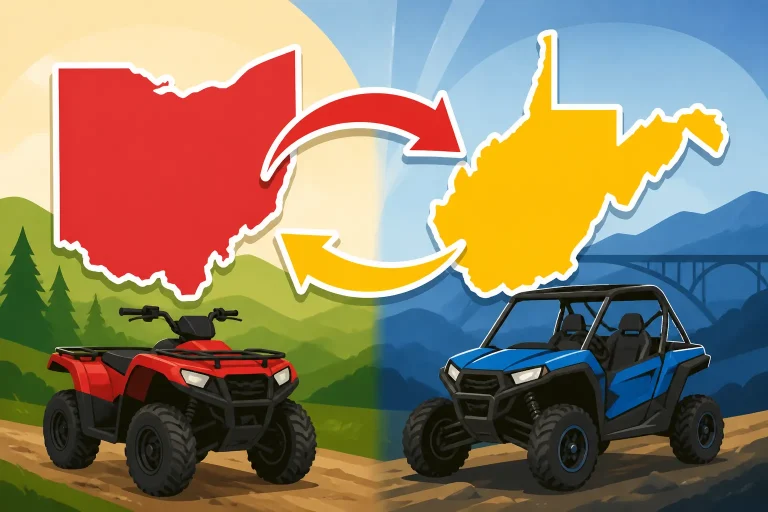
The distinction matters for both residents and visitors. Reciprocity may help a rider meet Ohio’s registration requirements, but it does not require a county park to open its land. A machine that is fully legal to ride on one approved trail may still be prohibited inside a nearby park.
Why county parks restrict ATVs and UTVs
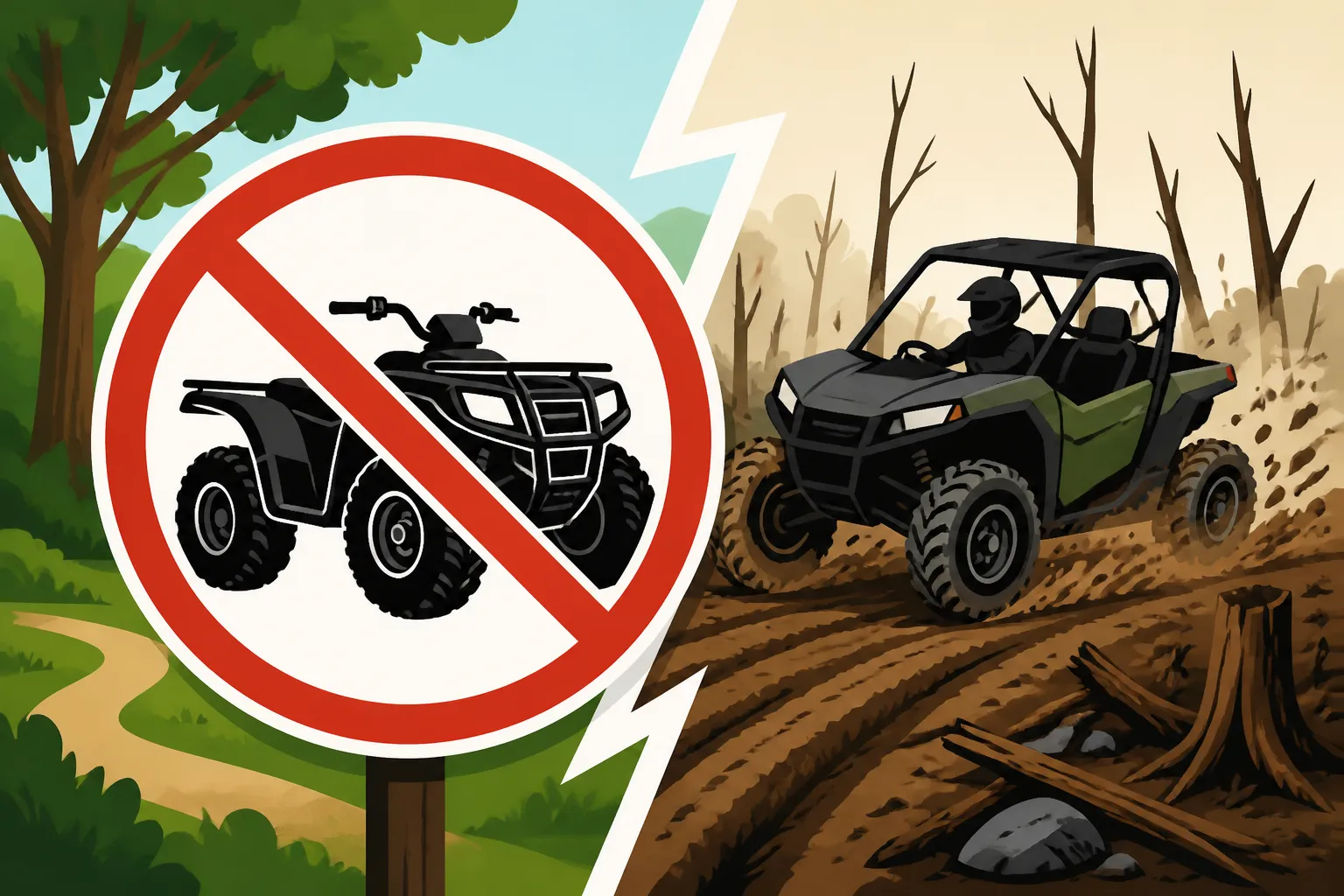
County parks are generally expected to serve a mix of outdoor uses: walking, nature observation, picnicking, and other low-speed activities. An ATV or UTV can create conflicts on narrow, shared-use paths, especially where people cannot see or hear an approaching machine in time to move safely. Even a responsible rider may encounter walkers, cyclists, children, or dogs around a blind bend.
The physical effect of motorized riding is another concern. A trail built for foot traffic may not have a durable surface, drainage, or width to handle the weight and repeated passage of off-road vehicles. Tires can loosen soil, widen a path, damage vegetation, and carry sediment toward a stream or wet area. A route that looks firm during a dry visit may become vulnerable after rain or during seasonal thaw.
Noise can also disrupt the experience a park is intended to provide. Sound travels beyond the route itself, affecting picnic areas, wildlife viewing, and neighboring homes. Restrictions help managers set consistent expectations instead of asking visitors to judge for themselves whether a particular machine, speed, or trail condition is acceptable.
Safety and liability are part of the decision as well. Parks may have limited sightlines, mixed traffic, steep banks, water, or trails that were not designed for vehicle speeds. Allowing machines can require additional signs, enforcement, trail maintenance, and decisions about which vehicles and riders qualify. A blanket prohibition may be simpler to communicate and enforce than a complicated network of exceptions.
Finally, a county park’s purpose and land history may limit what its manager can allow. A property acquired for conservation, habitat protection, or quiet recreation may have rules that do not match a nearby motorized trail system. Some land may be subject to agreements or management plans that restrict vehicle use. Those details are property-specific, so the explanation for a ban at one park may not apply to another.
These are reasons a ban may exist, not proof that every county park has the same policy. Nor should a rider treat a lack of damage or a quiet riding style as permission. The rule comes from the land manager, not from a rider’s judgment that a particular trip is harmless.
| Place or permission | What it may authorize | What it does not automatically authorize |
|---|---|---|
| Ohio APV registration | Operating a properly registered machine where riding is otherwise allowed | Entering a park that prohibits ATVs or UTVs |
| Out-of-state registration or permit | Meeting applicable visitor registration requirements | Access to every Ohio public property |
| County park access | Entering the property under its posted rules | Riding a vehicle on every path or road |
| State forest trail access | Riding on designated routes when the applicable rules are met | Riding in a county park or on a closed route |
| Landowner permission | Use allowed by the owner or manager’s terms | Ignoring other laws, restrictions, or safety conditions |
How to check a park’s rules before you go
A map can show where a park is, but it may not settle whether a machine is allowed. Check the rules for the specific park and, if possible, the specific trail or access road. If the wording is unclear, ask the agency or park office rather than relying on assumptions or an old post in a riding group.
Use this process before loading your machine:
- Identify who manages the property. A county park, state forest, wildlife area, municipal park, and private riding area can all have different rules. A property’s name alone may not make the managing agency obvious.
- Find the current rules for that exact site. Look for the park’s official use policy, posted vehicle restrictions, trail map, or signs at the entrance. Check for specific wording about ATVs, UTVs, off-highway vehicles, or motorized vehicles.
- Ask about the route and the activity. If the policy is ambiguous, ask whether riding is allowed, whether a particular route is open, and whether parking or unloading a trailer for that purpose is permitted. Ask about temporary closures too.
- Confirm permit and registration requirements separately. If the property allows riding, check what documentation, equipment, or other conditions apply. Do not treat a park’s permission as a substitute for state registration requirements.
- Recheck close to the trip. A route can close because of weather, maintenance, habitat protection, or a local decision. A map or report from a prior season may not reflect current conditions.
Do not rely only on a general county website that lists recreational activities across the park system. A county may have some properties with vehicle access and others where motorized use is forbidden. Similarly, a trail shown on a map might be a walking, cycling, or equestrian route rather than an ATV trail.
If you need clarification, describe the machine and intended use plainly. Say whether it is an ATV or UTV, whether you plan to ride on a designated route or simply use a park road, and whether you are asking about unloading or parking as well. That can prevent confusion between permission to enter with a vehicle and permission to operate it.
For adjacent public-land options, start with Ohio Rules for Riding State Forest Land and Do You Need a Permit for Ohio State Forest Trails?. State forest access is governed by its own rules; it should not be read as an exception to a county park’s ban. Ohio’s Four State Forest APV Areas can help you consider a designated riding location instead.
Where to ride instead—and how to avoid a costly mistake
If a county park does not allow ATVs, use a property that expressly authorizes motorized riding. Ohio has designated state forest APV areas, private riding parks, and other locations that may offer legal access under their own conditions. Those places are not interchangeable: each may limit machine width, operating hours, rider age, route choice, or required permits. Verify the rules for the destination before setting out.
A private property is not automatically open just because it is not a public park. Get clear permission from the landowner or manager, and stay within the boundaries and conditions they set. See Ohio Landowner Permission Requirements for more on that distinction. Likewise, a reclaimed mine or old haul road is not public riding land just because it looks like an established route; access and riding must be authorized. Ohio Rules for Riding a Reclaimed Mine explains why those areas need a separate check.
The safest practical rule is to treat a county park as closed to ATVs unless its official rules clearly say otherwise. When riding is allowed only on named routes, stay on those routes. Do not use a hiking path, maintenance road, or grassy shoulder as a shortcut to connect to a legal trail. A permitted route can still be closed temporarily, and a gate or closure notice should be taken seriously.
Before departing, make sure you can identify the destination, its manager, and the source of the permission you are relying on. Save the current map or rules for reference, but follow signs and closure notices on site if they differ. If you cannot confirm that riding is allowed, choose a location that clearly welcomes motorized vehicles rather than testing the boundary in a park.
That approach protects the park and other visitors, and it helps prevent a trip from turning into a citation, a forced turnaround, or a conflict with a land manager. Registration and reciprocity answer important legal questions, but neither is a substitute for permission to ride on the specific land beneath your tires.
Disclaimer
This article is for general informational purposes only and does not constitute professional advice. Laws, prices and regulations vary by location and change over time. Consult a qualified professional for guidance on your specific situation.