Where to Ride When the Forests Close
When Ohio’s state forest trails close for winter, it can feel as if your riding season has been cut off overnight. The good news is that a seasonal closure does not mean every legal place to ride shuts down. This guide explains how to check for open trails, find private riding areas, and plan a winter outing without mistaking a map route for permission to ride.
First, check what is actually closed
A state forest closure is not a statewide riding ban
Ohio’s state forest riding season is seasonal at most designated areas. The main riding season generally runs from the first Friday in April until the second Monday in December, but a closure schedule is only one part of the picture. Individual trails can close for weather, maintenance, land-management work, or other conditions, so it is worth checking the specific area before you load your ATV or UTV.
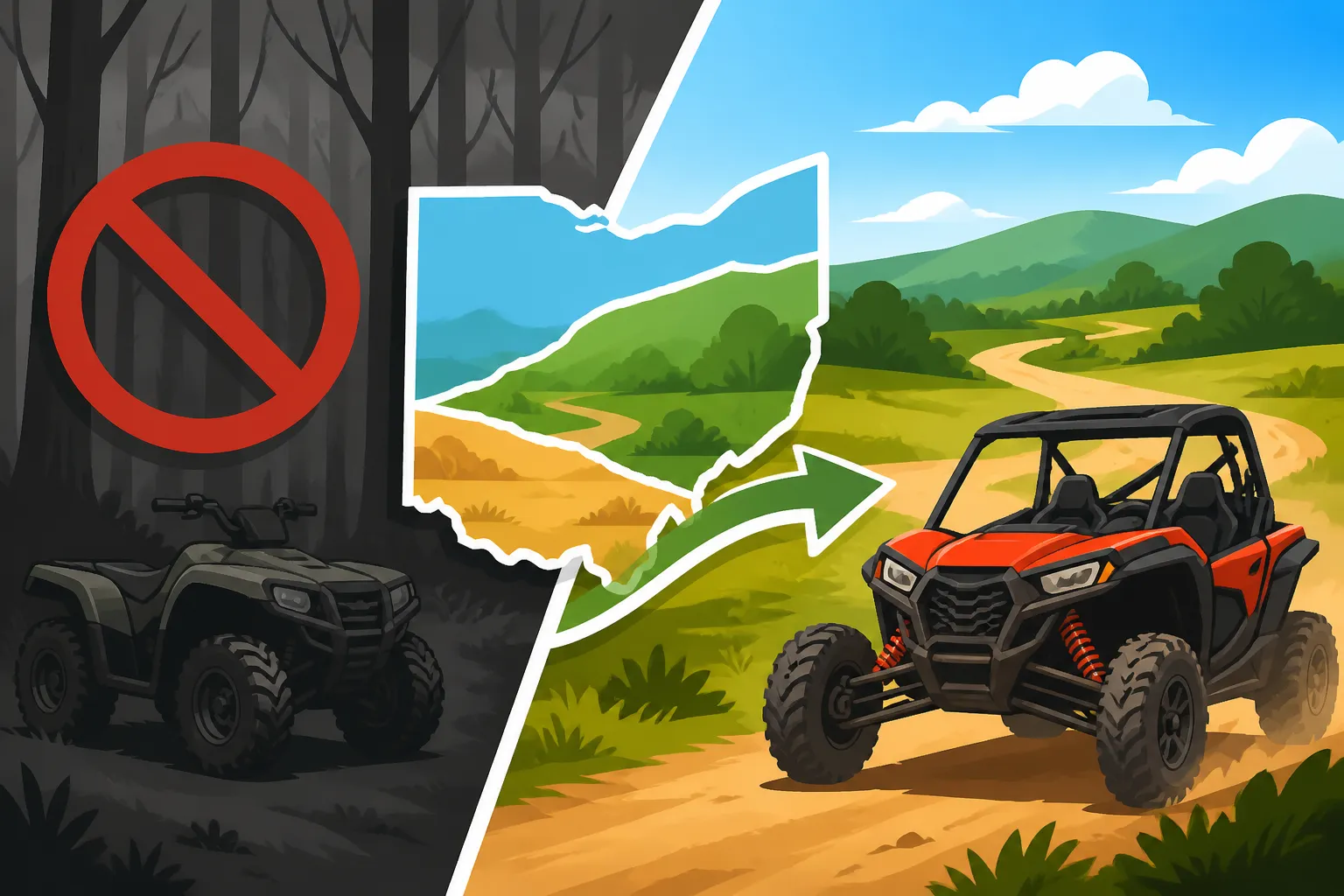
It is also easy to hear “the forests are closed” and assume every public riding opportunity is closed. That is not necessarily the case. Maumee State Forest is a notable exception, with a short designated trail system that is generally open year-round. Conditions, access rules, or temporary closures can still affect a particular visit, so confirm before you go. For a closer look at the seasonal pattern, see Why Three Forests Close and One Does Not and Ohio Trails Open in Winter.
A useful first question is not simply “Are the forests open?” but “Which trail system is open, and what rules apply to my machine today?” A trail that is open may have a width restriction, riding-hour limit, or other requirements. If you have a wide side-by-side, don’t assume it can use every route available to a narrow ATV. The Ohio’s 62-Inch State Forest Width Limit is one important restriction to understand before choosing a state forest trail.
Check the trail status before you leave home
Trail information can change after rain, snow, a freeze-thaw cycle, or maintenance work. A route that appeared rideable when you planned your trip may be closed or unsuitable by the time you arrive. Look for current notices from the land manager, and check the page or trailhead information for the specific area rather than relying on a general listing.
Mapping apps can help you see where a route is and plan a trip, but a line on a map is not proof that motorized riding is allowed. onX Offroad can help with route planning and orientation, especially when you are comparing possible areas, but use official land-manager information to confirm that the trail is open and that your machine is permitted. A mapped road, old haul route, or visible track can cross private property or land where motorized use is prohibited.
Before loading, make a quick check of three things: the trail system’s open status, your machine’s eligibility, and the access rules for that location. The Ohio Trail Conditions Before You Ride guide is a useful reminder that weather and trail notices belong in your planning routine, not as an afterthought at the trailhead.
Public-land options when the usual forest trails close
Consider Maumee State Forest for a winter ride
For riders looking for a public-land option during the winter closure period, Maumee State Forest is often the first place to investigate. Its designated riding area is relatively small compared with the larger systems in southern Ohio, so it may suit a shorter outing better than a full day of extended trail riding. That can still be a welcome option when your usual riding area is closed.
A short trail system also means expectations matter. Don’t plan as if you are heading into a large network with hours of new routes. Check the current trail map, riding requirements, and access conditions, then decide whether the distance and terrain are a good fit for your group. If the area is muddy, icy, or otherwise unsuitable, postponing is better than trying to force a ride and leaving deep damage behind.
Use your map to find the official trail and nearby access points, not to improvise a route through adjacent woods or roads. onX Offroad may help you orient yourself and understand the surrounding area, but it should be a planning aid rather than your permission source. Before you head out, confirm current conditions through the appropriate state information and review Maumee State Forest’s 8 Miles for more about the scale of the riding area.
Separate state forest trails from other public roads and lands
Winter can make familiar roads look like tempting substitutes for a closed trail. A gravel road, utility corridor, rail trail, wildlife area road, or old mining road is not automatically open to ATVs or UTVs. Access depends on who manages the land and what rules apply. A route that is legal for a road vehicle, a horse, or a snowmobile may not be legal for an APV.
That distinction matters particularly in Ohio, where road access can depend on local decisions and posted rules. A township road might be open to APVs under a local resolution while a nearby county road is not. The fact that a road appears on a navigation map—or that another rider used it—does not establish that your machine can legally travel there. Review Ohio Rules for Riding a Township Road and Ohio Rules for Riding a County Road before treating a road as a trail alternative.
Public land can have its own restrictions, too. Wildlife areas, county parks, and state forest land do not all allow the same activities. If you are considering a route outside an established OHV system, identify the land manager and get clear confirmation of the motorized-use rules. When the answer is uncertain, choose a designated trail or a riding park that explicitly allows your machine.
| Riding option | Why it may work after seasonal closures | What to confirm before you go |
|---|---|---|
| Maumee State Forest | A designated public trail area that is generally open year-round | Current status, trail conditions, machine limits, and riding rules |
| Private riding park | The operator may schedule riding outside the state forest season | Open dates, machine types, fees, required gear, and park rules |
| Out-of-state riding area | A nearby park may have a different operating season | Whether it is open, registration requirements, travel distance, and local rules |
| Road or other public land | May provide legal access in specific circumstances | Land manager, local authorization, signage, and rules for APVs |
Private riding parks can fill the gap
Find a park that fits your machine and riding style
Private parks can be a practical alternative when state forest trails are closed, but they are not interchangeable. Some cater to mud riding and larger machines, while others have tighter trails, wooded routes, or areas better suited to a particular type of ATV. A UTV owner should check width and trail-surface restrictions; a family with younger riders should ask about age rules, supervision, and beginner-friendly routes.
Start by checking the park’s own information for operating dates and whether it is open to the public on the day you want to ride. Some locations operate on selected weekends or around scheduled events, and a park’s general existence does not mean it is open every day. Ask whether you need to reserve, what the entry process is, whether camping is available, and whether the park has specific requirements for helmets, spark arresters, sound, or machine condition.
A mapping tool such as onX Offroad can help you compare the general location of potential parks with your drive and lodging plans. Still, park rules come from the operator, not the map. For an overview of how private facilities differ from state forest systems, see Ohio Private Trail Parks and Comparing a Forest Trail to a Private Park.
Call ahead with practical questions
A quick call or message to a park can prevent a frustrating drive with a trailer. Ask whether the park is open to your specific vehicle, whether the trails are suitable for your experience level, and whether recent weather has affected access. If you’re bringing a side-by-side, state its width and ask directly whether it is allowed on the trails you plan to use. If you’re bringing a youth machine, explain the rider’s age and ask what supervision the park requires.
It also helps to ask what the posted rules mean in practice. For example, a park may distinguish between trail access and access to a mud area, or it may restrict passengers on certain machines. Confirm whether the operator requires proof of registration or insurance, and whether a state plate or another form of documentation is needed. Do not assume that rules for private property are the same as rules for an Ohio state forest.
For an outing with friends, agree on the plan before everyone leaves home. Pick a meeting point, check arrival instructions, and make sure every rider knows whether the park requires a waiver or a particular safety item. The Riding a Private Park Instead of a State Forest guide can help you weigh the trade-offs, including the more structured access and possible costs of a private facility.
Plan a winter ride that stays safe and legal
Prepare for cold, mud, and shorter daylight
A winter ride can be enjoyable, but cold weather changes the basics. Dress in layers that still allow you to steer and operate controls comfortably. Bring dry gloves and a spare layer, and consider how wind chill will feel once the machine is moving. A warm morning can turn uncomfortable on exposed trails, especially if your route includes long stretches without shelter.
Trail surfaces can change quickly. Frozen ground may be firm early in the day and soft later, while thawing clay can become slick and rutted. Don’t use a “winter ride” as a reason to push into a trail that is too wet or unstable. Deep ruts can make the route harder for the next rider and more difficult to maintain. If the surface is deteriorating, turn around rather than cutting a new line around a muddy section.
Plan conservatively for daylight and recovery time. Check your lighting, carry a charged phone and basic recovery equipment, and tell someone where you plan to ride. If the area has limited cell service, download or save the information you need beforehand. An app such as onX Offroad may be useful for offline orientation where its features and coverage support your plan, but it does not replace trail signs, official maps, or a clear turnaround time.
Make a backup plan before towing
A backup plan saves a trip when your first choice turns out to be closed. Before leaving, identify a second legal riding option within a reasonable distance. Check its schedule and access requirements as carefully as you checked the first. If your backup is a private park, confirm that it accepts your machine. If it is public land, identify the exact designated route rather than relying on a broad map pin.
It can also help to keep the day flexible. If a trail is closed after heavy rain, consider rescheduling instead of driving to a second area that may have similar conditions. For out-of-state parks, build in time to check that state’s registration and permit rules. Ohio registration does not automatically answer every access question beyond Ohio, and reciprocity rules may vary by destination.
The best winter riding plan is specific: a confirmed open location, a suitable machine, the right paperwork, weather-appropriate gear, and a second choice if conditions change. For more options and planning context, start with Where to Ride an ATV in Ohio and Ohio Riding Compared to West Virginia. Then check the land manager or park operator again shortly before departure.
Disclaimer
This article is for general informational purposes only and does not constitute professional advice. Laws, prices and regulations vary by location and change over time. Consult a qualified professional for guidance on your specific situation.