Trails That Open the First Friday of April
The first Friday in April feels like the finish line after a long Ohio winter, but a calendar date alone does not guarantee a perfect ride. Seasonal trail openings can be affected by wet ground, maintenance, and local closures. This guide explains what the spring reopening means, how to prepare, and what to check before hauling your ATV or UTV to a trailhead.
What the first Friday in April means for Ohio riders
The date marks a seasonal reopening, not a promise about every trail
At several Ohio state forest riding areas, the first Friday in April marks the scheduled start of the riding season after a winter closure. It gives riders a useful date to plan around, but it should not be treated as a guarantee that every route, entrance, or facility will be open and ready for use that morning.
Ohio’s public riding areas do not all follow one identical schedule. The seasonal opening date is particularly relevant to the state forest trail systems that close over winter, while Maumee State Forest is known for a different, year-round schedule. For an overview of how schedules vary by location, see [Ohio Trail Season by Forest] and [Ohio's Four State Forest APV Areas].
It also helps to separate a season opening from a trail-condition announcement. A trail may be open for the season but still have a section temporarily closed because of wet conditions, repairs, a maintenance project, or another site-specific issue. A trailhead entrance being accessible does not necessarily mean every loop is passable.
The opening date changes from year to year
The first Friday in April falls on a different calendar date each year. If you are arranging a trip with friends, booking a nearby campsite, or asking someone to tow your machine, check the calendar rather than relying on last year’s date. A familiar weekend can be a different distance from the opening day than you remember.
The day of the week can also shape your plan. Some riders want to be at the gate as soon as the season opens; others prefer to wait until the first full weekend, when they can take their time with a longer ride. Either way, it is worth checking for official updates shortly before leaving home, especially if your travel involves a long drive from places such as Cleveland, Toledo, or Cincinnati.
Use the seasonal date as a planning marker, then confirm the actual riding status through the appropriate land manager’s notices and information at the trailhead. [Reopening the First Friday in April] offers a closer look at the seasonal reopening itself.
A season opening does not override other riding rules
Opening day does not make a closed route legal to ride, and it does not replace requirements for registration, permitted riding areas, safety gear, or machine access. A machine that is ready to go still needs to meet the requirements for the particular area where you plan to ride. Those requirements may differ between state forest trails, national forest routes, private parks, and public roads.
Before heading out, confirm that your registration and plate are in order, that your machine is permitted on the route, and that you understand any local trail restrictions. A spring trip can be an easy one to enjoy when the paperwork and equipment are sorted in advance, rather than discovered at the staging area.
How to check whether your trail is actually open
Check official conditions close to your departure
A schedule tells you when the riding season is expected to begin. A current trail notice tells you whether conditions or maintenance have changed the plan. Check official trail-condition information near your departure date, then check again before you load if weather has been unsettled.
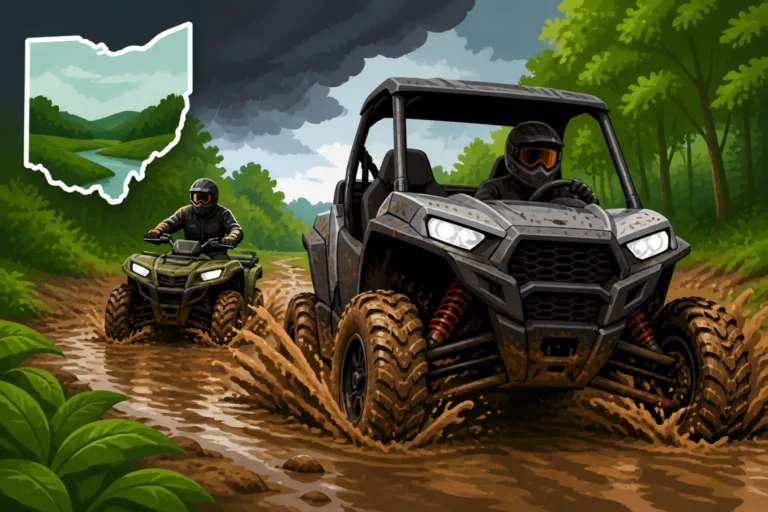
This matters most after a rainy stretch. Ohio soil can vary significantly from one riding area to another, and clay-heavy sections can become slick or deeply rutted. A trail may be technically open but still be a poor choice for a heavy side-by-side, a new rider, or a group that is not equipped for recovery. For practical guidance on reading updates and closures, see [Ohio Trail Conditions Before You Ride] and [Ohio Trail Closures to Check First].
Do not assume that a report from one forest applies to another. A sunny day in northwest Ohio does not tell you much about conditions in the hills of southern Ohio. Even within one riding area, a low-lying route can be muddy while higher ground is firm.
Treat maps as planning tools, not closure notices
A mapping app can help you understand where trails, roads, and access points appear in relation to one another. onX Offroad can be useful for reviewing a route and getting a broader sense of the surrounding area before you travel. That kind of preparation is especially helpful if you are visiting a trail system for the first time and want to avoid arriving without a clear idea of where to unload.
A digital map is not a substitute for current official information. It may not reflect a new closure, a temporary reroute, a washed-out section, or a gate that has been put in place since the map data was updated. Use onX Offroad as one planning reference, then confirm open routes with the land manager’s posted information and trailhead signs.
The same principle applies to screenshots and saved routes. They can be handy when cell service is unreliable, but a route saved last summer may no longer be appropriate in spring. Check the latest notices before relying on a saved track.
Pay attention to access and facility details
A trail’s status is only part of the trip. Before leaving, check whether the trailhead you plan to use is accessible and whether parking, restrooms, or other facilities are available. Spring maintenance can affect these details, and a site may not be operating exactly as it did at the end of the previous season.
If you are towing, confirm that the lot can accommodate your vehicle and trailer. Arriving at a small or crowded staging area with a long trailer can turn a promising morning into a frustrating round of backing and repositioning. [Parking a Trailer at a Forest Lot] can help you think through that part of the plan.
Also check the area’s permitted riding hours. Do not assume that a seasonal opening means you can ride at any hour. Details on daily access are covered in [Ohio State Forest Riding Hours].
Preparing your ATV or UTV for opening weekend
Do a post-winter machine check before loading
A machine that ran well in autumn may need attention before its first spring ride. Start with the basics: check tire condition and pressure, brakes, lights, throttle response, steering, battery charge, and fluid levels. Look for signs of rodents, corrosion, cracked hoses, damaged wiring, or a slow leak that was easy to overlook during storage.
For a side-by-side, inspect seat belts, doors or nets, mirrors, and any windshield or wiper equipment required for the kind of use you have planned. For an ATV, check that the controls move freely, the hand and foot brakes respond normally, and the tires are suitable for the terrain. If you added accessories over winter, make sure they are secured and do not interfere with safe operation.
Give yourself time for repairs at home. Finding a weak battery or a worn belt in the driveway is inconvenient; finding it after you have driven several hours and unloaded in a busy lot is much worse. A quick inspection also gives you time to decide whether a machine needs a mechanic before the season begins.
Pack for mud, changing weather, and a slower day
Early spring riding can mean cool air at the trailhead, warmer temperatures later, and a mix of damp ground and standing water. Pack clothing you can adjust in layers, gloves that still work when wet, and a change of clothes for the ride home. A small first-aid kit, drinking water, snacks, a basic tool kit, and a charged phone belong in your plan as well.
Bring recovery gear that suits your machine and the conditions you expect. A winch or tow strap is only useful if it is appropriate for the load and you know how to use it safely. Avoid turning a muddy patch into a group recovery exercise just to prove a machine can get through. If the route is soft, turning around early is often the better decision for both your equipment and the trail.
A simple opening-day checklist can keep the practical details from slipping through the cracks:
| Before you leave | What to confirm |
|---|---|
| Trail status | Seasonal opening and any current closures |
| Machine | Tires, brakes, lights, battery, fluids, and controls |
| Registration | Required plate, documents, and any area-specific pass |
| Route plan | Legal routes, access point, and permitted hours |
| Weather | Rain, temperature, and conditions likely to affect the ground |
| Group plan | Meeting point, communication plan, and recovery equipment |
Adjust your riding to spring trail conditions
Opening weekend often brings excitement and heavier use. Give other riders space, slow down around blind corners, and avoid cutting across soft shoulders to pass. Stay on marked routes. Riding around a muddy section can widen the trail and damage vegetation, while deep wheel ruts may remain long after the surface dries.
Do not assume that a machine with aggressive tires is better off pushing through every wet section. Spinning tires can dig holes quickly, and a stuck vehicle may block a narrow route for other riders. If a section looks too soft, turn back or choose a firmer legal route. For more detail on the impact of wet weather, read [Ohio Trails After Heavy Rain] and [Ohio Trails Closed in Spring].
On narrow trails, be patient when meeting another group. Slow down, make eye contact if possible, and communicate clearly before either group moves. Keep children and less experienced riders close enough to receive directions, without crowding them. [Ohio Trail Etiquette on Narrow Trails] covers additional ways to make shared routes safer and less stressful.
Planning an opening-weekend ride that goes smoothly
Choose a realistic route for your group
The first ride of the season does not need to be the longest ride of the year. If your group includes new riders, children, or machines that have been stored for months, pick a manageable route and leave time for breaks. A modest loop gives everyone a chance to check how the machine feels and how the group handles changing trail conditions.
Think about width as well as distance. Some forest routes have machine-width limits, and a wide side-by-side may not be suitable for every trail system. Check the rules for the area before setting out rather than assuming that a route shown on a map is open to every type of off-highway vehicle.
A good plan includes a fallback. If the trail is wetter than expected, a section is closed, or the staging area is full, know what you will do next. onX Offroad can help you review the area and organize your route ideas, but use official notices to confirm that each route is actually open and permitted. Keep the group together when plans change, and avoid improvising onto an unmarked road or private property.
Build extra time into the travel day
Opening day can bring more traffic to a trailhead than an ordinary spring weekday. Leave time for loading, fuel, parking, unloading, gear checks, and any delay caused by a full lot. If you are meeting friends, agree on a specific meeting point and a backup plan in case someone gets delayed or loses cell service.
Check fuel and food options before you leave. Do not count on finding an open business close to a remote trailhead, particularly early in the morning. A paper note or downloaded map can be useful if coverage is poor. onX Offroad may help you prepare a route in advance, but carry the key details you need in a form you can access without a reliable connection.
Most importantly, be ready to change plans. A season-opening date is exciting, but it is not worth risking a damaged machine or a preventable injury to complete a planned loop. If conditions are poor, choose a shorter legal route, return to the staging area, or save the longer ride for another day.
Make your final check before unloading
When you arrive, read the information posted at the trailhead. Look for route closures, temporary restrictions, riding-hour notices, and any instructions that differ from what you saw at home. Do not rely on another rider’s assumption that a route is open; conditions and access notices can change.
Before leaving the staging area, make sure every rider knows the route plan, how to regroup, and what to do if someone has a mechanical problem. Set a comfortable pace and agree that anyone can call for a stop without being pressured to keep up. A calm first ride is a better start to the season than an ambitious one that leaves someone stranded or uncomfortable.
The first Friday in April is a useful marker for Ohio’s seasonal trail calendar, but a successful ride depends on checking the specific area, preparing your machine, and respecting spring conditions. Confirm the opening and any local notices, then let the trail and your group’s experience guide the day.
Disclaimer
This article is for general informational purposes only and does not constitute professional advice. Laws, prices and regulations vary by location and change over time. Consult a qualified professional for guidance on your specific situation.