Trail Loops That Suit a Stock, Unmodified Quad
A stock quad can be a great fit for Ohio’s marked trails, but tight turns, slick clay, steep climbs, and a machine-width limit can turn a casual ride into a frustrating one. The key is choosing a route that matches your quad’s size and ground clearance, then checking trail access and conditions before you unload. This guide explains how to plan a manageable loop without relying on modifications.
What makes an Ohio trail loop suitable for a stock quad
Start with width, clearance, and the trail’s character
“Stock” does not automatically mean “ready for every trail.” A factory-standard quad may have enough clearance and traction for a maintained route, but it may struggle with deep ruts, exposed rocks, sharp ledges, or a muddy climb. Before choosing a riding area, compare your machine’s width and ground clearance with the route’s limits and expected terrain.
Ohio’s state forest trails have a 62-inch width limit for machines using those trails. Measure the widest part of your quad, including accessories that extend beyond the body. A machine that fits comfortably is easier to maneuver through narrow sections than one that barely meets the limit. For more detail on the restriction, see Ohio’s 62-Inch State Forest Width Limit.
Trail conditions can matter just as much as the machine’s specifications. A stock quad with sensible tires may handle firm, dry gravel and rolling terrain well, yet spin or bottom out in deep clay ruts after rain. If your machine has modest clearance, favor routes with smoother grades and avoid places where the only way through a muddy hole is to rely on a winch or aggressive tires.
Choose a ride you can shorten
A good first outing is not necessarily the longest one. Plan a route with a nearby staging area or a natural point where you can turn back, rather than committing to a full day far from your trailer. That gives you room to adjust if the trail feels rougher than expected, the group moves slowly, or a rider’s comfort level changes.
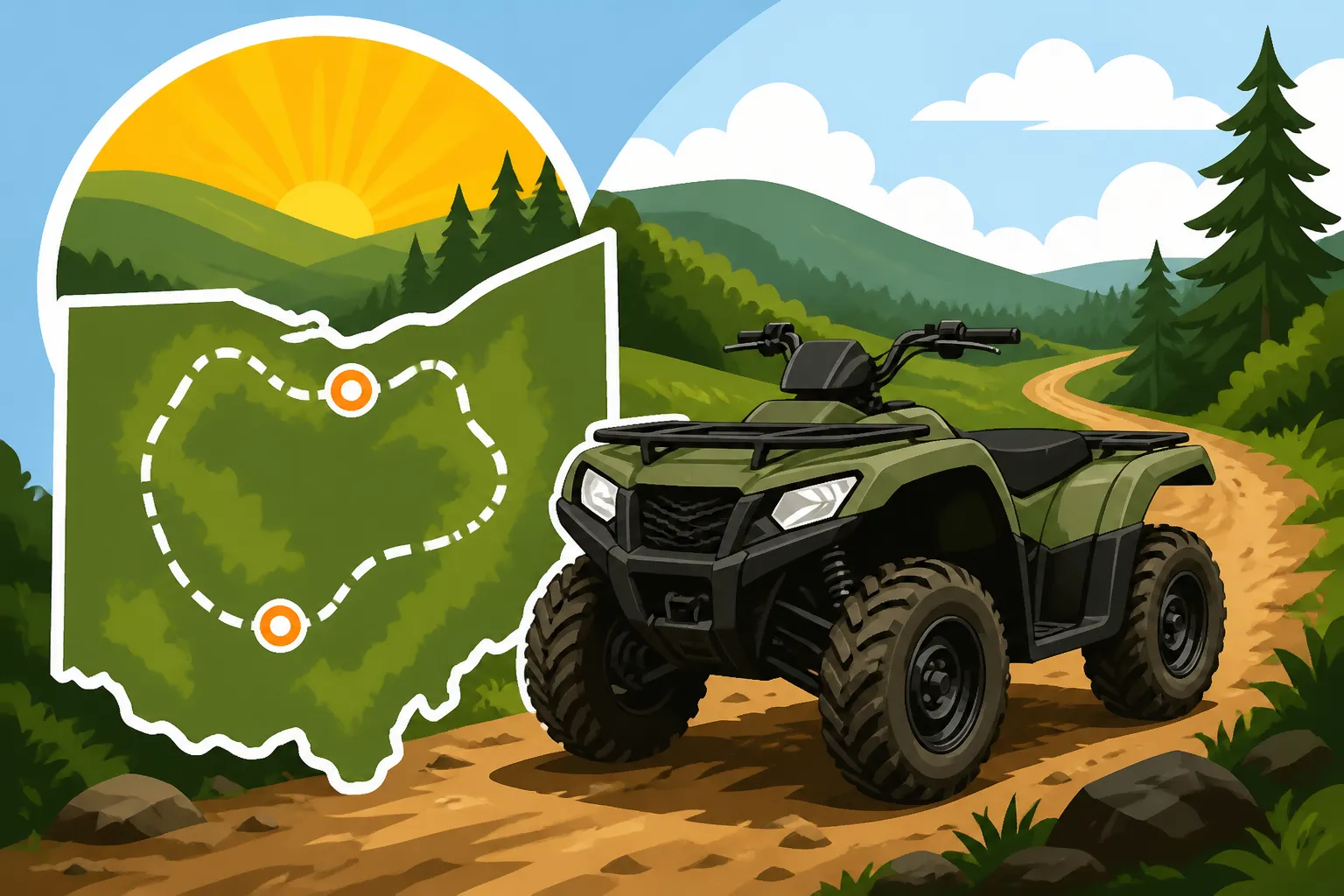
In Ohio’s forest systems, the marked route may include connectors and trail segments that do not form a neat, simple loop. Check the map before riding and confirm that each connection is open to your machine. A route that looks like a circle on a map may include a dead end, a restricted segment, or a section that is unsuitable for your quad. Ohio Trail Maps From ODNR can help you begin planning, while signs and current local notices matter once you arrive.
Ohio riding areas to consider for a stock quad
Wayne National Forest systems
The Wayne National Forest’s Ohio riding systems include Monday Creek, Hanging Rock, and Pine Creek. These southern Ohio areas offer forested terrain and changing elevation, so a stock quad can encounter a mix of comfortable stretches and more demanding sections. Don’t assume that every trail in a system has the same difficulty, or that a familiar route will feel the same after rain.
Use an official map to plan around the trails that match your machine and experience. If you are new to a system, begin with a shorter outing and allow time to stop, check signs, and make decisions at junctions. A route that looks manageable in a map app may include a steep or rough segment that is easier to judge in person. Riders using Wayne National Forest OHV trails also need to understand the separate forest pass requirement; the Ohio registration plate alone may not cover that access. See How the Wayne National Forest OHV Permit Works and Which Trails a Wayne Forest Pass Opens before setting out.
Mapping tools such as onX Offroad can help you view routes and organize a planned ride, but use them as one planning aid rather than a substitute for official trail information. Confirm that the route is authorized and open, and follow posted signs if they differ from a digital map. Mobile signal can be unreliable in forested areas, so save or carry the information you need before leaving home.
State forest areas and seasonal planning
Ohio’s state forest riding areas include Maumee, Perry, Pike, and Richland Furnace. Each area can offer a different experience, and trail conditions may change with weather, maintenance, and seasonal access. A stock quad may be comfortable on a dry, moderate route but far less capable when the ground is soft or rutted.
Check the specific forest’s rules and current status instead of assuming that all riding areas share the same opening dates or access conditions. Some state forest areas have seasonal closures, while Maumee has different seasonal access. A route can also be affected by maintenance, weather, or a temporary closure. For broader planning, browse Ohio’s Four State Forest APV Areas and Ohio Trail Conditions Before You Ride.
| Planning question | Why it matters for a stock quad | What to check |
|---|---|---|
| Does the machine meet the width limit? | A wide quad may not be allowed on a state forest route | Measure the machine at its widest point and confirm the area’s rules |
| Is the trail open? | Seasonal or temporary closures can change your plan | Review official notices and trailhead signs |
| Has it rained recently? | Wet clay and fresh ruts can challenge standard tires and clearance | Check recent conditions and be ready to choose a different route |
| Is the route within your comfort level? | Steep or rough sections can be difficult to turn around on | Study the map and plan a shorter option |
| Do you have the correct access credentials? | Registration and forest-specific access rules may differ | Confirm what is required for the riding area |
How to plan a stock-quad ride step by step
Match the route to the weakest machine in the group
If several people are riding together, plan for the least capable quad and the least experienced rider, not just the newest machine. A route that feels easy on a high-clearance quad with aggressive tires may be discouraging for a smaller stock machine. Agree in advance that the group can slow down, skip a segment, or turn around without pressure.
Look for practical route details: trail width, elevation changes, surface type, junctions, and whether the route offers a reasonable way back to the staging area. Read trail difficulty descriptions carefully, but treat them as general guidance rather than a guarantee. Rain, traffic, fallen branches, and rutting can change what a trail feels like from one visit to another. Ohio Trail Difficulty Ratings can help you think through the terrain before choosing a route.
For navigation, you might use a printed map, an official map, or a mapping app such as onX Offroad. Whatever you use, identify your starting point, intended turns, and a turnaround option before you ride. Do not rely on having cell service at every junction. If the route markings or posted notices do not match what you planned, stop and reassess rather than pressing ahead.
Check the machine and pack for ordinary problems
A stock quad does not need to be modified for every trail, but it should be in sound working order. Before loading, check tire condition and pressure, brakes, lights, fluid levels, and steering. Make sure any loose cargo is secured and that the tires are appropriate for the terrain you expect. A basic inspection can prevent a small problem from becoming a long, unpleasant walk back to the staging area.
Carry water, a first-aid kit, basic tools, and a way to communicate with your group. Bring enough clothing for changing weather, and keep your registration or other required documents accessible. A phone with a saved map is useful, but it should not be your only navigation plan. If riding in a group, agree on where to stop and what to do if someone falls behind.
Keep the ride within marked and authorized routes. Avoid cutting around a muddy section or bypassing a closure: leaving the designated trail can damage the area and put riders on land or routes they are not allowed to use. For broader preparation, see Ohio Trail Etiquette on Narrow Trails and [Ohio Rules for Riding State Forest Land].
Making the ride enjoyable when conditions change
Know when to turn around
Turning around is a sound decision, not a failed ride. If the trail becomes deeply rutted, the quad repeatedly bottoms out, or the group is using excessive throttle to climb, stop and reassess. A stock machine can be damaged by forcing it through terrain that exceeds its clearance or traction. A rider who feels uneasy may also make mistakes when pressured to keep up.
Pay attention to changes in the trail as you go. A firm opening stretch can lead into slick clay, standing water, or a steep descent. Stop before the difficult section if there is room to do so, and discuss whether everyone can safely continue. If turning around is safer, use a suitable location and avoid blocking the trail or damaging the edges.
Weather is a major part of the decision. After heavy rain, clay can become slippery and ruts can conceal holes. In dry conditions, loose material and dust may affect visibility. Check local updates before leaving, then adjust your plan at the trailhead if conditions do not match what you expected. Ohio Trails After Heavy Rain offers more context for evaluating wet-weather riding.
Build confidence gradually
If you are new to Ohio trails, start with a short ride and treat it as a chance to learn how your quad behaves on that surface. Notice how it handles turns, uneven ground, and moderate inclines without trying to prove what it can do. A relaxed pace gives you more time to read the trail and helps prevent avoidable mistakes.
After the ride, make a note of what worked. Was the trail comfortable for your ground clearance? Did the tires handle the surface? Were the signs and map easy to follow? Those observations make it easier to choose a suitable route next time. If the group enjoyed the terrain but found one section difficult, plan a shorter version or a different system rather than assuming a machine modification is the only answer.
A stock quad is often enough for an enjoyable Ohio outing when the route, conditions, and machine are well matched. Choose a marked route that fits the machine’s dimensions, check access and weather, carry a backup plan, and be willing to turn around. That approach makes the day safer and usually more fun than trying to force an unsuitable trail into a loop.
Disclaimer
This article is for general informational purposes only and does not constitute professional advice. Laws, prices and regulations vary by location and change over time. Consult a qualified professional for guidance on your specific situation.