Registering a Quad Kept at a Hunting Camp
It's a common scenario for folks in Ohio who love the outdoors: you've got a quad or side-by-side that lives primarily at your hunting camp, maybe deep in the woods or tucked away on a large tract of private land. You might think, "It never leaves the property, so why bother with registration?" But the truth is, Ohio's rules for All-Purpose Vehicles (APVs) can be a bit more nuanced than you'd expect, and understanding them is key to avoiding headaches. This guide is here to walk you through why and how you need to register that trusty machine that helps you haul gear, scout trails, and generally make your hunting season easier, even if its main address is your favorite rustic cabin.
Why Your Hunting Camp Quad Needs Ohio Registration (Even If It Stays Put)
Let's face it, when your quad is primarily used on private land, especially land you own or lease for hunting, the idea of registering it can feel like unnecessary bureaucracy. You might envision registration as something only needed for riding at a state forest or on approved public trails. However, Ohio law has a broad definition of an All-Purpose Vehicle (APV), which covers most ATVs, UTVs, and side-by-sides, and it dictates that these machines generally need to be registered.
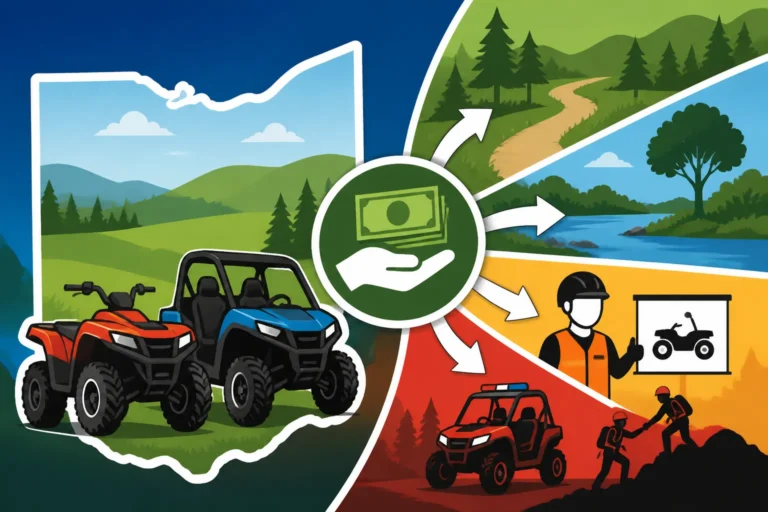
One of the biggest misconceptions is that if a machine never touches a public road or designated trail, it's exempt. While riding strictly on your own private, fenced land that has no public access points might allow you to forgo registration, that's rarely the reality of a hunting camp. Most camps involve shared access roads, crossing small township lanes to get from one part of the property to another, or even just driving a few feet onto a public right-of-way to access a field. Each of these seemingly innocent actions can trigger the need for official registration. Plus, the funds from registration fees actually go towards maintaining the very trails many riders enjoy, so it's contributing to the broader riding community. [Where Ohio APV Registration Money Goes] is an interesting read if you want to know more about that.
Consider a situation where your hunting camp is accessed via a township road, and you routinely drive your quad from the cabin down to a deer stand located further back on the property. Even if this short stretch of road feels "private" because it only leads to your camp, if it's legally a public thoroughfare, your machine is operating on it. The same applies if you need to cross a field that borders a state route, even for a moment. An Ohio State Highway Patrol trooper or a local deputy could observe your machine and issue a citation for non-registration. It's not about catching people, but about ensuring all vehicles operating on public or state-managed lands are identified and contributing to the system.
Furthermore, if you ever decide to take your hunting camp quad to a dedicated off-road park, an Ohio state forest trail, or even visit another private property that encourages legal riding, you'll find that having it registered is a requirement. Those places often check for current registration and a visible plate. Skipping registration now could limit your options and create a rush later when you actually want to take it somewhere. Think of it as having your bases covered for any adventure, planned or spontaneous.
Defining "All-Purpose Vehicle" in Ohio
Ohio law is quite specific about what constitutes an "All-Purpose Vehicle." It includes any self-propelled vehicle designed primarily for off-highway use and traveling over natural terrain, and that has one or more wheels or treads. This definition pretty much nails every ATV, UTV, and side-by-side out there, regardless of its primary use. [How Ohio Law Defines an APV] goes into greater detail, but the short of it is, if it's not a car, truck, or motorcycle, and it's built for off-road fun or utility, it's probably an APV.
This broad definition means that even if your quad is mostly hauling deer, pulling a small trailer of firewood, or scouting for turkey sign exclusively on your hunting lease, it still falls under the APV umbrella. The law doesn't differentiate based on how much you use it or where you think it should be used. It simply defines the machine itself. This is why the common belief that "it's just a farm machine" or "it's only on my land" doesn't always stand up to legal scrutiny in all scenarios.
Public vs. Private Land and the Gray Areas
The line between public and private land can often blur, especially around hunting camps that might abut state forests, wildlife areas, or even just rural township roads. While you might lease 100 acres, the access road leading to it could be a public right-of-way. Or perhaps you have an easement across a neighbor's property that crosses a small unposted road. In such gray areas, having your APV registered protects you.
Imagine you're driving your quad from your camp to a food plot on your leased land. If, for even a short distance, you travel on a road that is legally classified as public (even if it's gravel and looks like a private lane), your machine needs to be registered. The law isn't always about intent; it's about actual operation on regulated land. Even crossing a state route at a designated intersection often requires your machine to be properly registered and plated, along with meeting certain equipment requirements for road travel. [Crossing a Highway on an APV in Ohio] is a must-read if you anticipate any road crossings.
The Nitty-Gritty: How to Register a Quad for Your Ohio Hunting Camp
Alright, so you're convinced: that quad at the hunting camp needs to be properly sorted. The process itself isn't terribly complicated, but it does involve two separate stops in Ohio: one for the title and one for the registration and plate. Think of it like getting a driver's license – you first prove who you are, then you get the actual permit to drive.
The very first step is ensuring you have proper proof of ownership. For a brand-new machine, this means your Manufacturer's Certificate of Origin (MCO). If you bought it used, you'll need the previous owner's Ohio title, properly assigned to you. This is where many folks hit a snag, especially if they bought a used machine without a formal title transfer, perhaps from a friend or a private sale where the previous owner "never bothered" with a title. If you're in that situation, you might need a bill of sale or other documentation to help establish ownership. Resources like LawDepot can offer templates for a solid bill of sale if you're buying privately, helping to make sure you have the necessary documentation. [Buying a Used APV in Ohio] has great advice for this common situation.
Once you have your proof of ownership, you'll head to your County Clerk of Courts Title Office. This is the only place in Ohio where you can get a title issued. They'll verify your ownership documents and, for a fee, issue you an Ohio Certificate of Title in your name. This title is a crucial document – it's your permanent proof of ownership. You only title it once, unless you sell it or transfer ownership.
With your shiny new title in hand, your next stop is a Deputy Registrar's office. This is the place where you'll actually get your machine registered and receive your physical APV plate and validation sticker. You'll need to bring your new title, your identification, and be ready to pay the registration fees. They'll process the paperwork, take your money, and hand you the plate and sticker on the spot. It's a two-stage process, but each part is straightforward once you have your documents in order. [Where to Register an APV in Ohio] and [Where to Title an APV in Ohio] break down the specific locations.
Gathering Your Paperwork: What You'll Need
Having your documents in order before you leave home can save you a world of frustration and a second trip. Here’s a quick checklist of what you'll typically need:
- Proof of Identity: A valid driver's license or state ID card. Make sure the name on your ID matches the name you want on the title and registration.
- Proof of Ownership:
- New Machine: The Manufacturer's Certificate of Origin (MCO) provided by the dealer.
- Used Machine with Ohio Title: The properly assigned Ohio Certificate of Title from the previous owner.
- Used Machine without a Title (or out-of-state): This is where it gets trickier. You might need a bill of sale (like one from
LawDepot) detailing the sale, VIN, purchase price, and contact information for both buyer and seller. In some cases, if the machine is very old and was never titled, you might need to prove prior registration or submit an affidavit. It’s always best to call your county title office first if you're in this situation to confirm their specific requirements. [Ohio APV Bill of Sale Requirements] provides more details.
- Payment for Fees: Be prepared for title fees, registration fees, and a small deputy registrar service fee. While I can't give you exact numbers, understand that you'll be paying a few different charges. [Ohio APV Registration Cost] can help you get a general idea of the financial commitment.
It's a good idea to make photocopies of everything before you head out, just for your own records. Sometimes, having an extra copy of your bill of sale, especially if you secured it through a reputable service like LawDepot, can be beneficial.
The Two-Step Process: Title First, Then Register
This is critical to understand because people often try to do both at the same counter, only to be told they have to visit two different offices.
- County Clerk of Courts Title Office: This is your first stop. You'll bring your proof of ownership (MCO or assigned title) and your ID. The title office will process your application, confirm the VIN (sometimes requiring a physical inspection, especially for out-of-state machines or if there are discrepancies), and issue you the Ohio Certificate of Title. This document is usually printed on secure paper and is incredibly important. Keep it in a safe place, not on your machine. [Titling an APV at an Ohio Clerk of Courts] walks you through this in detail.
- Deputy Registrar Agency (Ohio BMV): Once you have your title, you can head to any Deputy Registrar location (these are the same offices where you renew your car tags). Here, you'll present your newly issued title, your ID, and pay the registration fees. They will then issue you your APV plate and validation sticker. This registration is typically valid for three years, expiring on December 31st of the third year. You'll also receive a registration card to keep with your machine. [Ohio's Three-Year APV Registration] explains the duration of your plate.
It sounds like a bit of a trek, but both steps are usually quite efficient if you have all your ducks in a row.
What to Expect at the Counter and Beyond for Your Hunting Camp Machine
Once you arrive at the Deputy Registrar's office, the process for getting your quad's registration and plate is generally pretty quick. You'll hand over your documentation, they'll verify everything, and you'll pay your fees. Remember, there's a specific charge for the registration itself, which goes to the state, and then a separate, small service fee that the Deputy Registrar's office keeps for processing the transaction. [Ohio's $3.50 Deputy Registrar Fee] is a good one to check if you're curious about that extra charge.
After the transaction is complete, you'll walk away with your Ohio APV license plate and a small validation sticker. The sticker is usually placed on the plate itself, indicating the year the registration expires. You'll also receive a registration card – a small paper document that lists your machine's information and your registration details. This card is important and should always be carried with you when you ride. You might want to consider laminating it or keeping it in a waterproof bag in your machine's storage compartment.
Even if your machine mainly stays at the hunting camp, having that physical plate affixed and the registration card handy is essential. Should a wildlife officer or local sheriff's deputy ever stop you while riding on a gray-area road or even during a routine check on your property (if accessible from public land), you'll be able to quickly show compliance. It's about proactive preparedness rather than reactive panic.
The APV Plate and Validation Sticker
The Ohio APV plate is distinct from a regular car plate. It's typically smaller and designed to be affixed to the rear of your all-purpose vehicle. Along with the plate, you'll receive a small validation sticker that shows the expiration year. You'll need to properly affix this sticker to the plate.
The plate itself needs to be "distinctly visible" when you're riding. This means it shouldn't be covered in mud, obscured by a cooler, or tucked away where it can't be easily seen. If your quad at the hunting camp is frequently used for muddy excursions or hauling gear, you'll want to ensure your plate has a designated spot where it can remain clean and visible. [Keeping an Ohio Plate Distinctly Visible] gives you practical tips on this. Unlike snowmobiles, which get decals, APVs get a proper plate. [Why Ohio Issues a Plate and Not a Decal] explains the difference.
The Importance of Your Registration Card
While the plate goes on your machine, the registration card is your personal proof of current registration. Think of it like your vehicle's insurance card or your driver's license. It should be with you whenever you're operating the APV. This doesn't mean you need to carry the physical title with you – that should stay safely at home. Just the registration card.
Why is this so important for a machine at a hunting camp? Again, it comes down to being prepared for those unexpected encounters. You might be stopped by a game warden while crossing a public access point to your hunting grounds, or a deputy might be investigating an incident nearby and ask to see your documentation. Being able to immediately produce your current registration card demonstrates that you're operating legally. It can also save you from a potential fine or a more in-depth investigation into your machine's status. [What Happens If You Ride Without Your Registration Card] is definitely worth a look.
What Happens If You Skip Registration for Your Hunting Camp Quad
Deciding to bypass the registration process for your hunting camp quad, even if you genuinely believe it's always on private land, can lead to some significant headaches. It's a risk that many riders unknowingly take, assuming that rural settings grant a sort of "out of sight, out of mind" exemption. Unfortunately, that's not how Ohio law views it, and the consequences for riding an unregistered APV can range from financial penalties to more serious legal issues.
The reality is that even on what seems like purely private property, there are numerous scenarios where your unregistered machine could attract the attention of law enforcement. Imagine a situation where you're loading your quad onto a trailer parked on the side of a public road, or perhaps you're stopped for a different infraction, and the lack of a plate is noticed. What if you have a mishap and need emergency services, and the responding officers need to identify your machine? All these situations can lead to questions about registration.
The main consequence, of course, is a citation. Riding an unregistered APV in Ohio, particularly on public land or any land that isn't exclusively and privately owned by you (and even then, there are stipulations), can result in fines. These aren't usually small slaps on the wrist; they can be substantial enough to make you wish you'd just paid the registration fees upfront. Beyond the initial fine, you could also face court costs and potentially even the impoundment of your machine until proper registration is obtained. This is far more inconvenient and expensive than the initial registration process.
Fines and Penalties for Non-Registration
If you're caught operating an unregistered APV in Ohio, you can expect a citation. The specific fine amount can vary depending on the county, the discretion of the officer, and whether there are any other accompanying violations. However, it's generally a traffic-type offense.
Consider this hypothetical: you're driving your side-by-side from your hunting camp across a short stretch of gravel road that leads to a county-owned culvert where you want to check a game camera. A deputy happens to be patrolling the area, sees you, and pulls you over. They ask for your registration, and you can't produce it. Boom – a ticket for operating an unregistered APV. Not only will you have the fine, but you'll have to deal with the court system, potentially taking time away from work or other responsibilities. [Ohio Fines for an Unregistered APV] goes into more detail about what those penalties could look like.
| Violation Type | Location of Violation | Potential Consequence |
|---|---|---|
| Unregistered APV | Public road/right-of-way | Citation, fine, court costs |
| Unregistered APV | State Forest Trail | Citation, fine, court costs, removal from trail |
| Unregistered APV | Private land (with public access) | Citation if observed from public land or during incident |
| No Registration Card | Any location where APV is operated | Citation, fine (often lesser than full unregistered APV) |
Dealing with Law Enforcement
Encountering law enforcement while on your APV, especially at a remote hunting camp, can be intimidating. However, if your machine is properly registered and you have your registration card and identification ready, the encounter is usually brief and professional. The officer confirms your compliance, and you're on your way.
If, however, your machine isn't registered, that simple stop can become a much bigger ordeal. Officers are trained to identify unregistered vehicles, and they will likely issue a citation. They might also ask where the machine was purchased, if it's stolen, or conduct further checks if ownership isn't clear. This is where having documentation like a LawDepot bill of sale for a used machine can be helpful, even if it doesn't replace the title and registration. The bottom line is that prevention through proper registration is much less stressful than dealing with the aftermath of a violation.
Remember, the purpose of these laws and the enforcement by agencies like the Ohio Department of Natural Resources (ODNR) and local law enforcement is not just about revenue. It's about safety, accountability, and funding for outdoor recreation resources. By registering your hunting camp quad, you're not just protecting yourself from fines; you're also contributing to the system that supports responsible APV use across the state.
Disclaimer
This article is for general informational purposes only and does not constitute professional advice. Laws, prices and regulations vary by location and change over time. Consult a qualified professional for guidance on your specific situation.