Does a Quad Used Only on a Farm Need Registering?
It’s a common headache for Ohio farmers and landowners: you’ve got an all-purpose vehicle (APV) that you use exclusively on your property for work, not for ripping up trails or cruising public roads. The question inevitably pops up – do I really need to go through the hassle of titling and registering this machine with the state? This guide will cut through the confusion and explain Ohio’s specific rules, helping you understand when your farm-only quad needs state paperwork and when it’s exempt.
Understanding Ohio's APV Definition and Agricultural Exemptions
First things first, let's get a handle on what Ohio considers an APV. Ohio Revised Code 4519.01 broadly defines an all-purpose vehicle as any self-propelled vehicle designed primarily for off-highway use, including ATVs, side-by-sides, and even some dirt bikes. For the average rider heading to a state forest trail, this means you absolutely need to title and register your machine. But agricultural use carves out a specific exception, which can be a huge relief if your quad is purely a workhorse.
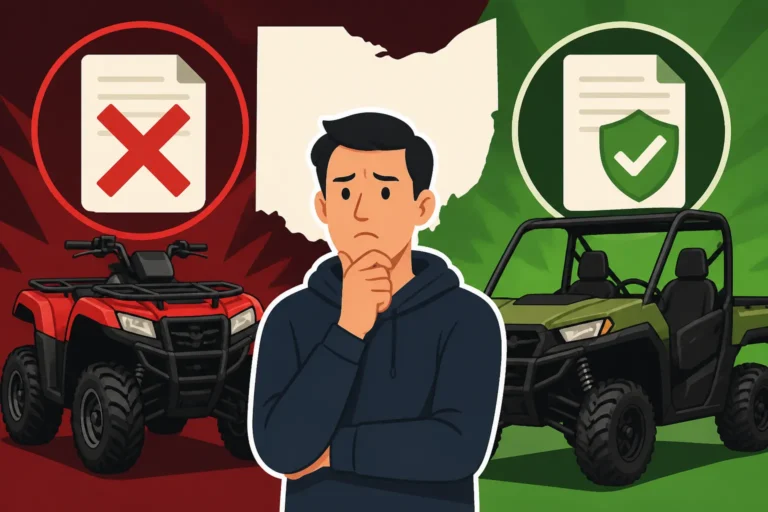
The law understands that a quad isn't always a recreational toy. For many farmers, it's an indispensable tool, just like a tractor or a pickup truck used around the farm. You’re using it to check fences, move irrigation lines, haul feed to livestock, or carry tools for field repairs. Because these tasks are integral to agricultural operations, the state has made provisions. This exemption isn't about giving farmers a free pass; it's about recognizing the practical reality of farming and distinguishing between recreational use and legitimate agricultural work. When your APV is genuinely confined to these agricultural tasks on private land, Ohio law typically allows it to operate without the standard registration and titling.
It’s easy to feel overwhelmed by all the rules and regulations that surround things like vehicle registration, especially when your machine rarely, if ever, leaves your own fields. Many people assume any motorized vehicle needs to be registered, but for farming equipment, there are often common-sense carve-outs. This specific exemption is a prime example of the state recognizing the distinct purpose of certain machinery in a working farm environment. To fully grasp the broader context of these definitions, it's helpful to look at [How Ohio Law Defines an APV].
What "Farm Use" Truly Means in Ohio Law
The key to this exemption lies in the definition of "farm use." This isn't a vague term; it’s fairly specific about the activities and locations that qualify. Generally, an APV is considered to be used for agricultural purposes if it's employed in activities directly related to cultivating the soil, raising or harvesting crops, or raising livestock or other animals, all within the confines of private property dedicated to these purposes. This means hauling fence posts across your back forty, checking on cattle in a pasture, or transporting tools from the barn to a distant field would typically fall under this umbrella.
However, "farm use" has its limits. If you decide to take that same quad out on a weekend joyride down a township road, or if you regularly use it to run errands into the nearest small town, you've stepped outside the bounds of the exemption. Even if you're a farmer, personal recreational use, hunting, or commuting off your property are not considered "farm use" in the eyes of the law for the purpose of avoiding registration. The intent and location of use are paramount. It’s not just who owns the machine, but how and where it’s being operated.
For instance, imagine Farmer Ted uses his side-by-side every day to spray his crops and move hay bales on his hundred-acre property near New Philadelphia. He never takes it off his land, and it rarely even sees the main gravel lane leading to his farmhouse. In this scenario, his machine would almost certainly be exempt from Ohio’s titling and registration requirements. Now, consider his son, Junior, who uses a quad on the same farm during the week for chores, but on weekends, he trailers it to Monday Creek State Forest for some serious trail riding. Junior’s quad would absolutely need to be titled and registered, because its use extends beyond the strict definition of agricultural purposes on private land. The machine is the same, but the application changes everything. For those specifically looking to understand the requirements for farm machines, a deep dive into [Registering a Farm Machine in Ohio] can be incredibly useful.
The Gray Areas and "Just in Case" Scenarios
Life on a farm isn't always neatly confined to a single parcel of land. There are situations where your "farm-only" APV might briefly touch public ground, and it's these moments that can introduce a lot of confusion and potential legal trouble. For example, what if your farm fields are split by a low-traffic county road, and you need to cross it to get from one section of your property to another? Or perhaps you occasionally lend your machine to a neighbor for a short, specific farm task on their adjoining property, which might require a quick hop across a shared easement?
These are the gray areas where the "farm use" exemption can get tricky. Generally, if you're crossing a public road in the most direct and expeditious manner possible, purely to get from one part of your farm to another, and this is an infrequent occurrence, you might still be okay without full registration. However, this is where you step onto thin ice. The moment you drive along a public road, even for a short distance, or if your crossing becomes a regular, integral part of your operation rather than an occasional necessity, you are likely required to have your APV registered. The law wants to distinguish between incidental contact with public ways and actual use of them.
It's also crucial to remember that even if your APV is exempt from registration, it might still need a title. The state wants a clear record of ownership for all vehicles, especially if there's ever a need to prove who owns it, like after a theft or if you decide to sell it. While a machine used exclusively for agriculture might not need an active registration, having a title provides that crucial proof of ownership. Many farmers choose to title their machines even if they don't register them, simply for peace of mind and to avoid future headaches. If you ever think you might sell your machine, a title is essential for [Selling an APV in Ohio]. If you're ever in doubt, it's always safer to err on the side of caution or consult with your local Deputy Registrar or Clerk of Courts office.
Here's a breakdown of common farm scenarios and their likely registration status:
| Scenario | Location of Use | Registration Required? | Reasoning |
|---|---|---|---|
| Hauling feed within your own fields | Private farmland only | No | Direct agricultural use, confined to private property. |
| Checking fence lines on your property | Private farmland only | No | Direct agricultural use, confined to private property. |
| Crossing a township road to another field | Brief, direct crossing of public road between owned parcels | Possibly No, but risky | Incidental crossing for agricultural purposes. Frequent or prolonged use of the road would trigger registration. |
| Riding to a neighbor's farm down a public road | Public road use, even if short and for farm tasks | Yes | Operating on public roads, regardless of intent, typically requires registration. |
| Hauling hunting gear on your own land | Private land, recreational/hunting use | Yes | While on private land, hunting is generally not considered "agricultural use" in the context of this exemption. If this is its primary use, registration is required. |
| Taking it to a local repair shop | Public roads involved | Yes | Any transport on public roads, even for maintenance, would typically require registration. Trailering it would avoid this. |
| Letting your kids ride it for fun | Private land, recreational use | Yes | Recreational use, even on private land, does not qualify for the agricultural exemption from registration. |
This table illustrates that the line is drawn quite clearly when public roads are involved, or when the use shifts from strictly agricultural work to anything recreational or personal, even on your own property. If you find yourself needing to draft documents for any machine transfer, even an informal one, services like LawDepot can provide templates for a [Ohio APV Bill of Sale Requirements], which can be invaluable for proving ownership later on, registered or not. Even for farm machines, having a proper paper trail is always a good idea.
Practical Steps for Ohio Farmers
Even if you believe your farm-only APV is exempt from registration, there are still some smart steps you should take to protect yourself and ensure you’re always on the right side of the law. The last thing any busy farmer needs is a run-in with law enforcement over something that could have been easily avoided.
First, always carry proof of ownership. Even without a registration card, you should have a bill of sale or, ideally, a title for your machine. This proves it's yours. If you're pulled over while briefly crossing a road (in one of those gray areas), having immediate proof of ownership, coupled with a clear explanation of your agricultural purpose and property boundaries, can make a huge difference. Without it, you could face questions about the machine's origin. [Ohio APV Title Requirements] are strict, and having a valid title is always the best way to prove you legitimately own the machine.
Second, understand local ordinances. While Ohio state law provides the general framework, individual townships and counties can have their own resolutions or rules regarding APV use, especially concerning road crossings or access. It's rare for them to override a state exemption for purely agricultural use, but it's always good to be informed about what your local government says. Contacting your township trustees or county commissioners' office can clarify any specific local concerns. This is especially true if you plan on using any farm lanes that might technically be public easements. Understanding [Ohio Rules for Riding a Farm Lane] is crucial.
Third, consider insurance. Even if you’re not required to have it for registration, personal liability insurance for your APV is a wise investment. Accidents happen, even on private property. If someone is injured on your farm while riding or working with your APV, or if there's property damage, having insurance can save you from significant financial hardship. Many insurers offer specific policies for off-road vehicles that can cover farm use. This protection is invaluable, especially as [Ohio APV Registration and Insurance Proof] is a growing concern for all riders, even if not strictly required for farm machines.
Finally, know the potential consequences of non-compliance. If you push the boundaries of "farm use" and an officer determines your machine should have been registered, you could face penalties. [Ohio Fines for an Unregistered APV] can be costly, not to mention the time and hassle involved in resolving such a citation. If you’re ever in doubt about whether your specific use case qualifies for the exemption, it’s far better to simply register and title the machine. The cost of a three-year registration is minimal compared to the potential fines and legal fees you could incur if found in violation. Even if you're certain of your exemption, keeping good records, such as a bill of sale you might prepare using a service like LawDepot, can serve as a robust backup, proving provenance and intent.
Disclaimer
This article is for general informational purposes only and does not constitute professional advice. Laws, prices and regulations vary by location and change over time. Consult a qualified professional for guidance on your specific situation.