Ohio Low-Speed Vehicle Rules
Navigating the labyrinth of Ohio's vehicle laws can feel like an impossible off-road trail, especially when you're trying to figure out what you can and can't legally drive on public roads. Many riders confuse low-speed vehicles (LSVs) with their beloved ATVs, UTVs, or even highly modified golf carts, leading to potential citations or safety issues. This guide is here to untangle the specific rules governing low-speed vehicles in Ohio, clarifying their definitions, where you can ride them, and what’s required to stay within the law.
What Exactly is an Ohio Low-Speed Vehicle (LSV)?
When you hear "low-speed vehicle" in Ohio, it's easy to picture a golf cart with some added lights, or perhaps a smaller UTV. However, the legal definition is much more precise, setting LSVs apart from other types of machines and dictating how and where they can be operated. Understanding this distinction is crucial to avoiding misunderstandings at the deputy registrar's counter or, worse, with law enforcement.
Defining an LSV by Ohio Law
In Ohio, a low-speed vehicle (LSV) isn't just any slow-moving vehicle. It's specifically defined as a four-wheeled electric vehicle with a top speed greater than 20 miles per hour but not greater than 25 miles per hour. This is a critical point: it must be electric, it must have four wheels, and its speed range is tightly regulated. This definition immediately excludes most traditional ATVs and UTVs, which are typically gasoline-powered and designed for higher speeds off-road, or for utility tasks that exceed this limited road speed.
Think about the difference: an ATV or a side-by-side, even if driven slowly, is legally categorized as an "all-purpose vehicle" (APV) under Ohio law, as we discussed in [How Ohio Law Defines an APV]. These machines are built for rugged terrain and demanding conditions. An LSV, on the other hand, is built for paved-road convenience in specific, slower-paced environments. They are often seen in planned communities, college campuses, or around golf courses, providing a convenient and eco-friendly way to get around without needing a full-sized car. The intent behind their design and their legal classification is fundamentally different from a recreational off-road vehicle.
Key Equipment Requirements for LSVs in Ohio
To be considered a legal low-speed vehicle on Ohio roads, the machine isn't just about its speed and electric motor; it also has to meet a stringent list of safety equipment requirements. These aren't suggestions; they are mandates designed to ensure the vehicle is safe for limited road use. Without these features, your vehicle, no matter how slow it goes, won't qualify as an LSV in Ohio.
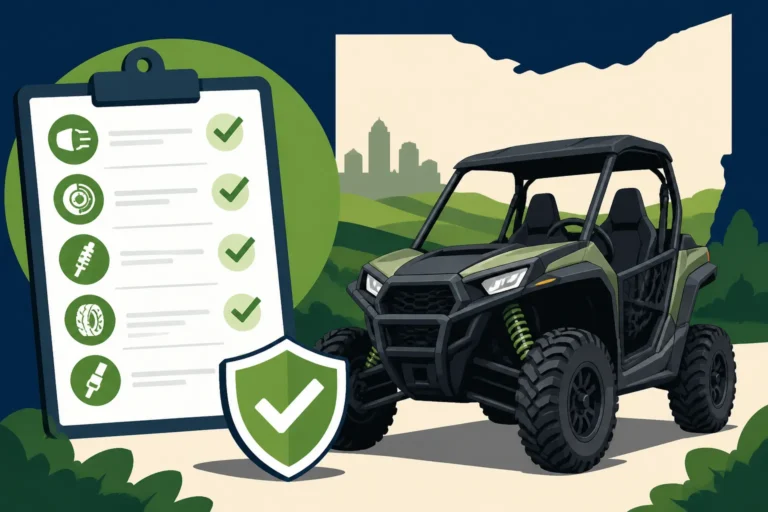
The required equipment includes headlamps, tail lamps, stop lamps, turn signals (both front and rear), reflex reflectors (red on the rear and amber on the front sides), an exterior mirror on the driver’s side and either an exterior mirror on the passenger’s side or an interior rearview mirror, a parking brake, a windshield, a horn, a vehicle identification number (VIN), and seat belts for each occupant. These are essentially the basic safety features you'd expect on a conventional automobile, scaled for an LSV. For anyone looking to convert a golf cart or similar machine into a legitimate LSV, they would need to ensure every one of these components is present and fully functional. This is where quality aftermarket parts come into play, with companies like SuperATV offering various lights, mirrors, and other accessories that could potentially help a builder meet these standards for certain vehicle types.
It's important to stress that simply adding a light kit to a golf cart usually doesn't make it an LSV. Each component must meet specific performance standards, such as headlight brightness or turn signal visibility. The comprehensive nature of these requirements is what truly distinguishes an LSV from a recreational vehicle or an un-road-legal golf cart. Without all these safety features, an otherwise compliant low-speed electric vehicle remains simply a golf cart, limited to private property or specific crossings, not open roads.
Where Can Ohio LSVs Be Driven Legally?
The limited speed of low-speed vehicles means their road access is also limited. While they offer a fantastic way to get around certain areas, they aren't meant for highways or even most major arterial roads. Understanding these restrictions is vital for safe and legal operation.
Road Restrictions and Speed Limits
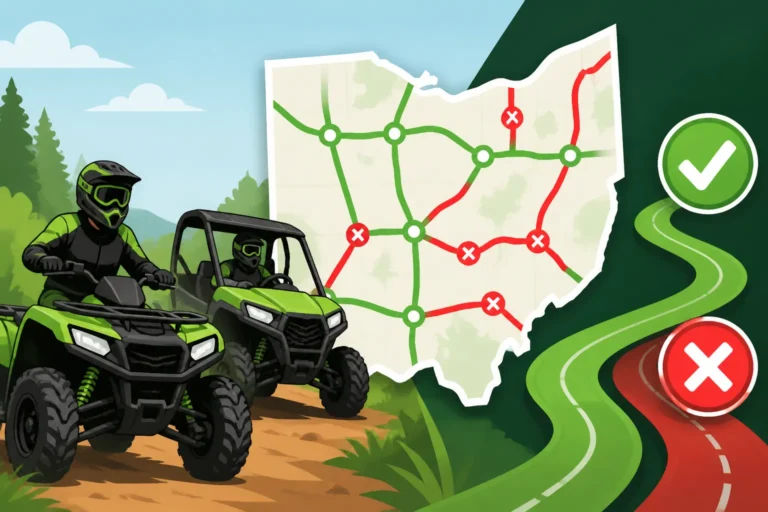
In Ohio, a low-speed vehicle is permitted to operate only on roads with a posted speed limit of 35 miles per hour or less. This rule is absolute. If a road's speed limit is 40 mph or higher, your LSV cannot legally be on it. This restriction is in place for obvious safety reasons; mixing a vehicle topping out at 25 mph with traffic moving at 40 or 50 mph creates a dangerous situation for everyone.
There are, however, some practical exceptions to this general rule that allow for limited mobility. An LSV may cross a road or highway with a speed limit greater than 35 mph, but it cannot travel on that road. For instance, if you're in a community where LSVs are common and you need to get from one neighborhood section to another, crossing a main road might be necessary. This is similar to how [Ohio Rules for Crossing a State Route] often apply to other vehicle types with limited road access. Such crossings must be made as directly and safely as possible, yielding to all other traffic. Beyond these limited crossings, if the posted speed limit climbs above 35 mph, your LSV must exit the roadway.
Local Ordinances and LSV Use
While state law sets the baseline for LSV operation, local municipalities in Ohio have the authority to further regulate or even prohibit LSV use on their streets. This means that even if a road technically has a 35 mph speed limit or less, a city, village, or township might have passed an ordinance that restricts or bans LSVs altogether. This is a common theme with specialized vehicles, where local control often dictates the practical reality of road access, much like with [Ohio Rules for Riding a Township Road] for APVs.
Imagine you live in a charming lakeside village. State law might allow LSVs on its 25 mph streets, but the village council, perhaps due to narrow roads or pedestrian concerns, could pass an ordinance completely prohibiting them. Conversely, a large retirement community, understanding the utility and appeal of LSVs for its residents, might actively encourage their use and designate specific routes or parking areas. Before purchasing or operating an LSV, it is absolutely imperative to check with the local government – the city or village clerk's office, or even the local police department – to understand any specific ordinances that apply in your immediate area. Relying solely on state law without checking local rules could lead to unexpected fines or impoundment.
Titling, Registration, and Licensing for Ohio LSVs
Unlike some recreational vehicles that have simpler paperwork or no title requirements, low-speed vehicles are treated much more like conventional automobiles in Ohio when it comes to official documentation. This means a clear process for titling, registration, and ensuring the operator is properly licensed.
The LSV Titling Process in Ohio
Just like any car, truck, or motorcycle intended for road use, a low-speed vehicle must be titled in Ohio. This process is handled through your county Clerk of Courts title office, the same place where you would title a standard car. For a brand-new LSV, you'll need the manufacturer's Certificate of Origin (MCO). If you're buying a used LSV, you'll need the previous owner's Ohio title, properly assigned to you. If it's an out-of-state LSV, the process will involve converting its out-of-state title to an Ohio title.
The titling process for an LSV is quite distinct from that for an [Titling an APV at an Ohio Clerk of Courts]. While an APV title is also issued by the Clerk of Courts, the fees and some of the requirements can differ slightly, reflecting their different legal classifications and intended uses. Ensuring your LSV has a clean, properly transferred title is the very first step toward legal operation on public roads. Without a title in your name, you won't be able to register the vehicle or obtain license plates.
Registering and Plating Your Ohio LSV
Once your LSV is titled, the next step is to register it with the Ohio Bureau of Motor Vehicles (BMV) and obtain license plates. This is done at any Deputy Registrar's office, the same locations where you renew your car's plates or get your driver's license. You'll need to present your Ohio title, proof of identity, and proof of insurance. The registration fees for an LSV are generally similar to those for passenger cars, though always check with the BMV or deputy registrar for current figures.
The license plate issued for an LSV is a standard passenger car plate, not the special plate issued for all-purpose vehicles. This visually reinforces its classification as a street-legal, albeit limited-speed, vehicle rather than a recreational off-road machine. Unlike the [Ohio APV Plates and Validation Stickers] which have a distinct look and specific placement rules, an LSV plate will be mounted in the same manner as a car plate. The registration is typically for one year, and you'll receive a sticker to apply to your plate, indicating the expiration date. Regular renewal is required to maintain legal road access.
Driver's License and Insurance Requirements for LSVs
Operating an LSV on Ohio public roads requires a valid driver's license. This isn't like operating a farm implement on a field or even riding an APV on private land where a license might not be necessary. Because an LSV is a street-legal motor vehicle, the operator must hold a valid Ohio driver's license, just as if they were driving a car. This means anyone driving the LSV must be at least 16 years old and have successfully passed the state's driving exams. As discussed in [A Driver's License on an Ohio Road], this applies to all vehicles deemed suitable for road use.
In addition to a driver's license, proof of financial responsibility, typically in the form of automobile liability insurance, is mandatory for LSVs operating on public roads. You must carry an insurance card and be able to present it if requested by law enforcement, just as you would with your car. The insurance requirements for an LSV are generally the same as for other motor vehicles, covering liability for bodily injury and property damage. Without this insurance, you are not only breaking the law but also exposing yourself to significant financial risk in the event of an accident. [Proof of Insurance on an Ohio Road] is not just a suggestion; it's a legal cornerstone for safe road sharing.
LSVs vs. All-Purpose Vehicles (APVs) and Golf Carts in Ohio
The lines between low-speed vehicles, golf carts, and all-purpose vehicles can often feel blurry, especially to the untrained eye. However, Ohio law draws very clear distinctions, which impact everything from where you can drive them to the equipment you need. Mistaking one for the other can lead to serious legal consequences.
Why an LSV Isn't Just a Souped-Up Golf Cart
It's a common misconception that if you take a standard golf cart, add a light kit, some mirrors, and maybe a lift, you've suddenly got an Ohio-legal low-speed vehicle. This simply isn't true. While some golf carts can be modified to meet LSV standards, the key difference lies in the vehicle's original design, manufacturing, and adherence to specific Federal Motor Vehicle Safety Standards (FMVSS). An LSV, as manufactured, is built to meet these rigorous standards, ensuring components like brakes, steering, and structural integrity are up to par for limited road use. Many standard golf carts are not.
Think of it this way: a golf cart is primarily designed for golf course terrain and very short, controlled trips. Its chassis, suspension, and braking systems are typically not engineered for the stresses of prolonged road use or potential impacts at 25 mph. An LSV, on the other hand, comes from the factory with these considerations in mind. For individuals attempting to build an LSV from a golf cart chassis, they would need to ensure that all necessary components meet the relevant federal and state standards, not just basic visibility. This could involve upgrading entire systems. Companies like SuperATV specialize in durable, high-quality accessories, but even their products, while excellent for UTVs, might not transform a basic golf cart into a federally compliant LSV without significant, professional engineering and certification.
The Key Differences from Ohio APVs
The distinction between an LSV and an All-Purpose Vehicle (APV), which includes ATVs and UTVs, is perhaps the most important for off-road enthusiasts. APVs are primarily designed for off-road recreation or utility tasks, and their limited road use in Ohio is a privilege granted under specific circumstances, often requiring local resolutions. An LSV, however, is designed for limited road use.
Here’s a breakdown of the critical differences:
| Feature | Low-Speed Vehicle (LSV) | All-Purpose Vehicle (APV – UTV/ATV) |
|---|---|---|
| Primary Use | Limited public road travel, neighborhood transit | Off-road recreation, utility, farm work |
| Power Source | Electric only | Typically gasoline (some electric models exist) |
| Top Speed | 20-25 mph (governed) | Varies widely, often much higher than 25 mph |
| Road Access | Roads 35 mph or less (with local discretion) | Very limited; specific county/township roads via resolution; [Ohio Counties That Allow APVs on Roads] |
| Titling | Required, like a car | Required, specific APV title |
| Registration | Standard passenger car plate & registration | Specific APV plate & 3-year registration [Ohio's Three-Year APV Registration] |
| Driver's License | Required | Required for road use |
| Insurance | Required, like a car | Required for road use |
| Inspection | Generally not required for standard LSV, but could be specific if custom built and deemed a street-legal vehicle like a UTV needing [Ohio UTV Inspection Requirements] | UTVs require inspection for road use; ATVs do not [Why an APV Needs No Inspection in Ohio] |
| Equipment | Comprehensive list (lights, signals, seatbelts, windshield) for road safety | Specific equipment for off-road and limited road use [Ohio APV Road Equipment List], [Ohio UTV Road Equipment List] |
You can see that the legal framework for an LSV is much closer to that of a conventional car than it is to an ATV or UTV. While some UTVs might have similar features to an LSV (like a windshield or seatbelts), their higher speeds and different primary design purpose mean they fall under entirely separate regulations for road use. An APV, even a fully equipped side-by-side, cannot simply be re-designated as an LSV just because it's being driven slowly. Each category has its own set of rules, and adhering to them is key for safe and legal enjoyment of your machine.
Disclaimer
This article is for general informational purposes only and does not constitute professional advice. Laws, prices and regulations vary by location and change over time. Consult a qualified professional for guidance on your specific situation.