Ohio Fines for Riding a Closed Trail
Ohio Fines for Riding a Closed Trail
A closed-trail citation can come from a state forest, a national forest, or another land manager, and the consequences are not necessarily the same. The key point is simple: a registration plate or trail permit does not give permission to ride a route that is closed. Knowing who manages the trail, what the closure covers, and what to do if you receive a citation can help you avoid a preventable mistake.
What riding a closed trail can mean in Ohio
A closure may apply to a single trail segment, a whole riding area, a road, or all motorized routes on a property. It may be seasonal or temporary, or it may remain in place until a repair or land-management issue is resolved. A closed trail is not simply a route that looks difficult or inconvenient: it is a route the responsible land manager has closed to riding.
Closures can be in effect even when the entrance is not blocked by a gate. A sign, a posted notice, an official closure map, or an instruction from the managing authority may tell riders that a route is off limits. If you are unsure whether a closure applies to the trail ahead, do not ride through to find out. Stop somewhere safe and check with the land manager.
A closure can be issued for reasons such as:
- Wet or unstable ground that could be damaged by tires.
- Trail repair, bridge work, logging, or other maintenance.
- A safety hazard, such as a washout or fallen tree.
- Seasonal restrictions or wildlife and habitat protection.
- A change in the routes open to motorized use.
These examples help explain why closure notices can change during the riding season. A trail that was open on a previous visit may be closed on your next one. Being familiar with the route, having a current registration, or holding a valid pass does not by itself authorize riding after a closure takes effect.
The land manager matters because Ohio riding areas are not all governed by one trail authority. State forests and Wayne National Forest, for example, have different managers and rules. A citation may be handled under the rules that apply to the property where the riding occurred. For a broader overview of public-land requirements, see Ohio Rules for Riding State Forest Land and Ohio Rules for Riding a National Forest.
| Situation | What it means for the rider | Practical response |
|---|---|---|
| A sign marks a trail closed | Do not enter or continue past the closure | Turn around safely and choose an open route |
| A gate or barrier blocks the route | The route is not available for riding, even if a map shows it | Do not go around, move, or bypass the barrier |
| A map and a sign appear to conflict | The information may be out of date or apply to different sections | Stop and ask the land manager before proceeding |
| A closure appears farther along the trail | The route ahead may be closed even if the entrance is open | Turn back at a safe point; do not ride to the barrier |
| A law-enforcement or land-management officer gives an instruction | The officer is directing you about the route or your conduct | Follow the instruction and ask questions calmly when safe |
How fines and other consequences depend on the land manager
There is no single statewide fine amount that applies to every closed-trail incident. The consequence can depend on who manages the land, the rule allegedly violated, the circumstances, and how the matter is processed. State forest land, national forest land, local property, and private land may involve different rules and enforcement processes.
A rider might receive a citation or notice that requires a response through a court or another designated process. The issuing authority may explain the alleged violation and provide directions for what to do next. Some incidents may involve more than one alleged violation—for example, riding into a closed area as well as damaging a trail or ignoring an instruction. Do not assume that two citations, or citations from different agencies, will be handled in the same way.
The amount, payment method, response deadline, and possible outcomes should be taken from the citation and the authority responsible for the property. They can vary, and they may change. Avoid relying on a friend’s experience or an old online post as a guide to what a current ticket will cost.
Possible consequences beyond a fine
Depending on the facts and applicable rules, a closed-trail incident may lead to more than a payment. The process could involve a required court appearance, additional penalties for separate violations, or responsibility for damage. Whether any of these apply is specific to the incident and the authority involved; they should not be treated as automatic consequences of every closure citation.
Trail damage can also create practical problems for other riders. A machine that breaks through wet soil may leave ruts, widen a route, or damage drainage features. A closure intended to protect a trail can become harder to lift if riders continue using it. If there is damage, report it to the land manager rather than trying to repair the area yourself. Unapproved work can create additional issues.
If you are cited, read the document carefully. It should identify the alleged violation and explain how to respond. Do not ignore it because you believe the closure was poorly marked or the ticket is mistaken. Missing a required response can create complications separate from the original allegation. If you are unsure what the citation requires, contact the issuing agency or the court named on the document. For questions about possible legal consequences or how to contest a citation, consider speaking with a qualified attorney.
For context on how a different registration-related citation is treated, see Ohio Fines for Riding Without a Plate. A registration issue and a closed-trail violation are not interchangeable: having a plate does not make a closed route open.
Why permits and reciprocity do not override closures
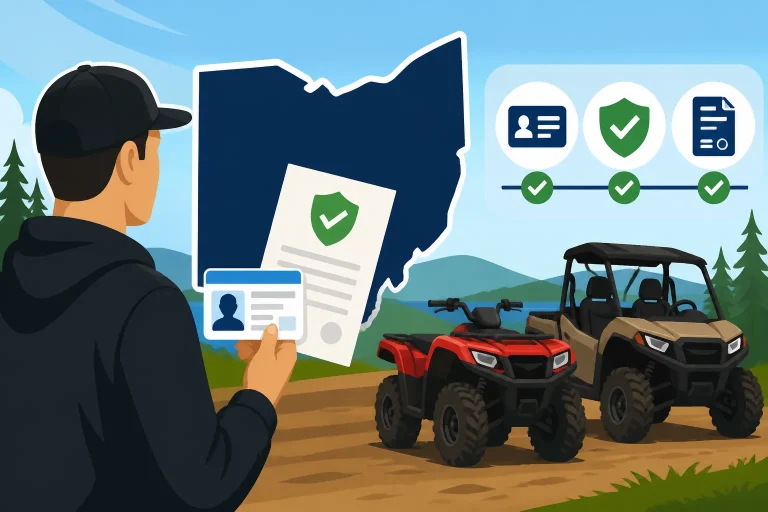
Ohio registration, a visitor permit, or a federal forest pass can be required for access to particular riding areas. Those credentials do not authorize riding on every route within the area. They establish eligibility to ride where riding is permitted, subject to the specific rules and closures in effect.
The same principle applies to a machine registered in another state. Reciprocity may affect whether a visitor can use an out-of-state registration on an Ohio riding area, but it does not cancel a closure. A rider with valid paperwork can still be cited for entering a route that is closed.
Before traveling, check both the access requirements and the current route status. The articles Ohio APV Reciprocity With Other States and Ohio Temporary Permit for Visitors can help clarify visitor paperwork, while Ohio Trail Closures to Check First focuses on checking closures before loading up.
How to tell whether a trail is closed
Start with the information published by the agency or land manager responsible for the trail. A general trail map can show the system, but it may not reflect a recent closure. Look for current notices, maps, trailhead signs, and direct updates from the managing office. If the closure is unclear, call before you ride.
At the trailhead, read the posted information before unloading. Look for signs at entrances and intersections, temporary notices, barriers, and changes to the route map. Do not assume that a sign applies only to vehicles of a certain type unless the notice clearly says so. If wording is unclear, ask the land manager instead of guessing.
Official information is especially useful when a closure is temporary. A trail may be shut after heavy rain, during repairs, or for another short-term reason. A map saved on a phone or printed before the trip may not show a change made afterward. Treat maps as planning tools, not as permission to pass a closure notice.
Useful habits include:
- Check the land manager’s current information shortly before leaving.
- Confirm which office manages the exact trail system you plan to ride.
- Read all notices at the staging area, not only the signs beside the trail.
- Pay attention to temporary signs at junctions and crossings.
- Ask whether a closure applies to the whole route or just a named section.
- Keep the land manager’s contact information available in case conditions change.
If an official source says the trail is open but a closure sign is posted on site, stop and seek clarification. Do not take the map as permission to ride past a sign. Conversely, if a closure notice is ambiguous or seems out of date, do not remove it or decide on your own that it no longer applies. Contact the responsible office. What the Trailhead Board Tells You Before a Ride and Calling a Ranger District Before You Load offer practical ways to use trailhead information and check with the managing authority.
What to do if you encounter a closure or get a citation
The safest response to a closure is to stop before entering it and turn around without damaging the trail or creating a hazard. If another rider in your group has already gone ahead, do not follow. Contact them by a safe, permitted method and direct them back if possible. If you cannot turn around without risk, stop and ask the land manager or an officer for direction.
Do not ride around a gate or barrier, move a sign, or use an unmarked bypass. A barrier may be protecting a damaged section or keeping riders away from work or a hazard. An alternate-looking track may be unauthorized, private, or equally subject to the closure.
If an officer or land manager stops you, remain calm. Follow directions, keep your hands visible, and provide identification or documents when requested. Ask what route or rule is involved, but avoid arguing roadside. Make a note of the time, location, trail name, signs you saw, and any directions given. Do not obstruct the officer or attempt to leave before the stop is complete.
If you receive a citation:
- Read the full document and identify the issuing authority, alleged violation, and response instructions.
- Note any deadline or hearing information printed on it.
- Keep the citation and any related paperwork together.
- Write down your recollection while details are fresh, including where signs and barriers were located.
- Save relevant photographs, maps, and official closure notices without altering them.
- Contact the agency or court listed if you do not understand how to respond.
- Consider legal advice if you plan to contest the citation or face consequences you do not understand.
A photograph can help document what a sign said or where it was placed, but it does not automatically prove that riding was allowed. If you collect images, do so safely and without interfering with an officer, workers, or other riders. Do not trespass or walk into a hazardous area to photograph a closure.
If you believe the closure was not clearly marked, focus on documenting the facts rather than making assumptions. Record the exact location, direction of travel, and what signs were visible from your approach. Keep copies of maps or notices you relied on, including the date you checked them if available. The agency or court can explain how to submit information as part of the formal process.
A citation should be treated separately from any immediate trail decision. Even if you believe the closure was mistaken, do not return to ride the route while the issue is unresolved. Ask the land manager whether the trail is open now and follow its current instructions. For information about another kind of citation on public riding land, see What a Wayne National Forest Citation Costs a Rider.
Preventing a closed-trail citation
A few minutes of preparation can prevent a long drive to a closed route and reduce the risk of damaging a trail. Build the closure check into your normal trip planning rather than relying only on memory or a map from a previous visit.
First, identify the exact riding area and its manager. A nearby road, forest, or trailhead may belong to a different authority than the route you intend to ride. Next, check current notices and ask about temporary closures if conditions are uncertain. Finally, read the trailhead information after arrival and remain alert for notices farther along the route.
It also helps to plan a fallback. If the route you came for is closed, know which other routes are open and whether your machine is permitted on them. Do not assume that every trail in the system has the same access rules or width limits. If no suitable route is open, the sensible choice is to unload somewhere else or make another trip.
A reliable pre-ride routine looks like this:
- Confirm the property and managing agency.
- Check current closure information close to departure.
- Verify required registration, permits, and access rules separately.
- Review the map and identify open alternatives.
- Read signs at the staging area before starting.
- Turn back when a closure is posted or an officer directs you to stop.
- Recheck conditions if you leave the trail system and return later.
These steps matter for both Ohio residents and visitors. An out-of-state plate may be accepted for some riding, or a visitor may need a temporary permit, but neither replaces checking whether the route is open. Similarly, a ride that was legal last month can become prohibited when a temporary closure is issued.
When a trail is closed, treat the notice as controlling unless the responsible land manager confirms otherwise. That approach protects the route, avoids unnecessary enforcement problems, and keeps the group from turning a manageable detour into a citation.
Frequently Asked Questions
Is there one fixed Ohio fine for riding a closed trail?
No single fine applies to every situation. The responsible land manager, the rule involved, and the facts of the incident can affect the process and outcome. Follow the citation and confirm current requirements with the authority named on it.
Can I ride past a closure if my Ohio plate is valid?
No. Registration or a required permit does not override a trail closure. It only addresses access credentials where riding is otherwise permitted.
What if the map says open but a sign says closed?
Stop and do not enter. Contact the land manager to clarify the conflict. A map may not include a recent closure, and a sign should not be ignored based on an older map.
Does a closed trail citation always require a court appearance?
Not necessarily. The citation or notice should explain what response is required. Check the instructions and contact the named court or agency if anything is unclear.
Should I photograph a closure sign after receiving a citation?
A safe, unaltered photograph may help document what you saw, but it does not determine whether the route was legally open. Do not enter a hazardous area or interfere with enforcement to take pictures.
Disclaimer
This article is for general informational purposes only and does not constitute professional advice. Laws, prices and regulations vary by location and change over time. Consult a qualified professional for guidance on your specific situation.