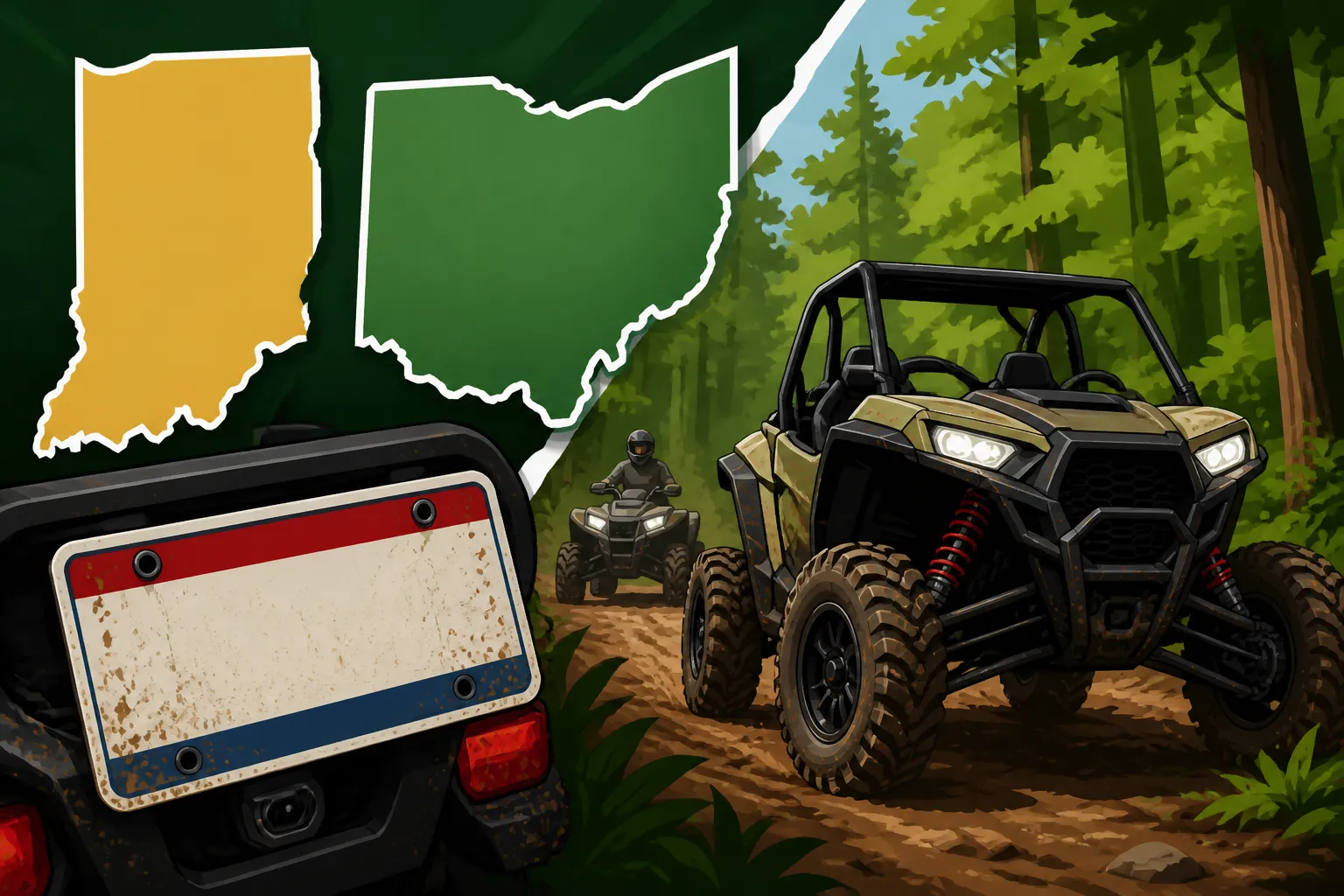
An Indiana Plate in an Ohio Forest
An Indiana registration can usually satisfy Ohio’s registration requirement for a visiting machine when it is valid and covered by Ohio’s reciprocity rules. But it is not a pass for every Ohio riding area. The key is knowing whether you are heading to an Ohio state forest trail or Wayne National Forest, and carrying the proof each one expects.
When an Indiana registration works in Ohio
Ohio generally recognizes valid off-road vehicle registration from states that register comparable machines, subject to reciprocity. That means an Indiana visitor may be able to ride an Ohio trail using the machine’s Indiana registration rather than obtaining a separate Ohio registration or visitor permit. The details matter: the registration must be current, apply to the machine being ridden, and meet Ohio’s requirements for recognition.
A state-issued registration credential is not always the same thing as a license plate. Depending on the machine and Indiana’s rules, the credential you need to display or carry may be a plate, decal, or registration document. A title proves ownership; it does not necessarily prove current registration. Likewise, a road-use plate or ordinary vehicle registration should not be assumed to replace an off-road registration if the trail system requires one.
Ohio reciprocity is about whether the state accepts the visitor’s registration. It does not mean every Indiana machine is automatically eligible everywhere in Ohio. Check the machine’s status before loading it, especially if it is borrowed, rented, newly purchased, or registered under a different owner’s name. For the broader rules, see Ohio Reciprocity for Out-of-State Machines and Which States’ Registrations Ohio Accepts on Its Trails. The Indiana-specific overview is Ohio Reciprocity With Indiana.
| What you have | What it may establish | What it does not automatically establish |
|---|---|---|
| Current Indiana off-highway registration | That the machine is registered in its home state and may qualify under Ohio reciprocity | Permission to ride every Ohio trail or road |
| An Indiana title | Ownership or a claim of ownership | Current registration or trail access |
| A road-use plate or vehicle registration | Road registration under the applicable rules | That the machine has any required off-road registration |
| A Wayne National Forest OHV permit | Required access for the applicable Wayne riding area | Registration or road-use permission |
| An Ohio visitor permit | A registration option for eligible visitors when reciprocity does not apply | A substitute for separate site-specific permits |
Before setting out, confirm that the Indiana credential is the kind Ohio recognizes for off-road use. Ohio’s reciprocity rules can depend on what the home state requires and whether the visitor’s registration is valid for the machine and use. If the machine is registered in Indiana only for road travel, ask Ohio’s official vehicle or natural-resources authorities whether that registration meets the trail requirement. Do not rely on a seller’s assurance or a plate that is no longer current.
A visitor whose home state does not register comparable machines may need an Ohio temporary permit instead. That is a different situation from bringing a machine with valid Indiana off-highway registration. See The Ohio Temporary Permit for Visitors and What a Visitor From a Registering State Must Show for the distinction and the documents to have ready.
Reciprocity also does not erase Ohio’s riding rules. An accepted Indiana registration does not authorize riding on a closed trail, a road that is not open to APVs, private property without permission, or land where the machine is not allowed. It does not waive Ohio’s applicable helmet, age, supervision, equipment, or operating requirements. Treat registration as one part of access, not a general permission slip.
State forest trails and Wayne National Forest are different
The word “forest” can refer to more than one kind of riding area in Ohio. Ohio state forest trails and Wayne National Forest are managed under different systems. A registration that is accepted as proof for one kind of access may not cover the separate permit or pass required at another. Check the specific riding area, not just the name of the nearest forest.
On Ohio state forest trails, the machine generally needs a valid registration credential accepted by Ohio. For an eligible Indiana visitor, an accepted home-state registration may serve that purpose under reciprocity. Ohio describes its own APV plate as part of the trail-access system, but a visitor should not assume an Indiana credential is treated identically in every detail. Confirm the current requirements for the particular trail and carry proof of registration. The state rules are outlined in Ohio Rules for Riding State Forest Land, and Ohio APV Reciprocity With Other States explains how out-of-state registration fits into the system.
Wayne National Forest is federal land, not an Ohio state forest. Its off-highway vehicle areas have a separate permit system. An Indiana registration does not replace a Wayne National Forest OHV permit where one is required. The permit applies to access under that forest’s rules; it does not register the machine with Ohio or make it legal to ride elsewhere. Check the details in How the Wayne National Forest OHV Permit Works before choosing a trailhead or buying a pass.
The distinction is practical:
- If you plan to ride an Ohio state forest trail, check whether your current Indiana registration is accepted for that trail and what proof must be displayed or carried.
- If you plan to ride in Wayne National Forest, check the federal forest’s permit rules separately, even if the Indiana registration is fully valid.
- If your trip includes both, meet both sets of requirements. Do not assume one credential covers the whole weekend.
- If you plan to use a road to reach or connect riding areas, check road access separately. Trail registration does not open a road to APVs.
For planning, use the trail system’s official information rather than a map pin or a general description that says an area is “open.” Ohio trail locations, closures, and access conditions can change. Ohio Trail Maps From ODNR is a useful starting point for state-managed riding areas, but confirm current notices before driving to a trailhead.
What to carry and check before crossing into Ohio
A little preparation helps avoid a trailhead problem, particularly when the machine’s registration is valid but the rider cannot readily show it. Keep the registration information accessible in a form accepted by the relevant authority. If you have a display credential, check that it is attached where required and readable. Carry proof of ownership or permission when the machine belongs to someone else, and bring the Wayne permit separately if your route requires it.
Use this checklist before leaving Indiana:
- Check the registration itself. Confirm that it is current and applies to the machine, rather than relying only on a title or road plate. If you are unsure which Indiana credential applies to off-highway riding, confirm with the state agency responsible for that registration.
- Confirm Ohio reciprocity. Verify that Ohio accepts the particular kind of Indiana registration you hold. A registration for a different vehicle category, an expired credential, or paperwork for another machine can create a problem.
- Identify the land manager. Determine whether the destination is an Ohio state forest trail, Wayne National Forest, a private park, or another property. Each may have different access rules and permit requirements.
- Check for an additional permit. For Wayne National Forest, review the OHV permit requirements independently of state registration. For a private park, ask the operator about its admission and vehicle rules.
- Check the machine’s eligibility. Width limits, vehicle type, trail designations, and local closures can affect whether a machine may use a route. A valid Indiana registration does not make a machine eligible for a trail that excludes it.
- Review rider requirements. Confirm the rules that apply to the operator and any passenger, including age, supervision, helmet, eye-protection, and licensing requirements where applicable.
- Plan for road segments. Do not assume that a route between a campsite and a trail is open to APVs. Check each road and crossing; local permissions and state rules can differ.
- Keep records handy. Carry registration proof, any required permit, and relevant permission for a borrowed machine. Save official instructions or contact details so you can resolve a question before unloading.
If reciprocity does not cover the credential you have, ask whether an Ohio visitor permit is available for your situation. Do that before traveling rather than expecting a trailhead officer to treat a title, expired registration, or road-only plate as a substitute. Permit eligibility and the documents required can depend on the visitor’s home-state rules, so use the official instructions for the exact case.
It is also worth checking the condition of the visible credential. A loose, damaged, obscured, or unreadable plate or decal can make a valid registration difficult to verify. A phone photo may help you keep a backup, but it should not be treated as a replacement for a required physical display or original document unless the authority says it is acceptable.
Common mistakes Indiana visitors can avoid
The most common mistake is treating an Indiana plate as a universal trail pass. It may establish valid registration under reciprocity, but it cannot override a separate land manager’s permit requirement. A visitor headed to Wayne National Forest should check the Wayne permit before departure, even if the Indiana registration is valid and visible.
Another frequent mix-up is confusing registration with ownership. A title shows ownership history; a bill of sale records a transaction; neither necessarily proves that the machine is currently registered for off-highway use. If you recently bought the machine, verify that registration has been completed and that the credential is in effect before bringing it to Ohio.
Borrowed machines deserve extra attention. Make sure the registration is current, confirm that the owner authorizes the trip, and ensure the documents correspond to the machine’s identifying information. If the registration is in someone else’s name, carry enough information to explain that arrangement if asked. A borrowed machine does not become exempt from registration or access rules simply because its owner is not riding.
Finally, do not treat “the forest is open” as confirmation that every trail is open to every machine. Seasonal closures, maintenance, weather, trail width, and land-management decisions can affect access. A machine may satisfy registration rules and still be excluded from a particular route. Checking the current map and closure notices is more reliable than assuming that a past visit, a friend’s account, or a general online listing reflects today’s conditions.
The practical answer is straightforward: an Indiana registration may be accepted for Ohio trail use when it qualifies under reciprocity, but it is not a blanket permit. Confirm the registration category, identify who manages the riding area, and check any separate access pass before you go. Those steps help keep a paperwork issue from ending the ride at the trailhead.
Disclaimer
This article is for general informational purposes only and does not constitute professional advice. Laws, prices and regulations vary by location and change over time. Consult a qualified professional for guidance on your specific situation.