Why Ohio Mandates No Safety Course
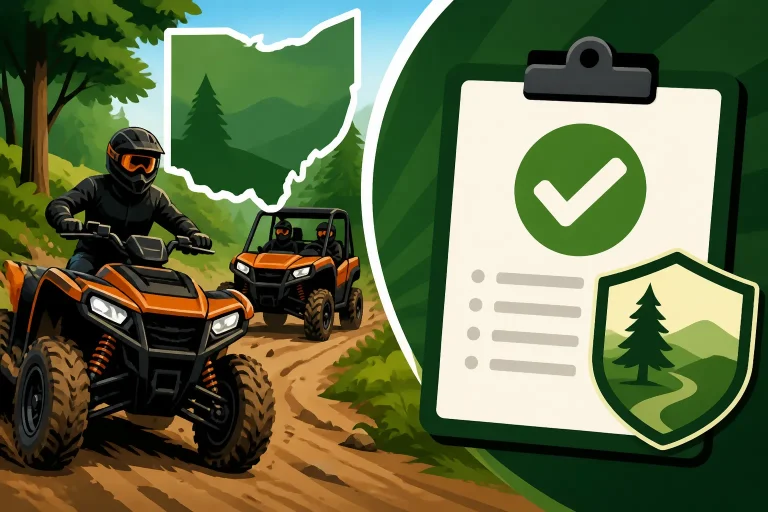
Ohio does not generally make an ATV or UTV safety course a condition of riding, registering a machine or using Ohio state forest trails. That can make the rules seem simpler than they are: age, supervision, land access and local requirements still matter. Here’s what the absence of a statewide course mandate means, and when training is still a smart choice.
What Ohio’s No-Course Rule Means
Ohio does not generally require an ATV or UTV operator to complete a safety course before riding. For ordinary recreational use, a course is not a universal prerequisite for registering an all-purpose vehicle, using Ohio state forest trails or riding wherever machines are otherwise permitted.
That is a narrow point, not a blanket statement that every rider can use every machine in every place without conditions. A course requirement is only one possible eligibility rule. A location may instead set minimum-age or supervision requirements, restrict machine types, require registration or a permit, or limit access to designated routes. A private park, event organizer, rental company or landowner may also set conditions for its own property or activity.
It helps to separate four questions:
| Question | What a safety course does | What to check separately |
|---|---|---|
| Is a course required by Ohio for ordinary riding? | Ohio does not generally make one a statewide prerequisite | Current state rules and the type of riding |
| Can a course replace registration? | No | The Ohio plate and registration rules for the machine |
| Can a course give access to a trail or property? | Not by itself | Land manager rules, permits and route restrictions |
| Does a course remove age or supervision rules? | No | Requirements for the rider’s age and riding location |
| Can a park or event require training? | It may set its own entry conditions | The park or organizer’s current rules |
A course certificate also does not turn an otherwise prohibited ride into a legal one. It cannot authorize riding on a closed trail, private land without permission, or a road that has not been opened to APVs. Those are separate access questions. For state forest access, start with Ohio Rules for Riding State Forest Land and confirm current information for the specific riding area.
The same separation applies to paperwork. Ohio registration and a Wayne National Forest pass, for example, serve different purposes. Neither one is a safety-course certificate, and completing a course does not replace a plate or pass when one is required. For registration details, see Why the Ohio Plate Is the Trail Permit. For nonresident rules, check Ohio Reciprocity for Out-of-State Machines.
Because local and site-specific requirements can differ, confirm the rules before hauling a machine to a park, organized ride or trail system. Ask directly whether training is required, recommended or simply accepted as proof of preparation. That avoids relying on a general statewide rule when the particular property has set an additional condition.
Why No Course Is a General Statewide Prerequisite
A statewide course requirement would create one standard gate before an operator could ride. Ohio’s general approach does not use course completion as that universal gate. Instead, the requirements riders encounter depend on factors such as the machine, the rider’s age, the location and the kind of use.
That means the absence of a course mandate should not be read as a finding that all riders already have the same level of skill, or that training is unnecessary. It means only that a general course certificate is not the usual statewide condition for ordinary APV riding. Riders still have to follow operating rules, use suitable equipment and respect land access restrictions.
There are practical reasons a single course rule would not answer every safety question:
- Machines differ. A small youth ATV, a full-size quad and a side-by-side do not respond in exactly the same way. Their weight, controls, passenger capacity and stability differ.
- Terrain differs. A marked trail, a steep hillside, a muddy route and a paved road crossing present different hazards.
- Riders differ. A first-time operator, an experienced adult and a young rider may need different instruction.
- Access rules differ. A state forest, private riding park, farm lane and public road are not interchangeable places to ride.
- Training is not the same as permission. A course may teach useful skills but cannot grant permission to use someone else’s land or override a closure.
A general course mandate also would not tell a rider whether a particular road is open, whether a machine meets local equipment rules, or whether a trail has a width limit. Those questions require checking the place and type of riding. For example, state forest trail access has requirements that are distinct from general registration, while road use can depend on local decisions and road-specific rules.
Registration, meanwhile, is a legal and administrative requirement where applicable. It identifies the machine for authorized use; it is not a training credential. Similarly, a permit or pass may cover access to a particular trail system, but it does not show that the operator has practiced braking, cornering or recovery skills.
This is why the most useful question is not simply “Do I need a course in Ohio?” It is “What rules apply to this rider, this machine and this place, and what preparation does the rider need to operate safely?” The first part is a compliance check. The second is a judgment about risk and skill.
What Still Applies to Young and Inexperienced Riders
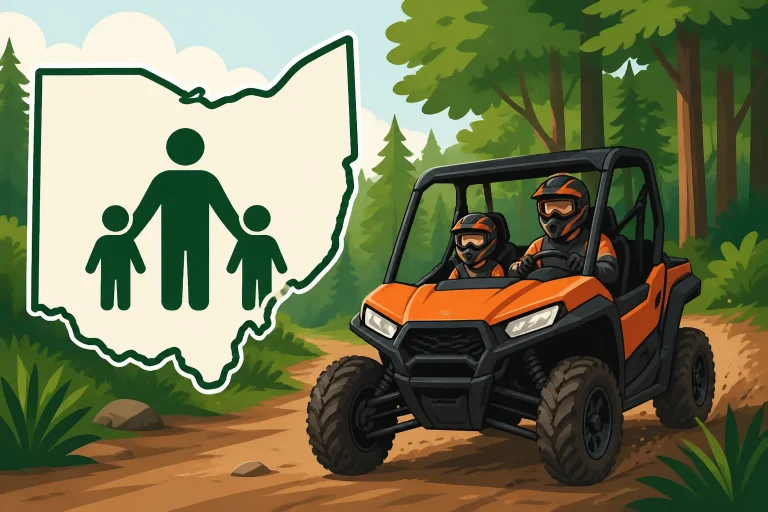
No general course prerequisite does not mean there are no rules for young riders. Age and adult-supervision requirements can apply independently of training, and the details may depend on where the machine is being used. A certificate should never be treated as a substitute for meeting those conditions.
Before a minor rides, check both the general rules and the rules for the specific land. Ohio’s minimum-age and supervision requirements are separate topics from course completion; Ohio Minimum Age to Ride an APV and [Ohio Supervision Rules on Forest Trails] can help frame the questions to verify. Rules for public land may not be identical to a private park’s youth policy.
A parent or guardian planning a ride should check:
- The rider’s age and the location. Confirm the minimum age and whether an adult must accompany or supervise the rider.
- The adult’s role. If supervision is required, confirm who qualifies and whether the adult needs a particular credential or license for that location.
- The machine’s size and controls. A child should be physically able to reach and operate the controls, steer, brake and stop the machine.
- The passenger rules. A machine designed for one rider should not be treated as a two-person vehicle. Check the machine’s design and the applicable rules before carrying a passenger.
- The property’s conditions. A private park or event may set its own age limits, waiver rules or supervision requirements.
- The rider’s readiness. Legal eligibility is not proof that a young operator can handle the machine or terrain.
A course can be particularly valuable for a new rider or a young operator because it gives structured instruction rather than leaving safety lessons to trial and error. But even a completed course does not automatically make a rider ready for a powerful machine, challenging terrain or unsupervised riding. Adults should match the machine and route to the rider’s ability, not only to the minimum legal threshold.
For families, training works best as one part of a broader plan. Teach the rider how to use the controls before entering a trail, explain where the machine is allowed to go, set clear limits on speed and distance, and practice basic maneuvers in a safe, permitted area. A parent should also discuss what to do if the machine stalls, a rider becomes separated from the group or an unexpected obstacle appears.
Protective equipment matters whether or not a class is required. A properly fitted helmet and eye protection are especially important, and other protective gear can help reduce injury risk. The required equipment can vary by location and activity, so check the rules for the planned ride rather than assuming that one equipment list applies everywhere.
A course may also help an adult spot a mismatch between a child and a machine. If the rider cannot comfortably reach the controls, keep a stable position or stop the machine promptly, more practice or a different machine may be needed. The fact that Ohio does not require a certificate does not make those practical checks optional.
Where Training Can Still Be Required or Useful
A statewide course rule is not the only way training can enter the picture. A private operator, event organizer, employer, insurer or other organization may set conditions for its own activity. That does not make the condition a general Ohio rule; it makes it a rule of that property, program or arrangement.
Before relying on the statewide rule, contact the place where you intend to ride. Ask specific questions rather than asking only whether “Ohio requires a course.” For example:
- Does this property require a certificate, or is training only recommended?
- Does the rule apply to every rider or only to minors, beginners or event participants?
- Will the property accept a course certificate from another provider?
- Is there a separate waiver, orientation or machine inspection?
- Does the requirement apply to a rental, guided ride or organized event?
- Are there additional rules for passengers or riders under a certain age?
Those distinctions matter because a course requirement may be part of a park’s admission policy or an organizer’s safety plan rather than a state licensing condition. Follow the more restrictive rule when you choose to ride at that property, and get confirmation before traveling if the requirement is unclear.
Training is useful even when it is optional. A good course can cover subjects that are difficult to learn safely while improvising, including safe starting and stopping, turning, braking, riding on slopes, reading terrain, avoiding rollover risks and responding to an emergency. The exact subject matter depends on the course, so check its curriculum rather than assuming every class covers the same skills or machine types.
When comparing training options, look for instruction that matches the machine and the rider. A course designed around a quad may not fully address side-by-side passengers or the different dimensions and handling of a UTV. A beginner benefits from hands-on practice and feedback, while an experienced rider may be looking for a refresher or instruction on a specific skill.
Useful questions to ask a provider include:
- Is the instruction intended for ATVs, UTVs or both?
- Is the course suitable for the rider’s age and experience?
- Does it include supervised practical exercises, or is it classroom-only?
- What equipment should the student bring?
- Is the certificate recognized by the property or event that requires it?
- Are there prerequisites or separate rules for minors?
A book, video or equipment checklist bought through a retailer such as Amazon can supplement instruction, but it is not a substitute for hands-on practice or an accepted course certificate. If a property requires a particular qualification, confirm that the resource meets that requirement before relying on it.
Training may also be worthwhile before a rider takes on a new kind of terrain or machine, even after years of general riding. Moving from a quad to a side-by-side, riding with a passenger, operating on steep ground or joining a group in unfamiliar conditions can introduce different decisions. A refresher does not need to be a legal requirement to be useful.
A Practical Checklist Before the First Ride
Use this checklist to separate legal permission from preparation. It applies whether the rider is new or experienced and whether training is required or voluntary.
- Identify the machine and its intended use. Confirm whether it is an ATV, UTV or another type of APV, and whether it will be used on trails, private property or roads.
- Confirm registration and paperwork. Check that the machine has the registration and plate needed for the intended use. A course does not replace those requirements.
- Check the exact riding location. Confirm that APVs are permitted, the route is open, and any pass, permit or access conditions are met.
- Review age and supervision rules. Do not assume that a completed course changes a minimum age or removes an adult-supervision requirement.
- Ask about site-specific training rules. Contact a private park, rental operator or event organizer to learn whether it requires a course, orientation or other condition.
- Match the machine to the rider. The rider should be able to control the machine and understand its limits. Consider whether the route and conditions suit that rider’s current skill.
- Check protective equipment. Confirm the applicable helmet and eye-protection rules, and choose gear that fits and is appropriate for the activity.
- Practice before tackling difficult terrain. Start in a safe, permitted area and review stopping, turning and basic control before riding a demanding route.
- Plan for the group. Agree on a route, regrouping points and what to do if someone has a problem. Keep inexperienced riders within an adult’s effective supervision.
- Recheck rules when circumstances change. A different trail, a road connection, a rental machine or an out-of-state registration can bring separate requirements.
For riders coming from another state, a home-state registration may address registration reciprocity, but it does not necessarily settle every access, age or site-specific question. Review Ohio Reciprocity for Out-of-State Machines and the applicable visitor requirements. Likewise, a valid plate does not establish that a particular trail is open to the machine.
For road use, do not assume that the absence of a safety-course requirement makes an APV street legal. Road access, equipment, insurance and local authorization are separate matters. Begin with Street Legal APVs in Ohio: The Short Answer and verify rules for the actual road or jurisdiction. Training can help with road-crossing judgment, but it cannot make a closed road open to APVs.
The safest way to use Ohio’s no-course rule is as a limited answer: a general statewide safety certificate is not ordinarily a prerequisite, but safe and legal riding still depends on the rider, machine and location. When in doubt, check the land manager or property operator and get the requirement in clear terms before riding.
Frequently Asked Questions
Does Ohio require an ATV safety course to register an ATV?
Ohio does not generally require a safety-course certificate as a condition of ordinary APV registration. Registration paperwork and course completion are separate matters. Confirm current registration requirements for the machine and its intended use.
Can a private trail park require a course?
A private park or event organizer may set its own participation conditions, which can include training, orientation, waivers or age limits. Check directly with the operator; a statewide rule does not necessarily control a private property’s entry policy.
Does taking a course let a young rider skip supervision rules?
No. Training does not replace age, supervision or other operating requirements. Check the rules for the rider’s age and the specific land where the ride will take place.
Is a safety course still worth taking if Ohio does not require one?
It can be. Structured instruction and supervised practice can help riders build control skills and recognize hazards. Choose training that fits the machine and rider, and do not treat a certificate as permission to use a closed or unauthorized route.
Disclaimer
This article is for general informational purposes only and does not constitute professional advice. Laws, prices and regulations vary by location and change over time. Consult a qualified professional for guidance on your specific situation.