Ohio APV Reciprocity With Other States
When you bring an ATV or UTV into Ohio, an out-of-state plate can feel like a simple yes-or-no answer: is it valid here, or do you need another permit? The catch is that “registration” can mean different things from state to state, and Ohio trail rules differ by land manager. This guide explains how reciprocity works and what to check before unloading.
What Ohio Reciprocity Means for ATV and UTV Riders
Registration in your home state may be recognized
Reciprocity is the recognition of another state’s registration for a machine being used temporarily in Ohio. It is not a blanket exemption from Ohio rules, and it does not mean every state’s registration is accepted for every purpose. The practical question is whether your machine’s home-state registration qualifies for the Ohio riding location and use you have in mind.
That distinction matters because a vehicle may have a title without having an off-highway registration, or it may carry a registration that applies only to certain land or activities back home. An ATV with paperwork for private-property use, for example, may not be treated the same way as one registered for public off-highway trails. Check what the document actually authorizes, not just whether it has a state seal or a number.
Ohio’s requirements can also depend on where you ride. State forest trails, Wayne National Forest routes, private riding parks, and public roads do not all operate under one identical permit system. Begin with the land manager’s rules, then confirm whether your existing registration satisfies them. Which States’ Registrations Ohio Accepts on Its Trails is a useful starting point for separating those questions.
Reciprocity does not make every ride legal
A recognized registration does not automatically authorize road riding, remove equipment requirements, or override restrictions on age, passengers, helmets, or trail access. It is evidence that the machine is registered under a home-state system. The route, land, operator, and vehicle still have to meet the rules that apply in Ohio.
For example, a rider might have valid registration from home and still discover that a particular trail system has its own pass requirement. A side-by-side might be registered but too wide for a trail. A machine might be allowed on a trail but not on the road that leads to the trailhead. These are separate issues, even if they all come up during the same weekend trip.
The safest approach is to treat reciprocity as one check in a larger pre-ride list. Confirm registration recognition, the land manager’s access rules, the machine’s width and equipment, rider eligibility, and any route restrictions. Riding Ohio With an Out-of-State Plate can help clarify why a valid plate should not be mistaken for permission to ride everywhere.
What to Check Before Traveling to Ohio
Identify the kind of registration you have
Before loading your machine, look closely at your home-state documents. Determine whether the record is an off-highway vehicle registration, a title, a license plate registration for road use, or a trail permit. Those documents may have different purposes. A title generally documents ownership; a registration or permit generally relates to use or identification. One does not necessarily replace the other.
Also check whether the registration is current and whether the identifying information matches the machine. Compare the VIN on the frame with the paperwork, and make sure the plate or sticker belongs to that specific vehicle. If the registration is in another person’s name, bring permission or other supporting paperwork if the land manager or officer may reasonably need to confirm your right to use it.
Keep the original documents where you can reach them, rather than buried beneath camping gear. A waterproof document sleeve can help protect papers from rain and mud; riders sometimes look for basic storage options on Amazon or at local outdoor and powersports retailers. A clear phone photo can be a useful backup, but do not assume a photo will substitute for documents that an official requires you to carry.
Match your destination to its rules
Write down the exact riding area and the route you expect to use. “Riding in Ohio” is too broad to answer the permit question. A state forest, a national forest, and a privately operated park may each have different access systems. Even within one public land area, designated trails and roads can have different restrictions.
For Ohio state forest riding, confirm that the machine fits the system’s access rules and that the required registration and equipment are in order. [Ohio Rules for Riding State Forest Land] explains why a plate alone does not settle every question. If you are planning to ride on a Wayne National Forest route, check that forest’s separate pass rules rather than assuming an Ohio plate covers every requirement.
Call or check with the land manager before traveling if the wording on your home-state paperwork is unclear. Ask a specific question: “Does this off-highway registration qualify for this trail system for a nonresident?” That is much more useful than asking only whether Ohio has reciprocity. Save the answer or note the office and date, then recheck shortly before your trip in case trail access or permit instructions have changed.
Ohio Trail Access and Separate Permits
State forest registration and trail access
Ohio’s all-purpose vehicle system uses registration and a plate for APVs, including many ATVs and UTVs. The exact requirements depend on the vehicle and the intended use. A visitor with a valid home-state registration should confirm whether it is recognized for the Ohio area they plan to ride, rather than assuming that registration from any state works identically.
Trail access is also limited by the land and the machine. A machine that is too wide for a particular state forest system may not be allowed there even if its registration is valid. Trail closures, operating seasons, hours, and marked-route requirements remain relevant. Review the land manager’s instructions and the route map before setting off. Do You Need a Permit for Ohio State Forest Trails? covers the separate question of what state forest access requires.
A common travel mistake is to focus on the paperwork and forget the physical restrictions. Measure the machine at its widest point, including accessories that affect its width, and compare that measurement with the current rules for the destination. A side-by-side that fits one riding area may be excluded from another. Do not rely on what a friend’s machine was allowed to do on a previous trip.
Wayne National Forest has its own pass system
Wayne National Forest is federally managed, so its OHV pass requirements are distinct from Ohio state forest registration. An Ohio plate or recognized out-of-state registration does not necessarily replace a Wayne Forest pass. Riders should check the forest’s current instructions for who needs a pass, which routes it covers, how to obtain it, and what documentation to carry.
This distinction catches visitors who have already done their homework on state registration. They arrive with a valid plate, see an open trail, and assume they are ready to ride. But a plate and a land-manager pass serve different functions. The registration identifies the machine under a state system; the federal forest pass addresses access under the forest’s rules. How the Wayne National Forest OHV Permit Works explains that separate layer.
If your trip includes both Ohio state forest trails and Wayne National Forest routes, make two checklists. Put the state registration and plate on one; put the forest pass and route-specific requirements on the other. Confirm whether every rider or passenger has a separate requirement, where the pass must be displayed, and whether the intended route is open. Do not assume one document covers your entire weekend itinerary.
| What you are checking | What it answers | What it does not automatically answer |
|---|---|---|
| Home-state registration | Whether the machine is registered under your state’s system | Whether every Ohio trail accepts it |
| Title or ownership document | Who owns the machine | Whether it is registered for off-highway use |
| Ohio visitor permit | Whether an additional Ohio document is required for your situation | Whether a particular trail or road is open |
| Wayne National Forest pass | Whether you have met that forest’s pass requirement | Whether the machine meets state forest or road rules |
| Trail map and land-manager rules | Where and how you may ride | Whether your documents are current |
Visitors From Nearby States
Pennsylvania and West Virginia
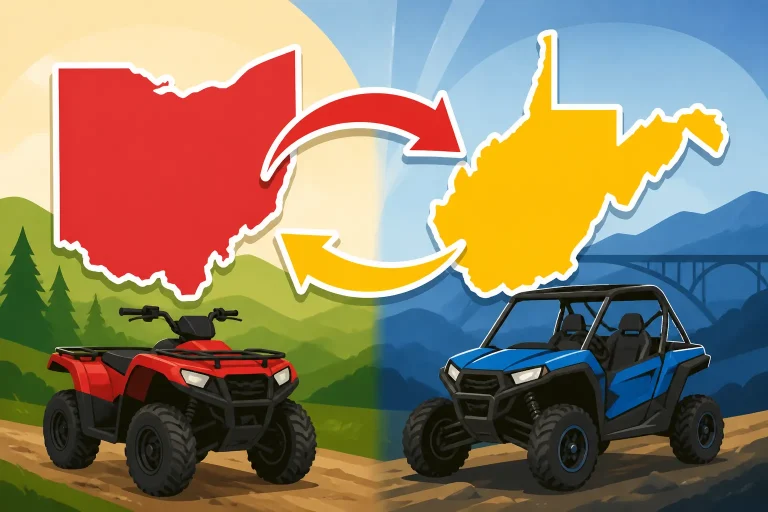
A Pennsylvania or West Virginia registration should be checked by its exact type and use. Do not rely on the fact that the machine is registered for riding somewhere in the home state. Confirm whether it is an off-highway registration accepted for the Ohio destination, and make sure it is current and assigned to the machine you are bringing.
Neighboring states can use different terms, stickers, plates, or registration categories. That makes it easy to mistake a trail authorization for a general vehicle registration, or vice versa. Check the issuing agency’s description of the document and then compare it with the Ohio land manager’s requirements. Ohio Reciprocity With Pennsylvania and Ohio Reciprocity With West Virginia address these state-to-state questions without treating every document as interchangeable.
Plan for the border crossing as a change in jurisdiction, not as a continuation of the same trail system. A registration that gives you access to a Pennsylvania or West Virginia riding area does not make that area’s rules apply after you cross into Ohio. Ohio’s route, equipment, land-access, and operating rules govern the Ohio portion of the trip.
Michigan and Indiana
Michigan and Indiana riders should take the same careful approach. Verify that the document is an off-highway registration or authorization relevant to the planned Ohio use, not merely a title or a road registration. If the home state handles different kinds of riding through different permits, identify which one you have before assuming it will qualify for Ohio reciprocity.
This matters particularly for riders who cross a state line often. Familiarity can create a false sense of certainty: a sticker has worked on a familiar local trail, so it seems likely to work in Ohio too. But the receiving state and the land manager determine what is accepted at the Ohio destination. Ohio Reciprocity With Michigan and Ohio Reciprocity With Indiana are useful prompts for checking those state-specific differences.
For a group ride, ask each rider to confirm their own machine’s registration rather than relying on the group leader’s paperwork. One person may have a current off-highway registration, while another has an expired sticker or only an ownership title. A group can be ready to ride in every other respect and still have one machine turned away because its documentation does not qualify.
If Your Home State Does Not Register ATVs the Same Way
Find out whether an Ohio visitor permit applies
States do not all use the same registration system for off-highway machines. In some places, the relevant process may be a permit or decal, and requirements can differ for residents and nonresidents. If your state does not issue the kind of registration Ohio expects for reciprocal use, do not guess that a title, bill of sale, or ordinary plate will fill the gap.
Ask the Ohio authority or land manager whether your specific situation requires an Ohio temporary permit or another document. Explain where the machine is registered, what paperwork you have, whether you are a resident or visitor, and where you intend to ride. What a Visitor From a Non-Registering State Must Buy and Ohio Temporary Permit for a Visitor address the visitor-permit question.
Do not rely on a permit intended for one kind of travel to cover another. A temporary operating permit, a trail pass, and a vehicle registration can have different purposes and conditions. Confirm the permit’s scope, term, display instructions, and where it is valid before purchasing or traveling. If you are uncertain, ask the office that issues the permit to confirm your intended use in plain language.
Allow time for paperwork and inspection questions
If your machine’s documents are incomplete, resolve that before your departure date. Waiting until you reach a trailhead can leave you with a trailer full of equipment and no clear way to ride. Contact the appropriate office early enough to ask what proof of ownership, identification, registration, or inspection information may be required.
A useful call script is simple: “I am visiting from this state. My machine has this type of registration, and I plan to ride at this named location. Do I need an Ohio permit, and what paperwork must I carry?” Keep a written note of the answer, including any instructions about displaying a plate or sticker. If the answer depends on the destination, get the land manager’s contact details too.
Use official state or land-manager information for the final decision. Online discussion boards can be helpful for hearing what other riders experienced, but a post from a previous season may describe a different rule, document, or trail condition. A photo of another rider’s plate is not proof that your own registration qualifies.
Registration Is Only One Part of Ohio Compliance
Road use is separate from trail reciprocity
An out-of-state registration does not grant general permission to ride an ATV or UTV on Ohio roads. Road access depends on the applicable state law and, in some cases, local decisions or road-specific restrictions. A route that appears to connect two trails may include a road that is closed to APVs, so check the legal route instead of following a map line or another rider’s tracks.
Do not confuse a machine being registered with it being road-legal. Equipment rules, inspection requirements, insurance, operator licensing, and local road permissions may all matter. These requirements can differ from trail access rules, and satisfying one does not satisfy the others. Street Legal APVs in Ohio: The Short Answer offers context on that distinction.
Before riding on or crossing a road, identify the road type and verify the rules for that location. A county road, township road, state route, and private access road may be treated differently. When a local road has been opened to APVs, that does not necessarily mean adjacent roads are open too. Follow posted signs and official local information rather than assuming a short connector is permitted.
Rider, machine, and trail restrictions still apply
Riders should check age and supervision rules, helmet and eye-protection requirements, passenger limits, and any restrictions on riding after dark. These are not replaced by an out-of-state registration. The rules may depend on the rider’s age, the land, and whether the machine is being operated on a trail or a road.
Machine-specific conditions matter as well. Width limits, safety equipment, sound restrictions, spark-arrester requirements, and marked-route rules may apply at a destination. A modification that seems helpful on private property can affect trail eligibility. Review the current rules for your exact machine rather than treating “ATV” or “UTV” as a single category with one set of requirements.
Make the final check close to the ride date. Weather, maintenance work, seasonal closures, and other conditions can affect access even when the paperwork is perfect. A quick confirmation of trail status can prevent a long, frustrating drive to a closed gate. Carry the relevant documents, follow signs, and stay on designated routes.
A Practical Pre-Ride Reciprocity Checklist
Work through the paperwork in order
Use this sequence before you load the trailer:
- Identify the machine. Confirm its VIN, type, and width, including any accessories that affect the measurement.
- Identify your documents. Separate title, home-state off-highway registration, road registration, and trail permit.
- Check registration status. Make sure the registration is current and belongs to that machine.
- Name your destination. Write down the specific Ohio forest, national forest route, private park, or road area.
- Ask about reciprocity. Confirm that the exact home-state document is accepted for that destination.
- Check for additional permits. Find out whether the land manager requires a separate pass or visitor permit.
- Review operating rules. Check equipment, width, age, supervision, passenger, helmet, and route restrictions.
- Recheck access. Look for current closures and trail conditions shortly before departure.
Keeping paperwork together makes an unexpected check much less stressful. A document folder or waterproof pouch can keep registration papers from being soaked or torn; Amazon and local powersports shops are among the places riders may browse for simple storage accessories. Whatever you use, make sure the documents remain accessible and legible.
Keep proof and plans usable during the trip
Save the land manager’s official information on your phone, but do not make your entire plan depend on mobile service. Some Ohio riding areas have weak or inconsistent coverage. Download or print the trail map, note the access point, and keep the office’s contact details in your trip notes. A paper copy in a protected sleeve can be handy when a phone battery is low or the screen is muddy.
Keep your registration documents separate from items that are likely to get wet, such as riding gloves or trail snacks. If you carry a phone image as backup, check that the VIN and document details are readable. It is a convenient reference, not a guarantee that a digital image will satisfy every request.
If your group is traveling together, share the checklist in advance. Ask each rider to confirm registration, permits, machine width, and required safety gear before departure. This is kinder than discovering at the trailhead that one person’s document is missing, and it gives everyone time to resolve a problem without rushing.
When the answer is unclear
If two sources appear to disagree, ask the agency responsible for the specific place where you plan to ride. An Ohio vehicle office can explain registration or permit paperwork; a forest or park manager can explain access to that land. Make clear that you are asking about a nonresident machine and describe its home-state documents precisely.
Avoid relying on broad statements such as “Ohio accepts out-of-state plates” or “all registered machines can ride.” Those phrases leave out the details that determine the answer: what the document represents, whether it is current, which land is involved, and whether a separate permit applies. What a Visitor From a Registering State Must Show is a helpful companion when assembling the documents for a visit.
When you have confirmation, carry out the instructions exactly. Display the plate or decal as directed, keep required paperwork with the machine, purchase any separate pass, and remain on approved routes. Reciprocity is most useful when you treat it as a documented permission question—not as a shortcut around the destination’s rules.
Disclaimer
This article is for general informational purposes only and does not constitute professional advice. Laws, prices and regulations vary by location and change over time. Consult a qualified professional for guidance on your specific situation.